
📌 Key Takeaways
A supplier proven fit for one type of building may lack proof for another — test each site separately before approving.
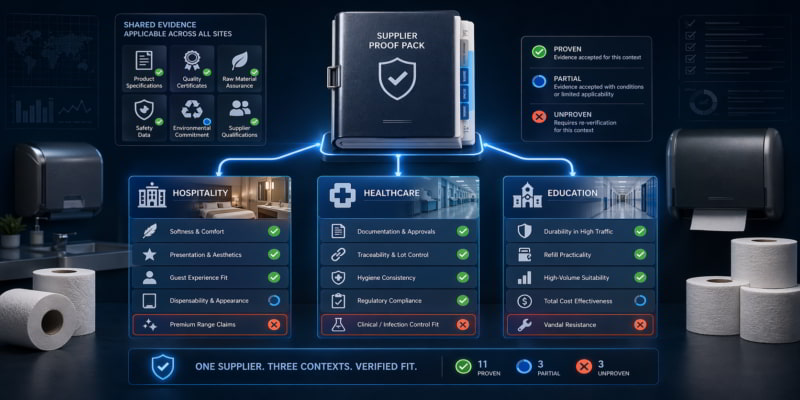
- Separate Shared From Specific: Shared proof shows a supplier is real and organized, but each site type needs its own fit check.
- One File Does Not Fit All: Hotels care about softness and look, hospitals need tight records, and schools need rolls that last all day.
- Map Before You Approve: A simple review map marks where proof is strong, partial, or missing — before the decision, not after.
- Name the Gaps Out Loud: When each team states exactly what is proven and what is not, approval talks get clearer and faster.
- Proof-to-Fit Beats Proof-to-Presence: A credible supplier is not the same as a proven supplier for your specific washroom, traffic, and refill reality.
A supplier story should not travel further than its proof.
Multi-site procurement leads and QA managers overseeing hospitality, healthcare, or education portfolios will gain a ready-to-use verification method here, preparing them for the detailed sector-by-sector framework that follows.
~ ~ ~ ~ ~ ~ ~ ~ ~ ~ ~ ~ ~ ~ ~ ~ ~ ~
Multi-site buying creates a hidden verification problem.
A sourcing team reviews a single toilet tissue roll supplier for a portfolio spanning a hotel group, a healthcare network, and a cluster of public schools. Certificates are current. Product specs are formatted. Everything checks out on paper. Then the review table starts filling up. The hotel team asks about guest-facing softness and dispenser presentation. The healthcare team asks for documentation clarity and supply consistency. The education team asks whether the roll will survive high-volume use without constant refilling.
That is where the real question surfaces — one that paperwork alone cannot answer: has this supplier been proven fit for all three operating contexts? The softness expectations in a hotel guest bathroom have nothing to do with the durability demands of a school corridor. And the pressure to approve one supplier across all sites can push teams into trusting a single evidence pack that was never tested against each end-use reality separately — standardizing too early and inheriting fit gaps that surface only after approval.
Shared proof tells you whether the AFH bath tissue paper supplier can operate professionally. Site-specific proof tells you whether that supplier can support hospitality, healthcare, education, or another AFH environment without hidden fit-gaps.
A Simple Multi-Site Fit Test Before You Trust One Supplier Story Everywhere
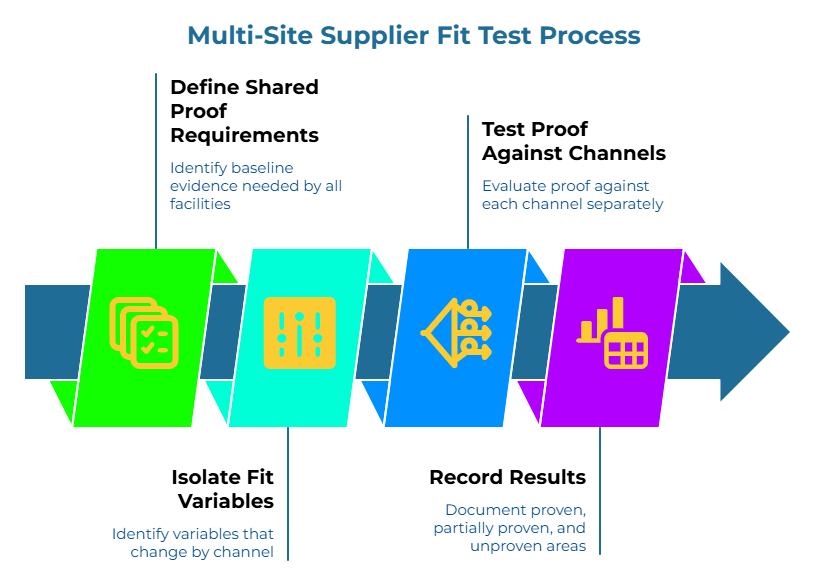
Apply this four-step method to any supplier under multi-site consideration:
- Define shared proof requirements. Identify baseline evidence every facility needs: supplier identity, product category, technical sheet availability, quality-system documentation, raw material consistency, converting quality, packaging integrity, order handling, communication reliability, and regulatory compliance. Teams beginning this process can find suppliers on PaperIndex to compare verified profiles against these baseline criteria. If the supplier cannot clear this bar, the review ends here.
- Isolate fit variables that change by channel. Softness targets, dispenser compatibility, refill cadence, hygiene documentation depth, and cost-per-use logic all shift by end-use setting — even when the toilet tissue rolls share the same product category.
- Test existing proof against each channel separately. For every site type, ask: what is this proof supposed to prove, in which setting, against which requirement? A quality certificate may satisfy a shared baseline but will not confirm whether roll diameter fits a specific wall-mounted dispenser.
- Record where the supplier is proven, partially proven, or unproven. Map each site type against the evidence reviewed and mark the open gaps before the approval decision — not after.
A Comparative Analysis of Cross-Sector Variance
A manufacturer can be operationally strong, technically organized, and well-documented, yet still lack the evidence that proves fit for a particular Away-From-Home (AFH) context.
Generic quality narratives describe supplier presence, not supplier fit. They answer “Is this supplier real?” but not “Has this supplier proven it can meet the demands of this facility type?” The governance failure occurs when teams approve on general credibility because the review never separated shared proof from site-specific proof.
But different facilities share a category label while operating under entirely different softness, durability, dispenser, and service expectations. Think of it like checking whether a builder can follow the same blueprint in different buildings. The builder may be skilled. The blueprint may be clear. Yet the hotel, clinic, and school each have different traffic patterns, finish expectations, service routines, and tolerance for disruption.
For teams reviewing bathroom tissue suppliers, this distinction helps prevent early standardization from hiding operational differences. For procurement leads managing diverse portfolios, this logic ensures that credibility at the corporate level translates to functionality at the stall level.
What to Stress-Test in Hospitality Settings
Hospitality verification is driven by guest perception, not just product performance. Tissue in a hotel guest bathroom carries a presentation burden absent from other AFH settings. The sector’s emphasis on guest-facing cleanliness — reflected in guidance such as the AHLA Safe Stay initiative — means tissue choices sit inside broader expectations of care, where presentation and service continuity are relevant contexts for hospitality buyers.
Focus on whether the supplier provides softness and presentation evidence validated against guest-facing benchmarks, not just a generic spec sheet. Confirm that roll dimensions fit installed dispensers at the refill frequency housekeeping teams require. Ask whether this proof comes from hospitality-context testing or from industrial environments where guest perception is irrelevant.
A hospitality-specific verification pack must align evidence with these operational requirements:
| Hospitality Fit Factor | Proof to Check |
| Guest-facing softness and appearance | Product sheet, sample review, consistency across lots |
| Dispenser presentation | Roll dimensions, core size, sheet count, dispenser compatibility |
| Service continuity | Lead-time clarity, order cadence, emergency replenishment process |
| Washroom image | Packaging condition, roll finish, visual consistency |
The key is not luxury. The key is alignment. A hospitality site may accept a higher service standard because the washroom is part of the guest experience.
What to Stress-Test in Healthcare Settings
Healthcare environments demand stricter documentation and traceability. Facilities following environmental infection-control principles — such as those outlined by the CDC — expect documentation discipline most general AFH suppliers do not provide by default.
Test for batch-level consistency, traceable lot numbers, material safety records, and evidence of performance under frequent-use, high-hygiene protocols — starting with verified toilet tissue mills that publish manufacturing-level documentation. If the supplier has never served healthcare-classified facilities, existing evidence may be technically accurate yet contextually incomplete. The fit gap is not about the product — it is about whether the proof answers the questions a healthcare review committee will actually ask.
Healthcare buyers should also test whether the supplier’s documents are usable by Procurement, QA, and facility teams — not just the supplier. A vague statement like “Quality Assured” does not answer much. A clearer proof set shows product specifications, lot references where relevant, consistency controls, packaging integrity, and contact points for issue resolution.
| Healthcare Fit Factor | Proof to Check |
| Documentation clarity | Technical sheet, certificate scope, specification fields |
| Consistency | Lot or batch reference practices, quality-control records where applicable |
| Operational assurance | Complaint handling, replacement process, supply continuity |
| Hygiene-sensitive environment fit | Packaging integrity, storage guidance, clean handling expectations |
Healthcare sites have less tolerance for ambiguous proof because unresolved gaps can become internal governance problems.
What to Stress-Test in Education Settings
Schools present a durability and supply continuity challenge the category label often obscures. Sanitation infrastructure in school settings carries operational weight documented by organizations like UNICEF’s WASH-in-schools program, which emphasizes clean, usable school sanitation environments as part of wider school hygiene practice. A product designed for low-traffic commercial offices often suffers structural failure or excessive waste in high-density student corridors.
Test whether the supplier has evidence of performance under heavy daily use — tensile strength, wet strength retention, institutional-traffic testing. Education facilities often operate with limited custodial staff, making refill practicality critical. Budget discipline matters too, but should not collapse into lowest-cost logic. A low-cost product that requires constant refilling or creates user complaints may not support the operating need. The right question is whether cost aligns with per-use performance, not just price per case.
| Education Fit Factor | Proof to Check |
| High-volume use | Sheet count, roll length, ply, strength indicators |
| Refill practicality | Dispenser fit, roll format, janitorial handling feedback |
| Budget discipline | Comparable specification basis, not price alone |
| Storage and distribution | Case pack, packaging strength, multi-site delivery clarity |
This is where shared proof often breaks. A supplier may show credible documentation, yet still fail to prove that the product is practical for student-heavy washrooms.
Build a Multi-Site Fit Review Map Instead of Forcing One Generic Approval Logic
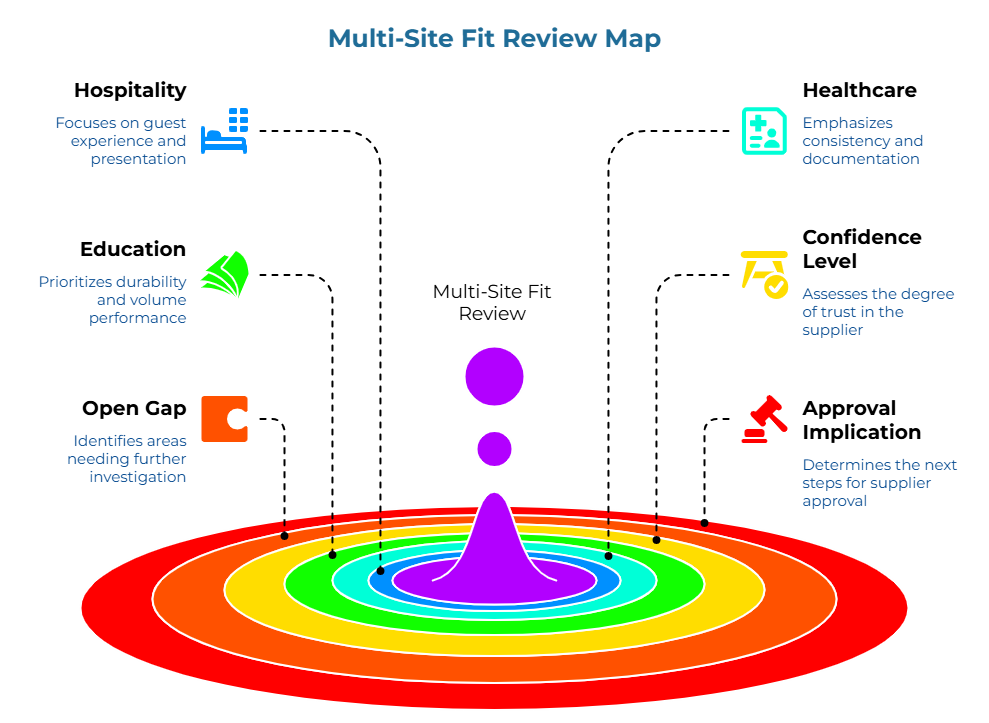
Consolidate the evaluation into a single internal review map. Use one row per site type, then separate what transfers from what must be re-verified. This allows Procurement, QA, Operations, and category owners to discuss the same supplier without collapsing every concern into a yes-or-no approval.
| Site Type | What Matters Most | Proof to Check | What Transfers | What Must Be Re-Verified |
| Hospitality | Softness, presentation, dispenser fit | Sample-based softness validation, dispenser compatibility, restocking evidence | Material quality, regulatory compliance, supplier identity | Guest-perception fit, dispenser match, housekeeping cadence |
| Healthcare | Consistency, documentation, traceability | Batch records, lot traceability, material safety docs, packaging integrity | Material quality, regulatory compliance, quality-system evidence | Documentation depth, infection-control alignment, repeat-order consistency |
| Education | Durability, volume performance, refill practicality | Tensile/wet strength data, institutional-use evidence, case pack | Material quality, regulatory compliance, product-category capability | High-traffic durability, custodial workflow fit, cost-to-performance ratio |
The “What Transfers” column saves time. The “What Must Be Re-Verified” column prevents mistakes. That distinction is the entire point.
Add three decision fields to the right side of the map: confidence level, open gap, and approval implication. That final step turns the map from a comparison table into a governance tool. A supplier may be “proven” for hospitality, “partially proven” for education, and “still unproven” for healthcare. That is not a contradiction. It is a more honest decision.
Use this map in the next internal supplier review. It turns a subjective “this supplier seems fine” into a defensible record of where the proof actually stands.
How Segment-Aware Verification Improves Governance
When verification separates shared proof from site-specific proof, approval conversations get cleaner. Instead of debating whether a supplier is “good enough” in general, every stakeholder points to specific evidence — or specific gaps — for each site type.
Segment-aware verification gives each function a cleaner way to speak:
Procurement can say, “The supplier is credible, but education fit is only partially proven.”
QA can say, “The documentation is acceptable for general review, but healthcare traceability still needs clarification.”
Operations can say, “The roll format works in the hotel dispensers, but the school refill pattern needs testing.”
The approval logic becomes context-explicit: proven for hospitality, partially proven for education, unresolved for healthcare, with clear documentation of what remains open.
This framework establishes a defensible audit trail, mitigating operational friction after implementation.
The sourcing head who started with one supplier and three different buildings now has a method for the question that actually matters. Not “Is this supplier credible?” — but “Is this supplier proven here, for this use, against these requirements?”
Proof-to-fit, not proof-to-presence. That is worth getting right.
For related verification methods, explore the PaperIndex Academy’s verification resources and supplier authentication guidance.
Disclaimer:
This article is educational and methodology-first. Readers should validate site-specific hygiene, procurement, and compliance requirements within their own operating environments before final supplier approval.
Our Editorial Process:
Our expert team uses AI tools to help organize and structure our initial drafts. Every piece is then extensively rewritten, fact-checked, and enriched with first-hand insights and experiences by expert humans on our Insights Team to ensure accuracy and clarity.
About the PaperIndex Insights Team:
The PaperIndex Insights Team is our dedicated engine for synthesizing complex topics into clear, helpful guides. While our content is thoroughly reviewed for clarity and accuracy, it is for informational purposes and should not replace professional advice.