
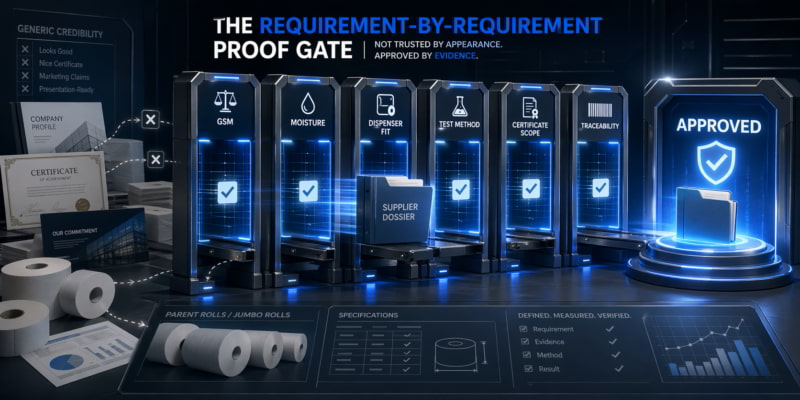
📌 Key Takeaways
Polished supplier documents don’t prove fit — only requirement-by-requirement evidence does.
- Proof Beats Presentation: A professional supplier profile shows organization, not that their product matches your specific needs.
- Certificates Have Limits: ISO or sustainability certifications confirm general quality processes — they don’t prove a supplier’s tissue fits your dispensers or converting lines.
- Time Pressure Distorts Choices: Rushed sourcing cycles reward suppliers who sound complete, not those who’ve actually proved fit against your requirements.
- Thin Approvals Create Governance Risk: When approval logic relies on soft impressions, complaints become hard to trace and decisions become hard to defend later.
- Ask the Right Question: Shift from “does this supplier look qualified?” to “has this supplier proved fit against each requirement we defined?”
Strong verification gives procurement a clear reason to say yes — and a clean way to explain it.
Away-from-home procurement teams and sourcing professionals will gain a practical framework for separating credible claims from confirmed fit, setting up the detailed verification guidance that follows.
~ ~ ~ ~ ~ ~ ~ ~ ~ ~ ~ ~ ~ ~ ~ ~ ~ ~
Current shortlists often present a deceptive level of readiness. Imagine reviewing your latest candidates: each sent a professional capability deck, a well-formatted spec sheet, and certification logos arranged neatly in the header. The sourcing team needs to move forward by Friday. But there is a nagging question nobody has framed cleanly enough to raise in the meeting: does any of this documentation actually prove the supplier fits the Away-From-Home (AFH) requirement set, or does it just prove they know how to present well?
That distinction is the core of toilet tissue supplier verification for Away From Home (AFH) use cases — the proof-based review of whether a supplier can credibly support the buyer’s defined requirement set. Not a review of whether the supplier looks credible in general. When those two things get confused, procurement risk grows quietly, in places that are hard to see and harder to defend during an audit.
Distinguishing Cosmetic Credibility from Technical Fit
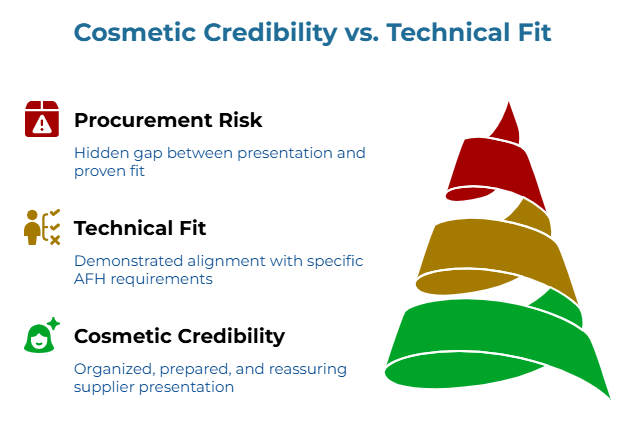
A supplier that sounds organized, prepared, and reassuring is not the same as a supplier that has proved fit. The difference matters, and it tends to collapse under time pressure.
Many Away-From-Home (AFH) buying teams work in a cross-functional environment where sourcing, QA, and category ownership overlap. Cross-functional teams often grant polished supplier language disproportionate weight because it reduces friction in the moment. It feels like progress. It sounds complete. It may still fall short of proving fit.
Think of it like hiring a builder for a complex project. A confident pitch and an impressive portfolio are encouraging. But what matters is whether the builder can follow your blueprint — not just admire it. Toilet tissue supplier verification works the same way. The relevant question is not whether a supplier appears capable in the abstract, but whether they have demonstrated fit against the specific AFH requirements the buying team has defined: the GSM tolerances that hold up on high-speed converting lines, the emboss patterns compatible with a particular dispenser fleet, the moisture stability needed for the storage and transit conditions in the actual supply chain.
That gap between a supplier who presents well and a supplier who has proved fit is exactly where procurement risk hides. Polished documentation alone cannot close it.
Why Weak Verification Creates Procurement Risk Before a Failure Ever Shows Up
The risk does not begin when toilet tissue jams dispensers across three facilities or when a converting line rejects an incoming parent roll. It begins the moment a supplier is approved on logic that cannot be defended when questioned.
When the approval rationale depends on soft assumptions — “they seemed professional,” “the specs looked right,” “they had the correct certifications” — the team has introduced a governance gap. That gap may never trigger a visible product failure. But it weakens every downstream decision built on top of it.
This is where the gap becomes a governance issue, not just a technical-review issue. When evidence is thin, different stakeholders fill the gaps with assumptions that never get tested — a pattern explored in depth in the cost of incomplete AFH toilet tissue specifications, where requirement drift produces the same cross-functional blind spots. Procurement assumes QA has validated the right points. QA assumes the buyer has already matched the proof to the requirement set. Operations may assume the polished supplier pack means the difficult questions have already been settled. The decision still moves forward, but the rationale is soft around the edges — and each function is relying on verification work that no one actually completed.
Reorders become harder to challenge. Complaints become harder to trace to the root cause. And if someone in operations or finance asks why this supplier was chosen, the original rationale offers no structured defense.
Procedural Selection Anxiety (PSA) represents the primary governance cost of this pattern. When a team privately suspects the verification was thin but lacks the vocabulary to explain why, every subsequent supplier interaction carries unspoken doubt. Stronger verification does not only reduce the risk of choosing the wrong supplier. It reduces the internal friction of defending why the right supplier was chosen — and that is a governance benefit that makes approval logic defensible during cross-functional audits.
Three Ways Polished Supplier Claims Distort Decision Quality
When Presentation Quality Is Mistaken for Fit Quality
A well-designed capability profile signals professionalism. It does not signal that the supplier’s toilet tissue parent rolls will match the dispenser specifications, emboss-to-ply requirements, or moisture thresholds a particular AFH environment demands. Under evaluation pressure, presentation quality often fills the space where fit-specific proof should sit.
When Generic Trust Signals Replace Requirement-Specific Proof
Certifications are legitimate evidence — within their defined scope. An ISO 9001 certificate confirms that a supplier maintains a quality management system. It does not confirm that the supplier’s parent rolls meet the tensile strength, caliper, or absorbency targets a specific converting line or end-use environment requires. Similarly, an FSC certification verifies chain-of-custody controls for responsible sourcing, not fitness for a particular AFH toilet tissue application — and neither replaces the requirement-matched evidence outlined in the AFH toilet tissue specification framework basics. When buying teams treat these broad signals as sufficient proof of fit, they skip the verification step that matters most: matching supplier evidence to the buyer’s own requirement set.
When Time Pressure Rewards the Supplier Who Sounds Most Complete
Sourcing cycles move fast. When a category deadline is two weeks out and three suppliers are in the pipeline, the team gravitates toward the supplier whose documentation feels most complete — not necessarily the one whose documentation most precisely addresses the defined requirements. Time pressure compresses the space available for critical evaluation, and the supplier who sounds most ready benefits most from that compression. The danger is not only operational. It is procedural — the buyer may end up defending a decision built on fluent explanation rather than requirement-specific evidence.
What Defensible AFH Verification Looks Like in Practice
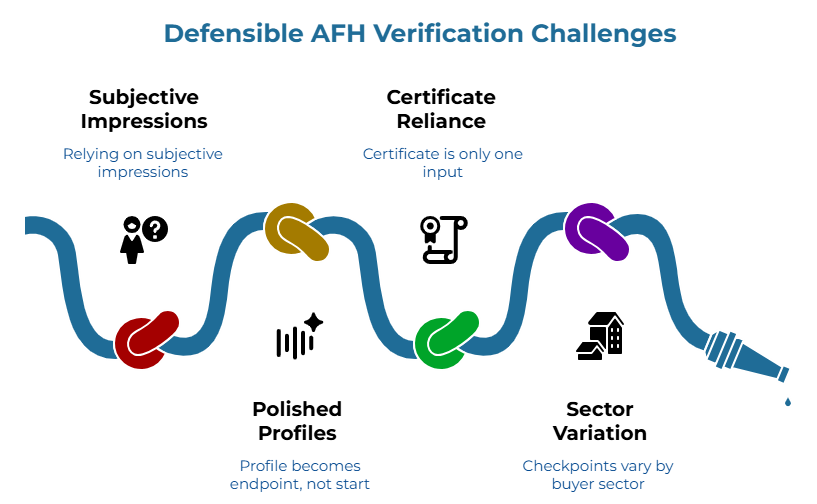
Defensible verification means separating general trust signals from fit-specific proof — then matching each piece of supplier evidence to the buyer’s defined AFH requirement set, not to the supplier’s preferred narrative about their own capabilities.
The shift is practical. Instead of asking “does this supplier look qualified?” the buying team asks a tighter question: “has this supplier provided proof against each requirement in the AFH specification?” That distinction changes what counts as successful verification. A polished profile becomes a starting point, not an endpoint. A certificate becomes one input among several. And the approval rationale becomes something a procurement lead can explain in a cross-functional meeting without relying on subjective impressions.
The exact checkpoints will vary. A multi-site hospitality buyer may review the issue differently from a healthcare or public-institution buyer. That variation is normal. What should not vary is the logic: the proof should match the requirement set, regardless of the buyer’s sector or facility mix.
For a deeper layered verification model, Beyond the digital profile: a 5-layer shield for bath tissue parent roll supplier verification walks through how to move from surface-level signals to evidence-backed fit assessment. Where the concern is distinguishing genuine manufacturers from intermediaries presenting borrowed credibility, Beyond the broker: three steps to direct toilet tissue raw materials supplier authentication offers a focused authentication framework. For buyers ready to examine their current process, The first 72 hours: how to audit your current cross-border toilet tissue parent rolls supplier vetting process is a structured starting point.
A Verification Risk Summary You Can Use in Internal Conversations
The matrix below is designed to be lifted into an email, a slide, or a meeting note. It helps explain — to colleagues who may not work in procurement — why polished supplier signals, while valuable, do not replace fit-specific verification.
| Polished Supplier Signal | What It Appears to Prove | What It Still Does Not Prove | AFH-Specific Risk If Accepted Too Quickly | Safer Verification Follow-Up Question |
| Professional capability profile | The supplier is organized and experienced | That their experience matches the buyer’s specific AFH toilet tissue requirements | Approval rests on general impressions, not requirement-level evidence | “Which of the defined AFH requirements does this profile directly address?” |
| ISO 9001 or equivalent management-system certificate | The supplier maintains a quality management system | That quality outputs match the buyer’s GSM, caliper, or absorbency targets | Certification scope is mistaken for product-level fit proof | “Does this certificate cover the specific product line and test parameters required?” |
| Detailed spec sheet | The supplier can produce toilet tissue to stated specifications | That those specifications align with the buyer’s dispenser, converting, and transit conditions | Spec-to-spec comparison replaces spec-to-requirement comparison | “How do these stated specs map against each line in the AFH requirement set?” |
| Fast, thorough responses to inquiries | The supplier is responsive and commercially prepared | That responsiveness reflects verified manufacturing capability | Communication quality substitutes for evidence quality | “Can the supplier provide method-linked test data for the claims made?” |
| FSC or sustainability certification | The supplier meets chain-of-custody standards for responsible sourcing | That the certified scope covers the specific product and grade being sourced | Sustainability credentials are treated as proof of product fit | “Does the certification scope cover the exact product category and supply path?” |
Critical Verification Clarifications
What Makes Supplier Verification Weak in AFH Toilet Tissue Procurement?
Verification becomes weak when it evaluates a supplier against general credibility signals — professional documentation, broad certifications, polished communication — rather than against the buyer’s specific AFH requirement set. These signals have genuine value, but they validate the supplier in general terms without confirming fit for a defined use case.
Are Certifications Enough to Reduce Supplier-Selection Risk?
Certifications are valuable but partial. A management-system certificate such as ISO 9001 confirms that the supplier follows defined quality processes.
A test-method standard such as ISO 287 provides a recognized procedure specifically for measuring the moisture content of paper and board, and TAPPI standards—such as TAPPI T 410 for grammage or TAPPI T 411 for thickness—illustrate what named, requirement-linked testing context can look like. Neither type tells a buying team whether the supplier’s toilet tissue parent rolls will perform correctly in a given dispenser fleet, survive particular transit conditions, or meet the absorbency expectations of specific end users. Certifications reduce risk in the areas they cover — not in the areas they leave open, which is typically where AFH-specific fit problems surface.
How Can Procurement Explain Verification Risk Without Using Price Arguments?
Frame the conversation around governance and defensibility. The question to pose internally is straightforward: “If this supplier is challenged six months from now, can the team explain exactly what evidence was verified — requirement by requirement — before the approval was granted?” When the answer depends on general impressions rather than structured proof, the approval logic is fragile regardless of the commercial terms. This framing resonates in cross-functional settings because it speaks to organizational risk, not just procurement preference. To evaluate your internal vetting workflow, consult the first 72 hours: how to audit your current cross-border toilet tissue parent rolls supplier vetting process.
A shortlist remains a hypothesis until each candidate is stress-tested against the AFH specification. Nothing here says otherwise. What changes is the question brought to it. Instead of asking whether a supplier looks qualified, the team now asks whether the supplier has proved fit — requirement by requirement, against the AFH specification the buying team defined. This shift in inquiry increases initial friction but ensures long-term procedural defensibility.
Stronger verification gives Procurement a clearer reason for saying yes, a cleaner reason for saying not yet, and a calmer way to move from persuasion to proof.
Once fit criteria and verification questions are clearly defined, browse AFH toilet tissue parent roll suppliers to begin the search with a stronger foundation.
Disclaimer:
This content is for informational and educational purposes only and does not constitute professional procurement, legal, or compliance advice. Supplier verification outcomes vary by buyer context, requirement set, and market conditions. PaperIndex is a neutral marketplace and does not broker deals or endorse specific suppliers. No affiliate relationships influence this content.
Our Editorial Process:
Our expert team uses AI tools to help organize and structure our initial drafts. Every piece is then extensively rewritten, fact-checked, and enriched with first-hand insights and experiences by expert humans on our Insights Team to ensure accuracy and clarity.
About the PaperIndex Insights Team:
The PaperIndex Insights Team is our dedicated engine for synthesizing complex topics into clear, helpful guides. While our content is thoroughly reviewed for clarity and accuracy, it is for informational purposes and should not replace professional advice.