
📌 Key Takeaways
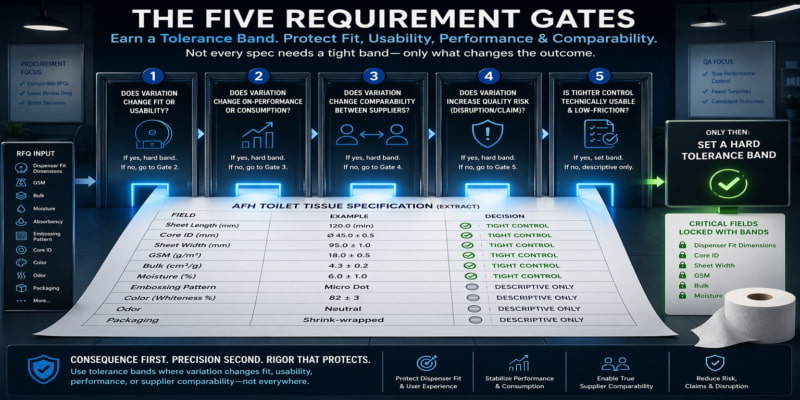
Tight tolerance bands help only when variation changes fit, performance, or service consistency across Away From Home (AFH) toilet tissue use cases.
- Control What Matters: Use hard bands only for fields that change dispenser fit, usability, or day-to-day performance.
- Stop Equal Precision: Giving every field the same level of precision creates extra work without improving real supplier comparison.
- Let Consequence Lead: Set strict limits when variation causes failures, and stay flexible when the risk is low.
- Align Procurement And QA: Five consequence-based questions turn internal debates into a shared rule for setting tolerance bands.
- Keep RFQs Usable: Group fields by consequence, separate critical controls from descriptive details, and name test methods only when needed.
Better specifications do not control everything; they control the few things that change outcomes.
AFH toilet tissue buyers balancing Procurement and QA priorities will get a cleaner decision framework here, guiding them into the detailed implementation steps that follow.
~ ~ ~ ~ ~ ~ ~ ~ ~ ~ ~ ~ ~ ~ ~ ~ ~ ~
Tolerance bands are not a way to make an Away From Home (AFH) toilet tissue specification look more technical. They are a way to decide where variation changes operational outcomes and where it does not—a logic closely aligned with a specification-to-normalization checklist that forces buyers to define what actually needs to be controlled. Tight bands protect fit, usability, and comparability when the consequence of variation is real. However, when applied universally, they do the opposite: slowing RFQs, creating supplier-format friction, and forcing teams to spend time on low-impact detail instead of the few variables that actually change performance.
What Tolerance Bands Actually Do in an AFH Toilet Tissue Specification
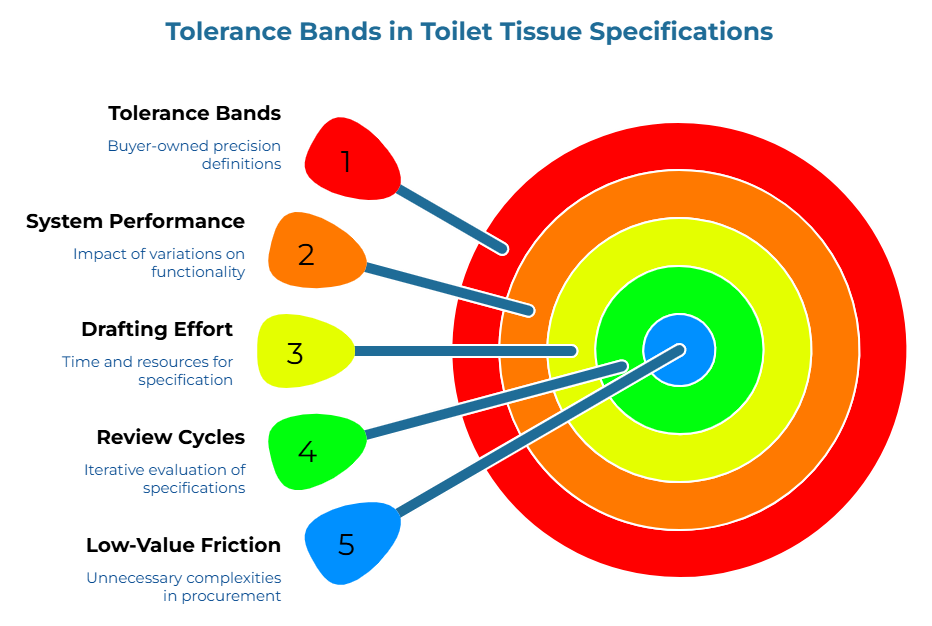
A tolerance band is a buyer-owned way to decide how precisely a requirement should be defined before supplier comparison starts.
Think of it like a blueprint. Some dimensions need to be exact because the building will not work if they drift. Others can stay flexible because small variation changes nothing that matters in practice. AFH toilet tissue specifications work the same way.
This is why two quotes can look equally complete and still be incomparable—a problem that often disappears when teams learn how to standardize global toilet tissue parent roll quotes without slowing down procurement. One AFH bath tissue supplier may interpret a loosely written field in a way that changes dispenser fit, service continuity, or real-world usability. The other may not. The problem is not always bad supplier intent. Often, it is a buyer-side requirement that was never pinned down clearly enough.
That is the core decision rule: set tighter bands where variation changes system performance. Stay lighter where extra precision mostly adds drafting effort, review cycles, or low-value friction.
Why Not Every Field Deserves the Same Level of Precision
Equal precision across every field is not rigor. It is often an unmanaged effort.
Some fields need a hard band because a small shift can break compatibility or change use performance. Some need a reasonable band because controlled variation is acceptable if the product still works as intended. Others can remain descriptive at RFQ stage because the consequence of variation is low, visible, or better handled later in proof review.
That distinction matters because Away From Home (AFH) buying is cross-functional by nature. Procurement wants a quote set that can move. QA wants a requirement set that can survive rollout. Good tolerance logic does not force one side to lose. It gives both sides a shared language for deciding where rigor ensures quality and where it introduces unnecessary overhead.
As a general procurement principle, tighter language should earn its place. If a field cannot be linked to compatibility, service life, and end-user requirements, it should not automatically receive the same precision level as a dispenser-critical or performance-critical field.
Where Tighter Precision Usually Protects Quality, Fit, or Usability
The highest-value tolerance work usually sits in field groups where variation changes real outcomes.
Dispenser-critical dimensions and roll-format compatibility are obvious examples. If diameter, core, width, sheet format, or related physical fit characteristics drift too far, the issue shows up quickly. The roll may not load correctly, dispense consistently, or align with the installed environment. Consequently, strict tolerance thresholds are non-negotiable to maintain machine uptime.
Performance-linked fields also deserve more disciplined treatment when variation changes real use. GSM, bulk, moisture, absorbency, and tensile-related properties often matter because they influence softness, strength, runnability, or service consistency. The exact threshold depends on the end-use setting, but the general rule is stable: if the variation changes how the product behaves, precision matters more than if it only changes how the spec sheet looks. For deeper field-specific examples, review our guides on setting baseline GSM and bulk specifications and normalizing absorbency and moisture tolerances.
A third group includes fields tied to service continuity and internal approval confidence. These parameters govern long-term operational stability; though failure isn’t instantaneous, laxity here guarantees cumulative friction in the form of stakeholder disputes and qualitative drift. That is often where Procurement and QA disagree at first, then align once the consequence is made explicit.
Where Extra Precision Often Creates Friction Without Equivalent Value
Overspecification has a cost, even when it sounds disciplined.
It slows RFQ drafting because every field is treated like a high-stakes variable. It increases supplier-format mismatch because AFH toilet tissue roll suppliers are forced to respond against detail that may not be structured the same way in their standard documents—a problem that often starts with hidden variables in tissue RFQs. It also creates extra review loops, because teams spend time debating low-impact variation instead of resolving the few fields that actually determine fit and performance.
This is where administrative drag disguises itself as rigor.
Some fields are better left descriptive until later validation. That does not mean they are unimportant. It means the added burden of hard-banding them at RFQ stage is not justified by the operational risk they carry. A field can still be reviewed, clarified, or supported by proof later without being forced into the first quote round at the same precision level as a dispenser-critical dimension or a performance-sensitive characteristic.
Decision rule: Tighten a field only when variation fundamentally alters the mechanical performance, supply chain reliability, or the end-user’s tactile experience in a meaningful way—and when naming the tighter band improves comparability more than it slows sourcing.
A Simple Procurement-QA Decision Guide for Setting Tolerance Bands
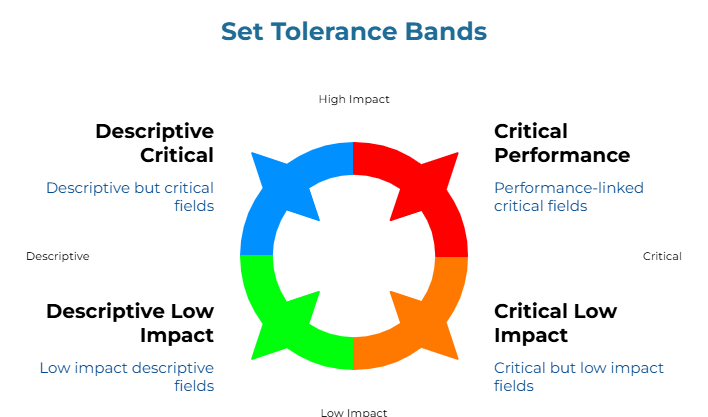
Use this matrix to sort fields before the RFQ is released.
| Field or requirement area | Why variation matters | What goes wrong if it is loose | Recommended precision level | Who owns the call | What proof or test method is needed |
| Dispenser-critical dimensions / roll format | Direct fit and compatibility | Loading, dispensing, or installation problems | Hard band | Procurement + QA | Dimensional confirmation tied to the quoted product |
| Performance-linked fields such as GSM, bulk, moisture, absorbency, or tensile-related properties | Changes usability, consistency, or runnability | Complaints, inconsistency, or downstream performance drift | Hard band or reasonable band, depending on use case | QA with Procurement input | Method-named proof where the field is critical |
| Low-impact descriptive fields | Limited effect on live use at RFQ stage | Extra drafting and review effort more than operational failure | Descriptive note | Procurement | Later proof review only if needed |
When a field is under debate, five questions usually resolve it:
- If this field varies, what fails?
- Does that failure show up in fit, function, continuity, or user experience?
- Can the consequence be detected only after rollout?
- Does naming a tighter band materially improve comparability?
- Is the added burden justified now, or is later proof review enough?
That sequence turns opinion into decision logic. It also gives Procurement and QA a cleaner way to disagree productively.
How to Write Tolerance Logic into the RFQ Without Slowing Down Sourcing
Start by grouping fields by consequence, not by habit.
Put the hardest controls around compatibility and performance-linked fields. Keep descriptive fields separate. Do not write every line item at the same precision level. That creates clutter, not control.
A practical RFQ structure usually follows this order:
- State the non-negotiable fit requirements first.
- Separate performance-linked fields from descriptive information.
- Name proof expectations only where method discipline matters.
- Keep the language consistent across Procurement and QA review.
- Exclude secondary variables from the core control framework unless a tangible operational risk is identified.
Where formal measurement discipline matters, the RFQ should name the method instead of relying on vague “supplier standard” wording; for example, teams should learn how to incorporate ironclad ISO 287 testing standards in their toilet tissue paper RFQ. Relevant public references include ISO 536 for grammage, ISO 287 for lot moisture by oven-drying, ISO 187 for conditioning and testing atmosphere, ISO 186 for representative sampling, andTAPPI T 581 when dry tensile properties for tissue products must be defined.
If the goal is cleaner comparability without extra drag, on our guide Standardizing global toilet tissue parent roll quote is the natural next read. For a broader field-by-field workflow, use understanding the toilet tissue paper specification-to-normalization checklist.
Frequently Asked Questions
Are tighter tolerance bands always better?
No. They are better only when variation changes an outcome that matters. If the operational consequence is low, tighter bands may add more friction than value.
Which AFH tissue fields should Procurement and QA review together?
The shared review should usually focus on compatibility-sensitive and performance-sensitive fields first, especially where drift could create rollout problems or internal approval disputes.
Can a quote still be comparable if some fields are not tightly toleranced?
Yes. Comparability does not require maximum precision everywhere. It requires disciplined precision in the few places where variation changes fit, function, continuity, or user experience.
What should be defined at the RFQ stage versus later verification?
Fields that materially affect comparison should be defined at RFQ stage. Lower-impact or proof-heavy items can often be handled later, provided that decision is deliberate and visible to both Procurement and QA.
The strongest AFH toilet tissue specifications are not the longest or the strictest. They are the ones that tell everyone which variations matter, why they matter, and when they should be controlled. Start there. Then make the quote round easier, not heavier.
Disclaimer:
This content is for general educational guidance on setting AFH toilet tissue specification tolerance bands. It does not replace product testing, dispenser-fit checks, QA review, supplier documentation review, or technical validation. Final requirements should be confirmed against the actual end-use setting, operating conditions, and procurement workflow.
Our Editorial Process:
Our expert team uses AI tools to help organize and structure our initial drafts. Every piece is then extensively rewritten, fact-checked, and enriched with first-hand insights and experiences by expert humans on our Insights Team to ensure accuracy and clarity.
About the PaperIndex Insights Team:
The PaperIndex Insights Team is our dedicated engine for synthesizing complex topics into clear, helpful guides. While our content is thoroughly reviewed for clarity and accuracy, it is for informational purposes and should not replace professional advice.