
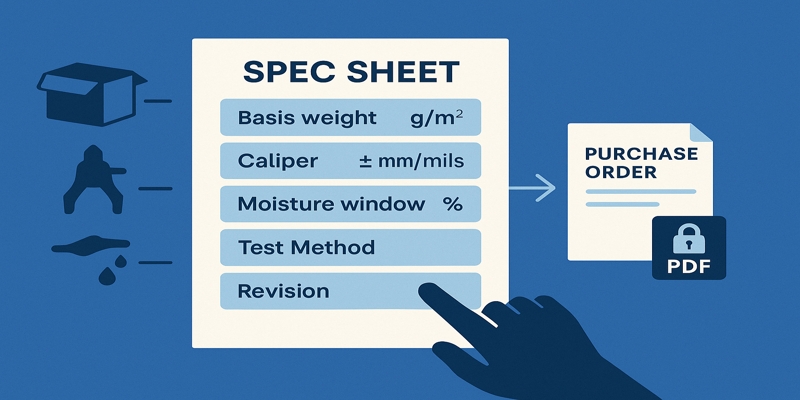
📌 Key Takeaways
Vague spec sheets create receiving disputes, incomparable quotes, and line stops—but five systematic fields eliminate the guesswork.
- Name the Test Method, State the Tolerance: Citing ISO 536 or TAPPI T 410 for basis weight (with ±% tolerance) transforms vague targets into enforceable standards and prevents “how did you measure this?” debates at receiving.
- Moisture Is a Window, Not a Point: Specifying a range like 6.5–8.5% acknowledges how paper equilibrates with ambient conditions, preventing curl and telescoping disputes that single-target specs invite.
- Version Control Stops Silent Drift: A revision block with ID number, owner, date, and change reason ensures all teams—from procurement to production—reference the same locked standard instead of three different informal edits.
- Connect Properties to Run Targets: Mapping basis weight and caliper to your knife/fold windows and target line speed converts abstract lab numbers into operational constraints suppliers can actually design to.
- Five Fields Prevent Most Failures: Basis weight, caliper, moisture (each with tolerance and test method), plus revision control form a minimum viable spec that’s sufficient to eliminate confusion without becoming burdensome.
Lock the standard, attach the PDF to every PO, and both sides execute without renegotiation.
Paper converters and their procurement teams will find a systematic framework here, preparing them for the detailed walkthrough and template that follows.
At-a-Glance: The Minimum Fields Every Spec Sheet Needs
A complete spec sheet requires five essential elements to prevent guesswork and receiving disputes:
- Basis weight with tolerance (±%) and test method (ISO 536 or TAPPI T 410)
- Caliper (thickness) with tolerance (±%) and test method (ISO 534 or TAPPI T 411)
- Moisture range (window, not a single target) with test method (ISO 287)
- Named tolerances for each paper property (never omit the ± values)
- Revision control (version ID, owner, date, and reason for changes)
Why Spec Sheets Fail (and How to Fix Them Fast)
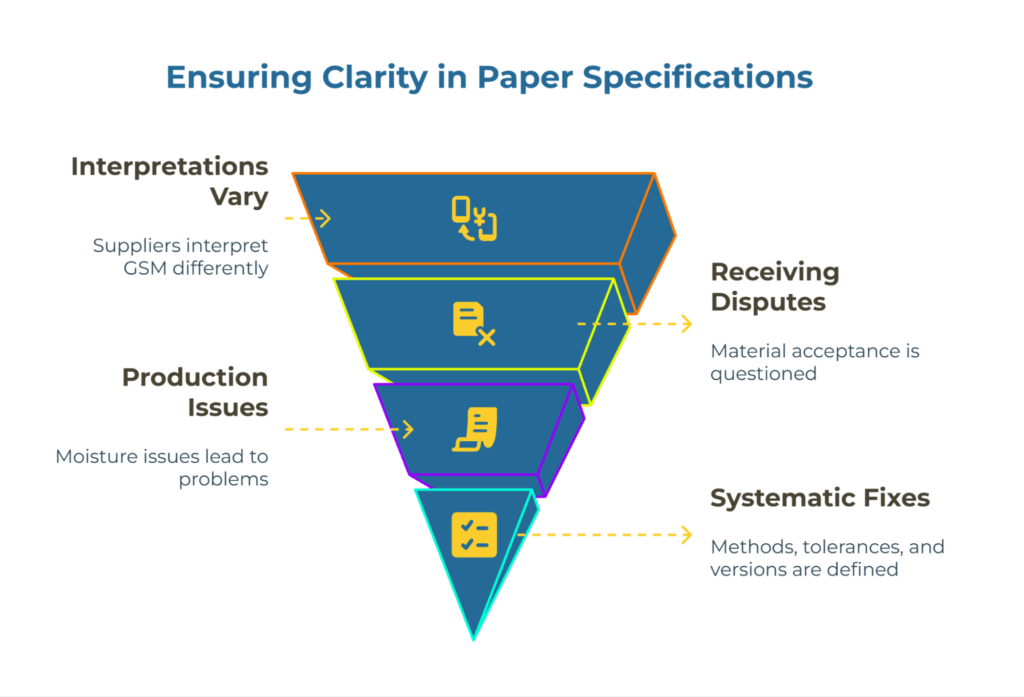
A spec sheet is your paper’s passport through receiving, storage, and the converting line. When the document is vague—listing “kraft linerboard, 150 GSM” with no tolerances, no test methods, and no version control—it becomes a source of confusion rather than clarity.
The consequence is predictable. Quotes become incomparable because one supplier interprets “150 GSM” as 148-152 while another assumes 145-155. Receiving debates erupt over whether delivered material is on-spec when the sheet never defines what “on-spec” actually means. Production teams inherit these ambiguities when moisture wasn’t specified as a range, leading to curl and telescoping issues that could have been prevented with proper acclimatization windows.
Missing tolerances and unnamed test methods create incomparable quotes and receiving disputes. The fix is systematic: name the method, state the tolerance, and lock the version.
The solution is not complex—it’s about completeness. A minimum viable spec sheet includes just enough fields to tie material properties to run targets, communicated in a language both parties understand: standardized test methods with explicit acceptance windows. This article walks through those minimum fields, shows how to connect them to your converting line’s requirements, and provides a template you can implement immediately.
For paper converters, this means fewer line stops and faster receiving approvals. For suppliers responding to RFQs, mirroring these same fields ensures your quotes are directly comparable and reduces post-award rework. Both sides benefit when the spec sheet does its job: eliminating guesswork before material ships.
The Minimum Viable Spec Sheet (MVS) Fields
Identification & Scope
Start with the basics that define what you’re actually buying. The grade name (e.g., “virgin kraft linerboard” or “recycled testliner”), the intended application (e.g., “heavy-duty shipping containers” or “retail-ready packaging”), and the form (sheet or roll stock with dimensions) establish the material’s identity.
Don’t overlook the revision ID. Every spec sheet should carry a version number, an owner (the person responsible for updates), and the date it was issued. This simple practice prevents teams from working off outdated documents and ensures everyone—from procurement to the production floor—references the same standard.
Basis Weight (With Tolerance and Method)
Basis weight is the foundation of any paper specification. It’s typically expressed in grams per square meter (GSM) or pounds per thousand square feet (lb/MSF), depending on your region.
The critical detail most sheets omit is the tolerance. Stating “150 GSM” tells you the target but not the acceptable range. A proper spec reads: “150 GSM ±2%” or “150 GSM ±3 GSM.” This clarity transforms a vague target into an enforceable standard.
Just as important is naming the test method. ISO 536 and TAPPI T 410 are the most common standards for basis weight measurement. When both parties reference the same method, you eliminate disputes over whether the material was tested correctly. Including the method name in your spec ensures consistency from the mill’s quality lab to your receiving dock.
Caliper / Thickness (With Tolerance and Method)
Caliper—paper thickness—directly impacts how material behaves on the converting line. It affects fold quality, die-cutting precision, and whether the sheet feeds cleanly through your equipment.
Like basis weight, the caliper needs both a target and a tolerance. A spec might read: “0.30 mm ±0.02 mm” or “12 mils ±5%.” The tolerance you choose depends on your converting process; tighter windows improve consistency but may limit your supplier pool.
The test method matters here too. ISO 534 and TAPPI T 411 define how calipers should be measured, including the pressure applied during testing. Referencing these standards prevents confusion when your incoming inspection results don’t match the supplier’s certificate.
Moisture Range (Window, Not a Point)
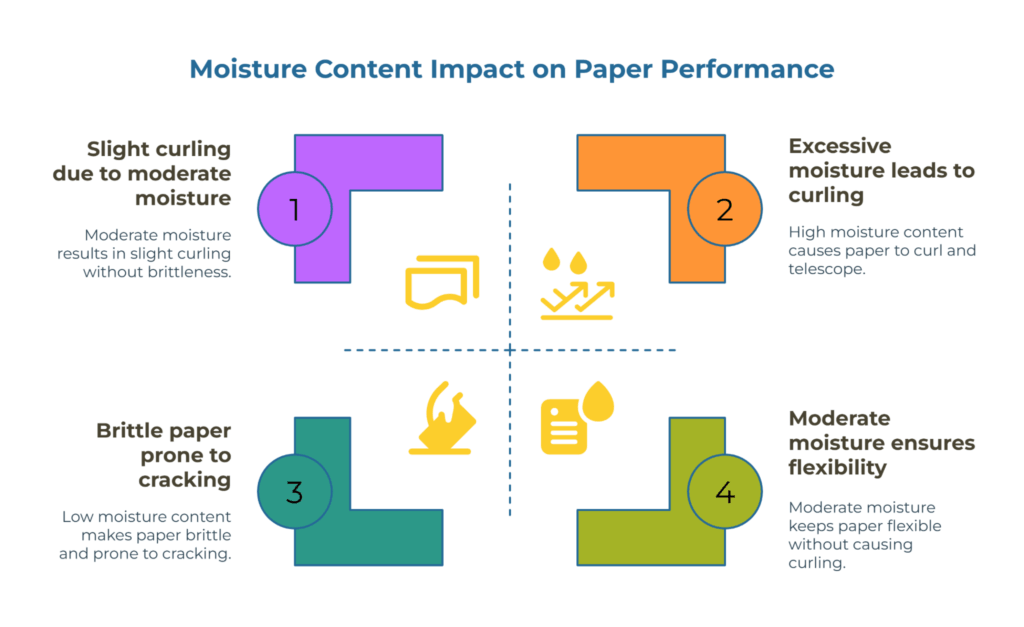
Moisture content is often misunderstood. Many specs list a single target—”7% moisture”—but this approach ignores how paper behaves in practice. Moisture equilibrates with the environment, so attempting to hit an exact point is both unrealistic and unnecessary.
A better approach is to specify a window: “6.5% to 8.5% moisture” or “target 7.5% ±1%.” This range acknowledges that paper will naturally settle within a band based on ambient conditions, and it aligns with how moisture affects converting performance. Too low, and the sheet becomes brittle and prone to cracking; too high, and curl or telescoping becomes a risk.
The standard method for moisture testing is ISO 287, which includes guidance on acclimatization. Referencing this method in your spec reinforces the importance of allowing reels to settle before testing or running them, reducing disputes over whether delivered material is truly out-of-spec. For more context on why ranges outperform single targets, see Moisture windows: why ‘within range’ matters more than absolute values for kraft paper converting.
Machine-Readiness Add-Ons for Converters
If you’re running roll stock, your spec sheet benefits from a few additional fields that tie directly to equipment compatibility. These aren’t always classified as “minimum,” but they’re common enough in practice to be worth including upfront.
Core ID specifies the inner diameter of the roll’s core (e.g., 3-inch or 6-inch). Your unwind mandrel won’t accept the wrong size, so this detail prevents delays. Max OD (outer diameter) ensures the roll fits your reel stand and doesn’t exceed your handling capacity. Splice policy clarifies whether splices are allowed in a reel, how many are acceptable, and what notification the supplier must provide. Edge quality defines acceptable trim standards—clean, square edges versus ragged or dusty ones.
For a more detailed walkthrough of these machine-readiness factors, refer to the reel & core fit checklist.
Tie Fields to Run Targets (Make It Actionable)
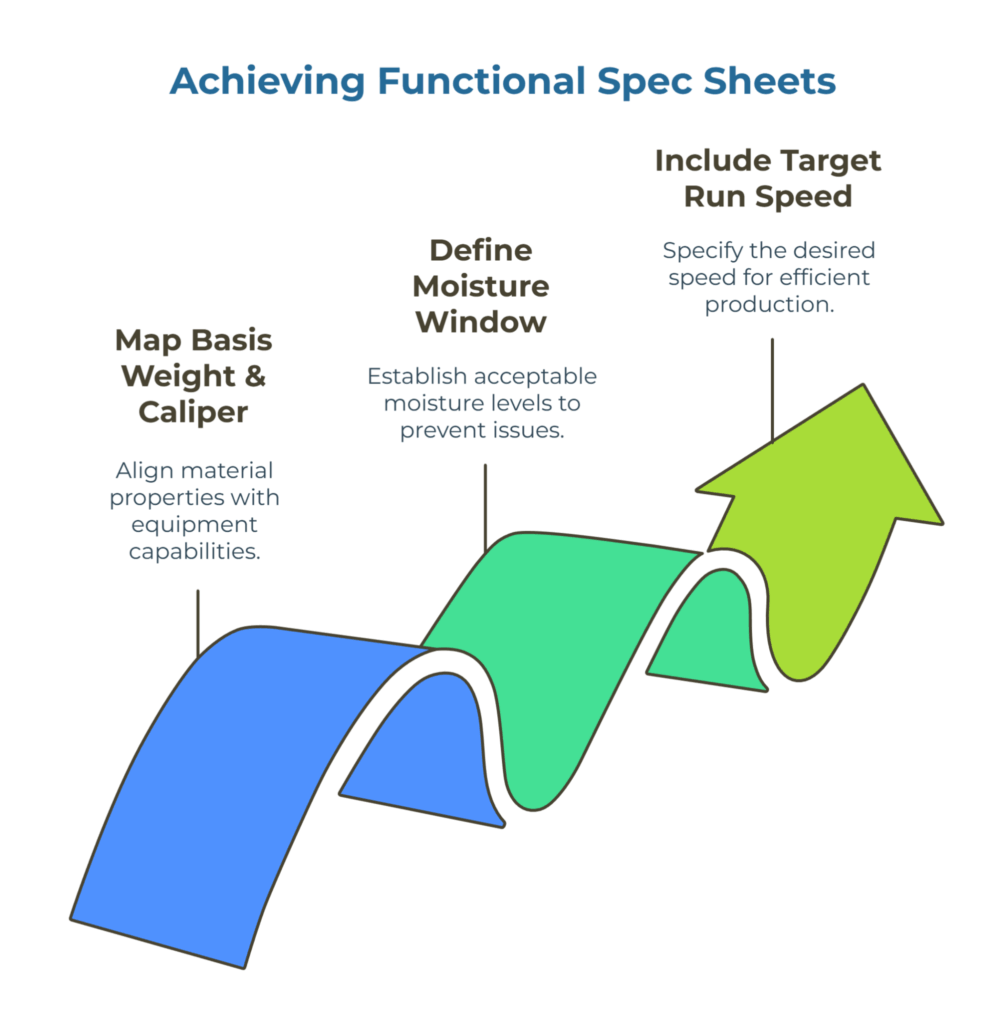
A spec sheet becomes truly useful when it connects material properties to your converting line’s operating envelope. This is where you move from abstract tolerances to practical guidance.
Start by mapping the basis weight and caliper to your equipment’s knife and fold windows. If your rotary die requires a minimum caliper of 0.28 mm for clean cuts, note that threshold on the spec. If your folder-gluer performs best with basis weights between 140-160 GSM, document that range. When suppliers understand your run targets, they can pre-qualify material before quoting, reducing the risk of delivering paper that technically meets the spec but fails on your line.
Moisture deserves the same treatment. Connect the moisture window to known curl and telescoping thresholds for your process. If experience shows that reels above 8.5% moisture consistently telescope during unwinding, your spec should reflect that limit. If material below 6.5% cracks during folding, document it.
Finally, include your target run speed. A spec that notes “designed for 200 meters/minute on XYZ equipment” tells suppliers your paper will face aggressive handling and needs appropriate strength and dimensional stability. This context transforms a static document into a functional blueprint for success.
Lock It Down With Version Control
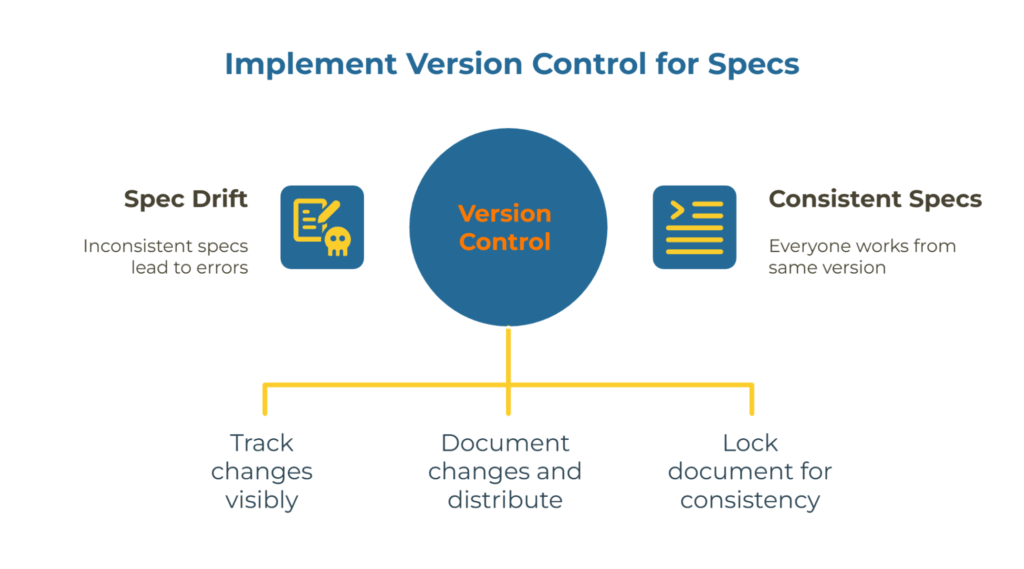
Spec drift—the phenomenon where a document slowly changes through informal edits, verbal agreements, or team turnover—is a silent killer of consistency. You issue version 1.0 of a spec, a buyer negotiates a slightly looser tolerance, and someone updates the local copy but not the master. Six months later, three different teams are working from three different versions, and no one can agree on what’s actually required.
Version control solves this problem with a simple discipline. Every spec sheet should have a visible revision block that includes the version number (e.g., “Rev 2.1”), the owner’s name (the person accountable for approvals), the date of issue, and a brief reason for any changes (e.g., “Tightened caliper tolerance based on Q3 line feedback”).
When you update a spec, increment the version, document why, and distribute the new revision as a read-only PDF. Attach that PDF to purchase orders so both parties are working from the same locked document. If a supplier proposes a change mid-order, it becomes a formal revision request rather than a quiet deviation.
This practice protects both converters and suppliers. Converters gain confidence that their teams aren’t inadvertently accepting off-spec material. Suppliers gain protection against scope creep, where buyers attempt to retroactively tighten requirements after the material has shipped.
How to Fill the Template (Walkthrough)
A blank template is only useful if you know what belongs in each cell. Here’s a step-by-step guide to populating the minimum viable spec sheet.
- Fill the identification section. Enter the grade name, intended application, form (sheet or roll with dimensions), and assign a revision number (start with “1.0” for new specs).
- Enter basis weight. Input your target value, select the tolerance (a range that can be as tight as ±2% to ±3% for sensitive applications, but is often wider, such as ±5%, for commodity grades), and name the test method (ISO 536 or TAPPI T 410). The template locks the method cell to prevent accidental edits.
- Enter the caliper. Input your target thickness, select the tolerance (which is often wider than basis weight, frequently falling in the ±5% to ±10% range, depending on the grade and your process’s sensitivity), and name the test method (ISO 534 or TAPPI T 411). Again, the method cell is locked.
- Enter the moisture window. Define the acceptable range (e.g., 6.5%–8.5%). Reference ISO 287 and note any acclimatization requirements (e.g., “Allow 48 hours at 23°C/50% RH before testing”). For guidance on why ranges matter, see Storage & conditioning for kraft reels.
- Add machine-readiness fields (if applicable). For roll stock, enter core ID, max OD, splice policy, and edge quality standards in the designated cells.
- Complete the revision block. Enter your name as the owner, today’s date, and the reason for creating or updating the spec (e.g., “Initial release” or “Updated moisture window based on summer humidity trials”).
- Save as a read-only PDF. Once complete, export the sheet as a PDF and attach it to RFQs and purchase orders. Keep the editable master file in a controlled location with restricted access.
Template availability: An Excel template with locked tolerance and method cells, plus a built-in revision block, can help standardize this process across your procurement team. The template includes data validation lists and protects critical fields from accidental changes.
Common Pitfalls (Fast Checks)
Before you issue a spec sheet, run through this quick checklist to catch the most frequent mistakes:
- Test Method not named. If your spec lists “150 GSM” without citing ISO 536 or TAPPI T 410, suppliers will test using inconsistent procedures. Always name the test method.
- Tolerance missing. A target without a tolerance is not a specification—it’s a wish. Add ±% or ±absolute values to every property.
- Moisture listed as a single number. Paper moisture is dynamic. Replace single targets with ranges (e.g., 7.5% ±1%) that reflect real-world behavior.
- No revision ID. A spec without version control will drift over time. Add a revision block with version number, owner, date, and change reason.
- Fields disconnected from run targets. If your spec doesn’t explain how basis, caliper, and moisture connect to your line’s speed, tooling, and quality requirements, it’s a static document, not a functional guide.
For a broader perspective on how test-method-named tolerances prevent disputes, review QA acceptance without debate: set method-named tolerances and attach results at quote time when sourcing kraft paper.
Frequently Asked Questions
What’s a good tolerance for basis weight versus thickness?
Basis weight tolerances depend heavily on the grade. While specialty grades may require tight tolerances like ±2% to ±3%, high-volume commodity grades commonly accept ±5%. Caliper tolerances are generally wider, often ±5% to ±10%, because thickness is harder to control precisely during manufacturing. Your choice depends on how sensitive your converting process is to variation—tighter tolerances improve consistency but may limit supplier options.
Do I list moisture as a range or a single target?
Always use a range. Moisture equilibrates with ambient conditions, so attempting to enforce a single target (e.g., “exactly 7%”) is impractical and invites disputes. A window like 6.5%–8.5% acknowledges natural variation while still protecting your process from extremes that cause curl or brittleness.
Which test method should I name—ISO or TAPPI (and does it matter)?
Both are widely recognized, and the practical difference is minimal for most properties. ISO standards (like ISO 536 for basis weight) are more common internationally, while TAPPI methods (like TAPPI T 410) are prevalent in North America. The key is consistency—pick one and reference it clearly so both parties test the same way.
What’s the difference between ISO 536 and TAPPI T 410 in practice?
Both standards determine grammage or basis weight, but they differ in apparatus details and testing procedures. For most paper converters and suppliers, these differences are minor. The important point is to choose one method and apply it consistently across all quotes and certificates, ensuring apples-to-apples comparisons.
Do converters need core ID and max OD on a minimum sheet?
If you run roll stock, yes. Core ID ensures the roll fits your unwind mandrel, and max OD confirms it doesn’t exceed your reel stand capacity or handling limits. These two simple specifications prevent fit and acceleration issues that can halt production. Omitting them from a “minimum” sheet often creates more downtime than a slightly loose material tolerance would.
How do I connect spec fields to run speed and fold/knife limits?
Add a notes section to your spec that maps properties to equipment thresholds. For example: “Designed for 200 m/min on rotary die; minimum caliper 0.28 mm for clean cuts.” This gives suppliers context and helps them pre-qualify material before quoting.
What belongs in the revision block to stop spec drift?
Include four elements: version number, owner (the person accountable for approvals), date of issue, and a brief reason for the revision. This creates a traceable history and ensures everyone works from the current standard.
How often should we issue a spec revision?
Only when tolerances or test methods change, when a run target shifts, or when machine-readiness limits are updated. Avoid the temptation to revise for minor clarifications—those can often be handled through footnotes or supplemental documentation. Record the reason for each revision in the revision block to maintain a clear audit trail.
Closing Thought
A spec sheet is only as good as the discipline behind it. The minimum fields outlined here—basis weight, caliper, moisture, tolerances, and test methods—are not a complete material characterization, but they are sufficient to prevent the most common sources of confusion and dispute. When you tie these fields to your run targets and lock them with version control, the spec transforms from a static document into a functional agreement that both sides can execute without guesswork.
For paper converters, this means faster receiving, fewer line stops, and less time spent resolving spec ambiguities. For suppliers, it means clearer RFQs, fewer post-award negotiations, and a better chance that delivered material will pass inspection on the first try. Both parties win when the paperwork is as reliable as the paper itself.
Disclaimer: This article provides general information about paper specification fields for educational purposes. Individual circumstances vary based on machine limits, tooling, and ambient conditions. For guidance tailored to your converting line’s targets, consult a qualified packaging engineer or quality professional.
Ready to connect with verified suppliers? Find suppliers or Submit an RFQ to receive quotes directly from mills and converters worldwide.
Our Editorial Process
Our expert team uses AI tools to help organize and structure our initial drafts. Every piece is then extensively rewritten, fact-checked, and enriched with first-hand insights and experiences by expert humans on our Insights Team to ensure accuracy and clarity.
About the PaperIndex Insights Team
The PaperIndex Insights Team is our dedicated engine for synthesizing complex topics into clear, helpful guides. While our content is thoroughly reviewed for clarity and accuracy, it is for informational purposes and should not replace professional advice.