
📌 Key Takeaways
Grease leaks through food packaging paper because the paper lacks a chemical barrier—not because it’s too thin.
- Kit Level Measures Protection, Not Thickness: A paper’s Kit rating (1–12) shows how well it blocks grease, which has nothing to do with how heavy or thick the paper feels.
- Heavier Paper Still Leaks: Grease travels through tiny gaps between fibers via capillary action—adding more fibers just creates more pathways unless the paper is chemically treated.
- Match the Rating to Your Menu: High-fat, hot foods like fried chicken need Kit 9–12; pastries only need Kit 1–3—overspecifying wastes money, underspecifying causes complaints.
- Hold Time Triggers Failure: Paper that works fine for dine-in can fail during a 20-minute delivery because grease has more time to migrate through untreated fiber.
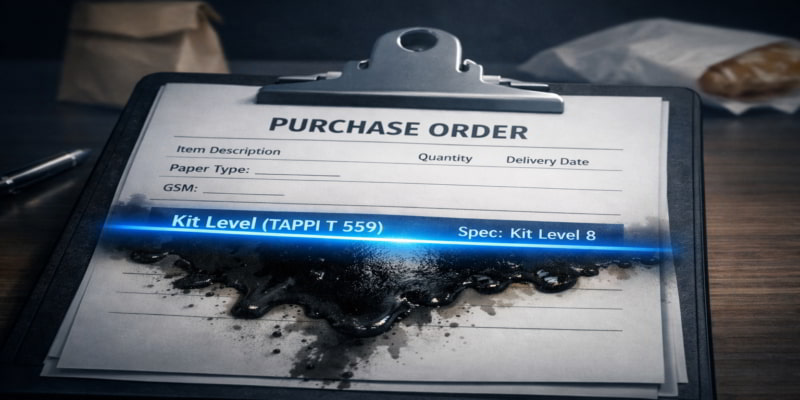
- Specify Kit Level on Purchase Orders: If your order doesn’t include a Kit Level test result per TAPPI T 559, you haven’t actually specified grease resistance—you’ve just ordered paper.
Specify the barrier, not the weight—that’s how you stop leaks before they reach customers.
Food service operators and procurement managers sourcing delivery packaging will gain clarity on specification gaps here, preparing them for the detailed menu-matching guidance that follows.
~ ~ ~ ~ ~ ~ ~ ~ ~ ~ ~ ~ ~ ~ ~ ~ ~ ~
The delivery driver calls. Another complaint. Grease leaked through the bag onto a customer’s leather car seat. The wrapper looked fine when it left the kitchen—but somewhere between handoff and arrival, the damage was done.
This scenario plays out daily in food service operations everywhere. The instinct is almost always the same: order thicker paper next time. Heavier stock. More substantial bags. The logic feels solid.
Except it doesn’t work.
Grease Resistance Ratings, measured by Kit Levels on a standardized 1–12 scale, define a paper’s ability to repel oil and grease for a specific duration. This is fundamentally different from paper weight or thickness. Generic ‘brown paper’ fails not because it’s too thin, but because it lacks the chemical barrier that Kit-treated greaseproof paper provides.
Kit Levels function as a performance threshold: a higher number protects against intense exposure (hot fryer oil), while a lower number suffices for lighter exposure (pastries). The number tells you how long the barrier holds under specific grease and heat conditions—not how heavy the paper feels in your hand.
Understanding this distinction transforms how you specify food packaging. It stops the leak before it reaches your customer.
What Grease Resistance Ratings (Kit Levels) Actually Measure
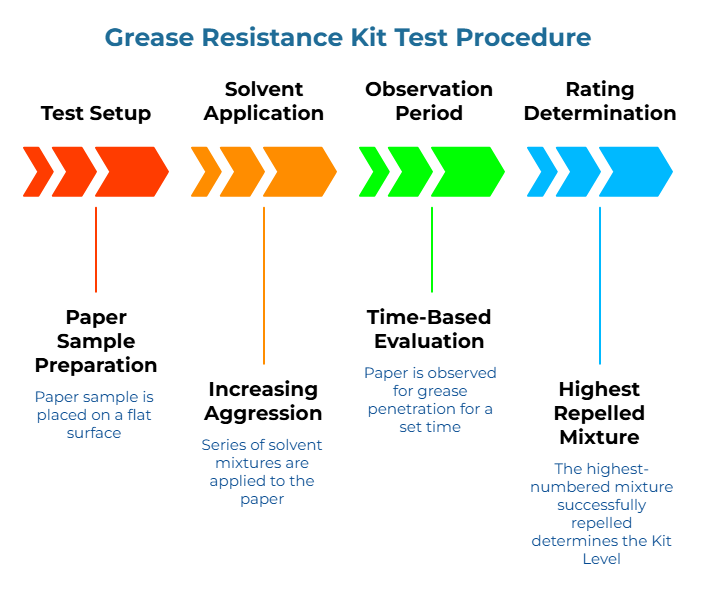
Kit Levels measure how well paper resists penetration by oils and greases under controlled test conditions—not how thick or heavy the paper is.
The Kit test (TAPPI T 559) applies a series of increasingly aggressive solvent mixtures to paper samples. The highest-numbered mixture that the paper successfully repels for a set time determines its Kit Level rating. A Kit 1 rating indicates minimal grease resistance; Kit 12 represents the highest protection against aggressive oils and fats.
The Kit number represents how aggressive a grease the paper can block—independent of the material’s basis weight or total duration of exposure in non-standardized environments.
A common mistake is assuming higher Kit numbers mean the paper is universally “better.” A Kit 12 paper designed for fried chicken would be overengineered and overpriced for wrapping a croissant. The goal isn’t to maximize the number. Match the number to your actual menu conditions.
Why the Scale Measures Performance, Not Thickness
Paper basis weight, measured in GSM (grams per square meter), tells you about the material’s mass and density, which generally correlates with stiffness. Thickness, or caliper, is measured separately in microns or mils—but crucially, neither metric dictates grease resistance (TAPPI T 410 & TAPPI T 411). It says nothing about the chemical barrier.
You can have a heavy 80 GSM paper that leaks grease in minutes and a lighter 45 GSM paper with a Kit 8 rating that holds up through a 20-minute delivery window. The confusion between weight and performance leads to wasted purchasing decisions. Operations teams order heavier paper expecting better protection, pay more, and still receive complaints.
The specification that actually matters—Kit Level—never appears on the purchase order. For foundational context on how these specifications relate, see food packaging paper specifications 101.
Why “Thicker Paper” Still Leaks: The Failure Mechanism
Thicker paper still leaks because grease doesn’t care about thickness. It cares about finding a path through.
Untreated paper consists of a highly porous web of fibers, which is why sourcing from greaseproof paper mills that apply proper barrier treatments is essential for food service applications. While cellulose itself is naturally hydrophilic (water-attracting) and fundamentally lipophobic, the physical structure of the paper is the true vulnerability. When grease contacts the surface, powerful capillary action pulls the lipids directly through the interstitial air spaces between the fibers. The porous network acts like a sponge, drawing oil deeper into the material. Over time, grease migrates to the other side and stains whatever it touches: hands, clothes, car seats, branded packaging.
This mechanism explains why simply adding weight doesn’t solve the problem. More fibers still create more pathways for grease to travel—unless those fibers have been chemically treated to repel oil.
Density and Capillary Wicking During Hold Time
The physics matter for operations planning. A wrapper might look perfectly clean when food is packaged. The grease migration is happening, but it hasn’t reached the outer surface yet.
Add a 15-minute delivery window, and suddenly the wrapper that “worked fine” in the kitchen fails catastrophically in the customer’s hands. This is why hold time is such a critical variable. Paper performing adequately for immediate consumption can fail completely when food sits longer—in a delivery bag, in a warming drawer, or on a customer’s desk waiting to be eaten.
Why Leaks Appear at the Worst Moment
Grease stains don’t appear the moment food touches paper. They appear after grease has had time to migrate through untreated fiber.
This creates a frustrating pattern: everything looks fine in the kitchen, complaints arrive later, and the connection to paper specification isn’t obvious. The customer doesn’t know your paper lacks a chemical barrier. They see a grease stain and draw conclusions about your food quality, your brand, and your attention to detail.
Operational Alignment: Matching Kit Level to Variable Exposure
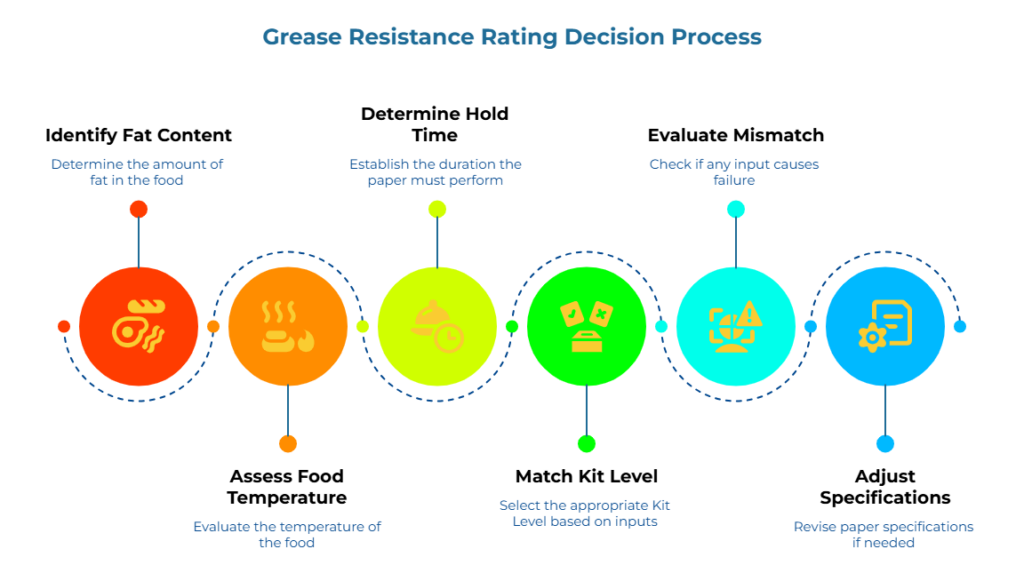
The decision rule is straightforward: match Kit Level to the combination of fat content, food temperature, and how long the paper must perform.
Higher fat content requires higher Kit protection. Higher temperature accelerates grease migration. Longer hold times give grease more opportunity to penetrate. All three variables interact. Mismatching any of them causes failure.
The Three Inputs That Matter
Fat content is the most obvious factor. A heavily greased fried chicken thigh presents a more aggressive challenge than a lightly buttered croissant. The grease load—how much oil actively presses against the paper surface—determines the baseline Kit requirement.
Temperature accelerates everything. Hot grease is more fluid and penetrates faster than cooler grease. Food coming straight off a fryer at 355 – 375°F (180 – 190 °C) attacks paper barriers more aggressively than room-temperature items.
Hold time determines how long the barrier must function. A wrapper performing for the 3 minutes between kitchen and counter might fail completely over a 25-minute delivery window—a critical consideration when sourcing wrapping paper for delivery-focused operations.
The Tipping Point: When “Fine” Becomes Failure
Delivery and extended hold times are where most grease failures manifest. Paper that served dine-in customers adequately for years suddenly generates complaints when delivery volumes increase.
This isn’t the paper getting worse. The conditions are getting more demanding. A 5-minute hold time becomes a 20-minute hold time, and the Kit Level that barely cleared the first threshold has no chance at the second.
The practical implication: expanding delivery or hold-and-serve operations may require revisiting paper specifications—even if the paper itself hasn’t changed.
Menu-to-Kit Matching Table
Use this reference to match common menu items to appropriate Kit Level ranges. The table accounts for typical fat content, serving temperature, and standard hold times.
| Menu Item | Fat Load | Typical Temp | Recommended Kit Range | Notes |
| Pastries, croissants, light baked goods | Low | Warm to room temp | Kit 1–3 | Minimal grease challenge; basic barrier sufficient |
| Sandwiches with light sauce | Low–Medium | Room temp to warm | Kit 3–5 | Higher range if hold time exceeds 15 minutes |
| Burgers (standard) | Medium–High | Hot | Specify after testing | Variables include patty fat content, toppings, and hold time |
| Fries, onion rings | Medium–High | Hot | Specify after testing | Heat, oil, steam, and closed containers affect performance |
| Fried chicken, wings | High | Very hot | Kit 9–12 | Maximum protection for high-fat, high-temp items |
Important context on burgers and fries: The appropriate Kit Level varies based on specific recipes and operations. A 90% lean patty with a 5-minute hold presents a different challenge than a 70% lean patty held for 20 minutes. Similarly, fries in vented packaging behave differently than fries sealed in delivery bags where steam accumulates. The table above provides anchored values where evidence supports them—confirm requirements with suppliers using actual menu conditions for items marked “Specify after testing.”
For a comprehensive matrix covering additional menu items and variables, see the menu-match matrix for food packaging paper. To source paper grades matching these specifications, explore food packaging paper suppliers from verified sources.
Business Impact: Why Grease Stains Damage Brand Perception
Grease stains function as a visible quality signal that customers cannot unsee—even when the food itself is excellent.
The bag arrives. There’s a dark, spreading stain on the paper. Before the customer tastes anything, they’ve formed an impression. That impression doesn’t say “the paper wasn’t specified correctly.” It says “this restaurant doesn’t care about quality.”
The Psychology of Packaging Integrity
Packaging is the first physical touchpoint in delivery and takeout. For many customers, it’s the only brand interaction between ordering and eating. A stained paper bag creates a negative first impression that the food must then overcome.
This effect compounds with premium positioning. A fast-casual brand charging higher prices creates higher expectations. A grease stain on commodity paper undermines the entire value proposition. The customer paid for quality and received visual evidence suggesting otherwise.
The Cost of Workarounds
Operations that don’t address the root cause often create expensive workarounds. Double-wrapping adds labor time and material cost. Extra napkins stuffed into bags increase per-order expense. Handling complaints and occasional refunds for damaged clothing or car interiors creates direct losses.
These workarounds treat symptoms while the underlying specification gap persists. The more sustainable path is matching Kit Level to menu conditions from the start—eliminating the need for reactive measures.
Sourcing Specifications: Supplier Inquiry Framework
When specifying grease-resistant paper, request the Kit Level test result and the test method used. Generic terms like “greaseproof” or “food safe” don’t provide the performance information needed to make informed decisions.
How to Request Kit Test Results
Ask suppliers directly: “What is the Kit Level rating for this paper, tested per TAPPI T 559?”
A supplier who cannot answer this question may not be testing for grease resistance in a standardized way. Legitimate food packaging paper suppliers can provide test documentation showing Kit Level results. If purchasing through distributors, documentation should trace back to the mill’s quality testing — food packaging paper mills maintain these records as part of their quality assurance processes.. Absence of this documentation warrants further inquiry.
For food-contact compliance, Kit Level testing exists alongside broader regulatory requirements. In the United States, FDA regulations (21 CFR 176.170) govern paper and paperboard in contact with fatty foods. In the European Union, Regulation (EC) No 1935/2004 establishes the framework for food-contact materials. Kit Level testing addresses performance; these regulations address safety. Both matter.
Where Kit Fits Alongside Other Specifications
A complete specification for food packaging paper includes several parameters working together. GSM defines weight and stiffness. Kit Level defines grease resistance. Additional specifications may include coatings (poly, wax, or greaseproof treatments), food-contact compliance documentation, and dimensional requirements.
These specifications address different properties—they don’t compete. A specification sheet listing GSM but omitting Kit Level hasn’t addressed grease resistance at all. For context on how different coating types compare, see poly vs. wax vs. greaseproof.
What Kit Testing Does Not Measure: The Kit test measures resistance to oil penetration under specific conditions. It does not measure moisture resistance, durability, printability, or food-contact compliance. A high Kit rating means the paper resists grease—it doesn’t mean the paper is suitable for every food application. Always verify that the paper meets all relevant requirements for the specific use case.
Day-to-Day Application: A Simple Workflow to Stop Leaks This Week
Addressing grease leaks can begin immediately by identifying highest-risk items and testing current paper performance against actual conditions.
Quick Triage: Which Items Are Most Likely to Fail
Start with the highest-fat, longest-hold menu items. These face the most aggressive grease challenge and have the most time for failure to manifest. Fried items held for delivery are the typical weak point.
List the top five menu items by complaint frequency related to packaging. These are testing priorities. If complaints aren’t tracked by item, start with items combining high fat content and extended hold time—fried chicken in delivery bags, for example, or loaded fries sitting in a warming station.
Log the Failure Moment in Operational Terms
Instead of reporting “paper is bad,” capture specific data that connects complaints to specification decisions:
- Item name and portion size
- Packaging SKU currently in use
- Time food was packed
- Time stain became visible
- Location of failure (fold, seam, bottom panel, corner)
This transforms vague complaints into specification-relevant evidence. A pattern of failures at folds and corners suggests stress points where grease pressure concentrates. Failures appearing consistently at the 18-minute mark indicate the barrier duration threshold. This data makes the next specification decision defensible.
Pilot Test and Feedback Loop
Run a simple pilot: wrap problem items in paper with a documented Kit Level appropriate for their conditions. Track complaints over a two-week period. If complaints drop, a specification gap has been identified that was costing customers.
One consideration during testing: a material that wins on grease resistance might reduce venting, affecting food texture—particularly for items like fries where crispness matters. The goal isn’t a maximum barrier in all cases, but adequate barrier for the required customer experience.
The feedback loop between kitchen and procurement matters more than most operations realize. Line staff see which wrappers fail. That information needs to reach whoever writes purchase orders. Without that connection, procurement continues buying on weight and price while operations absorb the consequences.
Consensus Kit: Building Internal Buy-In
Changing paper specifications requires alignment between operations, procurement, and sometimes finance. The comparison below clarifies what each approach actually delivers.
Approach Comparison
| Approach | What You’re Buying | Strengths | Weaknesses |
| GSM-only specification | Paper by weight, no performance requirement | Lowest unit cost; simple ordering | No guaranteed grease protection; leak risk remains |
| Kit-specified paper | Paper with tested grease resistance rating | Predictable performance matched to conditions | Requires knowing Kit requirement; may cost more than commodity |
| Coated barrier (poly/wax) | Paper with physical coating layer | Strong barrier; often includes moisture resistance | May not be recyclable; coating can affect food texture; steam trapping possible |
Each approach serves different operational priorities. GSM-only works for dry, low-fat items where grease resistance isn’t a concern. Kit-specified paper addresses the performance gap for greasy items. Coated barriers add another layer of protection but introduce tradeoffs around recyclability, cost, and potential texture impacts from trapped steam.
Risk-Mitigation Checklist Before Approving a New Wrapper
Before approving any new food packaging paper, verify three items:
Kit Level documentation exists and matches menu conditions. If the supplier cannot provide a Kit Level test result per TAPPI T 559, there is no verified grease resistance specification. For additional context on what this testing involves, the SGS-IPS overview of TAPPI T 559 provides a practical explanation.
Ensure hold time assumptions reflect peak delivery windows. Test against actual delivery windows, not ideal conditions. If the average delivery takes 22 minutes, don’t approve paper tested for a 10-minute hold.
The specification is written into the purchase order. Verbal assurances don’t survive supplier changes or quality drift. If Kit Level isn’t on the PO, it hasn’t actually been specified.
The Specification Shift That Protects Your Brand
Grease leaks aren’t solved by ordering thicker paper. They’re solved by specifying the right chemical barrier for actual menu conditions.
The shift is conceptual first, then practical. Stop thinking about paper weight as the variable that determines grease protection. Start thinking about Kit Level as the performance metric that actually predicts whether grease will reach customers.
Remember the SPF analogy: just as sunscreen protection is rated by its ability to block UV exposure over time—not by how thick it feels on skin—paper protection is rated by its ability to block grease under specific conditions. The number matters. The weight doesn’t.
Matching the wrong Kit Level to a menu causes both performance failure and wasted budget. Operations pay for paper that doesn’t protect, then pay again in complaints, workarounds, and brand damage. The alternative is straightforward: know the menu’s grease challenge, specify the appropriate Kit Level, and verify that specification in supplier documentation.
The customer who used to receive a grease-stained bag now receives clean packaging matching brand standards. The complaint calls stop. The apology emails stop. The paper does what it was supposed to do all along—because someone finally specified it correctly.
To map a full menu to appropriate specifications, use the menu-match matrix for food packaging paper.
Common Questions About Kit Levels and Grease Resistance
What is the Kit test for grease resistance?
The Kit test is a standardized laboratory method that produces a rating from 1 to 12, expressing how well paper resists grease penetration. The test applies increasingly aggressive oil-solvent mixtures to paper samples; the highest mixture the paper repels determines its Kit Level. For the technical method reference, see TAPPI T 559.
Do higher GSM papers stop grease leaks?
Higher GSM improves paper strength and stiffness, but grease leakage is a performance issue tied to barrier chemistry and migration over time. A heavy untreated paper can leak faster than a lighter treated paper. GSM should be specified alongside grease resistance performance, not instead of it.
What Kit Level is needed for fried chicken versus pastries?
Fried chicken is a high-heat, high-fat application requiring Kit 9–12 for adequate protection. Pastries present minimal grease challenges and typically perform well with Kit 1–3. The gap between these extremes illustrates why matching Kit Level to actual conditions matters more than defaulting to the highest available rating — greaseproof paper options span this full range of performance levels.
How do hold time and heat change the required Kit Level?
Longer holds and higher temperatures both increase grease migration risk. Heat keeps fats fluid and mobile; time gives them opportunity to penetrate. This effect intensifies in closed, humid environments like sealed delivery bags or insulated carriers. Items that perform adequately for dine-in service may require higher Kit protection when delivery hold times extend beyond 15–20 minutes.
How should Kit Level be written into an RFQ or specification sheet?
Request the test method reference (TAPPI T 559) and the reported Kit Level result. When ready to source, buyers can submit an RFQ to receive quotes from verified suppliers who provide this documentation. Include the service conditions the packaging must handle: expected food temperature at pack-out, typical hold time, and whether food will be enclosed in sealed bags or containers. A third-party resource like the SGS-IPS TAPPI T 559 overview can help align technical and operational teams on what this testing means.
Is Kit testing relevant for coated or film barrier papers?
Coated and barrier papers may resist grease through different mechanisms than chemically treated papers. The Kit test can still provide useful information, but results may not tell the complete performance story. For coated materials, a short pilot test using actual food under real holding conditions often provides the most reliable confirmation of whether the barrier will perform as needed.
Disclaimer:
This content is for informational purposes and reflects general industry practices. Specific Kit Level requirements vary based on menu items, operational conditions, and local regulations. Always verify specifications with qualified suppliers and confirm compliance with applicable food-contact regulations.
Our Editorial Process:
Our expert team uses AI tools to help organize and structure our initial drafts. Every piece is then extensively rewritten, fact-checked, and enriched with first-hand insights and experiences by expert humans on our Insights Team to ensure accuracy and clarity.
About the PaperIndex Insights Team:
The PaperIndex Insights Team is our dedicated engine for synthesizing complex topics into clear, helpful guides. While our content is thoroughly reviewed for clarity and accuracy, it is for informational purposes and should not replace professional advice.