

📌 Key Takeaways
Letting suppliers define your packaging specs means you’re comparing quotes that were never truly comparable in the first place.
- Own the Baseline First: Create a buyer-controlled spec sheet that tells every supplier exactly what to report, how to measure it, and what format to use—before comparing prices.
- Vague Specs Hide Real Costs: Words like “premium board” or “good stiffness” invite interpretation, and that interpretation gap often shows up as production failures, not pricing differences.
- Match Test Methods, Not Just Numbers: Two suppliers can report identical figures using different measurement approaches—standardise the method or the comparison is meaningless.
- Start Small to Build Momentum: Pick one high-pain variable like thickness, write a one-page mini-spec, pilot it on your next RFQ, then expand from there.
- Tolerances Turn Wishes into Standards: A requirement without a tolerance is just a preference—specify acceptable ranges or suppliers will choose their own.
Chaos thrives when no one owns the baseline—change the owner and comparability follows.
Packaging procurement managers and operations teams scaling multi-SKU portfolios will gain a practical framework here, preparing them for the detailed specification templates that follow.
~ ~ ~ ~ ~ ~ ~ ~ ~ ~ ~ ~ ~ ~ ~ ~ ~ ~
Five suppliers. Five quotes. Zero comparability.
Procurement teams frequently encounter specification gaps that remain latent until production failures occur—a pattern that echoes the challenges seen when corrugated box damage on arrival is a sourcing failure, not a logistics issue. These discrepancies often stem from inconsistent testing conditions—such as varying relative humidity—and incompatible units of measurement (e.g., microns vs. points).
Folding carton specification requirements are the standardized material, structural, and performance criteria that keep paperboard packaging consistent across your entire product portfolio. Think of them as the master architectural blueprint for your packaging program. When every contractor builds to the same blueprint, you can compare bids fairly and predict outcomes reliably. When each contractor brings their own interpretation of “structurally sound,” you get chaos dressed up as competitive bidding.
The path forward requires a shift in ownership. You need a buyer-owned house specification—a rigid baseline document that dictates exactly what folding carton suppliers must report, how they must measure it, and in what format they must respond. A standardized baseline enables immediate technical comparability across global quotes.
This guide shows you how to build that baseline, layer by layer, without overwhelming your team.
Why Buyers Must Stop Letting Vendors Define the Baseline
A supplier data sheet is not automatically wrong. It is simply written from the supplier’s point of view—and that distinction matters more than it first appears.
When you issue an RFQ without a rigid specification requirement, you hand suppliers the power to define what “acceptable” means. Supplier A interprets your request using their internal quality standards. Supplier B uses different assumptions. Supplier C provides only the metrics that make their product look competitive.
None of them are being deceptive. They are simply speaking different languages while you assume everyone is using the same dictionary.
This creates a structural control problem. The lowest quote might actually be the most expensive choice if its underlying specifications do not match your production requirements. But you cannot see that mismatch when every supplier frames their capabilities using their own terminology, their own test methods, and their own tolerance assumptions. That is not procurement control. It is structured ambiguity.
The risk compounds as your SKU portfolio grows. A single-product business can manage specification variance through tribal knowledge and manual oversight. A business launching fifteen new SKUs across three continents cannot. At scale, vendor-led data sheets stop being helpful reference documents and start becoming incompatible mini-systems that make governance impossible.
Supplier data sheets are not a procurement system. They were never designed to be one. Treating them as such is how packaging teams end up comparing apples to orangutans while calling both “fruit.”
The only path to control is to stop accepting supplier-defined inputs as the baseline. You must dictate the baseline yourself.
The Priority of Buyer-Owned Specifications
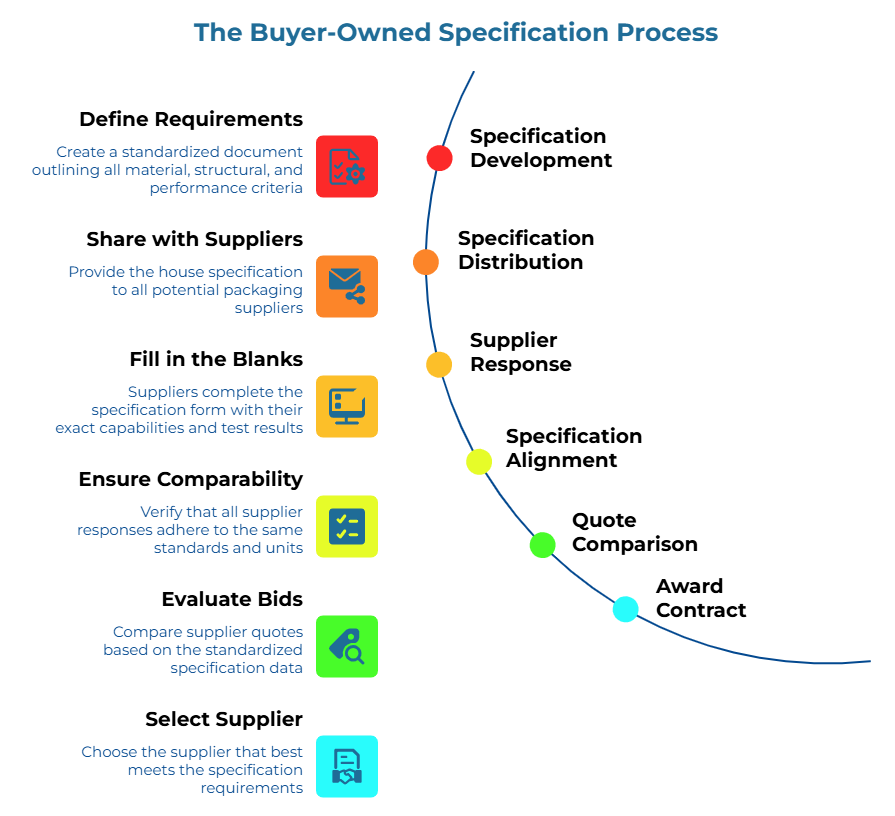
A house specification is exactly what it sounds like: your house, your rules.
It is a standardized document that defines every material property, structural requirement, performance threshold, test method, and response format that suppliers must use when bidding on your packaging. Instead of asking suppliers to describe their capabilities in their own words, you hand them a form that says: “Fill in these exact fields, using these exact units, referencing these exact test standards.”
The house specification does not replace technical expertise. It channels technical expertise into a consistent framework that makes supplier inputs comparable by design.
This must come before quote comparison because comparison without standardization is theater. You cannot meaningfully evaluate whether Supplier A’s 295 g/m² board is better than Supplier B’s 300 g/m² board if you do not know whether both measurements followed the same grammage standard, the same conditioning protocol, and the same measurement approach. The numbers look precise. The underlying reality may be chaos.
Quote comparison is the reward you earn after specification alignment. Attempting it before alignment is how packaging teams end up in endless cycles of renegotiation, surprise failures, and finger-pointing about who promised what.
The Non-Negotiable Layers of a Folding Carton Specification
A rigid house specification is not a single requirement. It is a stack of interlocking layers, each serving a distinct governance purpose. The following layers represent generally accepted practice in packaging specification development, though specific requirements will vary based on your product portfolio and operational context.
Material Requirements
This layer defines what the folding carton is made of. Key fields typically include:
Board grade and composition. Specify virgin fiber content, recycled content percentage, or specific furnish requirements based on your performance and sustainability needs. Words like “premium board” or “good stiffness” are too soft for a multi-supplier RFQ. Measurable descriptors create a stronger baseline.
Grammage (basis weight). Express in g/m² with an acceptable tolerance range, following the methodology established in ISO 536. For buyers unfamiliar with how basis weight interacts with other properties, understanding GSM and burst factor provides foundational context applicable across paperboard grades.
Thickness (caliper). Express in microns or millimeters with an acceptable tolerance range. ISO 534 establishes the standard methodology for thickness, density, and specific volume measurement.
Moisture content. Define target percentage and allowable deviation, as moisture directly affects board performance during converting and end-use.
Coating specifications. Document type, weight, and coverage requirements for any surface treatments. If the folding carton is tied to food or personal-care applications, additional material suitability rules may be necessary. For U.S.-oriented food-contact questions, the FDA’s Packaging & Food Contact Substances guidance provides a useful starting point, though exact requirements vary by end use, geography, and regulatory scope.
Each field must include the measurement unit, the reference standard, and the acceptable tolerance band. A specification that says “approximately 300 g/m²” is not a specification. It is an invitation for interpretation.
Structural Blueprint Requirements
This layer defines how the folding carton is constructed:
- Blank dimensions. Length, width, and depth with tolerances in millimeters.
- Score and fold geometry. Score depth, fold angle tolerances, and panel alignment requirements.
- Glue flap specifications. Width, adhesive type, and bond strength requirements.
- Die-cut tolerances. Acceptable variance on cut edges and window openings.
- Grain direction. Machine direction orientation relative to primary fold lines.
Structural requirements must account for how the folding carton performs during filling, closing, stacking, and shipping—not just how it looks as a flat blank. This is where many teams stay too abstract. They define material but leave structure semi-implied. Then the first operational problem arrives and everyone starts tracing the issue backwards through drawings, emails, and supplier notes.
A folding carton fails in use as a structure. Not as a sentence.
Performance and Tolerance Requirements
This layer defines what the folding carton must withstand. Common parameters include burst strength, edge crush resistance, fold endurance, compression strength, and coefficient of friction for surfaces that interact during packaging line operations.
A requirement without a tolerance is often only a preference. Every performance requirement needs an associated tolerance. Specifying “burst strength: 250 kPa minimum” provides a starting point. Specifying “burst strength: 250–275 kPa, tested at 23°C and 50% RH after conditioning” creates an enforceable standard.
One caution: specific thresholds should be set only where the organization has a validated basis for them, such as prior operational performance, converter requirements, or approved internal standards. Inventing arbitrary numbers without operational justification creates false precision that can be as damaging as no specification at all.
Tolerances are not optional additions. They are what separate a wish list from a specification.
Named Test Methods and Reporting Requirements
This layer eliminates interpretation by mandating exactly how suppliers must generate and present their data:
Test method citations. Reference specific ISO, TAPPI, or ASTM standards for each measured property. For teams standardizing measurement discipline, TAPPI/ISO in plain English explains which test methods to require and why—guidance transferable across paper and board grades.
Conditioning protocols. Specify temperature, humidity, and duration before testing.
Sample size and selection. Define how many samples and from which production positions.
Reporting format. Require a standardized response template that suppliers must complete field-by-field.
Certification and traceability. Require lot-linked test reports, not generic capability statements. For guidance on distinguishing valid certificates from documentation that fails under scrutiny, spotting fake FSC, PEFC, and ISO certificates provides a visual verification framework.
Without named test methods, two suppliers can report identical numbers while measuring completely different things. One supplier’s “burst strength” tested on freshly manufactured samples is not the same as another’s tested after humidity exposure. The numbers match. The reality does not.
Supplier Response-Format Requirements
This final layer ensures that supplier responses arrive in a structure you can actually compare. Mandate that all suppliers complete the same form, in the same sequence, using the same units. Do not accept free-form data sheets. Do not accept “see attached specification” responses that link to the supplier’s own documentation.
When every supplier fills in the same form, comparison becomes a matter of reading columns instead of translating documents. For a template-driven approach to this challenge, the spec-driven RFQ template demonstrates how to combine technical specs and commercial terms into a single standardized request.
For guidance on building enforceable specification documents that produce comparable supplier quotes, the quality blueprint for defining and enforcing specifications provides a transferable framework applicable across paper and board grades.
Where Vendor-Led Data Sheets Create Truth Decay
Truth decay is what happens when specification language drifts across suppliers, SKUs, and time until no one can reconstruct what the numbers actually mean. Vendor-led data sheets accelerate this decay through several mechanisms.
Different Test Methods
Two suppliers can report the same property using different test methods or different measurement assumptions—a problem that becomes acute when ECT versus bursting strength measurements create incompatible data sets. Supplier A tests burst strength using one international standard. Supplier B uses a different methodology. Both report a number in kPa. On the spreadsheet, the line items look aligned. In practice, the comparison may already be unstable.
You cannot see this mismatch on a spreadsheet that only shows the final number. The test method difference hides inside the data, waiting to surface as a production problem.
Different Tolerance Assumptions
Your specification says “grammage: 300 g/m².” Supplier A interprets this as 300 ±3%. Supplier B interprets it as 300 ±5%. Supplier C interprets it as a target with no binding tolerance at all.
Your specification says “grammage: 300 g/m².” Supplier A may assume a ±3% variance, while Supplier B defaults to ±5%, and Supplier C treats the figure as a non-binding target.
Each supplier believes they are compliant. Only one may match what your production line actually requires. You will not know which one until cartons start running—a discovery process that containerboard quality acceptance criteria is designed to prevent through pre-agreed thresholds and triage protocols.
Different Reporting Depth
Supplier A provides a detailed technical data sheet with twelve measured properties, conditioning notes, and lot traceability. Supplier B provides a one-page marketing summary with three headline numbers and no test method citations.
Comparing these inputs requires you to guess what Supplier B actually measured and how. That guesswork introduces risk you cannot price.
Category-by-Category Specification Drift
This is the slowest form of decay. It is also one of the most expensive.
As your SKU portfolio grows, different product managers request folding cartons from different suppliers at different times. Each request uses slightly different language. Each supplier responds with their own data sheet format.
Over eighteen months, you accumulate dozens of specification variants across a portfolio that should have three baseline grades. No one can trace which variant applies to which SKU. Truth has decayed into tribal memory and email archaeology.
That is why teams sometimes switch vendors to fix a recurring packaging problem when the deeper issue is the lack of a buyer-owned baseline. The supplier may not be flawless. The undefined specification is often doing more damage than anyone admits.
How to Build a Rigid House Specification for a Growing Multi-SKU Portfolio
Building a house specification does not require stopping all other work. It requires a disciplined approach that separates universal requirements from SKU-specific exceptions. The following approach represents one practical methodology, though implementation will vary based on organizational structure and existing processes.
Start with Shared Baseline Fields
The safest place to start is not with the whole portfolio. It is with the repeatable spine.
Identify the specification fields that apply to every folding carton in your portfolio, regardless of product category. These typically include grammage and thickness ranges for your standard board grades, universal test method citations, conditioning protocol requirements, response format templates, and certification documentation requirements.
These baseline fields become the foundation of your house specification. Every supplier, for every SKU, must complete these fields using the same format. The backbone first.
Separating Universal Standards from SKU-Specific Deviations
Not every folding carton needs the same performance threshold. A premium skincare box may require tighter caliper tolerances than a value-tier household product folding carton.
Structure your house specification with a universal layer that applies to all SKUs and an exception layer that captures category-specific or product-specific deviations. The exception layer should be small, documented, and justified—not a loophole that swallows the rule.
That single design move keeps the system usable. Shared rules stay stable across the family. True exceptions remain visible instead of quietly rewriting the baseline.
Standardize Terminology and Units
Mandate a single vocabulary across your organization and your suppliers. If you measure thickness in microns, every supplier reports in microns. If you reference a specific ISO standard for caliper measurement, no supplier substitutes a different test method without explicit approval.
This sounds obvious. In practice, it requires active enforcement. Suppliers will default to their internal terminology unless you insist otherwise.
Terminology drift becomes governance drift faster than most teams expect.
Require the Same Response Structure from Every Supplier
Create a response template that suppliers must complete field-by-field. This uniformity transforms the evaluation process from manual document translation into a direct side-by-side data comparison—the same principle behind Incoterms normalization for true door-to-door pricing, which ensures commercial terms receive equally rigorous standardization.
How to Normalize Supplier Inputs Before Comparing Quotes
Once your house specification exists, normalization becomes a mechanical process rather than a judgment call.
Verify completeness. Check that every supplier completed every required field. Flag incomplete responses for follow-up before comparison begins. Do not fill gaps with assumptions. A response that does not follow the required structure is incomplete, even if the price is attractive.
Verify test method alignment. Confirm that each supplier used the test methods and conditioning protocols specified in your house specification. For teams managing multiple international quotes, specification alignment first provides a methodology for normalizing vendor data across global suppliers. If a supplier substituted a different test method, their data point cannot be compared directly—note it as non-conforming.
Verify unit consistency. Convert any non-standard units to your baseline units. A supplier who reported thickness in mils instead of microns may have made a formatting choice, not a technical error. Convert and proceed.
Flag outliers for investigation. If one supplier’s burst strength differs significantly from the rest, investigate before drawing conclusions. The outlier may reflect a different test condition, a reporting error, or a genuine capability difference. You need to know which.
Separate conforming bids from alternative proposals. A supplier may have a valid engineering alternative. That should be reviewed as an exception to the baseline, not blended into the comparable quote pool.
Compare normalized values. Only after verification and conversion do you compare the numbers. At this stage, the comparison is meaningful because every data point references the same baseline.
That sequence matters because “comparing quotes” sounds like one task. In a controlled system, there are at least three: normalize the technical response, isolate declared deviations, and compare the bids that are actually bidding against the same structural baseline. That is what true comparability looks like.
This workflow takes longer than glancing at a spreadsheet. It also prevents the slow-motion disasters that happen when specification mismatches hide in plain sight.
For teams building supplier evaluation processes alongside specification discipline, the 5-step paper bag supplier verification checklist offers a complementary framework for risk reduction that applies across packaging categories.
The First-Step Rollout Plan for Overwhelmed Teams
If your current specification practice is chaotic, a complete overhaul can feel paralyzing. The antidote is a low-friction first step that demonstrates value without requiring a full portfolio audit.
- Pick one high-impact variable. Choose a single specification field where variance creates the most production pain. For many folding carton operations, this is caliper (thickness). Caliper variance directly affects die-cutting, folding, and filling line performance—a dynamic explained in detail in containerboard basis weight versus caliper, which addresses trade-offs for clean runs on existing equipment. Standardizing caliper requirements across your top five SKUs can create immediate operational benefit. For other teams, the right starting point may be the response template, material language, or test-method naming. The choice depends on where confusion is costing the most time.
- Draft a one-page mini-specification. Document the acceptable caliper range, the required test method, the conditioning protocol, and the response format for that single field. Keep it to one page.
- Pilot with your next RFQ. Attach the mini-specification to your next folding carton RFQ. Require suppliers to complete it alongside their standard quote. Compare the responses.
- Measure the difference. Note how many suppliers could comply, how many needed clarification, and how the standardized data changed your comparison process.
- Expand from there. Once the first variable is normalized, add the second. Then the third. Build the full house specification incrementally, proving value at each step.
This approach respects the reality that overwhelmed teams cannot stop production to build perfect governance. It creates momentum through small wins rather than demanding transformation upfront.
Common Failure Modes When Folding Carton Specifications Stay Vague
Teams that resist specification discipline often learn its value through painful experience. The following failure modes recur across industries and geographies.
False alignment. Quotes appear comparable until production, qualification, or line-side review exposes a hidden mismatch. A folding carton that performed adequately for two years starts collapsing during palletization. Investigation reveals the supplier adjusted board caliper within their own internal tolerance—but outside the range your filling line requires. This pattern of quality drift is why verification must extend beyond initial qualification. No one caught it because no one had documented the required range.
Silent substitution. A supplier answers the spirit of the request rather than the exact requirement because the exact requirement was never fixed tightly enough. The “winning” quote becomes a starting point for change orders rather than a binding commitment.
Endless renegotiation cycles after award. A supplier wins on price, then reveals during production that their quoted specification assumes conditions different from your actual use case.
Inability to qualify backup suppliers. Your primary supplier faces a capacity crunch. You scramble to qualify an alternative. But your specification exists only as a collection of emails and tribal knowledge scattered across three product managers. Qualification stalls while you reconstruct what you actually need—a scenario where the hidden cost of single-sourcing addresses through proactive backup qualification before disruptions force emergency switches.
Portfolio drift. One folding carton family becomes several unofficial variants, each defended by an old spreadsheet, an inherited email chain, or supplier precedent. Within a year, the portfolio may contain several unofficial definitions of what was supposed to be one controlled folding carton family. The documents still exist. The control system does not.
Audit failures tied to traceability gaps. A customer or regulator asks for documentation proving your packaging meets specific material and performance standards. You cannot produce it because your suppliers provided data sheets in inconsistent formats without lot-linked traceability.
Governance fatigue. Teams stop trusting the documents because the documents no longer control the outcome.
Each failure traces back to the same root cause: the buyer did not own the baseline. The baseline owned the buyer.
That is the hidden damage of vendor-led standards. They do not just create technical inconsistency. They slowly erode professional authority inside the buying organization.
House Specification Template
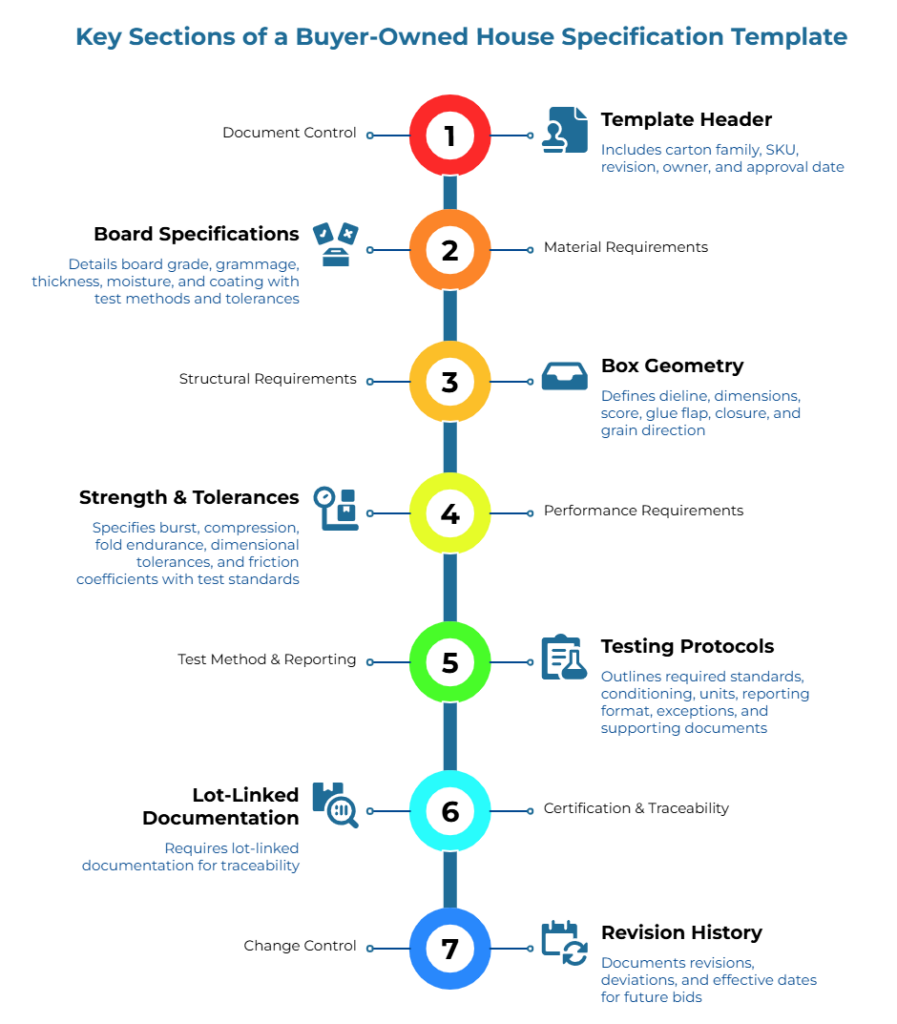
The practical takeaway from this guide is not abstract advice. It is a template you can use.
A House Specification Template provides the structural framework for documenting your mandatory fields, test methods, tolerance bands, and response requirements in a single, reusable document. It is designed as a buyer-owned control document—not a supplier questionnaire.
The template should include:
- Document control section with fields for carton family, SKU reference, revision number, owner, and approval date.
- Material requirements section with fields for board grade, grammage, thickness, moisture, and coating specifications—each with named test methods and tolerance bands.
- Structural requirements section with fields for dieline reference, blank dimensions, erected dimensions where needed, score geometry, glue flap specifications, closure style, and grain direction.
- Performance requirements section with fields for burst strength, compression strength, fold endurance, dimensional tolerances, and friction coefficients—each tied to specific test standards.
- Test method and reporting section specifying required standards, conditioning protocols, required units, reporting format, declared exception field, and supporting-document requirements.
- Certification and traceability section requiring lot-linked documentation.
- Change control section documenting revision history, approved deviations, and effective date for future bids.
When you distribute this template with every RFQ, you stop hoping suppliers will guess what you need. You start knowing that every response follows the same structure, uses the same units, and references the same standards.
That is how specification alignment creates the foundation for meaningful quote comparison.
Specification discipline is not about making procurement harder. It is about making procurement honest.
Every hour spent building a rigid house specification saves weeks of rework when quotes arrive. Every field you standardize eliminates one more variable that could hide a dangerous mismatch. Every supplier who completes your template instead of their own data sheet moves you closer to true comparability.
The vendors are not the enemy. The chaos is. And chaos thrives when no one owns the baseline.
Change who owns the baseline. The rest follows.
For teams ready to deepen their specification discipline, the PaperIndex Academy offers additional frameworks for building enforceable requirements and evaluating supplier capabilities.
Ready to explore folding carton options from verified suppliers? Browse folding carton listings or connect with folding carton suppliers on PaperIndex.
Disclaimer:
This content is educational only. Specific technical thresholds, regulatory obligations, and acceptance criteria should be validated against the product, converting process, and target market before being adopted into a live specification.
Our Editorial Process:
Our expert team uses AI tools to help organize and structure our initial drafts. Every piece is then extensively rewritten, fact-checked, and enriched with first-hand insights and experiences by expert humans on our Insights Team to ensure accuracy and clarity.
About the PaperIndex Insights Team:
The PaperIndex Insights Team is our dedicated engine for synthesizing complex topics into clear, helpful guides. While our content is thoroughly reviewed for clarity and accuracy, it is for informational purposes and should not replace professional advice.