

📌 Key Takeaways
Moisture defense and physical packaging must be selected together based on route risk—not negotiated separately as independent line items.
- Map Risk Before Importing Paper: Classify each shipping lane by climate exposure, handling intensity, and voyage duration to determine which protective bundles are actually required.
- Moisture Weakens Physical Defenses: Corrugated packaging loses compression strength as humidity rises, causing cartons and edge protectors to fail under loads they would normally handle.
- Pair Layers as Matched Bundles: Desiccants need liners to work effectively, and physical bracing must not puncture moisture barriers—design both together or neither performs.
- Write Specifications, Not Vague Instructions: Replace “seaworthy packing” with measurable specs: desiccant capacity in kilograms, liner coverage areas, maximum stacking heights, and required photo evidence.
- Treat Every Container as Data: Document arrival conditions against the protection level specified, then refine your protocol based on actual outcomes rather than assumptions.
Integrated protection turns reactive damage management into a repeatable, defensible standard.
Paper importers and procurement managers responsible for transit risk will gain a systematic framework for coordinating moisture and physical defenses, preparing them for the detailed protocol implementation that follows.
After mapping out your warehouse-to-warehouse protection strategy, the next step is making moisture control and physical packaging work together as one unified standard.
Picture this: A container arrives at port after crossing two climate zones. You open the doors to find some rolls dry but slightly oval, others perfectly round but with rust stains on the wrapping, and a few that are both wet and crushed. The supplier followed your packing instructions—desiccants were placed, edge protectors were installed, pallets were properly configured. Yet damage still occurred.
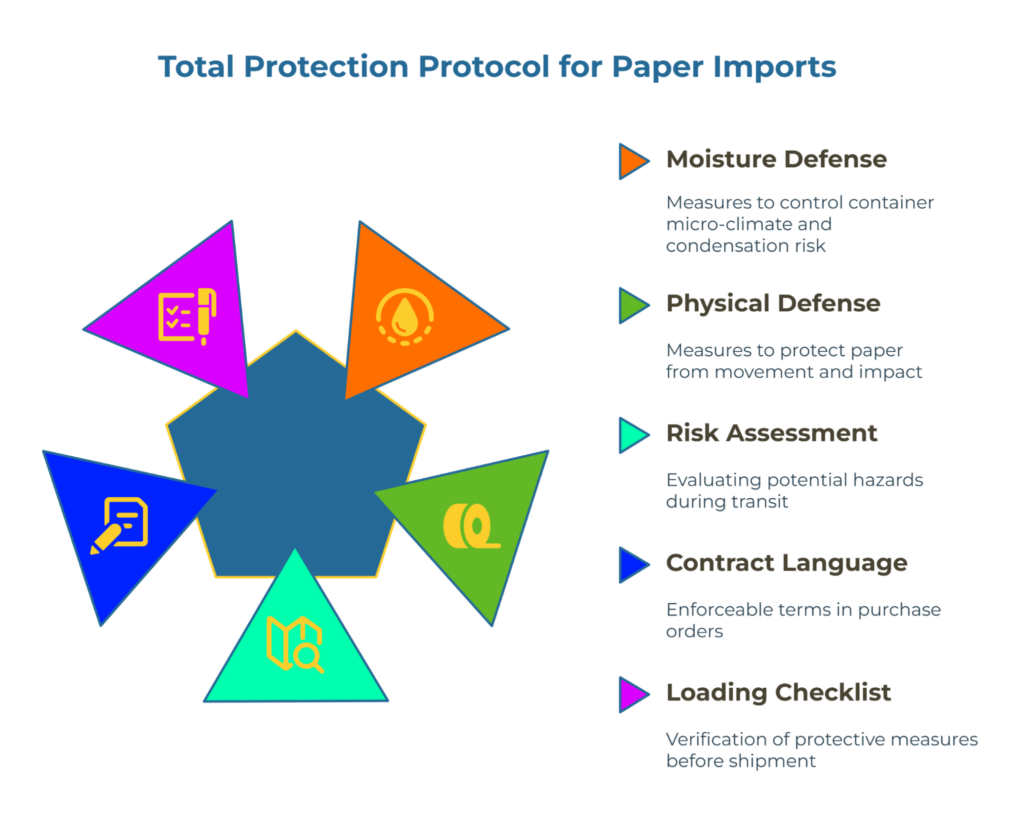
This scenario reveals a fundamental gap in how most paper importers approach transit protection. Moisture defense and physical defense are negotiated separately, specified in different sections of purchase orders, and often handled by different people within the supplier’s organization. The result is a patchwork approach where each protective measure works in isolation rather than as part of an integrated system.
A Total Protection Protocol solves this by treating moisture control and physical packaging as complementary layers of a single defensive system. The protocol consists of two distinct but interdependent components:
- Moisture Defense (Layer 1): Measures that control the container micro-climate and limit condensation risk—desiccants, container liners, kraft liners, vapour-barrier films, and ventilation choices.
- Physical Defense (Layer 2): Measures that protect rolls and sheets from movement, compression, and impact—edge protectors, pallets, dunnage, lashing, and stowage patterns.
Think of it as a survival suit for paper: the climate shield on the inside, the physical armour on the outside, both fitted to the same journey. Rather than asking “what desiccants do I need?” followed weeks later by “what edge protectors should I specify?”, you assess route risk once and select both moisture and physical defenses together as matched pairs. This integrated approach acknowledges a basic truth: physical packaging protects the roll, but moisture control protects the packaging itself.
This article provides a practical framework for building and implementing a Total Protection protocol. You’ll learn how to map journey risks, pair moisture and physical defenses based on those risks, write the protocol into enforceable contract language, and diagnose failures when they occur. The goal is to replace reactive damage management with a proactive, repeatable standard you can apply to every shipment.
Why Moisture and Physical Defense Cannot Be Planned in Silos
Most packaging failures during sea transit fall into two categories: climate-driven damage and movement-driven damage. Climate-driven damage includes container rain condensation, moisture absorption by paper and packaging materials, rust formation on metal components, and mold growth in high-humidity conditions. Movement-driven damage encompasses compression from stacking loads, impact from rough handling or road conditions, vibration during transport, and shifting cargo when lashing fails or loosens.
The critical insight is that these two failure modes are not independent. They interact and amplify each other throughout the journey.
Consider what happens to corrugated boards when they absorb moisture. Standard corrugated packaging maintains its rated compression strength under normal atmospheric conditions. However, when that same board absorbs water vapor from container air or direct condensation, the paper fibers swell and lose structural integrity. Corrugated fibreboard is particularly sensitive to this effect: when moisture content rises above a certain threshold, compression strength declines significantly and boxes lose stacking capacity. Studies show that corrugated fibreboard can lose 40% to 60% of its rated compression strength when exposed to high relative humidity (e.g., above 80% RH) for extended periods. The physical defense you specified—stacking patterns, edge protectors, load distribution—was calculated based on dry packaging performance. When moisture enters the system, those calculations no longer hold.
The interaction works in both directions. Damaged physical packaging creates pathways for moisture intrusion. A torn stretch wrap layer allows humid air to reach inner packaging. A crushed corner on a carton creates a direct channel where condensation can pool. Edge protectors that shift during transit expose vulnerable paper edges to container wall condensation. Each physical failure compromises the moisture barrier, and each moisture incursion weakens physical defenses further.
This feedback loop explains why partial solutions often fail. An importer adds desiccant bags to control humidity but doesn’t upgrade the kraft liner quality. Condensation still forms on the container ceiling, drips onto the load, and saturates the top layer of cartons. Another importer invests in heavy-duty edge protectors but skips moisture barriers. The edge protectors perform well initially, but gradual moisture absorption over a three-week voyage softens the corrugated core they’re meant to reinforce.
The traditional approach treats these as separate procurement decisions. Moisture control might be discussed with one supplier contact during technical specifications. Physical packaging gets negotiated later with the logistics team during load planning. This organizational separation mirrors a conceptual separation—the assumption that you can optimize each defense independently and combine them at shipping time.
A Total Protection protocol rejects this assumption. It starts from the premise that your paper cargo requires a coordinated defensive system where moisture control and physical packaging are selected together based on a unified risk assessment. The route profile, climate exposure, and handling conditions determine which moisture defenses you need. Those same factors, plus the interaction effects between moisture and physical stress, determine which physical defenses will actually perform as intended throughout the journey.
Mapping Your Journey Risks: Route, Climate, and Handling Profile
Before selecting any protective measures, you need a clear picture of what your shipment will face. Transit risk assessment provides the foundation for pairing moisture and physical defenses appropriately. The most reliable answer to “how to prevent paper damage in shipping” is deceptively simple: map the risk first, then choose products and specifications. Buying “a few desiccant bags” or “heavier cartons” without a route-specific risk view leads back to the same inconsistent results.
Start by classifying your typical routes into risk bands. A short regional route—perhaps 7 to 12 days from a neighboring country with a similar climate—presents lower cumulative risk than a 35-day intercontinental crossing through multiple climate zones. Distance matters, but so does route complexity. A direct port-to-port shipment carries different risks than one involving transshipment through a consolidation hub where your container sits on deck in tropical heat for five days waiting for the next vessel.
For each major lane, classify three elements:
Route and climate factors include whether the journey is short regional versus long intercontinental, whether it passes through temperate, tropical, monsoon-affected, or strongly seasonal zones, and whether there are significant temperature differentials along the way.
Handling and consolidation profile covers full-container loads versus mixed or consolidated loads, direct vessel routing versus multiple transshipments, and expected road quality at origin and destination points.
Risk level assignment translates these factors into moisture risk (likelihood of high humidity or condensation cycles) and physical risk (level of handling, re-stacking, and road shock).
A basic matrix is enough to start:
| Example Lane | Climate Risk | Handling Intensity | Moisture Risk | Physical Risk |
| Short regional, temperate, FCL | Low | Low | Low | Low–Medium |
| 30–40 day tropical export, FCL | High | Medium | High | High |
| Mixed LCL load, transshipment, monsoon | High | High | High | High |
Use this table primarily as a decision driver, not a scientific model. The aim is to avoid treating a 10-day temperate move and a 35-day tropical, two-transshipment move as if they deserve the same packaging recipe.
Climate exposure during the voyage drives moisture risk. Tropical and subtropical routes, especially during monsoon seasons, create the highest moisture challenge. Containers passing through or originating in regions with high ambient humidity and significant day-night temperature swings face elevated container rain risk. A shipment from Southeast Asia to Europe in July will encounter very different conditions than the same route in January.
Temperature differential is particularly important. When a container loaded in a hot climate enters cooler waters or vice versa, the temperature differential between container walls and interior air creates condensation. The larger and more frequent these temperature swings, the more aggressive your moisture defense needs to be. A container moving from 35°C to 15°C over the course of a voyage creates substantial condensation potential.
Handling intensity affects physical risk throughout the journey. Port infrastructure quality varies considerably. Some ports feature modern container handling equipment and smooth surfaces. Others involve older equipment, unpaved surfaces, and rougher handling practices. The number of times your container is lifted, moved, and set down multiplies physical stress. A direct shipment might see four handling events: factory loading, port loading, port unloading, final delivery. A shipment involving transshipment and inland transport might see eight or more events, each representing an opportunity for impact damage or load shifting.
Road and rail quality at origin and destination points matter significantly for paper cargo. Smooth, well-maintained roads impose minimal vibration stress. Rough roads with potholes, unpaved sections, or poor maintenance create sustained vibration and occasional sharp impacts that can shift loads, stress lashing systems, and deform packaging. If your shipment includes 100 kilometers of rough road transport at origin or destination, that segment may pose greater physical risk than the entire ocean voyage.
Dwell time at various points adds cumulative risk. A container sitting at a tropical port for two weeks before vessel departure experiences prolonged high-temperature, high-humidity exposure before the voyage even begins. Extended dwell time at the destination port in summer heat can undo moisture protection that worked well during the voyage. Each additional day of exposure extends the time window in which moisture can penetrate defenses and physical stresses can accumulate.
This risk mapping exercise serves two purposes. First, it prevents both under-protection and over-protection by matching defensive measures to actual exposure. Second, it creates a documented, repeatable framework you can share with suppliers, internal teams, and logistics partners. When everyone references the same risk assessment, specification discussions become more productive and less prone to misunderstanding about why certain protective measures are required.
Layer 1: Moisture Defense—Building a Climate Shield Around Your Paper
Moisture defense creates a controlled micro-climate around your paper cargo that prevents condensation damage and limits humidity-driven degradation. This layer addresses the container’s internal atmospheric conditions rather than external forces. For shipping container moisture control, three principles are broadly accepted in logistics and conservation practice: limit how much moisture enters the system, manage temperature swings and cold surfaces, and provide a path for moisture to either be absorbed safely or isolated from the cargo.
Paper and wooden pallets are hygroscopic materials. If they are loaded at very high relative humidity, the container begins the voyage “pre-loaded” with moisture. Storage and loading environments around 30–50% relative humidity are commonly recommended for long-term paper stability—a useful design target for desiccant planning even though shipping containers present more variable conditions than controlled archives.
Desiccant bags absorb water vapor from the air inside a sealed container. They work by creating a lower equilibrium humidity level, reducing the moisture available to condense on surfaces or be absorbed by paper and packaging. The amount of desiccant capacity you need depends on container volume, expected temperature differentials, and voyage duration. For a standard 40-foot container on a moderate-risk route, the desiccant specification should target a minimum of 4,000 to 6,000 grams of water absorption capacity (at 90% RH), distributed throughout the load according to the supplier’s guidelines.
Desiccant placement matters as much as quantity. Bags should be distributed around the perimeter of the load rather than concentrated in one area. Position them where air circulation patterns will draw moisture-laden air past the desiccant material. Avoid placing bags where they might be crushed by shifting cargo or where condensation dripping from container walls could saturate them prematurely.
Container kraft liners create a physical barrier between the container’s metal walls and your cargo. Steel walls are natural condensing surfaces when outside air is much colder than the air and materials inside. When properly installed, a liner prevents condensation that forms on cold container walls from dripping directly onto paper. Liners also provide some insulation, moderating the rate of temperature change inside the load space. For high-risk routes, specify liners with adequate coverage—floor, walls, and ceiling—rather than partial wall-only installation.
The liner material itself needs consideration. Standard kraft paper liners offer basic protection. For routes with extreme moisture risk, consider liners with vapor barrier properties or laminated construction that provides both physical separation and moisture transmission resistance. The liner quality should align with your voyage duration and climate exposure. A seven-day temperate route might perform well with basic kraft. A 38-day tropical crossing requires more robust barrier properties.
Vapor barrier films provide an additional moisture isolation layer when paper is particularly sensitive or route risk is severe. These films are applied directly to paper wrapping or as an overwrap for palletized loads. Pallet shrouds, shrink hoods, or full-roll barrier wraps create a local sealed environment around each unit or block of cargo. When properly applied and sealed, they slow moisture ingress from ambient air and allow desiccants placed inside the barrier to work more predictably. Films add cost and require careful application to avoid trapping existing moisture inside, so they’re typically reserved for higher-risk scenarios or premium paper grades where even slight moisture exposure creates quality issues.
Ventilation and loading practices are often overlooked. General principles include avoiding loading very warm, humid cargo into a much colder container where possible, minimizing dwell time with doors open in humid conditions, and avoiding “dead pockets” of warm air trapped at the top with no air movement.
Your moisture defense choices should follow directly from the route risk assessment:
Low-risk temperate, short routes: Limited desiccant focused on shoulder seasons, spot use of pallet covers or shrouds for higher-value reels.
Medium-risk routes (mixed climate, moderate duration): Container liner plus calculated desiccant quantity, consistent pallet shrouds for all rolls in outer rows.
High-risk, long tropical or monsoon routes: Full container liner covering roof and walls, desiccants sized for the full moisture load of paper, pallets, and expected humidity, vapour-barrier shrink hoods or full wraps for all units rather than just exposed rows.
When specifying moisture defense in purchase orders, use explicit line items rather than vague language. Instead of “adequate moisture protection,” specify “minimum 10 kg calcium chloride desiccant capacity distributed in 5-6 bags, full-coverage kraft-poly laminate liner, vapor barrier film on outer row pallets.” This precision eliminates ambiguity and creates clear acceptance criteria.
Moisture defense must be chosen with physical defense in mind. If your physical defense strategy includes extensive dunnage and bracing, ensure those materials won’t puncture or displace your liner. If you’re using barrier films, your edge protectors and strapping need to be positioned so they don’t tear the film during transit. The two layers of protection must be compatible in their physical arrangement inside the container.
Layer 2: Physical Defense—Preventing Crushing, Shifting, and Impact
Physical defense protects paper cargo from mechanical forces encountered during handling and transport. This layer addresses compression, vibration, impact, and load movement.
Edge protectors are rigid or semi-rigid strips placed vertically at the corners and edges of palletized loads. They serve two functions: distributing the point load from strapping across a wider area to prevent cutting into the paper, and providing vertical stiffening that resists crushing from stacked weight. Edge protectors should run the full height of the pallet load and extend slightly above the top layer. For paper rolls, angle-board style protectors work well. For sheet paper in cartons, flat edge protectors provide adequate protection.
The material and thickness of edge protectors should match your stacking requirements and handling intensity. Standard corrugated edge protectors suit moderate-risk routes with reasonable stacking heights. High-risk routes or loads subject to significant stacking weight may require plastic or composite edge protectors with greater crush resistance. Remember that if moisture compromises the corrugated material during the voyage, your edge protectors will lose effectiveness—another reason why moisture and physical defenses must be paired.
Corner guards protect the vulnerable corners of cartons or wrapped rolls where impact damage concentrates. They can be foam, plastic, or heavy corrugated material formed into an angle. Corner guards are particularly important for outer rows of cargo that sit near container walls where shifting or impact might occur. Specify corner guards for all four corners of perimeter pallets on medium and high-risk routes.
Honeycomb or corrugated dunnage fills void spaces between the cargo and container walls. This material prevents load shifting during transport and provides some cushioning against impact. For paper cargo, avoid using dunnage that could abrade or puncture packaging. Corrugated pads, honeycomb boards, or even additional layers of kraft paper can serve as dunnage material. The goal is to create a snug fit where cargo cannot move more than a few centimeters in any direction.
Proper palletization provides the foundation for physical defense. Pallets should be sturdy enough to support the loaded weight without deflection. Pallet dimensions should match container floor dimensions efficiently to minimize wasted space and reduce shifting potential. Load patterns on pallets should be stable—interlocked or cross-stacked patterns generally outperform simple column stacking for stability.
Maximum stacking height requires careful consideration. While maximizing container cube utilization is economically attractive, excessive stacking height increases compression stress on bottom layers. If your moisture defense isn’t perfect and humidity increases during the voyage, packaging on lower layers will weaken. What seemed like an acceptable stacking height with dry packaging may cause crushing once moisture softens the material. For high-risk routes, consider reducing maximum stacking height by 10 to 15 percent compared to what you might use on a low-risk route.
Chocking and lashing prevent horizontal movement of the load. Wooden chocks can be placed against the bottom layer of pallets to prevent sliding. Strapping or lashing connects cargo to container anchor points or creates a web that holds the load together as a unit. For paper cargo, avoid over-tightening straps to the point where they crush or deform the product. Proper tension secures the load without causing damage. Use protective materials like edge protectors and corner guards at all strap contact points.
Stowage position within the container affects physical stress. Cargo near container doors experiences more impact during door opening and closing. Cargo on the top layer faces more risk from overhead condensation and may experience greater temperature variation. If you’re sharing container space with other cargo, specify that your paper should be positioned away from particularly heavy items or cargo with sharp edges that could cause puncture damage if shifting occurs.
Your physical defense specifications should also follow from route risk assessment. A low-risk route might require only basic edge protectors, minimal dunnage, and standard palletization. A medium-risk route calls for full-height edge protectors on all pallets, corner guards on perimeter loads, void filling with appropriate dunnage, and documented load securing procedures. A high-risk route demands maximum physical defense: heavy-duty edge protectors, comprehensive corner protection, extensive dunnage, reduced stacking height, multiple lashing points, and photographic documentation of load securing.
Physical defenses are planned on top of a known moisture defense setup. They must not compromise the liner or barrier films you’ve specified. For example, if you’re using wooden chocks for bracing, ensure they’re positioned so they don’t puncture the container liner. If you’re using metal strapping, verify that sharp edges won’t tear vapor barrier films. The physical defense layer must work in harmony with the moisture defense layer beneath it.
The Total Protection Protocol: Step-by-Step Integration Guide
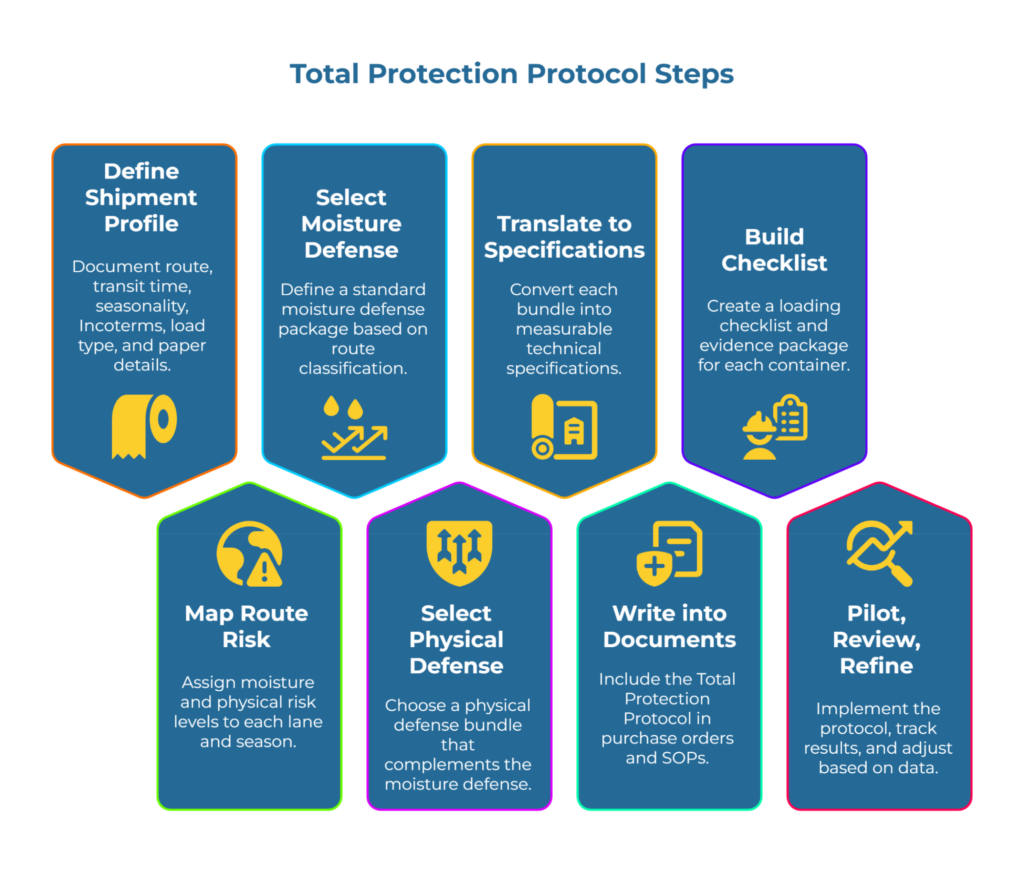
This numbered protocol translates risk assessment into a coordinated set of decisions that ensure moisture and physical defenses work together. You can adapt this sequence directly into your internal standard operating procedures.
Step 1: Define the shipment profile. Document for each lane or major customer: route, transit time, seasonality, Incoterms, load type (FCL/LCL), and typical paper grades, formats, and roll diameters.
Step 2: Map route, climate, and handling risk. Use the simple matrix from earlier to assign moisture and physical risk levels (Low / Medium / High) to each lane and season. Record it in a central chart so purchasing and logistics share the same view. The combined profile determines your defensive requirement level.
Step 3: Select moisture defense bundle based on route classification. For each lane/season combination, define a standard package:
- Low-risk routes: pallet shrouds plus basic desiccant allowance (4-6 kg capacity).
- Medium-risk routes: container kraft liner plus pallet shrouds plus calculated desiccant units (8-12 kg capacity).
- High-risk routes: full container liner covering roof and walls plus full-coverage vapour-barrier wraps plus high-capacity desiccant system (12-16 kg capacity).
Include clear notes on where desiccants are placed, how liners are installed, and any checks such as desiccant count confirmed before door closure.
Step 4: Select a physical defense bundle that complements the moisture bundle. Lock in set combinations:
- Low-risk routes: standard edge protectors, basic palletization, minimal dunnage.
- Medium-risk routes: full-height edge protectors on all pallets, corner guards on perimeter loads, void filling with appropriate dunnage, documented lashing, defined carton grade, maximum two-layer stacking, airbags between pallet columns.
- High-risk routes: heavy-duty composite edge protectors, comprehensive corner protection, reinforced core plugs, top frames, extensive dunnage, reduced stacking height by 10-15%, multiple lashing points, specific blocking and bracing pattern, mandatory load photos.
Ensure these layouts do not damage liners or barrier films. Where necessary, include protective pads between timber bracing and container liners.
Step 5: Translate the protocol into technical specifications. Convert each bundle into measurable specs: board grades, grammages, pallet dimensions, and maximum stack heights; minimum desiccant performance stated as equivalent moisture absorption capacity per container size; required installation diagrams for liners, wraps, blocking, and bracing. These specifications should be precise enough that two different suppliers on two continents would interpret them the same way.
Step 6: Write Total Protection into purchase orders and supplier SOPs. Create a named clause such as “Total Protection Protocol—Moisture & Physical Defense” in purchase orders and supplier packing instructions. Reference both Layer 1 (moisture defense components, quantities, and installation method) and Layer 2 (physical defense components, layout, and stacking rules). Avoid vague terms such as “seaworthy packing” as stand-alone language.
Step 7: Build a loading checklist and evidence package. Require a simple checklist for each container covering confirmation of liner installation and integrity, desiccant type, quantity, and placement points, stow pattern and blocking/bracing details, count and position of edge boards, core plugs, and top frames, and photographs at key stages: empty lined container, mid-load, full load before doors, and sealed doors. These records become your primary audit trail if damage occurs. Define what evidence confirms proper installation: supplier loading photos showing liner installation in progress, desiccant placement, physical defense configuration, and final loaded container state. Third-party inspection reports if using a consolidator. Receiving warehouse inspection protocol that checks for moisture indicator status, physical damage, and packaging integrity.
Step 8: Pilot, review, and refine. Start with one high-value lane or customer. Implement the protocol, track arrival condition for several shipments, and adjust—more desiccant, different pallet type, or tighter lashing if needed. Treat each voyage as data to refine the protocol, not as an isolated event. After each shipment, record actual outcomes: moisture indicator readings if used, visible condensation or water damage, physical damage patterns, packaging condition at opening. Compare actual outcomes against the Total Protection specification level that was used. Over time, this feedback loop helps you calibrate your risk matrix and refine your defensive pairing decisions. Schedule quarterly protocol reviews with key suppliers to review damage incidents, discuss protocol effectiveness, and align on any necessary adjustments.
Establishing revision rules for unusual circumstances: Not every shipment fits neatly into low, medium, or high categories. Define decision rules for edge cases: when extended port dwell is expected, add 20-30% more desiccant capacity; when monsoon season creates temporary high risk, upgrade moisture defense by one level; when transshipment involves a known rough-handling port, upgrade physical defense independently. Document these revision rules so the protocol can flex without requiring complete renegotiation.
Specifying Total Protection in Contracts, Purchase Orders, and Supplier SOPs
Converting the protocol into enforceable contract language ensures that Total Protection becomes a standard business practice rather than an occasional extra effort. A protocol only changes behaviour when it is embedded in documents that suppliers and internal teams must follow.
Purchase orders should include a dedicated section for paper protection during shipping specifications that addresses both moisture and physical defenses together. Rather than scattering protective requirements across multiple sections, consolidate them into a single “Total Protection Specification” clause. This clause should reference your route classification and explicitly list the required moisture bundle and physical bundle for that classification.
For example: “Total Protection Specification for Route Class: High Risk. Moisture Defense Bundle: Minimum 14 kg calcium chloride desiccant capacity distributed in 6-8 bags per ISO desiccant placement guidelines, full-coverage kraft-poly laminate liner with ceiling coverage, vapor barrier film on all outer row pallets and any sensitive grades. Physical Defense Bundle: Heavy-duty composite edge protectors on all pallets, corner guards on perimeter positions, corrugated dunnage for void filling, maximum stacking height 2.2 meters, lashing to container anchor points with photographic documentation at completion.”
Link your Total Protection specification to the Incoterms clause. If you’re buying FCA or FOB, make it clear that the supplier’s responsibility includes implementing the specified Total Protection measures. If you’re buying CIF or CIP, clarify whether the supplier or freight forwarder handles protective installation and who provides evidence of compliance. The protocol should state which party is responsible for implementing each layer under each term. The goal is to eliminate ambiguity about who owns each protective measure.
Include an inspection and acceptance protocol. Define what evidence the supplier must provide before shipment: timestamped photographs showing liner installation in progress, desiccant placement, physical defense configuration, and final loaded container state. Specify that payment or shipment release is conditional on receiving this evidence. For high-value shipments or new supplier relationships, consider requiring third-party inspection with a documented checklist covering all Total Protection elements.
Build the Total Protection protocol into supplier quality agreements or manufacturing SOPs if you have ongoing relationships. Rather than specifying protective requirements in every purchase order, reference a master document that defines your standard for each route class. This approach works well when you have a limited number of regular suppliers and relatively stable shipping lanes. The master document can be updated annually or when your risk assessment changes.
Address packaging cost allocation explicitly. Suppliers often resist enhanced protective measures due to cost concerns. Clarify in the contract whether protective costs are included in the unit price, itemized separately, or shared. For long-term relationships, consider absorbing some protective costs in exchange for documented damage rate reduction. Frame this as a partnership where both parties benefit from lower claims and fewer commercial disputes.
Create remedies for non-compliance. If a shipment arrives damaged and investigation shows the supplier failed to implement specified Total Protection measures, the contract should outline consequences: replacement at supplier cost, price reduction for degraded product, or progressive penalties for repeat failures. These remedies shouldn’t be punitive for isolated incidents but should create accountability for systematic non-compliance.
Document the Total Protection standard in your internal logistics manual so internal stakeholders understand the approach. Procurement teams, quality assurance personnel, warehouse managers, and finance staff should all reference the same protocol. This internal alignment prevents situations where procurement negotiates one protective standard, quality assurance expects another, and receiving operations aren’t prepared for either.
Common Failure Modes When Moisture and Physical Defenses Are Not Aligned
Understanding typical misalignment patterns helps you diagnose problems quickly and adjust your protocol for future shipments. Even a good protocol will be applied imperfectly at first. Treat each damaged shipment as a case study to locate misalignment between moisture and physical layers.
Scenario 1: Adequate desiccants, no liner. The supplier places the specified amount of desiccant but doesn’t install a container liner or installs only a partial floor liner. During the voyage, condensation forms on container walls and ceiling. Water drips directly onto the outer rows of cargo despite the desiccant’s best efforts to reduce air humidity. Outer cartons become saturated, lose compression strength, and collapse under stacking weight. Inner rows remain relatively dry but suffer from compression damage as outer rows fail. This scenario demonstrates that desiccants alone cannot prevent all moisture problems. The liner provides the physical barrier that complements the desiccant’s humidity control function. Layer 1 is incomplete; the liner reduces drip but does not manage overall humidity. Layer 2 may be adequate, yet packaging has been weakened by moisture. The correction involves increasing desiccant capacity, reviewing loading humidity conditions, and confirming barrier wraps for outer rows.
Scenario 2: Good liner, no desiccant. The supplier installs a high-quality liner with full coverage but uses minimal or no desiccant. The liner initially prevents dripping, but humidity inside the sealed liner space builds up over the voyage duration. Without desiccant to absorb moisture, relative humidity inside the liner reaches saturation. Condensation forms on the inner surface of the liner itself and on the paper packaging. The result is similar to having no liner at all—saturated packaging, reduced compression strength, possible mold growth. The liner needs the desiccant’s support to maintain a dry internal environment.
Scenario 3: Excellent moisture defense, inadequate physical bracing. All moisture control measures are properly implemented: appropriate desiccant quantity, good liner installation, vapor barrier films where specified. However, physical defense is minimal—light-duty edge protectors, no corner guards, insufficient dunnage, poor load securing. During rough road transport at destination, the load shifts. Pallets move a few centimeters with each bump. Over hundreds of kilometers, this micro-movement adds up. Strapping cuts through edge protectors. Rolls become slightly oval. Cartons at load edges get crushed against container walls. The moisture defense performed perfectly, but physical forces still caused damage. Total Protection requires both layers working together.
Scenario 4: Heavy physical protection tears moisture barrier. The supplier installs robust physical defenses—heavy wooden dunnage, multiple steel strapping lines, extensive bracing. During installation, the heavy materials puncture the container liner in several places. Steel strapping edges cut through vapor barrier film. The physical protection functions as designed during transport, but the compromised moisture barriers allow condensation to reach cargo at multiple points. When the container is opened, wet spots appear wherever the barrier was breached. This scenario shows that installation sequence and compatibility matter—physical defenses must be installed in a way that preserves moisture defense integrity. Good Layer 2 undermined Layer 1. The correction involves introducing protective pads where bracing contacts liners and standardising bracing patterns that maintain barrier integrity.
Scenario 5: Good stowage plan, wrong for conditions. The supplier follows a well-designed stowage plan that works perfectly on low-risk routes. However, the actual voyage encounters unexpected high-risk conditions—extended tropical port dwell, monsoon weather, or transshipment delay. The moisture defense specified for moderate conditions becomes inadequate. As humidity increases inside the container, packaging gradually absorbs moisture. The physical defense—designed assuming dry packaging strength—becomes less effective as materials weaken. Compression damage occurs at stacking levels that should have been safe under dry conditions. High-grade cartons specified and seemingly sufficient in a dry warehouse fail after a long monsoon voyage because box compression strength was specified for standard lab conditions (around 50% relative humidity) but not derated for sustained high humidity. This scenario highlights why route classification must account for reasonably foreseeable variations, not just ideal conditions. The correction involves pairing carton specifications with expected humidity profile and moisture controls, reducing stacking height, or increasing mechanical support when humidity cannot be reliably controlled.
When damage occurs despite having “Total Protection” on paper, walk back through the protocol systematically. Check whether the route was classified accurately—did unexpected factors increase risk beyond the rated level? Verify actual moisture defense installation against specification—were all elements present and correctly positioned? Confirm physical defense compliance—were materials appropriate for the load and conditions? Look for installation conflicts—did one defensive layer compromise another?
Most alignment failures trace back to one of three root causes: incomplete risk assessment that underestimated actual exposure, specification that didn’t explicitly address how layers interact, or execution that treated moisture and physical defenses as independent checklist items rather than coordinated system components. In every scenario, the question is the same: which layer failed, and how should the paired bundle be redesigned for that lane? Each failure provides data to refine your protocol for subsequent shipments.
Turn Every Shipment into a Total Protection Case Study
The fragmented approach to paper protection—negotiating moisture control separately from physical packaging, treating each shipment as a unique situation, reacting to damage rather than preventing it—keeps importers in a cycle of uncertainty and loss. You open containers hoping for the best while preparing for claims and disposal costs. This reactive stance limits your confidence in taking on longer routes, more price-competitive suppliers, or more demanding customers.
A Total Protection protocol breaks this cycle by giving you a systematic framework built on risk assessment and coordinated defensive measures. The protocol acknowledges a reality that fragmented approaches miss: moisture weakens physical defenses, and physical breaches compromise moisture barriers. By selecting and specifying both layers together based on the same route risk evaluation, you create protection that works as an integrated system rather than a collection of independent measures.
The eight-step protocol detailed in this article provides the operational structure you need. Route classification moves you from vague assessments like “risky” or “should be fine” to documented risk profiles that justify defensive choices to internal stakeholders and suppliers. The bundling approach—linking moisture and physical specifications to risk levels—simplifies what could otherwise become an overwhelming number of variables. Documentation requirements and post-arrival audits create accountability and learning mechanisms that improve performance over time.
Implementation doesn’t require perfection from day one. Start with one high-value shipping lane or a key customer relationship where damage reduction would have immediate impact. Apply the full protocol to that lane for three to six months. Measure actual damage rates against your historical baseline. Calculate the financial benefit in terms of reduced claims, less disposal waste, and improved customer satisfaction. Use that case study internally to build support for broader adoption and with suppliers to demonstrate that Total Protection is worth any incremental cost.
As you master this protocol, you’re building more than better packaging specifications. You’re developing strategic procurement capability that distinguishes you from competitors who still approach protection reactively. Three to five years from now, when you’re in a more senior role overseeing broader trading operations or supply chain strategy, this foundation in systematic risk management and evidence-based specification will set you apart. The ability to document your decision logic, defend your requirements with clear risk analysis, and demonstrate measurable results positions you as the go-to person for transit risk strategy within your organization. The goal is not zero incidents—no protocol can promise that—but a dramatic reduction in frequency and severity, supported by clear evidence when things do go wrong.
The Total Protection protocol connects the two foundational frameworks in your broader paper protection strategy: the moisture control methodology and the physical protection standards you’ve developed through other resources. This integrated approach is the practical bridge that makes those frameworks operational in your daily trading activities.
Your next step is implementation. Download or screenshot the protection pairing logic from this article as a quick-reference tool. Compare your current packing instructions against the eight-step protocol and identify gaps. Share the framework with your logistics team and primary suppliers as a conversation starter about standardizing protection across your shipments.
For access to additional frameworks on international trading, specification writing, and supplier qualification, explore resources available through PaperIndex Academy. The platform also provides supplier search tools if you need to identify partners who can meet comprehensive Total Protection specifications as you upgrade your standards.
Every container that arrives with dry, round, commercially usable paper validates the protocol. Every instance of damage provides data to refine it. Over time, Total Protection evolves from a new standard you’re testing to simplify the way you conduct business—the baseline expectation you hold for every shipment, with every supplier, on every route.
References for Further Reading:
- National Archives and Records Administration—guidance on temperature and relative humidity ranges for preservation of paper records (typical recommendation around 30–50% RH for textual records).
- Technical literature on corrugated fibreboard properties, noting that excessive moisture reduces compression strength and stacking performance.
- Research on box compression tests under variable humidity and temperature, illustrating how long-term high humidity accelerates box collapse compared with standard laboratory conditions.
- Cargo-handling and insulation guidance discussing condensation, container rain, and the role of liners and desiccants in mitigating moisture damage inside steel shipping containers.
Disclaimer: This article provides general guidance on integrating moisture and physical protection strategies for paper imports. Specific implementations should account for your particular routes, supplier capabilities, product requirements, and risk tolerance. Consult with logistics specialists and packaging engineers for situations involving unusual cargo types, extreme routes, or regulatory compliance requirements.
Our Editorial Process:
Our expert team uses AI tools to help organize and structure our initial drafts. Every piece is then extensively rewritten, fact-checked, and enriched with first-hand insights and experiences by expert humans on our Insights Team to ensure accuracy and clarity.
About the PaperIndex Insights Team
The PaperIndex Insights Team is our dedicated engine for synthesizing complex topics into clear, helpful guides. While our content is thoroughly reviewed for clarity and accuracy, it is for informational purposes and should not replace professional advice.