

📌 Key Takeaways
FSC certification protects retail brand reputation only when you can produce documentation that proves every sustainability claim on your packaging.
- Documentation Prevents Greenwashing Accusations: Vague supplier assurances without formal third-party certificates create reputation risk when customers challenge your environmental claims.
- Verify Certificates Before Printing Claims: Confirm your supplier’s FSC chain-of-custody certificate covers your specific bags and matches exactly what you print on packaging.
- Specific Language Beats Vague Promises: “Made from FSC-certified paper” is verifiable; “eco-friendly packaging” invites scrutiny you cannot answer with evidence.
- Align Teams on What You Can Prove: Marketing, procurement, and operations must work from identical verified documentation to prevent claim mismatches.
- Prioritize High-Visibility Applications First: Branded shopping bags and premium packaging carry greater reputation stakes than back-of-house materials.
Certification without documentation = claims without protection.
Retail managers and procurement teams sourcing paper bags will gain a clear verification framework here, preparing them for the detailed checklist that follows.
A single sustainability claim on your shopping bags can either strengthen customer trust or trigger accusations of greenwashing. The difference often comes down to one thing: whether you can back up that claim with documentation.
Picture this: a grocery store manager proudly displays new paper bags featuring a ‘sustainably sourced’ message. A customer photographs the bag, posts it online, and asks for proof. The manager scrambles to find documentation from the supplier. There is none. What started as a marketing decision becomes a reputation problem.
This scenario plays out more often than most retailers realize. The good news? FSC certification provides a straightforward way to verify and communicate responsible sourcing, but only when used correctly.
Key Terms
- FSC (Forest Stewardship Council): An international nonprofit that sets standards for responsible forest management and tracks certified materials through the supply chain.
- Chain-of-custody: The documented path a product takes from certified forest to final product, ensuring traceability at each stage.
- Certified claim: A statement about a product’s certification status that meets specific labeling requirements.
- Greenwashing: Making misleading or unsubstantiated environmental claims that can damage brand credibility and invite regulatory scrutiny.
What FSC Certification Actually Signals
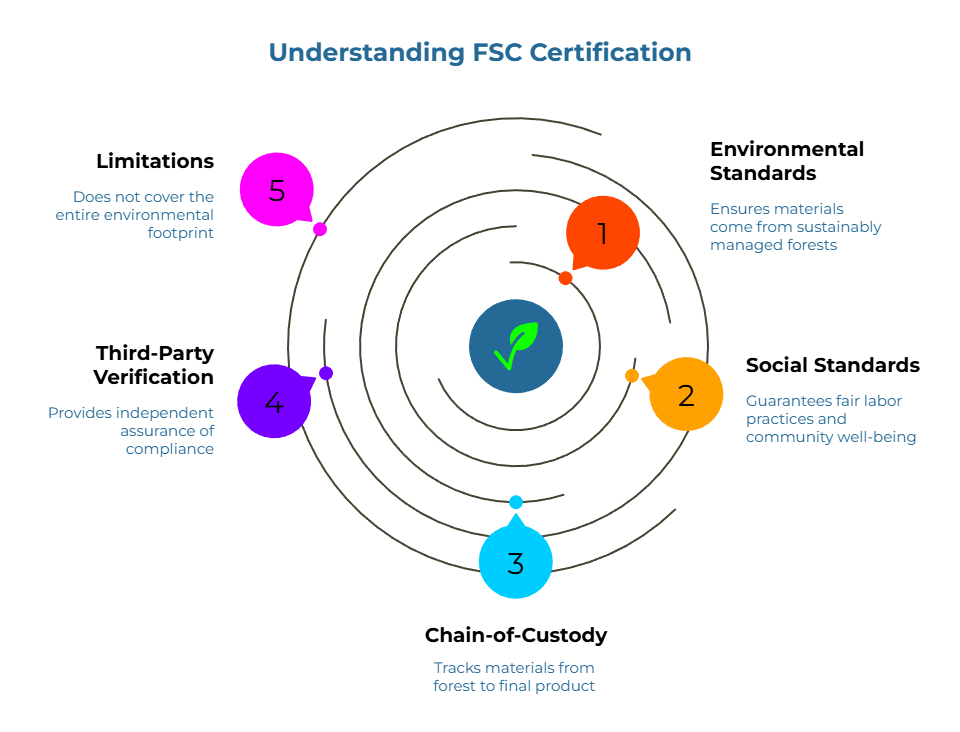
FSC certification provides a verifiable signal that paper materials originated from responsibly managed sources. For retail buyers, this matters because it offers third-party verification rather than relying solely on supplier assurances.
The certification communicates several things to your customers and stakeholders. It indicates that the fiber source meets established environmental and social standards. It confirms that a chain-of-custody process tracks the material through production. It demonstrates that your business made a deliberate choice to source verified materials.
However, FSC certification does not automatically guarantee everything a retailer might assume. The certification covers the sourcing and tracking of materials, not the entire environmental footprint of the final product. It verifies compliance with FSC standards specifically, not all possible sustainability criteria. Understanding these boundaries helps you make accurate claims and avoid overpromising.
Think of certification as a receipt for a specific transaction. The receipt proves you made that particular purchase, but it doesn’t speak to every other financial decision you’ve ever made. Similarly, FSC certification validates a specific sourcing choice without making broader guarantees about your entire sustainability program.
The Real Reputation Risk: Documentation Gaps
The primary risk for retailers isn’t whether customers notice sustainability logos. The real vulnerability lies in making claims you cannot substantiate when questioned.
Greenwashing accusations often stem from a retailer making an environmental claim based on vague or internal assurances that lack formal, third-party documentation to back them up when challenged. A vague statement like “eco-friendly packaging” invites scrutiny because it lacks specificity. A precise statement like “made from FSC-certified paper” can be verified, but only if you actually have the documentation.
Documentation gaps create problems in several ways. Marketing teams may make claims based on verbal supplier assurances that were never formalized. Procurement may switch suppliers without updating the information that marketing uses—a particularly critical gap when verifying international paper bag suppliers. Operations may not retain the certificates that prove what was ordered matches what was delivered.
These internal disconnects are where reputation risk actually lives. The certification itself provides protection only when the supporting documentation flows through your organization properly.
A Retailer’s Verification Checklist

Before printing any sustainability claim on paper bags, work through these verification steps:
1. Request and file supplier documentation. Ask your paper bag suppliers for their FSC chain-of-custody certificate—or submit an RFQ to receive quotes from multiple FSC-certified suppliers at once. Confirm the certificate number is valid and current. Keep copies accessible to anyone who might need to reference them.
2. Verify the certificate covers your specific products. A supplier may hold FSC certification for some products but not others. Confirm that the specific bags you’re ordering fall within the scope of their certification.
3. Align internal teams on claim language. Bring procurement, operations, and marketing into the same conversation about what can and cannot be stated. The person ordering the bags, the person receiving them, and the person writing about them should work from the same verified information.
4. Match printed claims to documentation on file. If your bags say “FSC-certified,” ensure you have the chain-of-custody documentation that supports that specific statement. If documentation only supports a narrower claim, adjust your messaging accordingly.
5. Establish a review trigger for supplier changes. Any time you change kraft paper bag suppliers or product specifications, re-verify documentation before continuing to make the same claims.
How to Talk About FSC Without Greenwashing
The language you use matters as much as the certification itself. Vague claims invite questions; specific claims demonstrate credibility.
Say this: “These bags are made from FSC-certified paper.” This statement is specific, verifiable, and matches what FSC certification actually provides.
Not this: “Our packaging is eco-friendly and sustainable.” This language is broad and subjective. It implies guarantees that certification alone doesn’t provide and invites challenges you may not be able to answer.
Say this: “We source FSC-certified materials as part of our commitment to responsible packaging choices.” This frames certification as one element of a broader effort without overstating what it covers.
Not this: “Our bags save forests and protect the environment.” This makes causal claims that extend far beyond what any single sourcing decision can substantiate.
The principle is straightforward: keep claims narrow, specific, and directly tied to evidence you hold. Broader aspirational statements about your company’s values are fine, but they should be clearly separated from factual claims about specific products.
When in doubt, ask yourself whether you could produce documentation within five minutes if someone challenged the claim. If the answer is no, the claim is probably too broad.
What Buyers Will Request: A Note for Suppliers
Retail buyers increasingly treat FSC documentation as a baseline expectation rather than a differentiator. Suppliers who prepare for these requests position themselves as easier to work with.
A prepared supplier should be ready to provide their current FSC chain-of-custody certificate with a verifiable certificate number. They should clarify which specific products in their catalog fall under that certification, since not all items may be covered. They should also be able to explain the process for providing transaction-level documentation when orders are placed.
Buyers don’t need elaborate sustainability reports at the initial sourcing stage. They need clear answers to basic questions: Are you certified? Does that certification cover what we’re ordering? Can you document it?
Suppliers who proactively share this information—following a comprehensive wholesale paper bag supplier vetting checklist—rather than waiting to be asked, signal operational competence. For retail buyers evaluating multiple kraft paper bags sources, ease of verification becomes a practical consideration alongside price and quality.
When FSC Matters Most for Retail Packaging
Not every paper bag in a retail operation carries the same visibility or brand impact. FSC certification tends to matter most for high-visibility applications where the packaging itself communicates brand values.
Branded shopping bags that customers carry out of the store and reuse become mobile representations of your business. Premium packaging for gift items or specialty products signals quality and care. Bags used in marketing campaigns or seasonal promotions receive heightened attention.
For back-of-house packaging or purely functional applications, the calculus may differ. The point isn’t that certification only matters for customer-facing items, but rather that the reputational stakes vary by context. Prioritizing verification efforts for high-visibility applications ensures your most brand-sensitive packaging is properly supported.
FSC as Part of Your Broader Compliance Strategy
FSC certification addresses one specific question: Can you verify the sourcing of your paper materials? It’s an important question, but it sits within a larger landscape of packaging regulations, sustainability expectations, and compliance requirements.
Retailers navigating plastic bag bans, recyclability requirements, and evolving sustainability standards need a systematic approach rather than piecemeal responses. FSC certification functions as one proof-point within that system, demonstrating verified sourcing as part of a broader commitment to compliant, responsible packaging choices.
The businesses that manage this well don’t treat each requirement as an isolated problem. They build processes that connect supplier verification, internal documentation, and external communication into a coherent workflow.
To see how FSC fits into the broader compliance strategy, explore our complete guide to the retailer’s guide to sustainable packaging compliance: navigating bans and certifications.
Disclaimer:
This guide is for general educational purposes only.
Our Editorial Process:
Our expert team uses AI tools to help organize and structure our initial drafts. Every piece is then extensively rewritten, fact-checked, and enriched with first-hand insights and experiences by expert humans on our Insights Team to ensure accuracy and clarity.
About the PaperIndex Insights Team
The PaperIndex Insights Team is our dedicated engine for synthesizing complex topics into clear, helpful guides. While our content is thoroughly reviewed for clarity and accuracy, it is for informational purposes and should not replace professional advice.