
📌 Key Takeaways
Universal greaseproof paper fails because different menu items stress wrappers in completely different ways—one specification cannot handle them all.
- Match Paper to Food, Not Labels: Kit Level (a 1–12 grease resistance scale) tells you exactly how much protection paper provides, while “greaseproof” tells you nothing useful.
- Double-Wrapping Signals a Specification Problem: When staff add extra layers, they’re fixing a paper failure—not being careless—so upgrade those specific items instead of blaming the team.
- Over-Specification Wastes Money Silently: Using heavy-duty wrap on pastries costs 30–40% more than needed, but no one notices because the paper “works fine.”
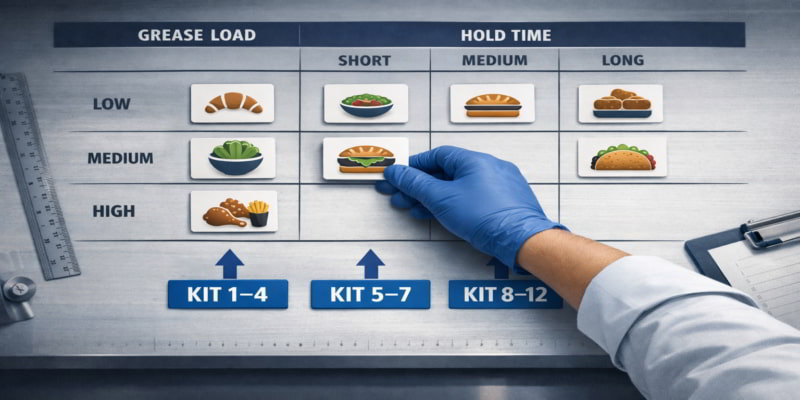
- Group Menu Items by Stress Profile: Sort foods by grease load (low, moderate, high) and hold time (short, medium, long), then assign Kit Levels—most operations need only 2–4 paper specifications.
- Delivery Changes Everything: A wrapper that worked for dine-in may fail when hold times double for delivery—re-evaluate specifications whenever service models shift.
Specify the wrapper to the food’s stress, not to the label on the box.
Procurement managers and food service operators sourcing packaging will gain a clear framework for eliminating waste, preparing them for the detailed specification guide that follows.
~ ~ ~ ~ ~ ~ ~ ~ ~ ~ ~ ~ ~ ~ ~ ~ ~ ~
Universal greaseproof paper fails because menus are not universal. A simple matrix matching Kit Level to grease load and hold time eliminates double-wrapping waste and unnecessary cost.
The same wrapper that “covers everything” often covers nothing—forcing teams to double-wrap. That single universal greaseproof paper specification approved for all locations? It quietly drives up costs in ways that never appear on a purchase order.
During peak service, high-fat menu items like fried chicken often exceed the saturation point of standard food packaging paper wraps within 11 minutes of heat-lamp exposure. The wrapper darkens. Grease seeps through. The customer opens the kraft paper bag to find stained paper and oily fingers. Three stations down, a croissant gets the same heavy-duty wrap—paper engineered for hot grease protecting something that barely needs protection.
This pattern repeats across food service operations everywhere. Procurement teams face pressure to standardise packaging across locations and menus, often relying on a single paper bag supplier for all their needs. Fewer SKUs. Simpler ordering. Consistent brand presentation.
But the hidden cost tells a different story. When one specification fails to match the actual demands of different menu items, two problems emerge: staff double-wrap items that overwhelm the paper, and every low-grease item gets unnecessarily expensive protection. Both outcomes waste money. Both trace to the same root cause.
The Myth: Universal Greaseproof Covers Everything
The word “greaseproof” on a specification sheet suggests a binary outcome. Paper either blocks grease or it does not. This framing creates a dangerous assumption—that any paper carrying the label will handle any food item equally well.
Universal works only if your menu is universal.
Menus are not uniform stress tests. For instance, a freshly cooked fried chicken thigh typically releases liquid fat continuously over an extended holding period. Conversely, a hot grilled cheese sandwich generally produces moderate grease for a shorter duration. A blueberry muffin at room temperature releases almost nothing. Creases and tight wraps can create weak points in real use—another variable that a single specification cannot account for.
When one paper specification is expected to handle all three scenarios, failure at the extremes becomes inevitable. The specification that works adequately for sandwiches fails on fried items. The specification is robust enough for fried chicken wastes money on pastries.
What Actually Happens: Two Opposite Failure Modes
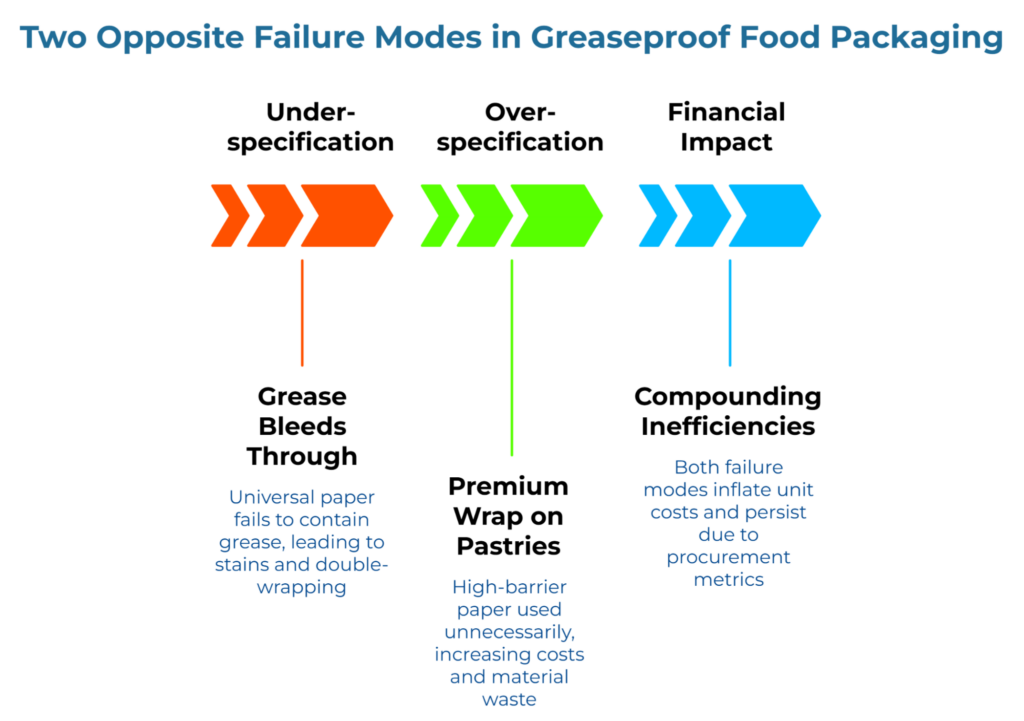
Under-specification. When the “universal” paper cannot handle high-grease items, the failure is visible. Grease bleeds through. Wrappers discolour. Customers see stains before they taste food.
Line staff adapt. They add a second layer of paper to protect against what the first layer cannot stop. This double-wrapping is not carelessness—it is a rational response to a specification gap. Staff see the problem daily and solve it with available materials.
The cost? Two sheets of paper instead of one. Labour to apply both. Waste when customers discard the extra layer. None of these costs appear on a line item labelled “wrapper failure.”
Over-specification. The opposite failure is invisible. When high-barrier paper is purchased to “cover everything,” premium prices apply to items that need no such protection. That heavy-duty wrap on pastries generally carries a significant price premium—currently estimated at 12–22% in the PFAS-free market—more than a lower-barrier alternative that would perform identically.
Over-specification also carries material weight. Higher-barrier papers often require additional coatings or treatments. Using them unnecessarily increases consumption without functional benefit. The waste is silent but real.
The financial impact compounds over time. Over-specification inflates unit cost without improving performance. Both problems persist because they remain invisible to standard procurement metrics that track only purchase price.
These inefficiencies result from procurement protocols that prioritize nominal labeling over empirical performance metrics. The fix requires a different decision language.
Replace Vague Labels with Measurable Language: Kit Level
The paper industry has a standardised scale for grease resistance called Kit Level. The TAPPI T 559 test method measures how well paper resists penetration by increasingly aggressive oil-based solutions. Another established method, TAPPI T 454 (the Turpentine Test), provides an alternative standard for measuring the grease resistance of paper..
Kit Level runs from 1 to 12. Paper rated Kit 1 offers minimal grease resistance—suitable for dry baked goods. Paper rated Kit 12 resists the most aggressive oils under sustained contact. Most food packaging applications fall somewhere between Kit 4 and Kit 10.
The value of Kit Level is precision. Instead of debating whether paper is “greaseproof enough,” specify a number. Instead of relying on greaseproof paper supplier descriptions, request test data. For a detailed explanation of how these ratings translate to real-world performance, explore the PaperIndex Academy guide: stop the leak: how grease resistance ratings protect food packaging paper and brand.
Kit Level shifts the conversation from “Is this greaseproof?” to “Is this greaseproof enough for this specific use?” That shift changes everything.
Key Term: Kit Level
A standardised 1–12 scale measuring grease resistance in paper, tested per TAPPI T 559. Higher numbers indicate greater resistance. Kit 1–4 suits dry goods; Kit 5–7 handles moderate grease; Kit 8–12 resists heavy, sustained oil contact. Kit Level ratings apply to greaseproof paper and other barrier-treated food packaging materials. For more detail, see What Is a Kit Level?.
The Fix: Menu-Match Mini-Matrix
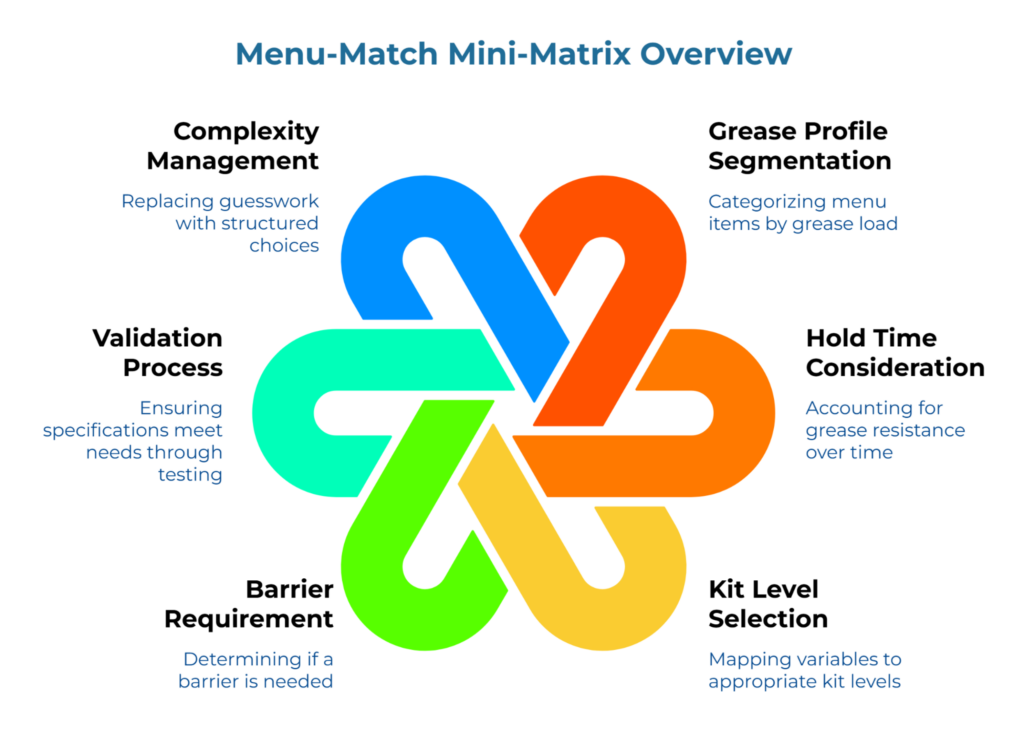
A universal wrapper is a universal assumption. Replace it with a 3-step mapping that matches paper specification to actual menu demands.
I. Segment the Menu by Grease Profile
Group menu items not by category name but by the stress they place on packaging. High grease load includes fried chicken, fish and chips, and anything submerged in oil during cooking. Moderate grease load covers grilled sandwiches, burgers, and pan-seared proteins. Low grease load applies to baked goods, salads, and items served at room temperature.
II. Factor in Hold Time
Grease resistance degrades over time. A wrapper performing at minute 3 may fail by minute 12. Short hold (under 5 minutes) applies to made-to-order items with immediate handoff. Medium hold (5–15 minutes) covers typical delivery queues and warming station items. Extended hold (over 15 minutes) includes batch production, catering prep, and long delivery windows.
III. Select Kit Level Range
The following matrix maps these variables to recommended Kit Level ranges. Use it as a starting point for specification discussions.
Menu-Match Mini-Matrix
| Menu Category | Grease Load | Hold Time | Kit Level Range | Barrier Required? |
| Fried items (chicken, fish, fries) | High | 5–15 min | Kit 8–10 | Yes |
| Fried items (extended hold) | High | >15 min | Kit 10–12 | Yes (poly recommended) |
| Grilled sandwiches, burgers | Moderate | 5–15 min | Kit 5–7 | Maybe |
| Grilled items (extended hold) | Moderate | >15 min | Kit 7–9 | Yes |
| Bakery, pastries | Low | Any | Kit 1–4 | No |
| Cold sandwiches, salads | Low | Any | Kit 1–3 | No |
Kit Level ranges are starting points. The exact point of failure varies by paper construction, coating, converting format, folds, and menu conditions. Validate with supplier test data and in-house trials before finalising specifications.
This matrix replaces guesswork with a repeatable decision framework. For deeper guidance on mapping specifications to specific menu items, see food packaging paper menu-specific specification mapping.
Start with your highest-risk items—typically the fried foods generating the most customer complaints. Specify those first, then work backward to lower-grease categories. Many operations generally observe that three specification tiers can successfully cover the vast majority of their menu, with a fourth tier reserved for edge cases like extra-long-hold catering items.
What if operations resist multiple specifications? The concern is understandable. More SKUs mean more complexity at the station level. But consider the alternative: staff already manage complexity through ad-hoc double-wrapping. Formalising two or three wrapper tiers replaces invisible workarounds with visible, controllable choices. The complexity exists either way—the question is whether it remains hidden or becomes manageable.
Myth vs. Reality: Four Beliefs That Drive Food Packaging Paper Waste
Before changing specifications, align your team on what actually causes wrapper failures.
| Myth | What Actually Happens | The Fix |
| One greaseproof grade can cover the whole menu | Different foods create different stress profiles. High-grease items overwhelm low-barrier paper; low-grease items waste high-barrier paper. | Segment menu into 2–4 grease-load categories and specify Kit Level for each. |
| If it’s thicker (higher GSM), grease won’t leak | GSM measures weight, not grease resistance. An 80 GSM kraft paper without barrier treatment fails faster than a 50 GSM paper with Kit 8 treatment. | Specify Kit Level as the primary grease-resistance metric, not GSM. |
| If teams are double-wrapping, staff are being careless | Double-wrapping is a rational workaround when paper fails under real hold conditions. Staff solve visible problems with available materials. | Audit where double-wrapping occurs and upgrade the spec for those items. |
| Switching suppliers will fix the problem without changing the specification | A vague specification (“greaseproof”) produces inconsistent interpretations and hard-to-compare quotes. If the specification is wrong, any supplier meeting that specification produces the same failure. | Fix the specification first by naming the performance language (Kit range + intended conditions), then evaluate suppliers against the corrected requirement. |
When Delivery Growth Breaks a “Working” Universal Specification
Consider a scenario shift: dine-in volume drops and delivery becomes the dominant channel. Hold times lengthen, items stack tighter in paper bags, and wrappers spend more time in warm, enclosed conditions.
A universal wrapper that seemed acceptable under short, in-store handoff can suddenly fail. Operations react first (double-wrapping), procurement reacts next (blanket upgrade), and the waste becomes systematised.
This is why the decision rule must be tied to hold time and grease load, not last year’s purchasing simplification. When service models change, wrapper specifications must be re-evaluated against the new stress profile.
Two Controllable Levers That Reduce Paper Wrap Cost and Waste
The waste created by “universal greaseproof” is not inevitable. Two changes bring it under control.
Specification clarity. Replace “greaseproof” with Kit Level. When the specification states Kit 7 instead of “greaseproof,” the requirement becomes measurable. Suppliers can quote against it. Incoming shipments can be verified against it. Ambiguity disappears, and supplier comparability improves.
For food service applications, ensure your specifications explicitly require food grade kraft paper that meets regulatory compliance standards in addition to performance metrics.
Menu segmentation. Stop treating all menu items as identical stress cases. Group items by grease load and hold time, then match specifications to each group. The most defensible approach is controlled consolidation: two to four house specifications that cover most items, plus a small, documented exception list for true outliers.
Together, these levers address the root cause of both failure modes. Under-specification disappears because high-grease items get appropriate protection. Over-specification disappears because low-grease items no longer carry unnecessary barrier cost. Operations trusts the specification because it works in practice. Procurement gains leverage because quotes become comparable.
The supplier comparability point deserves emphasis. When specifications use vague language like ‘greaseproof,’ food packaging paper suppliers interpret requirements differently. Quote comparisons become unreliable because underlying products vary. When specifications state Kit Level with test method references, every supplier quotes against the same measurable standard—making it easier to submit RFQ requests and compare responses fairly. Price differences reflect genuine value differences rather than interpretation gaps.
Why not just buy the highest Kit Level for everything? Because “maximum” is not a strategy. Buying the highest grease resistance across the whole menu tends to increase unit costs on low-risk, high-volume items and reduces the organisation’s ability to understand what is actually required per cluster. Controlled consolidation—specifying the lowest performance level that reliably survives the real stress profile—delivers cost control without sacrificing protection where it matters.
According to U.S. EPA data on containers and packaging, paper and paperboard packaging represents a significant portion of municipal solid waste. Optimizing specifications reduces source waste by eliminating the 2x material multiplier inherent in double-wrapping, aligning ESG goals with bottom-line procurement.
To implement these changes, operations should first map current menu categories to the corresponding Kit Level requirements using a standardized matrix, then find suppliers capable of meeting those specifications.
Disclaimer:
This content is educational and informational purposes only.
Our Editorial Process:
Our expert team uses AI tools to help organize and structure our initial drafts. Every piece is then extensively rewritten, fact-checked, and enriched with first-hand insights and experiences by expert humans on our Insights Team to ensure accuracy and clarity.
About the PaperIndex Insights Team:
The PaperIndex Insights Team is our dedicated engine for synthesizing complex topics into clear, helpful guides. While our content is thoroughly reviewed for clarity and accuracy, it is for informational purposes and should not replace professional advice.