

📌 Key Takeaways
Mixed Incoterms quotes create false cost comparisons that lead to budget surprises and internal team conflicts.
Stop Comparing Apples to Oranges: EXW, FOB, CIF, and DDP quotes include different responsibility packages—normalize every quote to a single “to-door” total before making any price decisions.
Map, Add, Apply One Method: Identify what each Incoterm covers, add missing freight/insurance/duty components consistently, and use the same HS classification approach across all suppliers.
Document Everything in One Log: Record your lane specifics, dates, coverage assumptions, exchange rates, and HS methodology in a single audit trail that Finance, Logistics, and Operations can trust.
Normalization Reshuffles Rankings: The “cheapest” quoted price often becomes the middle or highest option once all responsibility legs and statutory costs are equalized.
Make It Standard Operating Procedure: Embed the three-step normalization method into your RFQ templates and train teams once to use the same assumptions log format in every sourcing cycle.
Transform quote chaos into defendable decisions with one transparent methodology.
For procurement professionals and converting operations managers dealing with international kraft paper sourcing, these strategies eliminate the guesswork and internal debates that slow down purchasing decisions.
Silence after “cheapest” falls.
The spreadsheet shows bold numbers, but your gut snags on what’s missing: insurance, duty, the last mile. A forklift beeps in the background.
You need a method, not another price. To-door comparability gives you one defensible total per quote—so Finance, Logistics, and Operations see the same story instead of arguing over asterisks. As you plan your next kraft paper sourcing cycle, anchor every RFQ to a single, normalized, to-door number.
What Is To-Door Comparability—And Why It Ends Quote Debates?
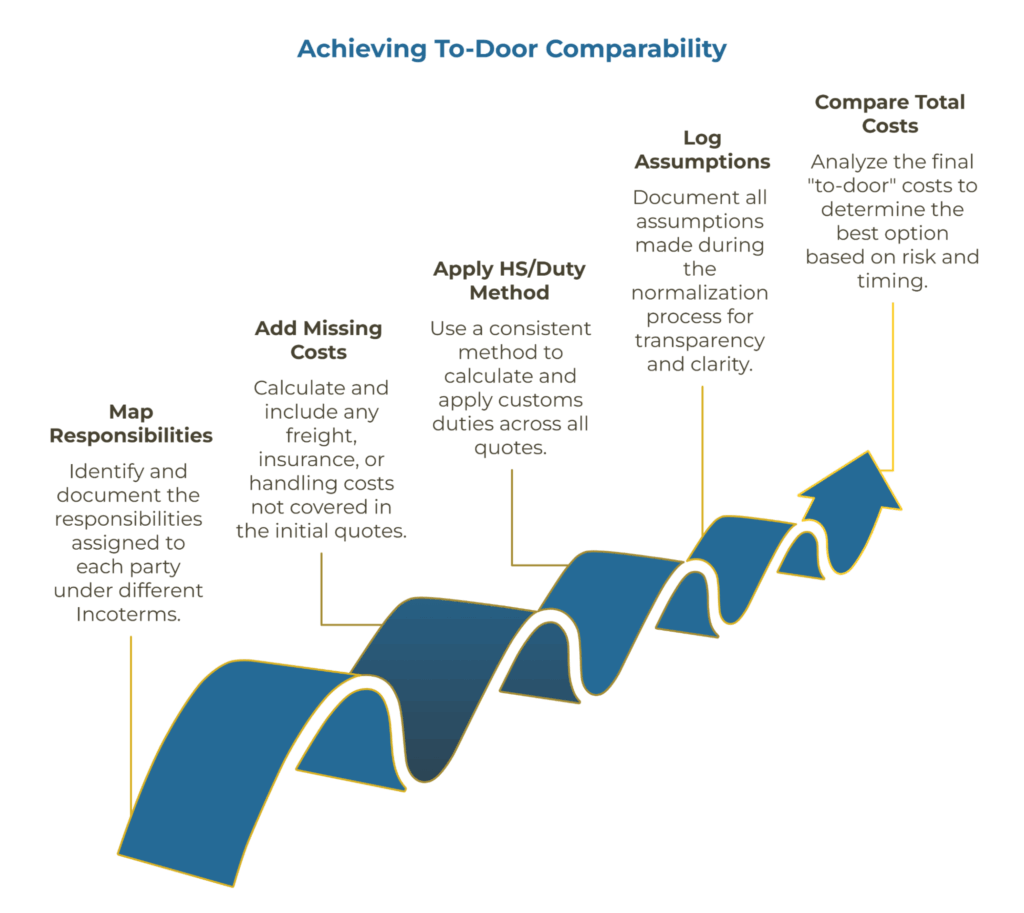
To-door comparability means converting mixed Incoterms (EXW, FOB, CIF, DDP) into one “to-door” total for each quote, covering all responsibility legs and statutory costs to your receiving location. Record the assumptions used. When every kraft paper quote lands on a single number with a shared assumptions log, debates shift from “who missed what” to “which option fits risk and timing.”
Featured Answer: To-door comparability is a normalization method that turns different Incoterms quotes into one total delivered to your facility. Map responsibilities, add missing freight/insurance/handling, and apply a single HS/duty method to all quotes. Log assumptions. This produces one defensible “to-door” figure per supplier and ends apples-to-oranges arguments.
The traditional “cheapest quote” approach fails because different Incoterms assign vastly different responsibilities to buyers and sellers. When Finance compares a $680 FOB quote to a $750 CIF quote, they’re not comparing equivalent packages. The FOB quote excludes freight and insurance costs that the buyer must arrange separately, while the CIF quote includes these critical components.
Reference: Incoterms® rules are published and maintained by the International Chamber of Commerce; see ICC materials for scope and structure of the rules. The Harmonized System (HS) underlying duty assessment is governed by the World Customs Organization.
The 3-Step Normalization Method (EXW/FOB/CIF/DDP → One Number)
Converting mixed-term quotes into comparable figures requires systematic methodology that accounts for every cost component from supplier to receiving dock.
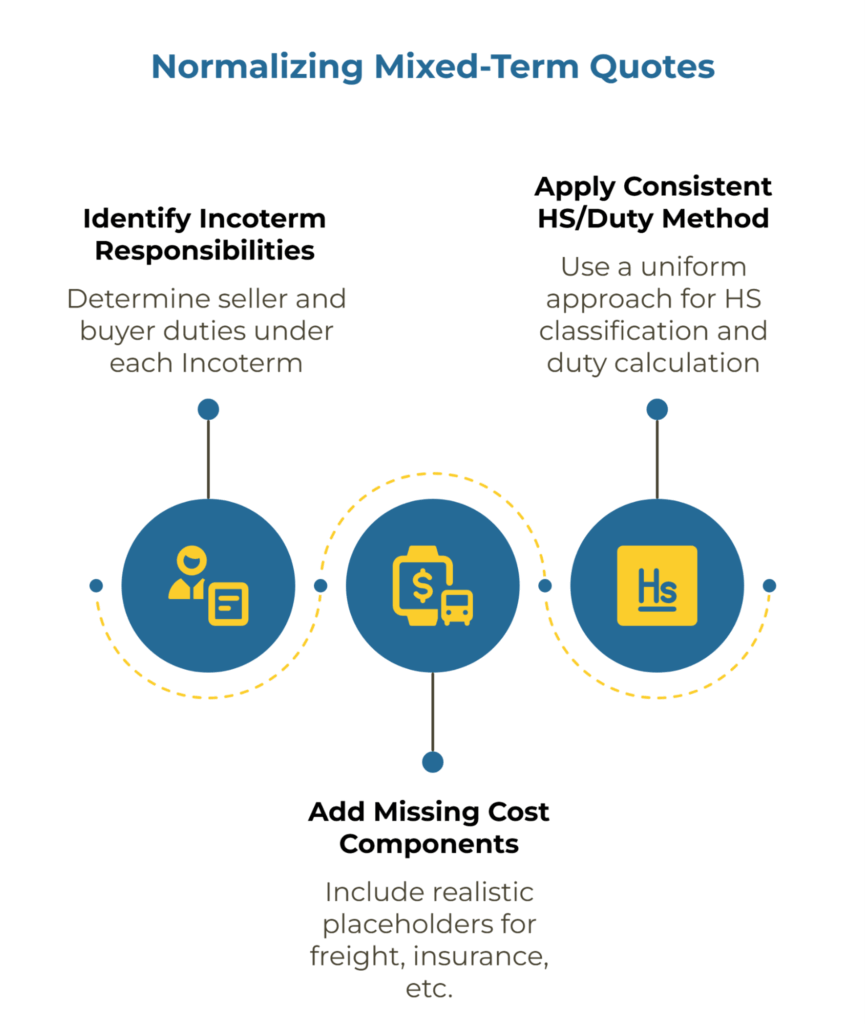
Step 1: Map Responsibilities Clearly
List what the seller covers under the quoted Incoterm and what you must add (e.g., pre-carriage, main carriage, insurance, import clearance, last-mile delivery). This step relies on the ICC’s definitions and scope of each rule. Use official terminology to avoid mixing obligations.
Under EXW terms, the seller’s responsibility ends at their facility, leaving the buyer to arrange all transportation, insurance, and customs clearance. FOB responsibility transfers when goods are “on board” the vessel. CIF terms extend seller responsibility to include freight and insurance to the destination port.
Step 2: Add the Missing Legs—Consistently
Fill the gaps with realistic placeholders for freight, insurance, terminal handling, and delivery to your door. Mark these as illustrative if they’re based on general practice rather than contracted rates. The key is consistency: apply the same logic to every quote so like is compared with like.
For EXW quotes, this means adding inland transportation to port, ocean freight, marine insurance, destination handling, customs clearance, and duties. FOB quotes require adding ocean freight, insurance, destination charges, and duties. CIF quotes typically need only destination handling, customs fees, and duties added.
Step 3: Apply One HS/Duty Method Across All Quotes
Choose the appropriate HS classification and duty approach for the product and destination, then apply it the same way to every quote. The HS is the universal coding system maintained by the WCO; classification and duty calculation processes are described in WCO materials and national customs guidance.
Most people miss this completely.
Leaving HS/duty out for non-DDP quotes quietly distorts totals. Normalization fixes that distortion before it becomes a budget surprise.
To-Door Credo: The 5 Rules
✓ Anchor every quote to one to-door total
✓ Map obligations per the quoted Incoterm before adding costs
✓ Add all missing legs (freight, insurance, handling, delivery)
✓ Use one HS/duty method across all quotes
✓ Keep a single assumptions log everyone can audit
Build the Assumptions Log Teams Can Trust
A strong normalization rests on a tight assumptions log. Treat it as the audit trail that lets Finance, Logistics/Compliance, and Operations sign off with confidence.
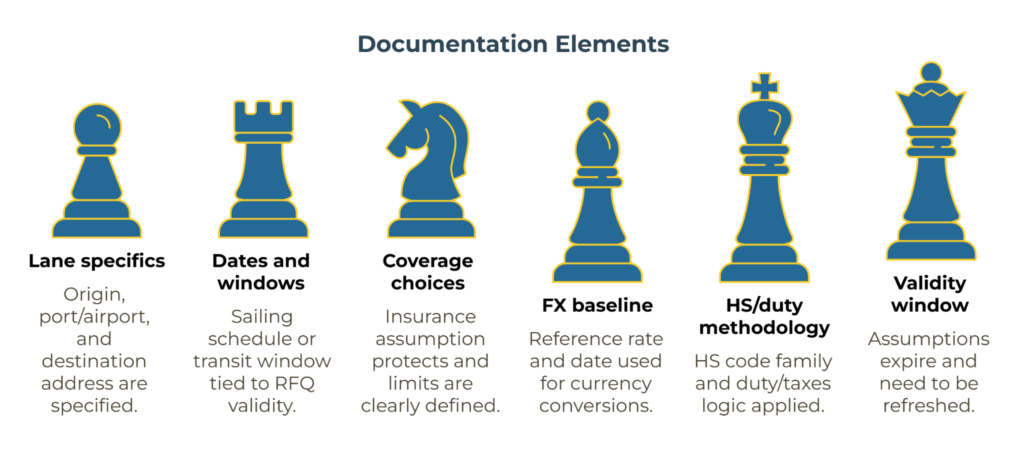
Essential Documentation Elements:
-
- Lane specifics: origin location(s), port/airport, destination address
-
- Dates and windows: sailing schedule or transit window tied to the RFQ’s validity
-
- Coverage choices: what the insurance assumption protects (and limits)
-
- FX baseline: the reference rate and date used for currency conversions
-
- HS/duty methodology: the chosen HS code family and the duty/taxes logic applied
-
- Validity window: when the assumptions expire and need refresh
Quick Template: Lane: [ORIGIN → DESTINATION] | Dates: [ETD/ETA window] | Coverage: [Insurance scope] | FX: [Rate + date] | HS/Duty Method: [Code family + approach] | Validity: [Through date] | Notes: [Anything unusual or illustrative]
Consider a mid-sized converter finalizing Q3 buys. The team labeled “Supplier 3” as the lowest initial number. After adding last-mile and duties using the same HS method for every quote, the ranking flipped. The CFO signed off without a second meeting because the assumptions log made the decision defendable.
That’s predictability.
How Normalization Reshuffles “Cheapest” Rankings
Normalization makes trade-offs visible. The matrix below illustrates how different freight and duty realities can reorder options—without using specific rates.
|
Option |
Strength Under Stable Freight |
Sensitivity to Duty |
Last-Mile Exposure |
Notes (Illustrative) |
|
EXW-based |
High control; flexible carriers |
Medium–High (all duties on buyer) |
High (all local legs added) |
Strong if you already have rates locked |
|
FOB-based |
Balanced control/cost |
Medium (duty still on buyer) |
Medium |
Useful when you trust your forwarder’s contracts |
|
CIF-based |
Predictable main-carriage |
Medium (duty on buyer) |
Medium–High (local legs vary) |
Watch terminal/handling specifics |
|
DDP-based |
Low internal workload |
Low (duty included by seller) |
Low |
Validate what’s actually included to door |
What Could Go Wrong (And How to Prevent It):
-
- Hidden terminal fees: Avoid by listing handling separately in Step 2
-
- Ambiguous insurance: State coverage assumptions explicitly in the log
-
- Duty method drift: Lock the HS/duty approach for the whole RFQ period
Bridge to action: With the matrix in mind, the next logical step is to standardize the process so new RFQs don’t backslide into apples-to-oranges.
Governance Tips to Prevent Future Apples-to-Oranges
Make Normalization Your Default SOP
Embed the three steps and the assumptions log into your RFQ template. Require sellers to state the Incoterm and what their figure includes. Point stakeholders to the ICC’s role in defining these rules and to WCO references for HS classification to keep language consistent.
Train Once; Reuse Forever
Walk the team through one illustrative worked example. Then reuse the same log fields in every cycle so results are comparable quarter to quarter—not just supplier to supplier.
Audit for Drift
Every new quote should either match the standing assumptions or flag what changed (lane, coverage, or timing). If something changed, update the log first—then the number.
Quick Reference Checklist
✓ Identify the quoted Incoterm and map responsibilities
✓ Add the missing legs: freight, insurance, handling, delivery
✓ Apply one HS/duty method across all quotes
✓ Record lane, dates, coverage, FX, and validity
✓ Publish one to-door total per supplier with the log attached
Where to go next: When you’re ready to scan potential partners, explore kraft paper suppliers on PaperIndex.
Frequently Asked Questions
What does “to-door” include?
All obligations needed to land material at your receiving location: the seller’s Incoterms responsibilities plus the added legs (freight, insurance, handling) and statutory charges such as duties and taxes.
How can EXW and CIF be evaluated fairly?
Convert each to the same to-door basis by adding the parts each quote omits and using one HS/duty method for both. The point isn’t the starting term—it’s the shared finish line.
Which Incoterms include duties?
DDP typically includes duty in the seller’s responsibility; others usually don’t. Always confirm against official ICC explanations and then capture your chosen approach in the assumptions log for transparency.
Helpful navigation for sourcing teams: Browse kraft paper products or go straight to find kraft paper suppliers and manufacturers. For a deeper mindset shift, read next: Comparability Before Price: The Spec-True Mindset.
Educational Notice: PaperIndex is a neutral, non-transactional connector and does not broker deals. The content above is for information only; examples are illustrative. Incoterms® rules are defined and maintained by the International Chamber of Commerce, and the HS system used for classification and duties is governed by the World Customs Organization. See ICC and WCO resources for official guidance.
About the PaperIndex Insights Team
The PaperIndex Insights Team synthesizes complex topics into clear, helpful guides. Content is for informational purposes and should not replace professional advice.