
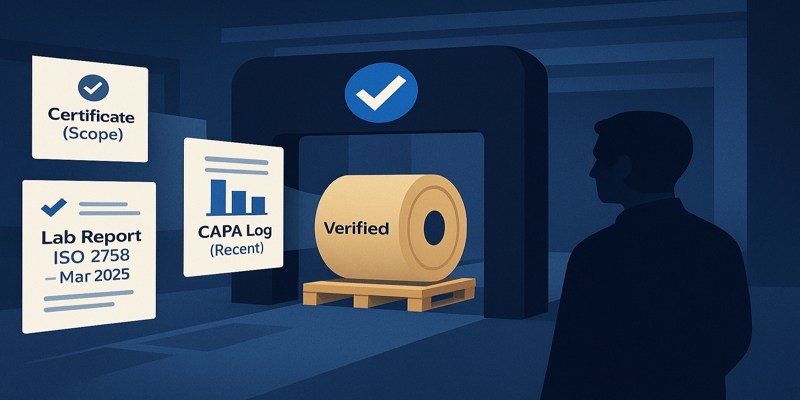
📌 Key Takeaways
Supplier promises mean nothing until backed by verifiable proof—certificates, lab reports, and audit trails that withstand scrutiny.
- Certificates Require Three Checks: Validity dates, explicit scope coverage for your kraft paper grades, and chain-of-custody validation for sustainability claims separate real assurance from decorative credentials.
- Method Identifiers Make Test Results Comparable: A lab report stating “burst strength per ISO 2758: 352 kPa, tested March 2025” carries enforcement weight that a spec sheet listing “350 kPa” never will.
- Recurring Verification Converts Claims Into Reliability: CAPA (corrective and preventive actions) closure rates, 90-day OTIF (on-time-in-full) snapshots, and calibration consistency reveal whether a supplier’s quality system actually prevents problems or just documents them after the fact.
- Documentation Accuracy Predicts Supply Stability: When shipping marks match packing lists and certificates of analysis reconcile before containers arrive, reliability failures that consume margin become visible early enough to prevent them.
- Small Buyers Can Verify Without Labs: Accredited third-party spot checks, roll-tied mill reports for every lot, and simple moisture-plus-caliper intake verification catch specification drift before it reaches the production line.
Evidence-first procurement eliminates the margin erosion that comes from emergency sourcing, inbound holds, and downstream claims when promises fail. Procurement and quality managers at packaging manufacturers will find a systematic framework here, preparing them for the detailed verification protocols that follow.
When a kraft paper supplier presents a polished sales deck and promises consistent quality, what separates a reliable partner from a risk waiting to materialize? The answer lies not in what suppliers say, but in what they can prove.
In kraft paper procurement, the shift from accepting supplier promises to demanding verifiable evidence represents a fundamental change in how procurement and quality teams assess risk. Verifiable evidence in this context means certificates with validated scope, laboratory test results aligned to named standards, and recurring audit signals that confirm ongoing capability. This approach transforms supplier evaluation from a trust-based exercise into a systematic, proof-driven process that cuts procurement risk and stabilizes supply chains.
Why “Promises” Fail Procurement (and What Counts as Evidence)
Defining Verifiable Evidence in Kraft Paper Sourcing
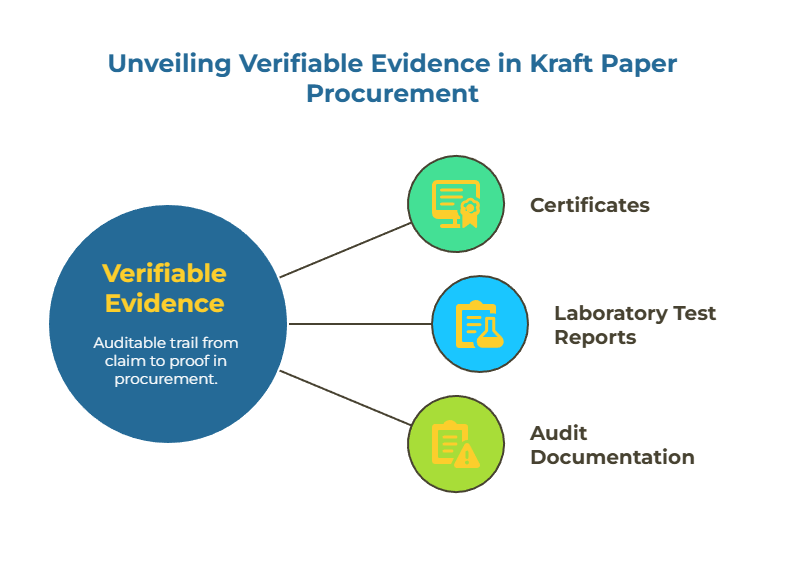
Verifiable evidence enables reliable kraft paper supply by establishing an auditable trail from claim to proof. It consists of three core elements: certificates issued by recognized bodies that remain current and within scope, laboratory test reports that specify the measurement method and testing date, and audit documentation that captures non-conformances alongside corrective and preventive actions (CAPA).
A certificate for ISO 9001 quality management becomes meaningful only when procurement teams verify its scope explicitly covers kraft paper manufacturing, confirm the validity period hasn’t lapsed, and—for sustainability claims like FSC or PEFC—validate the chain of custody documentation that traces certified material through the supply chain. Without these verification steps, certificates function as decorative credentials rather than operational assurance.
Laboratory evidence carries weight when test results reference recognized standards by name and number. A spec sheet listing “burst strength: 350 kPa” provides far less assurance than a lab report stating “burst strength per ISO 2758: 352 kPa, tested March 2025.” The method identifier transforms a number into a verifiable claim that procurement can cross-reference against their own quality specifications. Similarly, when a label declares 200 gsm but caliper measurements reveal 180 gsm, or when a moisture meter reading shows 10.5% against a specified maximum of 8%, the gap between promise and proof becomes impossible to ignore.
Recurring verification through audits and CAPA tracking reduces production downtime risk by converting one-time claims into evidence of sustained capability. A supplier might pass an initial qualification, but the real test of reliability appears in how they respond to non-conformances over time and whether corrective actions actually prevent recurrence.
The Cost of Unverifiable Claims
When procurement decisions rest on unverifiable promises, three categories of risk emerge. First, specification drift occurs when incoming material gradually deviates from agreed parameters because no one is checking test reports against named standards. The packaging line runs until a batch fails, forcing emergency sourcing at premium prices.
Second, compliance exposure builds silently. A supplier’s FSC certificate might have expired months ago, or its scope might cover office paper but not the kraft grades your corrugated plant depends on. Valid chain of custody (FSC/PEFC) prevents out-of-scope sustainability claims from reaching end customers who increasingly audit their packaging suppliers. Without proactive CoC validation, brands discover compliance gaps only when downstream customers raise questions—often too late to avoid reputational damage.
Third, audit fatigue sets in when procurement teams lack a structured evidence framework. Every supplier assessment becomes a custom exercise, quality managers reinvent checklists for each mill, and findings sit in isolated spreadsheets rather than feeding into systematic supplier scorecards.
Certificate Integrity—Scope, Validity, and Chain-of-Custody

Reading ISO 9001/14001 Scope Statements and Validity Dates
An ISO 9001 certificate confirms a quality management system exists, but the scope statement determines whether that system actually governs kraft paper production. Procurement teams should locate the scope clause on every certificate and verify it explicitly names the product categories and manufacturing processes relevant to their purchase orders. A certificate scoped for “paper and paperboard products” provides broader assurance than one limited to “office and printing papers.”
Validity dates appear clearly on certificates, yet checking them remains a surprisingly common oversight. A certificate issued three years ago might have expired if the certification body conducts surveillance audits on an annual or three-year cycle. Procurement should flag certificates within 60 days of expiration and request updated documentation before placing new orders.
FSC and PEFC Chain of Custody Checks
For kraft paper used in consumer packaging, sustainability certifications create market access. FSC (Forest Stewardship Council) and PEFC (Programme for the Endorsement of Forest Certification) both maintain public databases where procurement teams can verify a supplier’s certificate number, check its current status, and confirm the certificate holder’s legal name matches the entity issuing your invoice.
Chain of custody validation confirms that certified fiber actually flows through the supplier’s operations without mixing with non-certified material. A mill might hold an FSC certificate, but if procurement orders a product not listed in the CoC scope, the finished goods cannot carry FSC claims. Checking CoC scope before contracting prevents claim disputes and protects brands from greenwashing allegations. The FSC certificate database and PEFC registry provide direct access to current certification status and scope details.
When a Certificate Isn’t Enough
Certificates establish that a management system or chain of custody exists at a point in time. They do not confirm that today’s shipment meets your technical specifications for basis weight, burst strength, or moisture content. This gap explains why procurement needs laboratory evidence alongside certification documents. The factory audit checklist for kraft paper manufacturers provides a structured approach to verify both process capability and certification integrity during supplier qualification.
Laboratory Evidence—Which Tests Matter for Kraft Paper

Basis Weight, Burst, Cobb, Tensile—Name the Standard on Every Result
Kraft paper’s performance in converting and end-use applications depends on four primary physical properties: basis weight (mass per unit area), burst strength (resistance to rupture), Cobb value (water absorption), and tensile strength (resistance to tearing). Each property has recognized test methods published by standards organizations like ISO, TAPPI (Technical Association of the Pulp and Paper Industry), and national bodies.
Procurement teams should require that every lab report cites the specific standard used. Basis weight might reference ISO 536 or TAPPI T 410, burst strength commonly follows ISO 2758 or TAPPI T 403, Cobb testing aligns with ISO 535 or TAPPI T 441, and tensile measurements reference ISO 1924 or TAPPI T 494. For corrugated applications, ring crush test (RCT) and edge crush test (ECT) results provide critical compression strength data that determines box performance under stacking loads. When a supplier provides results without method identifiers, the numbers lose their meaning because test conditions vary between standards, making it impossible to verify whether results meet specification.
The capability matrix: GSM, BF/BST, moisture & certifications demonstrates how to compare suppliers using normalized test methods, ensuring that procurement decisions rest on apples-to-apples comparisons rather than method-dependent variations.
Spec Sheets Versus Lab Reports—Understanding the Weight Difference
A specification sheet published by a mill lists target values for standard grades. It functions as a product catalog, not a quality document. A laboratory test report, in contrast, documents actual measurements from a specific production run or sample, includes the testing date, references the measurement method, and often carries the signature of a quality manager or accredited laboratory.
During supplier onboarding, procurement should request lab reports for the initial qualification samples, ideally tied to specific lot IDs and roll numbers that match incoming shipments. These reports establish a baseline for comparison and confirm the supplier’s testing capability. If a mill cannot produce lab reports with method identifiers and dates, this signals either inadequate quality infrastructure or a reluctance to provide verifiable data—both red flags that warrant deeper investigation.
Align Method Identifiers in Onboarding and Repeat During Recurring Audits
Once procurement defines which test methods apply to each kraft paper grade in the purchase specification, those same method identifiers should appear consistently in supplier documentation—from pre-qualification questionnaires through certificate of analysis documents accompanying every shipment. Method alignment prevents confusion when results from different suppliers look similar but derive from incompatible test procedures.
Recurring audits and CAPA reviews provide opportunities to verify method consistency over time. When a supplier changes testing equipment or shifts to a different lab, method identifiers might change, signaling the need to re-baseline specifications. A practical verification step involves requesting the last two calibration entries for the mill’s core testing instruments—moisture meters, micrometers, and burst testers. Consistent calibration records correlate strongly with fewer specification surprises in production. The integration playbook: evidence + exporter reliability shows how to combine manufacturer test evidence with exporter operational metrics to de-risk international kraft paper supply chains.
Recurring Assurance—From Pre-Qualification to Audit and CAPA
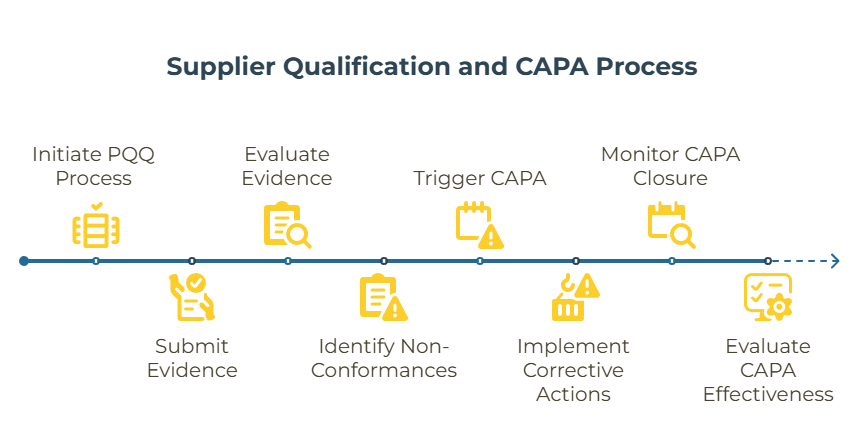
Pre-Qualification Questionnaire Evidence Minimums
A pre-qualification questionnaire (PQQ) establishes the evidence threshold before a supplier enters active consideration. For kraft paper suppliers, procurement should require three categories of evidence at PQQ stage: current certificates with validated scope (ISO 9001, ISO 14001, FSC or PEFC as applicable), laboratory test reports from the past six months covering the specific grades procurement intends to order, and a summary of the most recent internal or third-party audit findings along with any open corrective actions.
This evidence package separates suppliers who maintain systematic quality and compliance programs from those who assemble documentation reactively when pursuing new business. If a mill cannot produce recent lab reports or claims their last audit found zero non-conformances, procurement should question whether their quality systems operate rigorously enough to catch issues before they reach customers.
Triggers for Corrective and Preventive Action
CAPA systems track two types of events: corrective actions that respond to identified non-conformances (a failed test, a customer complaint, an audit finding) and preventive actions that address potential problems before they manifest. Procurement’s interest in CAPA extends beyond whether a supplier has a system—it focuses on the cadence and closure rates that indicate system effectiveness.
When evaluating kraft paper suppliers, procurement should ask: How many CAPAs were opened in the past 12 months? What percentage remain open beyond their target closure date? What categories of non-conformances appear most frequently? A high CAPA volume paired with rapid closure might indicate an active quality culture, while low CAPA counts could signal either excellent performance or poor detection. The pattern matters more than the absolute numbers.
Remote Audits Versus On-Site Audits—Choosing the Right Cadence
On-site audits provide the highest assurance by allowing quality teams to observe production processes, review original documentation, and interview personnel directly. They also carry significant costs in travel time and audit team availability. Remote audits using document review and video facility tours offer a middle ground for ongoing surveillance once a supplier passes initial on-site qualification.
A reasonable cadence for kraft paper suppliers might include an initial on-site audit before first commercial orders, remote audits every 12 months for stable suppliers with no major non-conformances, and triggered on-site audits whenever significant quality issues arise or when suppliers undergo major operational changes like equipment upgrades or facility relocations. When conducting remote assessments, requesting a 90-day on-time-in-full (OTIF) performance snapshot alongside documentation accuracy metrics provides leading indicators of supply reliability. The supplier reliability scorecard provides a framework to track operational metrics that help determine when remote surveillance suffices and when on-site investigation becomes necessary.
Practical Verification Steps Procurement Can Implement Now

Beyond establishing formal audit programs, procurement teams can strengthen evidence collection through five immediate actions. First, tie test reports to specific roll numbers and lot IDs that match incoming shipments, creating traceability from mill floor to receiving dock. Second, commission spot checks through accredited third-party laboratories for critical production runs, sending blind samples for independent verification of basis weight, burst strength, moisture content, and Cobb values.
Third, request recent calibration proof for the supplier’s core testing instruments rather than relying solely on annual audit reports. Asking for the last two calibration entries creates accountability without demanding full calibration histories. Fourth, reconcile shipping marks against packing lists and certificates of analysis before containers arrive, catching documentation mismatches early when corrections cost less than inbound holds.
Fifth, establish simple tracking for OTIF performance and documentation accuracy rates. These metrics function as early-warning signals that predict supply disruptions before they affect production schedules. Small buyers without dedicated quality laboratories can implement most of these checks using external testing services and basic intake verification procedures.
Frequently Asked Questions
How do I catch out-of-scope ISO certificates?
Read the scope statement on every ISO 9001 or ISO 14001 certificate carefully. The scope must explicitly name the product categories and manufacturing processes relevant to your purchase orders. A certificate scoped for “paper and paperboard products” covers kraft paper manufacturing, while a scope limited to “printing and writing papers” does not. Cross-reference the certificate holder’s legal name against your supplier’s invoicing entity to confirm they match. If the scope appears ambiguous, request clarification from the certification body before finalizing contracts.
What’s the fastest CoC sanity check for FSC/PEFC claims?
Use the public registries maintained by FSC and PEFC to verify certificate numbers, check expiration dates, and confirm the certificate holder matches your supplier. The FSC certificate search and PEFC directory allow real-time lookups. For chain of custody validation, verify that the specific kraft paper grade you’re purchasing appears within the certificate’s product scope. If your order falls outside the listed scope, the supplier cannot make valid sustainability claims for that material.
Which lab results matter for corrugated versus bag applications?
For kraft paper destined for corrugated board production, prioritize ring crush test (RCT) or edge crush test (ECT) results alongside basis weight and moisture content. These compression strength metrics directly predict box performance under stacking loads. For bag applications, burst strength, tensile strength, and Cobb value (water resistance) take precedence because bags must withstand filling pressure and moisture exposure during handling. Always verify that test methods reference recognized standards like ISO or TAPPI to ensure results remain comparable across suppliers.
Make Evidence the Default Lens
The shift from accepting supplier promises to requiring verifiable evidence represents a recurring health check for your supply chain. Just as medical diagnostics rely on test results rather than patient self-assessment, kraft paper procurement should rest on certificates with validated scope, lab reports tied to named standards, and audit findings that reveal how suppliers respond when quality slips.
Evidence Hierarchy for Kraft Paper Procurement
Apply this six-step hierarchy when evaluating supplier documentation:
- Certificate current and in scope – Verify validity dates and scope statements explicitly cover kraft paper grades you purchase
- Chain of custody validated – For FSC/PEFC claims, confirm CoC documentation traces certified fiber through supplier operations using official registries
- Lab report with method and date – Require test results that cite specific standards (ISO, TAPPI) and testing dates within the past six months, tied to lot IDs where possible
- First-article or production run data – Request quality data from actual production runs, not just capability samples
- Audit summary with non-conformances and CAPA – Review recent audit findings and verify corrective actions closed on schedule
- Ongoing quality KPIs – Track metrics like specification conformance rates, 90-day OTIF performance, documentation accuracy, and claim frequency
This hierarchy transforms supplier evaluation from a binary qualified/not-qualified decision into a graduated assessment that reveals where suppliers provide strong evidence, where documentation gaps exist, and where procurement should focus verification efforts.
Verification Resources
When cross-checking supplier claims, consult these official registries and standards bodies for authoritative validation:
- FSC Certificate Search – Verify chain of custody certification status and scope
- PEFC Registry – Confirm certified organizations and product categories
- ISO 9001 Standards – Reference for quality management system requirements
- TAPPI Standards – Paper testing method specifications and procedures
When evidence becomes the default lens, procurement decisions gain defensibility, quality risks become visible early, and supply chains stabilize because everyone operates from the same proof-based foundation. For procurement teams ready to implement evidence-based supplier evaluation, exploring systematic audit frameworks and developing internal verification protocols represent logical next steps. The knowledge base at PaperIndex Academy offers practical guidance on factory audits, capability assessments, and integration strategies that connect manufacturer evidence to exporter reliability for international kraft paper sourcing. Buyers seeking to expand their qualified supplier network can explore verified mills and exporters through the kraft paper suppliers directory.
Our Editorial Process
Our expert team uses AI tools to help organize and structure our initial drafts. Every piece is then extensively rewritten, fact-checked, and enriched with first-hand insights and experiences by expert humans on our Insights Team to ensure accuracy and clarity.
About the PaperIndex Insights Team
The PaperIndex Insights Team is our dedicated engine for synthesizing complex topics into clear, helpful guides. While our content is thoroughly reviewed for clarity and accuracy, it is for informational purposes and should not replace professional advice.