

📌 Key Takeaways
Containerboard landed costs remain stable only when explicit guardrails prevent quote confusion, freight surprises, and specification drift.
- Normalize Every Quote to a Single To-Door Basis: Comparing EXW to CIF without translating both to the same delivery point hides true cost and risk allocation, making the lowest quoted price meaningless.
- Stress-Test Freight Across Baseline, Surge, and Relief Scenarios: The supplier who wins on today’s rates may lose competitiveness when ocean freight surges 40%—scenario modeling before award reveals which supplier remains stable across rate swings.
- Method-Named Specifications With Attached Results Prevent Acceptance Disputes: Listing “127 GSM basis weight” without citing ISO 536 and defining tolerance bands transforms receiving inspection into a negotiation instead of a verification.
- Assumption Logs and Review Cadence Catch Drift Before It Compounds: Monthly tracking of freight rates, exchange rates, and test methods coupled with quarterly reviews ensures variance stays within managed bands rather than erupting as invoice surprises.
- Operating Rhythm Transforms Guardrails Into Sustainable Discipline: One-time normalization exercises fade quickly, but monthly assumption reviews and quarterly QBRs with defined exception triggers create organizational memory that improves with each procurement cycle.
Guardrails installed = volatility managed as bandwidth, not crisis.
Procurement managers, finance controllers, and operations leaders at converters will find immediate implementation guidance here, preparing them for the detailed guardrail framework and step-by-step playbook that follows.
Cost stability isn’t a lucky outcome—it’s the result of explicit guardrails that link specifications, Incoterms, freight scenarios, review cadence, and change control to a defensible to-door range. The procurement manager stares at three containerboard quotes. Same grade, similar volumes, delivery windows within a week of each other. Yet the numbers tell three different stories. One supplier quotes EXW, another FOB, the third CIF. Ocean freight has jumped 30% since last quarter, and no one knows if that surge will hold through the contract period. Worse, two suppliers list “basis weight 127 GSM” without specifying the test method or tolerance bands. When the shipment arrives and quality disputes erupt six weeks later, the true cost becomes painfully clear: rework, production delays, and tense conversations about who bears the burden of off-specification material.
This scenario plays out daily across the containerboard supply chain. Quote variance, freight volatility, and specification drift create a cascade of disputes and unexpected costs that erode margins and strain supplier relationships. The challenge is not finding suppliers or negotiating lower per-ton prices. It’s building a foundation that keeps landed costs stable and predictable across quotes, awards, and ongoing deliveries.
This article provides a practical playbook for establishing cost and contract guardrails that bring clarity to containerboard procurement. Rather than chasing the lowest quoted price or reacting to market swings, cross-functional teams can build a structured approach that normalizes comparisons, tests assumptions, and prevents the evidence gaps that trigger rework. The goal is simple: move from volatility to visibility, replacing guesswork with guardrails that stabilize your to-door cost across the entire contract lifecycle.
The Guardrail Model for Landed Cost
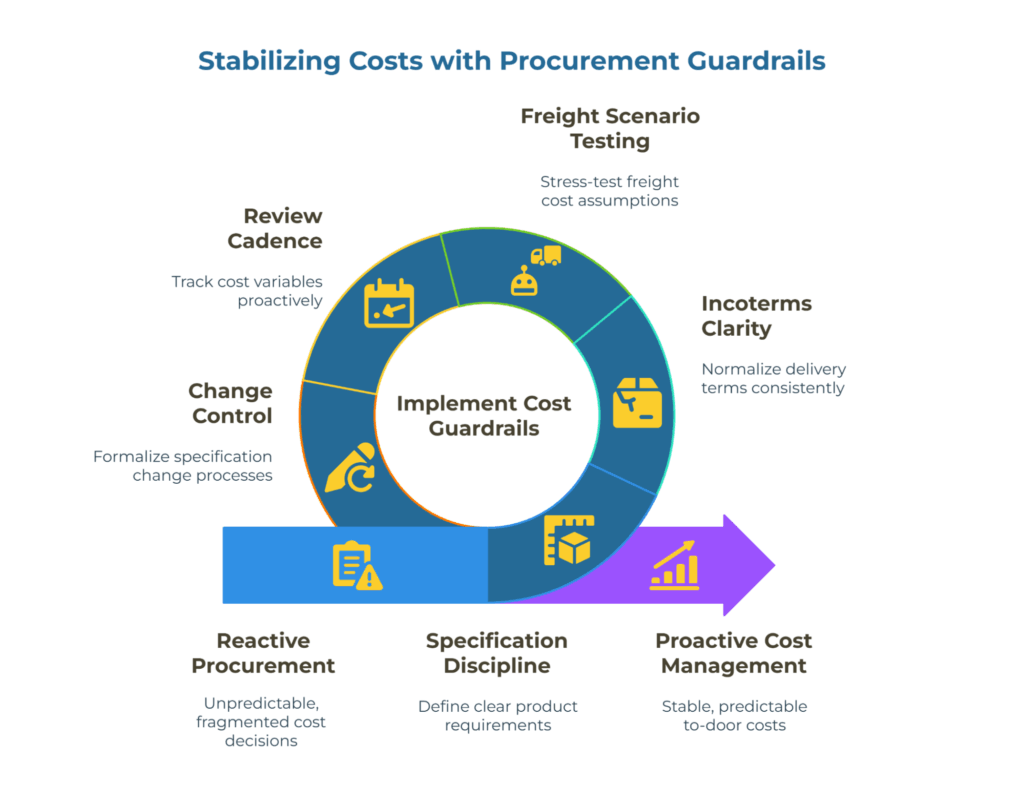
Cost and contract foundations are the named guardrails that link specification discipline, Incoterms clarity, freight scenario testing, review cadence, and change control into a stable, predictable to-door range. Without these foundations, procurement operates reactively. Teams compare quotes that cannot be compared, award contracts based on incomplete cost pictures, and discover problems only when invoices or quality reports reveal discrepancies. Guardrails shift the operating model from reactive troubleshooting to proactive cost management.
Think of guardrails as the structural elements that prevent cost estimates from drifting into unpredictable territory. Just as highway guardrails define safe boundaries, cost guardrails define the parameters within which landed costs remain stable and defendable. These parameters include normalized delivery terms, stress-tested freight assumptions, method-specific quality tolerances, and formal change controls. When all quotes are normalized to the same to-door basis and tested against realistic freight scenarios, comparisons become meaningful. When acceptance criteria reference specific ISO or TAPPI test methods with documented tolerances, disputes diminish. When assumption logs track every variable that affects cost, quarterly reviews catch drift before it becomes a crisis.
The alternative to guardrails is ad-hoc decision-making. Procurement compares EXW to CIF without adjusting for freight and insurance. Finance accrues costs based on outdated rate assumptions. Quality rejects shipments because tolerances were never formalized. Operations halts production because specifications shifted without notice. Each gap compounds, creating volatility that no single negotiation can resolve. Guardrails eliminate this fragmentation by establishing a unified framework that all stakeholders reference when making cost decisions.
Where Volatility Creeps In
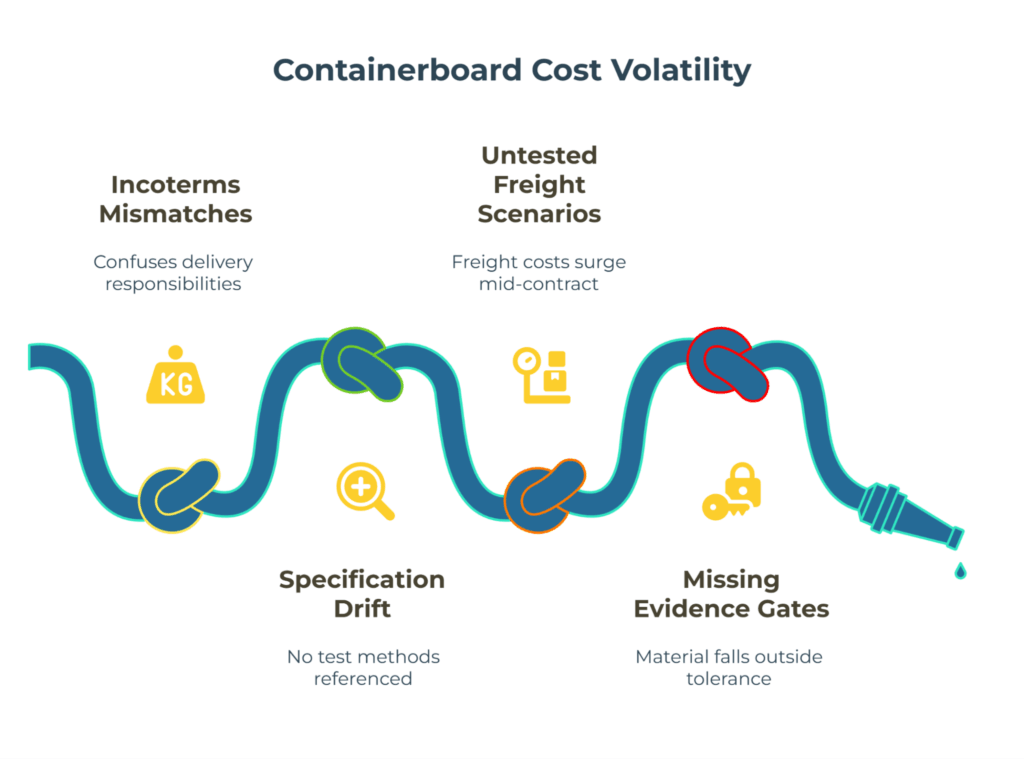
Volatility infiltrates containerboard cost management through four primary channels: Incoterms mismatches, specification drift, untested freight scenarios, and missing evidence gates. Each channel introduces uncertainty that compounds across the procurement cycle.
Incoterms mismatches occur when procurement compares quotes without normalizing delivery responsibilities. An EXW quote appears lower than a CIF quote, but the EXW price excludes all freight, insurance, port handling, and customs clearance. Without adding those costs, the comparison is meaningless. Yet many RFQ processes solicit mixed terms and rely on intuition to estimate the gaps. The ICC Incoterms® 2020 framework establishes the globally recognized structure for allocating responsibilities between buyers and sellers, providing the foundation for accurate cost comparison. The landed-cost framework for kraft paper provides a systematic method for normalizing all quotes to a single delivery point, ensuring every comparison reflects true to-door cost.
Specification drift happens when RFQs list properties without referencing test methods or tolerance bands. A supplier quotes “basis weight 127 GSM” and procurement awards the contract, assuming both parties agree on what 127 GSM means. Six weeks later, the lab report shows 129 GSM using ISO 536, but the supplier tested using a different protocol and insists the material is within their internal tolerance of ±3%. The shipment sits in dispute, and production schedules slip. Comparability before price explains how method-named specifications with explicit tolerances prevent these conflicts before they arise.
Untested freight scenarios create silent exposure. Procurement awards a contract based on current ocean rates, then watches freight costs surge 40% mid-contract due to port congestion or carrier surcharges. Suddenly, the awarded supplier is no longer the lowest to-door option. Freight scenarios that flip supplier rankings demonstrates how baseline, surge, and relief modeling reveals which supplier remains stable across rate swings.
Missing evidence gates allow suppliers to quote without attaching recent test results, calibration records, or certification confirmations. Procurement assumes the supplier can meet specifications, only to discover during receiving inspection that the material falls outside the undocumented tolerance window. The eight evidence gaps identifies the documentation checkpoints that turn assumptions into verified commitments.
These four channels do not operate in isolation. Incoterms confusion compounds when freight scenarios go untested. Specification drift accelerates when evidence gates are absent. The result is a procurement environment where volatility is the norm, and cost surprises are predictable only in their unpredictability.
The Five Guardrails

The guardrail model condenses cost and contract stability into five actionable checkpoints. Each guardrail addresses a specific volatility channel and provides a mechanism to lock in predictability. These form the core of the 5-Point Guardrail Checklist, a practical tool designed to be embedded in every RFQ pack and contract exhibit.
Guardrail 1: To-Door Normalization
Normalize all quotes to a single delivery point before comparing. Whether suppliers quote EXW, FOB, or CIF, convert every offer to the same to-door basis by adding freight, insurance, port charges, and customs duties. This eliminates the false economy of accepting a low EXW quote that becomes the highest total cost once logistics are included. Incoterms for kraft paper buyers clarifies how to map Incoterms responsibilities and build an accurate to-door total for each quote.
Guardrail 2: Freight Scenario Testing
Model baseline, surge, and relief freight scenarios before awarding. Take the normalized to-door costs from Guardrail 1 and stress-test them against +30%, +50%, and -20% freight rate changes. Identify which supplier remains cost-competitive across all three scenarios, not just the baseline. This prevents mid-contract surprises when ocean rates spike or drop. Document the freight assumptions used in each scenario, including carrier surcharges, port congestion factors, and seasonal peaks. The Price-to-Door Scenario Sheet template provides a structured format for capturing and comparing these projections.
Guardrail 3: Method-Named Acceptance and Tolerances
Define acceptance criteria using specific ISO or TAPPI test methods and explicit tolerance bands. Instead of listing “basis weight 127 GSM,” specify “basis weight 127 GSM ±2% per ISO 536.” For properties like water absorptiveness, reference recognized standards such as TAPPI T 441 for Cobb testing. Require suppliers to attach recent lab results using the named method at quote time. This widely established best practice transforms quality acceptance from a negotiation into a verification. QA acceptance without debate provides the template for writing specifications that eliminate post-award disputes.
Guardrail 4: Review Cadence and Market Intelligence Policy
Establish a quarterly business review (QBR) trigger to reassess freight rates, specification compliance, and contract performance. This is not about renegotiating every term. It is about identifying drift early, before it compounds into material cost variance. Importantly, this review references observable trends—such as published carrier surcharges or documented delivery delays—not proprietary pricing indices. PaperIndex educates on market intelligence concepts, but the platform does not sell or publish pricing indices. All negotiations and pricing decisions occur directly between buyers and suppliers.
Guardrail 5: Change Control and Assumption Logging
Maintain a formal log of every assumption that affects cost: freight rates used, test methods specified, Incoterms basis, currency exchange rates, and lead times. When any assumption changes, trigger a documented review and approval process before adjusting the contract. The Assumptions Log + QBR Triggers template provides a structured format for tracking these variables. This prevents informal drift and ensures that cost adjustments are transparent and mutually agreed upon. Common pitfalls in landed-cost estimates outlines the most common assumption gaps that lead to invoice disputes and the logging discipline that prevents them.
These five guardrails form a checklist that procurement, finance, and operations can execute in sequence. Each guardrail builds on the previous one, creating a compounding effect that stabilizes cost and reduces friction across the entire contract lifecycle.
Build Your Playbook
Implementing the guardrail model requires a structured process that integrates cross-functional input and produces reusable templates. The playbook below outlines the step-by-step approach, designed to be executed as generally accepted practice in volatile supply lanes.
Step 1: Normalize All Quotes to a Single To-Door Basis
Collect quotes from suppliers and identify the Incoterms basis for each. For every quote that is not already on a DDP (Delivered Duty Paid) basis, calculate the additional costs required to reach your receiving dock. This includes ocean or air freight, port handling, insurance, customs duties, and inland transport. The landed-cost framework for kraft paper provides a systematic method for mapping these costs and building a normalized comparison table. The output is a single spreadsheet where every supplier’s total cost reflects the same delivery point and responsibility split.
Step 2: Stress-Test Freight Assumptions
Take the normalized costs from Step 1 and build three scenarios: baseline (current freight rates), surge (+30% to +50% rate increase), and relief (-20% rate decrease). For each scenario, recalculate the to-door total and rank suppliers. Identify which supplier ranks first across all three scenarios. If the winner changes between baseline and surge, document the flip point and decide whether the baseline winner’s vulnerability to rate increases creates unacceptable risk. This scenario modeling prevents the common mistake of awarding the cheapest baseline quote only to discover mid-contract that a rate surge makes the second-place supplier more cost-effective. Freight scenarios that flip supplier rankings explains the mechanics of scenario testing and provides a template for documenting results.
Step 3: Define Method-Named Specifications and Tolerances
List every critical property for the containerboard grade: basis weight, burst strength, Cobb value, moisture content, and any application-specific requirements. For each property, specify the ISO or TAPPI test method and the acceptable tolerance band. Require suppliers to attach recent lab results using the named methods at quote time. Naming the test method is a widely established standard that preserves traceability from the certificate of analysis through incoming inspection. This step transforms vague specifications into verifiable commitments. QA acceptance without debate provides the framework for writing specifications that prevent post-award rework.
Step 4: Establish Review Cadence and Triggers
Define the conditions that trigger a contract review. Common triggers include freight rate changes exceeding 20%, specification failures on two consecutive shipments, or currency fluctuations beyond a defined band. Set a quarterly calendar review as the baseline rhythm, with exception-based reviews as needed. Document this cadence in the contract’s operating terms so all parties understand when and why reviews occur. This prevents the trap of setting fixed terms that become outdated within months.
Step 5: Implement Change Control and Assumption Logging
Create a simple log that tracks every assumption affecting cost: the freight rate used, the exchange rate, the test methods specified, the Incoterms basis, and the lead times. When any assumption changes, require a formal review and approval before adjusting the contract. This log serves as the single source of truth for cost reconciliation and variance analysis. Common pitfalls in landed-cost estimates explains how assumption drift causes disputes and how logging prevents it.
The playbook’s output is a set of reusable templates that make cost management systematic and auditable:
- 5-Point Guardrail Checklist: Embed in every RFQ pack to ensure consistent execution
- Price-to-Door Scenario Sheet: Structure cost drivers and scenario toggles for freight stress testing
- Assumptions Log + QBR Triggers: Track variables and automate exception escalation
- 2×2 Responsibility Map: Clarify which stakeholder owns spec verification, freight testing, and change control
These templates reduce the cognitive load for future RFQs and create organizational memory that improves with each procurement cycle.
Stakeholder Sidebars
Cross-functional stakeholders bring different priorities to containerboard procurement. Guardrails succeed when they address each stakeholder’s core concerns.
Business Impact (Finance and Executives)
Finance prioritizes cost predictability and variance reduction. Guardrails deliver both by eliminating the surprise adjustments that disrupt budget forecasts. When quotes are normalized to-door and stress-tested for freight surges, accruals align with reality. When specifications reference exact test methods and tolerances, quality disputes decline and rework costs drop. The measurable outcome is a narrower variance band between estimated and actual landed costs, which improves forecast accuracy and reduces emergency adjustments. This approach aims to streamline month-end close by implementing a single normalization method and maintaining a current assumptions log.
Technical Note (Quality Assurance and Technical Teams)
QA teams prioritize method alignment and evidence chains. Guardrail 3 addresses this directly by requiring method-named specifications and attached lab results at quote time. Use recognized test methods for basis weight, Cobb water absorptiveness, burst strength, moisture content, and caliper. Define sample conditioning requirements and acceptance limits aligned to process capability. This ensures that acceptance criteria are unambiguous and that receiving inspections verify against the same test protocols used during quoting. The evidence chain—from supplier lab to receiving dock—becomes traceable and defensible, reducing the friction of disputed shipments.
Day-to-Day Application (Operations and Packaging Engineering)
Operations teams prioritize process stability and lead time predictability. Guardrails prevent the line-stop surprises caused by off-spec material or delayed shipments. When freight scenarios are stress-tested and assumption logs track lead times, operations receive advance warning of potential delays. When specifications are method-named and suppliers verify compliance before shipping, the risk of receiving material that cannot run on existing equipment diminishes. Evidence gates move quality debates upstream to sourcing decisions, not to the receiving dock when production is already scheduled. The practical benefit is fewer emergency supplier switches and more consistent production schedules.
Consensus Kit (Cross-Functional Alignment)
For complex, cross-functional decisions, the Consensus Kit provides a comparison table and risk-mitigation checklist. The comparison table contrasts the guardrail approach against common alternatives: cheapest-quote procurement, verbal-spec sourcing, and single-scenario cost modeling. Include a one-page view showing to-door costs under baseline, surge, and relief scenarios for the top suppliers. The checklist identifies the risks each alternative introduces and maps the guardrail that mitigates it. This kit accelerates alignment by showing stakeholders the specific consequences of skipping guardrails and the specific protections guardrails provide.
Anti-Patterns and Failure Modes
Even well-intentioned procurement processes fail when they rely on anti-patterns that introduce hidden risk. Recognizing these failure modes is the first step to avoiding them.
Cheapest-Quote Thinking
Awarding the lowest quoted price without normalizing to-door costs is the most common anti-pattern. A supplier quotes EXW at $800 per ton, another quotes CIF at $950 per ton. Procurement awards to the EXW supplier, only to discover that freight, insurance, and port charges add $200 per ton, making the total $1,000—higher than the CIF option. The failure is not in the negotiation. It is in the comparison methodology. Guardrail 1 prevents this by requiring normalization before comparison.
Evidence Gaps
Accepting quotes without attached lab results or certification proofs creates silent risk. Procurement assumes the supplier can meet specifications, but no one verifies the assumption before awarding. When the shipment arrives and testing reveals off-spec material, the dispute becomes a negotiation about who bears the cost of rework. Guardrail 3 prevents this by requiring evidence at quote time, transforming assumptions into verified commitments.
Unmanaged Changes
Allowing informal adjustments to specifications, lead times, or freight terms without formal review is a failure mode that compounds over time. A supplier asks to shift from ISO 536 to an internal test method “for convenience.” Operations agrees verbally, assuming the methods are equivalent. Six months later, quality disputes erupt because the methods produce different results and no one documented the change. Guardrail 5 prevents this by requiring formal change control and assumption logging for every adjustment.
No Scenario Testing
Awarding contracts based solely on current freight rates without testing surge or relief scenarios creates exposure to rate volatility. Procurement locks in a three-year contract with Supplier A because their current to-door cost is 5% lower than Supplier B. Eight months later, ocean rates surge 35% and Supplier B’s cost becomes 8% lower. The contract is locked, and procurement has no mechanism to adjust. Guardrail 2 prevents this by testing scenarios before awarding and selecting the supplier whose cost remains competitive across rate swings.
These anti-patterns share a common theme: they trade short-term convenience for long-term instability. Guardrails reverse this trade-off by investing effort upfront—normalization, scenario testing, evidence verification—to achieve stability across the entire contract lifecycle.
Operating Rhythm and QBR Template
Guardrails require an operating rhythm to remain effective. The quarterly business review (QBR) provides the structured cadence for reassessing assumptions, catching drift, and triggering adjustments before variance compounds.
Monthly Assumption Log Review
Each month, the procurement lead reviews the assumption log to verify that the variables affecting cost remain stable. Track current shipping lanes, fuel basis, carrier surcharges, duty and tariff notes, packaging and handling assumptions, and any requested changes to test methods or tolerances. If freight rates, exchange rates, or lead times shift beyond a predefined tolerance band, flag the change for formal review. This monthly pulse check prevents surprises and ensures that stakeholders receive early warning of potential cost adjustments.
Quarterly Review Triggers
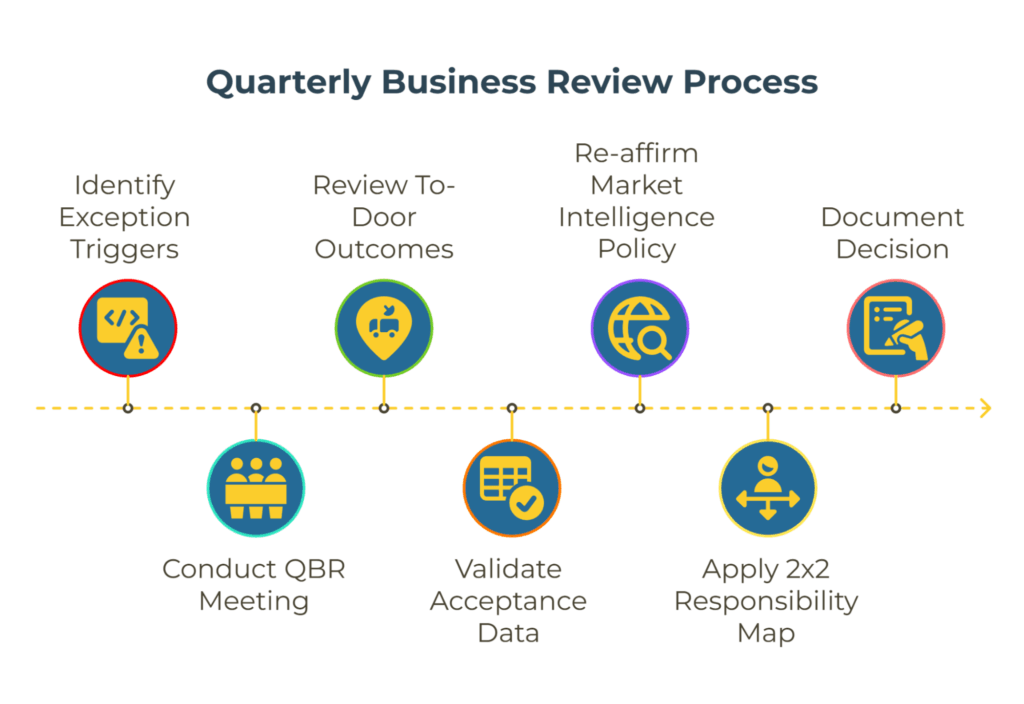
Conduct a formal QBR every quarter, or sooner if exception triggers fire. Exception triggers include freight rate changes exceeding 20%, specification failures on two consecutive shipments, currency fluctuations beyond 5%, delivery delays exceeding the contracted lead time by more than one week, method revisions, or regulatory changes. The QBR agenda includes:
- Review to-door outcomes versus scenarios (did actual freight track baseline, surge, or relief projections?)
- Validate acceptance data by comparing method-named results against tolerance bands and reviewing any non-conformance reports or credit notes
- Re-affirm or adjust the market intelligence policy (if indices are referenced) and confirm effective dates
- Apply the 2×2 Responsibility Map (Specs↔Terms versus Risk↔Cost) to verify that what’s being measured aligns with who bears the risk and who pays the cost
The output is a documented decision to continue, adjust, or escalate the contract terms.
Exception Handling Protocol
When an exception trigger fires, initiate a rapid review within five business days. Assemble the cross-functional team, review the assumption log, identify the root cause of the variance, and decide whether the change requires a contract amendment. Document the decision and update the assumption log to reflect the new baseline. This protocol prevents drift from compounding into material cost variance.
Bridge to Integration Playbook
The QBR template serves as a bridge to the Integration Playbook, which connects cost and contract guardrails with quality tolerances. The Integration Playbook provides a 2×2 responsibility map that clarifies which stakeholder owns specification verification, which owns freight scenario testing, and which owns change control. This map prevents gaps and overlaps, ensuring that every guardrail has a clear owner and a defined review cadence. The price-to-door playbook integrates driver-based benchmarks with the landed-cost framework, providing a comprehensive view of cost management across sourcing and contract execution.
The operating rhythm transforms guardrails from a one-time exercise into a sustainable discipline. Monthly reviews catch small drifts. Quarterly QBRs validate the big picture. Exception handling responds to volatility without panic. Together, these rhythms create a procurement function that manages cost proactively rather than reacting to surprises.
From Guesswork to Guardrails
Containerboard procurement operates in an environment of structural volatility: freight rates swing, specifications drift, and quotes arrive in formats that resist comparison. The instinct to chase the lowest quoted price or negotiate harder on individual terms is understandable, but it addresses symptoms rather than causes. The root issue is not the level of any single cost element. It is the absence of a structured framework that stabilizes cost across quotes, awards, and ongoing deliveries.
The guardrail model provides that framework. By normalizing quotes to-door, stress-testing freight scenarios, defining method-named specifications, establishing review cadence, and maintaining change control, procurement teams replace guesswork with visibility. The outcome is not perfect cost predictability—no framework can eliminate market volatility—but it is significant variance reduction and the organizational confidence that comes from knowing every assumption is documented, every comparison is fair, and every adjustment is deliberate.
The five-point guardrail checklist, the price-to-door scenario sheet, the 2×2 responsibility map, and the assumptions log are not complex tools. They are simple disciplines that compound over time. The first procurement cycle using guardrails requires effort to build the templates and align stakeholders. The second cycle is faster because the templates exist. By the fifth cycle, the guardrails become the default operating model, and the organization wonders how it ever managed without them.
For procurement teams ready to implement the guardrail model, the next step is simple: start with the checklist. Normalize one RFQ to-door. Stress-test one set of freight scenarios. Define one specification with method-named tolerances. Each guardrail builds confidence, and confidence builds momentum. When these guardrails are installed, volatility becomes a managed bandwidth rather than a surprise.
Read Next
Deepen your understanding of containerboard cost management with these related resources:
- Price-to-Door Playbook – Integrate driver-based benchmarks with landed-cost frameworks for defensible supplier selection
- Comparability Before Price – Adopt the spec-first, lane-aware mindset that reduces RFQ chaos
Disclaimer: This article provides general information about stabilizing containerboard landed cost for educational purposes. Individual situations vary with factors like Incoterms and responsibility splits, lane-specific freight volatility, tariff and duty regimes, and test-method acceptance tolerances. For guidance tailored to your cost structure and governance needs, consult qualified professionals.
Explore More Resources
To deepen your understanding of containerboard cost management and global paper sourcing, explore these additional resources:
- Explore PaperIndex Academy – Access comprehensive guides on international trading, Incoterms, and procurement best practices
- Find Suppliers – Connect with verified containerboard suppliers across 195 countries
- Submit RFQ & Receive Quotes Free – Post your buying requirements and receive direct quotes from global suppliers
- Join PaperIndex Free – Suppliers can list their company and access 49,000+ active buyers commission-free
Our Editorial Process
Our expert team uses AI tools to help organize and structure our initial drafts. Every piece is then extensively rewritten, fact-checked, and enriched with first-hand insights and experiences by expert humans on our Insights Team to ensure accuracy and clarity.
About the PaperIndex Insights Team
The PaperIndex Insights Team is our dedicated engine for synthesizing complex topics into clear, helpful guides. While our content is thoroughly reviewed for clarity and accuracy, it is for informational purposes and should not replace professional advice.