

📌 Key Takeaways
Invoice disputes start long before the shipment arrives—they begin with inconsistent cost calculations that turn straightforward procurement into expensive guesswork.
Normalize Everything to One Delivery Standard: Convert all supplier quotes to the same endpoint using visible equalization rows that show exactly which logistics legs you’re adding or removing for true comparison.
Document Every Assumption With Dates and Sources: Create a living log that captures Incoterms responsibilities, currency exchange rates with tolerance bands, HS/HTS classifications, and specification impacts—making disputes resolvable rather than argumentative.
Use Ranges Instead of Point Estimates: Replace precise freight forecasts with driver-band sanity checks that help spot outliers without pretending to predict exact market rates.
Run a 10-Minute Cross-Check Before Award: Align Finance, Logistics, and Operations on currency sources, responsibility matrices, and delivered totals before issuing purchase orders.
Encode Assumptions Into Legal Documents: Transform your assumption log into contract addenda that make responsibilities legally binding and invoice verification straightforward.
Standardized methods prevent disputes; documented assumptions resolve them.
For global B2B kraft and packaging paper buyers managing complex international procurement where Incoterms confusion and hidden logistics costs create expensive invoice surprises.
Kraft paper buyers don’t lose money in the mill. They lose it in the gaps between quotes, contracts, and invoices.
A shipment arrives; the invoice is higher than expected; the scramble begins. Freight legs were read differently, duties were assumed incorrectly, and someone used a different currency exchange date. You can stop this pattern by standardizing how you make landed-cost estimates and making every approval traceable.
The solution lies in consistent execution: normalize all paper quotes to a single to-door total, keep a dated assumption log, sanity-check the big drivers, and get a quick pre-award cross-check from Finance, Logistics, and the Buyer.
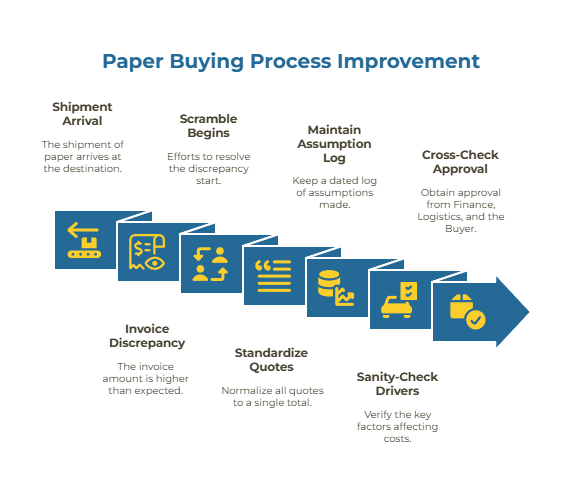
Normalize all quotes to a to-door total, then record every assumption in a dated log: Incoterms rule and named place, who pays each leg, insurance basis, HS/HTS code with duty source and date, currency exchange source and date with tolerance band, and spec/yield notes. Before the award, run a 10-minute Finance × Logistics × Buyer cross-check.
Why Landed-Cost Calculations Go Wrong
Landed-cost errors rarely come from a single bad number; they accumulate from mismatched assumptions across the procurement process.
Incoterms responsibility gaps create the most common blind spots. EXW, FOB, CIF, and DDP shift “who does what, and where” across pickup, export, main carriage, import, and final delivery. If your estimate doesn’t map those hand-offs correctly, you will either double-count or miss legs entirely. The ICC Incoterms® 2020 provides authoritative definitions that eliminate guesswork.
Missing cost elements frequently surface only when invoices arrive. Insurance, duties and taxes, port/terminal fees, local drayage, brokerage, and documentation charges often sit outside the unit price but inside the final invoice. Leaving any component out turns cost comparisons into guesswork rather than analysis.
Currency exchange timing misalignment creates expensive surprises. Teams sometimes price quotes using one day’s exchange rate and later reconcile invoices against another. Without an agreed currency source, date, and tolerance band, both sides can be “right” and still disagree about the final amount.
Specification and yield differences hide in unit pricing comparisons. Basis weight, Cobb absorption, moisture content, and performance metrics like burst/compression strength affect usable yield and effective cost per finished unit. A lower unit price can still produce a higher delivered, true-use cost when these factors are considered.
HS/HTS classification surprises represent expensive last-minute discoveries. A different tariff code or country-of-origin designation can change duty rates significantly. The USITC Harmonized Tariff Schedule search for U.S. imports and EU TARIC system for European trade provide current classification guidance. For background on how the system works globally, the World Customs Organization explains the Harmonized System.
Note on certainty levels: Incoterms definitions and tariff structures are standardized and verified through official sources. Local charges and brokerage fees vary by port, carrier, and service provider, making them context-dependent. Currency controls and specification impacts represent generally accepted procurement practices but require site-specific calibration.
A Simple Method to Avoid Invoice Disputes
Four straightforward practices eliminate most invoice disputes when applied consistently.
Normalize to a single delivery basis. Treat your delivery address as the anchor point. For each quote, add or remove logistics legs to reach the same endpoint. Use visible “equalization rows” in your analysis so additions remain transparent rather than buried in calculations. This approach transforms incomparable quotes into genuine alternatives.
Maintain a date-stamped Assumption and Responsibility Log that becomes a living record, not just meeting notes. Include RFQ/PO identification and version, the Incoterms rule plus named place, responsibility assignments for each logistics leg, HS/HTS classification with duty source and date, currency exchange source and date with tolerance band, and specification/yield impact notes.
Use driver-band sanity checks instead of point estimates. Work with ranges—freight per tonne-kilometer, typical port fee bands, historical duty expectations by code and origin—rather than single-point forecasts. This approach helps identify outliers without pretending to predict exact values. For insights on building confidence through systematic benchmarking, see our guide on driver-based benchmarks for kraft paper procurement.
Run a 10-minute cross-check before award involving three key stakeholders:
- Finance confirms currency exchange source, date, and tolerance band, ensuring the approval sheet ties to delivered totals
- Logistics/Trade Compliance validates the Incoterms rule and named place, scanning HS/HTS classification, duty source and date, and brokered service legs
- Buyer/Operations verifies specification and yield impacts, confirming the selected quote achieves true comparability on a delivered basis
This quick alignment loop coordinates decision-makers without slowing procurement cycles. For broader approaches to role coordination, explore our one-page decision matrix for aligning finance and logistics priorities.
Incoterms in Practice: Getting to Apples-to-Apples
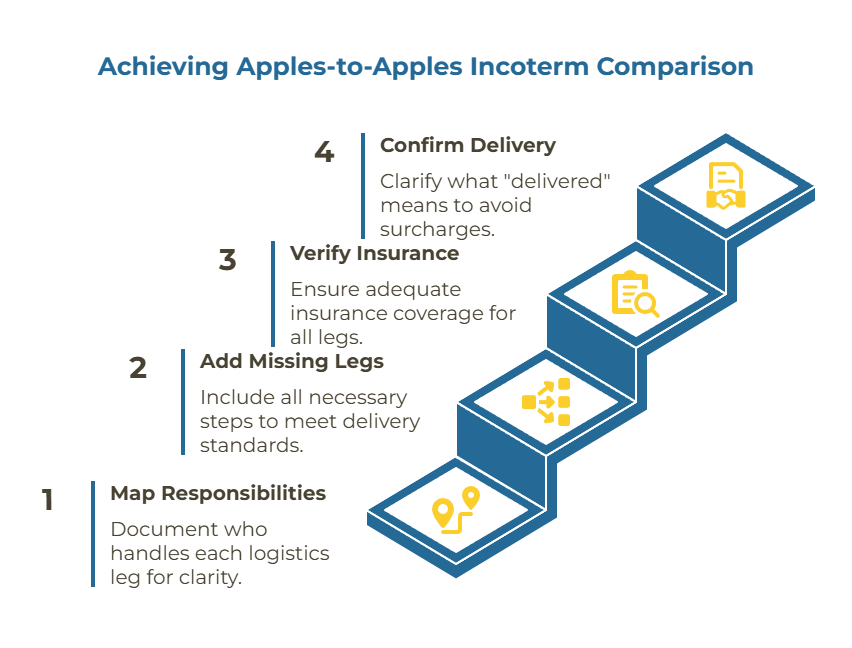
Incoterms allocate tasks, costs, and risk between seller and buyer throughout the logistics journey. Two principles make comparisons reliable.
Map responsibilities to specific legs. For the named place in each quote, document who arranges and pays for pickup, export clearance, main carriage, insurance, import clearance, duties/taxes, and final delivery. The ICC Incoterms® rules hub provides detailed guidance when responsibility assignments aren’t clear.
Add missing legs to reach your delivery standard:
- From EXW: Add all legs from pickup through final delivery
- From FOB: Add main carriage, independent insurance if needed, import clearance, duties/taxes, and local delivery
- From CIF: Add import clearance, duties/taxes, and local delivery; verify insurance coverage adequacy
- From DDP: Confirm what “delivered” includes, as last-mile surcharges can still vary
For practical examples of this normalization process, see our detailed guide on comparing quotes across Incoterms. Understanding why this approach beats “cheapest quote” thinking is covered in our analysis of to-door comparability for kraft paper.
Note on certainty: Incoterms definitions are standardized and verified, but carriers and freight forwarders may package costs differently, making equalization a required method rather than optional step.
Approvals That Stick
Approvals fail when numbers float without their supporting assumptions. Make approvals portable and auditable through systematic documentation.
Encode assumptions in purchase orders or contract addenda. Include the Incoterms rule plus named place, HS/HTS codes with duty source and date, currency exchange source and date with tolerance band, and references to the versioned delivery analysis and assumption log. This integration makes assumptions legally binding and easily verifiable.
Tie invoice verification back to the original log. Accounts payable should verify invoice legs against the delivery equalization analysis and named responsibilities. If a supplier rebills a logistics leg that the buyer owns under the agreed Incoterms, the variance becomes visible and resolvable through documented assumptions.
Define acceptable variance limits per cost category and require an automatic review whenever those limits are exceeded. Small variations represent normal market fluctuations, but larger discrepancies require investigation and potential supplier discussion before payment approval.
Templates
Landed-Cost Pitfall Checklist
Incoterms Responsibility Map
- [ ] Rule and named place written in full (pickup → export → main carriage → import → delivery)
- [ ] Seller vs. buyer responsibility matrix completed for each leg
Cost Elements Verification
- [ ] Freight, insurance, duties/taxes, port/terminal, local drayage present
- [ ] Brokerage and documentation/compliance fees included
- [ ] All elements traced to delivery total
Currency and Specifications
- [ ] Exchange rate source, rate, date, and tolerance band documented
- [ ] Basis weight, burst/compression, Cobb absorption, moisture content specified
- [ ] Yield factors and usable percentage calculated (Cobb per ISO 535)
Pre-Award Sign-Off
- [ ] Finance approval (initials/date): _______
- [ ] Logistics verification (initials/date): _______
- [ ] Buyer confirmation (initials/date): _______
Assumption and Responsibility Log—Required Fields
Basic Information: RFQ/PO ID + Version + Date; Supplier name and contact
Trade Terms: Incoterms rule + place/port; Seller vs. buyer responsibility matrix
Transportation: Freight legs and routing; Insurance basis (who arranges, coverage level)
Regulatory: HS/HTS code + duty source with URL and date; Port/terminal/local charges included/excluded
Financial: Brokerage and documentation fees; Currency exchange source/rate/date/tolerance band
Specifications: Basis weight, burst/compression, Cobb absorption, moisture; Yield impact notes affecting effective cost
Approvals: Sign-offs from Finance, Logistics, and Buyer with initials and dates
Illustrative Example (Structure Reference):
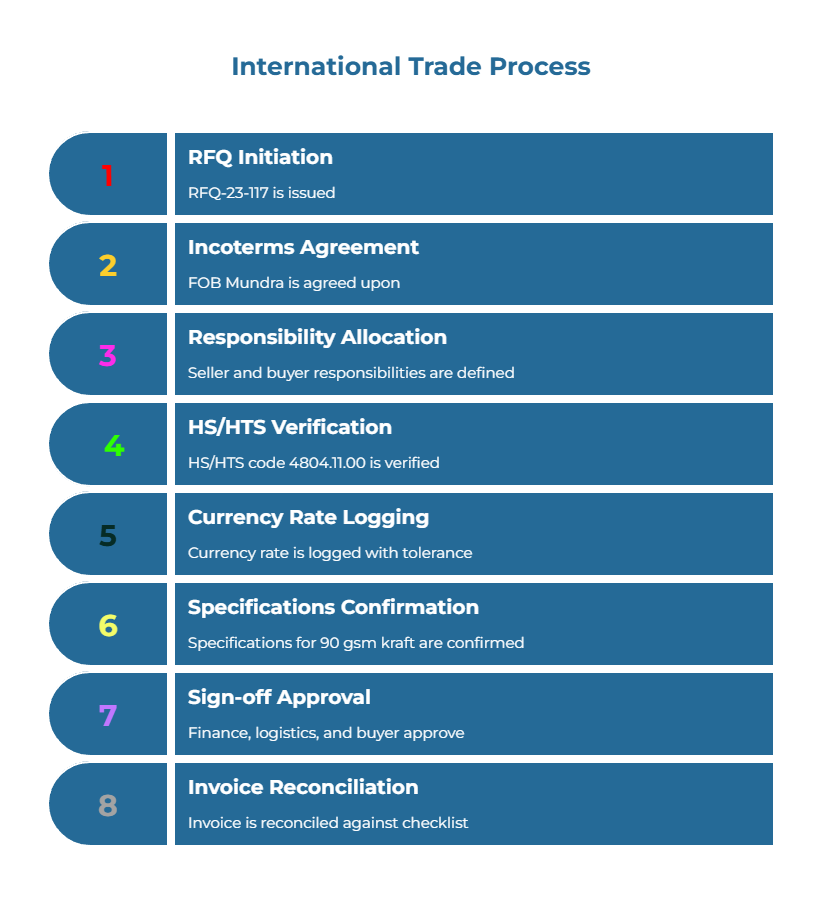
- RFQ: RFQ-23-117 / PO-DRAFT v3 (2025-09-12)
- Incoterms: FOB Mundra
- Responsibility: Seller handles export clearance + origin terminal; Buyer handles ocean freight, insurance, import clearance, duties/taxes, local delivery to facility
- HS/HTS: 4804.11.00; duty source: USITC HTS (verified 2025-09-12)
- Currency: Source = ECB 16:00 CET; Rate/Date logged; Tolerance ±2%
- Specifications: 90 gsm kraft, Cobb 60 target, moisture 7% ±1%
- Sign-offs: Finance JS; Logistics RK; Buyer MN (2025-09-13)
Invoice Reconciliation Checklist
- [ ] Invoice reflects agreed Incoterms rule and named place
- [ ] Billed legs match documented responsibility matrix
- [ ] Duties calculated per logged HS/HTS code and source date
- [ ] Currency basis consistent with documented source and tolerance band
- [ ] Local/terminal/brokerage fees fall within expected ranges
Frequently Asked Questions
What if a supplier quotes different Incoterms than requested?
Convert their quote to your standard delivery basis using current market rates for missing services. Keep the supplier’s original Incoterms intact on their quote, then add missing legs in visible equalization rows. Document the named place explicitly and verify responsibility assignments against official ICC guidance.
How should large currency moves between quote and shipment be handled?
Establish upfront agreements on currency exchange source, time of day for rate capture, and tolerance bands for approvals. Treasury departments typically operate with a narrow tolerance band around the market rate for major currency pairs such as EUR/USD. Movements beyond agreed bands should trigger supplier conversations about impact sharing, particularly for moves exceeding 5%.
Which local charges most often cause invoice disputes?
Terminal handling charges, documentation fees, customs processing, and last-mile delivery surcharges frequently appear after contract award. Keep these as separate equalization lines so visibility remains high throughout the approval process. Port and carrier practices vary significantly by trade lane and season.
The key insight preventing most disputes is straightforward: standardize everything to the same delivery basis, document every assumption with dates and sources, and verify that contracts reflect your documented assumptions. When all stakeholders work from the same cost breakdown, disputes become rare exceptions rather than regular frustrations.
For additional insights into building procurement confidence, explore our guide on spec-true thinking that reduces RFQ chaos. Teams can also benefit from visiting the PaperIndex Academy for more procurement-ready frameworks and checklists.
Disclaimer: PaperIndex is a neutral marketplace and does not provide market-intelligence products or definitive price guidance. This article is for educational purposes.
Our Editorial Process
Our expert team uses AI tools to help organize and structure our initial drafts. Every piece is then extensively rewritten, fact-checked, and enriched with first-hand insights and experiences by expert humans on our Insights Team to ensure accuracy and clarity.
About the PaperIndex Insights Team
The PaperIndex Insights Team is our dedicated engine for synthesizing complex topics into clear, helpful guides. While our content is thoroughly reviewed for clarity and accuracy, it is for informational purposes and should not replace professional advice.