

📌 Key Takeaways
“Seaworthy packing” protects against handling damage, not moisture, and that gap ruins paper cargo.
- Seaworthy Is a Label, Not a Spec: The phrase implies basic transport fitness but defines nothing about humidity control, condensation management, or moisture barriers inside the container.
- Plastic Traps Moisture, Not Blocks It: Tight shrink-wrapping seals humid air against paper surfaces, accelerating mould, edge softening, and staining when container rain forms.
- Carriers Defend Claims With Your Vague Instructions: Without written packing specifications and timestamped photos, “insufficient packing” and “inherent vice” arguments weaken your position before any dispute begins.
- Insurance Compensates—It Does Not Prevent: Marine cargo policies are financial backstops for residual risk, not substitutes for proper moisture-control measures that protect production schedules and customer relationships.
- Buyer Silence Invites Lowest-Cost Packing: Suppliers optimize within cost limits; without a one-page packing checklist on every purchase order, standards drift toward “good enough” rather than moisture-safe.
Replace vague promises with checkable specs—your cargo depends on it.
Paper importers, procurement managers, and export logistics teams responsible for paper shipments will gain a clear framework for rewriting packing instructions, preparing them for the myth-versus-reality reference table that follows.
The container doors swing open. Inside, your paper reels sit exactly where they were loaded—but something is wrong. Edges are soft. Cartons show tide-like stains. A faint smell of mould drifts out. You check the shipping documents: “Seaworthy packing confirmed.”
If this scenario sounds familiar, you are not alone. Importers and procurement managers across the paper industry face the same frustrating pattern: cargo arrives damaged, everyone points fingers, and the phrase “seaworthy packing” appears in the paperwork as if it were a guarantee. It was not.
In everyday shipping paperwork, “seaworthy packing” sounds like a firm promise that your paper cargo is safe. In reality, it is usually a vague, minimum-standard label that says very little about how well moisture and condensation have been managed inside the container. This article walks you through five common myths hidden inside that phrase and shows you how to turn them into simple, checkable packing specifications that travel with every purchase order.
This article is part of the Paper Protection During Shipping Transit series on moisture and humidity control for paper cargo. It is written for small and mid-sized importers, procurement managers, and export logistics teams who want to replace blind trust in vague wording with practical, moisture-focused packing standards that can be specified, documented, and repeated.
Key Terms You Need to Know
| Term | Practical Meaning |
| Seaworthy packing | A general statement that cargo is packed suitably for ocean transport. It typically implies basic protection against normal handling but rarely defines specific moisture-control performance. |
| Container rain | Condensation that forms when warm, moist air inside a shipping container meets cold steel walls during temperature swings at sea. Water droplets collect on the ceiling and walls, then drip onto cargo below. |
| Moisture barrier | A material or layer designed to prevent water vapour or liquid water from reaching the cargo surface. Common examples include moisture-resistant kraft paper, aluminium foil laminates, or specialised films. |
| Desiccant | A substance, often silica gel or calcium chloride, placed inside containers or packaging to absorb excess humidity and reduce condensation risk. |
| Inherent vice | A legal and insurance term referring to a quality within the cargo itself that causes damage—such as paper’s natural tendency to absorb moisture. Carriers and insurers sometimes cite this to limit liability. |
Why ‘Seaworthy Packing’ Feels Safe—And Why It Is Not
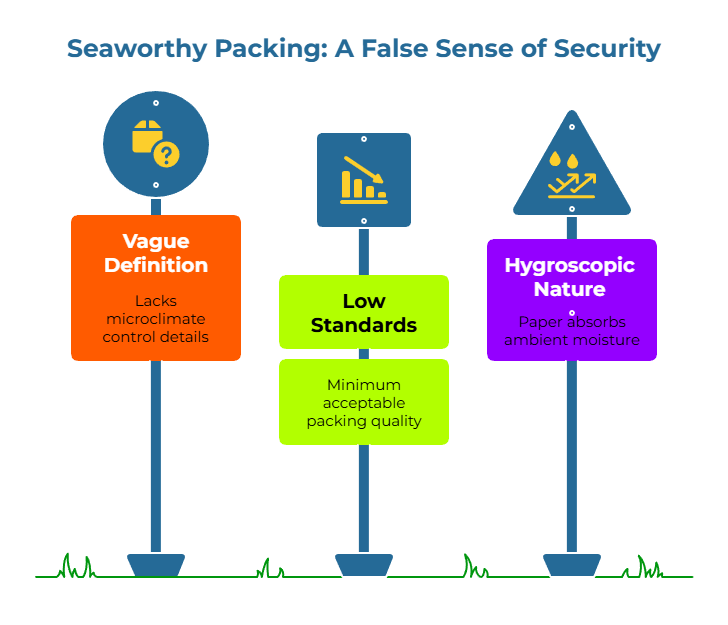
The phrase appears everywhere: supplier emails, freight quotes, bills of lading. It sounds reassuring. After all, if packing is certified as “seaworthy,” surely your paper is protected?
Not quite. “Seaworthy” generally means cargo is packed well enough to survive normal transport without obvious damage during loading and unloading. It says almost nothing about how the container microclimate is controlled over several weeks at sea—the humidity fluctuations, condensation drip, and temperature swings that cause container rain.
In practice, the term is often interpreted at the lowest acceptable standard. For hygroscopic materials like paper, which actively absorb moisture from surrounding air, that gap between comfort and reality is where most moisture claims begin.
Myth #1: ‘Seaworthy Packing’ Automatically Protects Against Moisture
The myth in the buyer’s words: “Don’t worry, we always use seaworthy packing. Your cargo will be fine.”
Reality on the ground: When suppliers or forwarders use this phrase, they typically mean cargo will not shift or collapse during transit and will look intact when the container opens. Moisture performance inside the container—where humidity can spike above 80% and condensation can drip for days—is rarely part of that promise.
Unless your purchase order explicitly requires moisture-control measures, “seaworthy” often translates to the cheapest packing that passes a visual check. Paper reels wrapped in basic stretch film may look protected, but that film does nothing to manage humid air trapped inside.
What to specify instead:
- Name the moisture-barrier material required around reels or cartons.
- State minimum stowage gaps from container walls (commonly 10–15 cm) to prevent contact with wall condensation, while explicitly requiring dunnage bags or bracing to fill these voids and prevent cargo shifting.
- Require desiccant bags with specified absorption capacity based on shipment volume and expected route humidity.
Myth #2: Plastic Wrapping Is a Moisture Shield, Full Stop
The myth in the buyer’s words: “If it’s fully shrink-wrapped, water can’t get in.”
Reality on the ground: Plastic wrapping keeps liquid water out—but it also traps moisture vapour inside. When container rain forms and temperatures drop, trapped humidity condenses directly against the paper surface. The plastic meant to protect cargo now holds water in place, accelerating edge softening, mould growth, and staining.
Think of wrapping a hot dish in cling film and putting it in the refrigerator. Condensation forms inside the wrap, not outside. The same physics apply to paper crossing climate zones at sea.
What to specify instead:
- Request wrapping schemes that allow drainage rather than sealed cocoons. Some suppliers use perforated films or leave openings at the base.
- Require absorbent top sheets and corner protectors that wick moisture away from edges.
- Include clear instructions about where plastic should be applied—and where it should not form a sealed barrier.
The focus shifts from “more plastic” to controlled moisture paths.
Myth #3: If Cargo Is Wet, the Carrier Will Pay Anyway
The myth in the buyer’s words: “We’ll just claim from the carrier. That’s what insurance is for.”
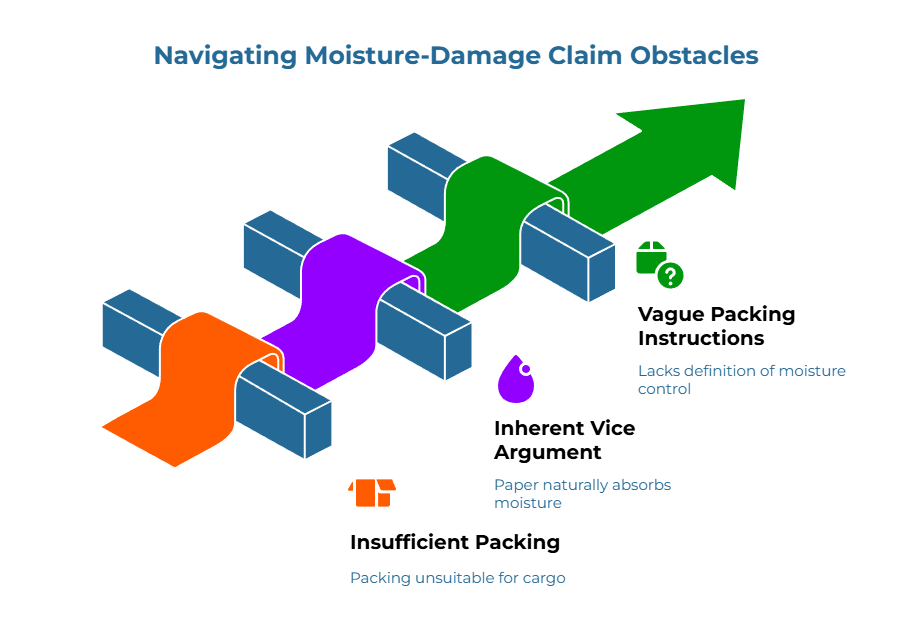
Reality on the ground: Filing a claim is rarely straightforward. Carriers and insurers routinely defend against moisture-damage claims by arguing that packing was “insufficient” or “unsuitable” for cargo type and route conditions. They may invoke “inherent vice”—the argument that paper naturally absorbs moisture and this tendency, not carrier negligence, caused the damage.
Vague packing instructions make these defences easier. If your purchase order simply says “seaworthy packing” without defining moisture control, you have little documentation to counter the carrier’s position.
What to specify instead:
- Share written packing instructions with your supplier before shipment, clearly stating moisture-control requirements.
- Agree in writing on who is responsible for selecting packing methods and materials.
- Require dated, timestamped photos of packed cargo before the container is sealed.
Visual evidence of desiccants in place, barrier materials applied, and stowage gaps maintained strengthens your position significantly.
Myth #4: Insurance Is Your Moisture Protection Plan
The myth in the buyer’s words: “We have marine cargo insurance, so we’re covered.”
Reality on the ground: Insurance is a financial backstop for residual risk—not a humidity-control system. While a successful claim under standard Institute Cargo Clauses typically reimburses the invoice value (plus a percentage), it rarely covers indirect financial losses such as production downtime, expedited replacement freight, or brand reputation damage.. If insurers argue packing was substandard, coverage may be reduced or denied.
What to specify instead:
- Treat packing standards as your first line of defence. Design packing and moisture-control measures as if there were no policy.
- Use claims history and near misses to refine specifications over time.
- Calibrate insurance coverage for residual risk—events good packing cannot fully prevent—rather than treating it as a substitute for proper packaging.
Prevention is faster, cheaper, and more reliable than compensation.
Myth #5: ‘The Supplier Knows Best—We Should Not Interfere’
The myth in the buyer’s words: “They’ve been exporting for years. They know what they’re doing.”
Reality on the ground: Suppliers have expertise, but they also face pressure to keep costs low. Packing materials, desiccants, and labour all cost money. In the absence of precise buyer specifications, packing standards often default to the most cost-effective option that meets basic shipping regulations. This means protection levels may fluctuate based on material availability and cost pressures rather than the specific climate risks of your route. But “good enough for most shipments” may not suit your specific route, seasonal humidity conditions, or downstream customer requirements.
What to specify instead:
- Own the minimum specification. Define baseline moisture-control requirements in writing.
- Attach a one-page packing checklist to every purchase order covering required materials, stowage instructions, desiccant quantities, and photo documentation.
- Invite suppliers to propose stronger options above baseline—but not weaker ones.
From Vague ‘Seaworthy’ to Checkable Specs
The phrase “seaworthy packing” is a label, not an engineering specification. It tells you nothing about humidity targets, barrier materials, or condensation management. To change outcomes, start by auditing current purchase orders, contracts, and shipping instructions. Wherever “seaworthy” appears alone, support it with clear requirements anyone on the packing floor can follow.
Myth vs. Reality: Quick-Reference Table
| Myth | Reality | What to Specify Instead | Risk If Believed |
| “Seaworthy packing” guarantees moisture protection | Reflects minimum handling fitness, not defined humidity or condensation control | Named moisture barriers, wall clearances, moisture-control measures on every PO | Wet but technically “seaworthy” arrivals, disputed claims |
| Plastic wrapping is a complete moisture shield | Tight plastic traps condensation against paper, worsening damage | Wrapping schemes allowing drainage, absorbent layers, clear application instructions | Mould, edge softening, staining hidden under intact wrap |
| The carrier will pay if cargo is wet | Carriers cite “insufficient packing” or “inherent vice” to limit liability | Written packing instructions, agreed responsibilities, timestamped photos | Prolonged disputes, partial or denied claims |
| Insurance is your moisture protection plan | Insurance is financial backstop; cannot recover lost time, trust, or indirect costs | Packing as first defence; insurance for residual risk | Frequent claims, hidden operational costs |
| The supplier knows best—don’t interfere | Suppliers optimise for cost; buyer silence pushes toward lowest-acceptable standards | Buyer-owned packing checklist on every PO, room for stronger supplier proposals | Inconsistent packing, preventable moisture problems |
Print or share this table with your team and suppliers when updating packing instructions. It provides a shared language for moving from slogans to specifications.
Where to Go Next
Understanding why “seaworthy packing” fails is the first step. The next is building specifications, checklists, and documentation practices that replace it.
The cluster hub on defeating container rain explains condensation physics and temperature swings in shipping containers—essential background for designing moisture-control standards. Related articles cover why claim-reliance is a costly strategy and how to structure spec-based packing instructions suppliers can follow consistently.
For broader guidance on paper procurement, export logistics, and risk management, explore the PaperIndex Academy. To connect with verified suppliers or discover new sourcing options, PaperIndex serves as a neutral B2B marketplace for the global pulp and paper industry.
Disclaimer: The information in this article is for general educational purposes only and does not constitute legal, insurance, or financial advice. Packaging obligations, carrier responsibilities, and insurance coverage vary by contract, jurisdiction, and policy. Always review your specific situation with qualified legal, logistics, and insurance professionals before making decisions.
Our Editorial Process
Our expert team uses AI tools to help organize and structure our initial drafts. Every piece is then extensively rewritten, fact-checked, and enriched with first-hand insights and experiences by expert humans on our Insights Team to ensure accuracy and clarity.
About the PaperIndex Insights Team
The PaperIndex Insights Team is our dedicated engine for synthesizing complex topics into clear, helpful guides. While our content is thoroughly reviewed for clarity and accuracy, it is for informational purposes and should not replace professional advice.