

📌 Key Takeaways
How you store kraft paper matters more than when you bought it — moisture and humidity can quietly ruin usable stock.
- Storage Trumps Purchase Date: Paper stored in unstable humidity can lose quality fast, no matter how recently it was made or how good the grade is.
- Paper Absorbs Its Surroundings: Kraft paper naturally soaks up and releases moisture from the air, so even mild humidity swings can cause warping, curling, or soft spots over time.
- Order Size Shapes Storage Risk: Buying in bulk saves money, but stock sitting longer in a humid warehouse faces more exposure — match order volume to how fast you actually use it.
- Ask Before You Order: Check with your warehouse about humidity, pallet conditions, and stock rotation before placing large orders — not after quality complaints show up.
- Supplier Guidance Prevents Waste: Ask your supplier for specific storage and handling recommendations for your grade and format — one conversation can prevent costly reorders.
The warehouse is where shelf life is won or lost — not the purchase order.
Procurement teams managing kraft paper inventory will gain practical ways to reduce storage-related waste, preparing them for the detailed overview that follows.
~ ~ ~ ~ ~ ~ ~ ~ ~ ~ ~ ~ ~ ~ ~ ~ ~ ~
Procurement teams evaluate kraft paper by grade, price, supplier reliability, and delivery schedule. These criteria shape the purchase, but they do not dictate the material’s lifecycle. Once the paper arrives, storage conditions begin influencing whether it stays usable when the warehouse, packaging, or operations team actually needs it.
In practical procurement terms, kraft paper shelf life is the period during which the paper remains suitable for its intended packaging use. That period varies by grade, format, packaging, storage environment, handling, and supplier guidance. Moisture and humidity are especially important because paper materials are highly reactive to environmental changes. But storage risk also involves packaging protection, pallet practices, handling, stock rotation, and how long material sits before use. Purchasing decisions directly affect these variables. Understanding that connection helps avoid preventable waste and improve coordination with warehouse teams and suppliers.
Why Kraft Paper Shelf Life Depends on Storage, Not Just Purchase Date
Storage conditions can significantly shorten kraft paper’s usable life, though the exact rate of degradation heavily depends on the specific grade, as heavily sized or poly-coated variants offer greater moisture resistance. Ultimately, a recent manufacturing date cannot guarantee usability if environmental controls fail.
The core issue is the common assumption that shelf life depends mostly on the product itself: the supplier’s quality controls, the paper grade, or the date printed on the certificate. Those factors matter, but they represent only part of the picture.
Paper and paperboard materials are sensitive to relative humidity — the amount of moisture present in the air compared to how much the air can hold at a given temperature — and to temperature itself. Humidity and temperature are important enough in paper testing that TAPPI T 402 defines standard atmospheres for conditioning and testing paper, board, and related products. TAPPI standards for paper conditioning confirm that properties like dimensional stability depend on maintaining consistent environmental conditions. The Library of Congress similarly notes that paper storage benefits from a cool, dry, clean, and stable environment — though archival preservation guidance must be adapted for industrial kraft paper contexts where handling volumes and warehouse realities differ.
The practical implication: shelf life is not a fixed number. It’s a variable shaped by the material, the storage environment, and storage duration. Procurement teams that factor these conditions into ordering decisions are better positioned to avoid quality complaints and emergency reorders.
How Humidity and Moisture Can Affect Kraft Paper in Storage
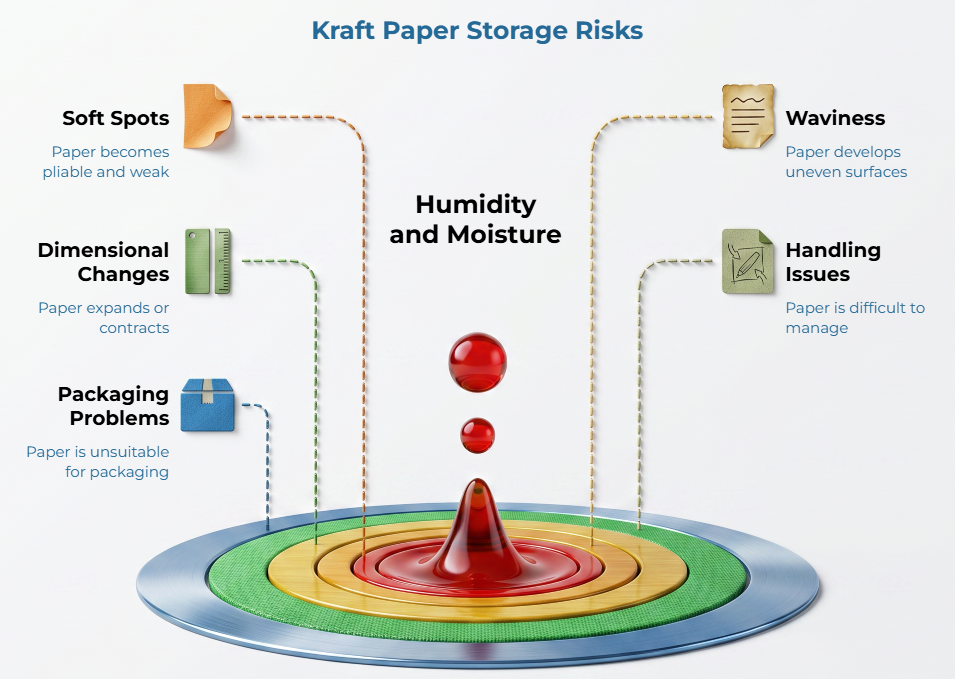
Kraft paper is hygroscopic — meaning it naturally absorbs and releases moisture in response to surrounding air. When relative humidity rises in a storage environment, the paper takes on moisture. When it drops, the paper releases it.
This ongoing exchange is normal. It becomes a problem when conditions are unstable, excessive, or prolonged.
Kraft paper doesn’t have to be soaked to become a storage concern. Prolonged or repeated exposure to unfavorable conditions can gradually affect usability, appearance, handling characteristics, and packaging readiness. Sheets or rolls stored in a humid environment may develop soft spots, waviness, or subtle dimensional changes that only become apparent during converting or packaging operations.
The risk isn’t limited to humid air. Common moisture pathways include condensation on walls or ceilings, water seepage near dock doors, wet floors, leaks from roofing or plumbing, and contact with damp pallets or concrete flooring. Even protective wrapping can lose effectiveness if torn, punctured, or loosened during handling.
Stability is often more important than absolute dryness. TAPPI T 502 provides the standard test method for determining the equilibrium relative humidity (ERH) of paper and paperboard, helping operators predict whether a sheet will absorb or release moisture in a specific environment. Because paper dynamically responds to these metrics, maintaining a stable surrounding atmosphere is generally more practical for converters than attempting to alter the inherent moisture profile of the sheet itself. A warehouse with reasonably consistent conditions tends to be safer than one that swings between extremes. Dramatic fluctuations cause fibers to expand and contract repeatedly, which may lead to curling, warping, or tension imbalances. The principle of moisture windows for kraft paper converting — maintaining a stable range rather than targeting a single exact number — applies to storage as well. Related guidance on storage and conditioning for kraft reels explores how transit and warehouse staging interact with moisture quality risks.
Storage Conditions Procurement Should Ask About Before Ordering
Procurement professionals rarely control the warehouse directly. That doesn’t mean purchasing decisions happen in isolation. Asking the right questions before placing or increasing an order can reduce storage-related risk — not by managing warehouse operations, but by ensuring order volume and timing reflect storage realities.
The following table connects common warehouse storage factors to the procurement questions they should prompt:
| Storage Factor | Procurement Question to Ask |
| Humidity levels and fluctuation | Is the warehouse prone to elevated or seasonally changing humidity? |
| Moisture exposure zones | Are there known risk areas near dock doors, exterior walls, or floor drains? |
| Temperature swings | Does the storage environment experience significant temperature variation that could cause condensation? |
| Packaging damage | Who inspects incoming deliveries for torn, punctured, or missing protective wrapping? |
| Floor and pallet contact | Is stock kept off concrete floors using intact, dry pallets? |
| Extended holding time | How long will the ordered volume realistically sit before it’s consumed? |
| Stock rotation | Is a first-in, first-out process in place for paper inventory? |
| Supplier guidance | Has the supplier provided storage and handling recommendations for this grade and format? |
Packaging integrity — the condition of the wrap, pallet, labels, and outer protective layers after shipment and handling — deserves particular attention. Where supplier guidance supports it, keeping protective wrapping intact until the material is ready for use can help reduce unnecessary exposure. Rolls or sheets with torn or missing packaging should be flagged at receiving and prioritized for early use.
Handling adds risk too. Repeated movement, rough roll handling, and torn packaging during internal transfers can increase moisture exposure — even in an otherwise well-managed warehouse. For inspection-based approaches, review current guidelines on how to protect kraft paper parent rolls from warehouse moisture and temperature risks.
Dust and pest exposure are worth mentioning as secondary risks for extended storage. Direct sunlight, however, presents a more immediate risk; UV exposure typically causes rapid photodegradation of lignin in unbleached kraft grades, while localized heating creates severe moisture gradients that warp the sheet. Conversely, bleached kraft paper—having had most of its lignin removed during processing—is less susceptible to UV degradation, though it remains highly vulnerable to thermal warping.
Why Order Volume and Delivery Cadence Affect Shelf-Life Risk
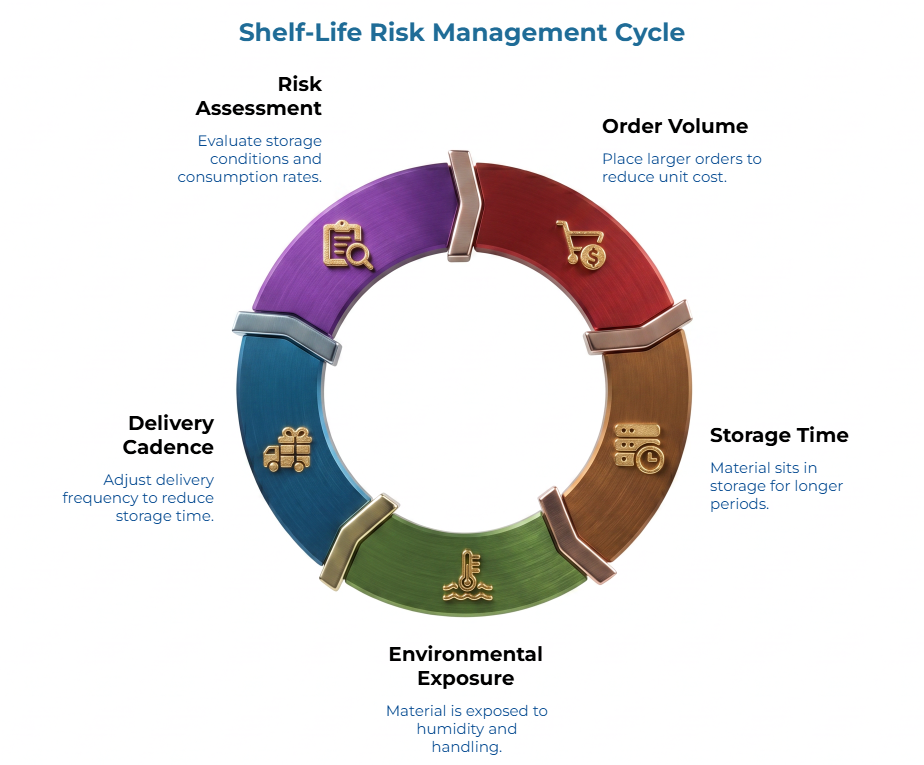
One of the most direct ways procurement can influence storage risk is through order volume relative to consumption rate. Larger orders may reduce unit cost, but they increase the time material sits in storage — and with it, cumulative exposure to humidity fluctuations and handling.
This isn’t an argument against bulk buying. It’s a reason to weigh the cost advantage against the storage reality.
For instance, a team that consumes kraft paper within an optimized short-term window—such as 14 to 21 days—generally faces lower exposure risks and can typically handle larger orders with minimal concern, provided the warehouse is protected from extreme seasonal humidity spikes or direct moisture. The same order volume sitting through a humid season in a warehouse without environmental controls presents a different risk profile entirely — even though the paper, supplier, and price are identical.
Delivery cadence — the frequency and timing of shipments — offers a practical lever. More frequent, smaller deliveries reduce the time any batch spends in storage. That approach requires reliable supplier performance and well-calibrated reorder cadence for kraft paper, but it can lower exposure risk in challenging environments or during seasonal humidity changes.
Before increasing order volume, estimate how long additional stock will sit, whether the warehouse experiences seasonal humidity shifts, and whether the storage area can protect the material for the expected holding period.
A Storage-Readiness Checklist Before Placing a Kraft Paper Order
Translating storage risk into action is easier with a structured approach. Before placing a large or recurring kraft paper order, the following checklist helps assess whether storage conditions support the order size.
- Expected storage duration: How long will the ordered volume sit before it’s consumed? Holding inventory for weeks, rather than days, makes storage conditions significantly more critical.
- Humidity and moisture concerns: Is the warehouse prone to elevated or fluctuating humidity? Are there known moisture-risk areas near dock zones, floor drains, or exterior walls?
- Seasonal changes: Will stock be held through a season when humidity shifts? Planning deliveries around those periods may reduce exposure.
- Packaging condition on receipt: Who inspects deliveries for damaged wrapping or compromised protective layers? A structured approach to kraft paper bulk receiving controls supports that process.
- Wrapping stays intact: Can rolls or bundles remain in original protective packaging until needed?
- Pallet and floor-contact prevention: Are pallets in good condition? Is stock kept off concrete and away from wet surfaces?
- Stock rotation: Is a first-in, first-out practice in place? Without rotation, some stock sits far longer than planned. Refer to industry guidelines on kraft paper jumbo roll storage for related rotation practices and production readiness.
- Partially used rolls and opened bundles: Are these protected after use, or left exposed in the storage area?
- Supplier handling recommendations: Has the supplier provided storage guidance for the grade and format ordered?
- Inspection after storage: What’s the process for checking material condition after extended storage?
- Escalation for suspected exposure: Is there a documented process for flagging suspected moisture damage before material reaches production?
Ask your supplier for storage and handling recommendations before placing large-volume orders. That single conversation can clarify half the items on this list.
Warning Signs That Storage May Be Affecting Kraft Paper Usability
When to investigate: The following signs don’t confirm moisture damage on their own, but each can be a reason to check storage conditions, receiving records, and handling history before sending material to production.
- Visible moisture, water staining, or condensation on wrapping or outer packaging surfaces
- Warping, curling, or waviness that wasn’t present at delivery
- Soft spots or areas where the paper feels noticeably different from the rest of the roll
- Damaged or missing wrapping — especially if the packaging was intact at receiving
- Musty or unusual odor, which may indicate prolonged moisture contact
- Dust accumulation or signs of pest activity on stock held in long-term storage
- Performance complaints from operations or converting teams after using stored materials. If operational issues arise, consult your internal guidelines on why kraft paper curls, cracks, or wrinkles during conversion
Consider a case where a packaging team reports that kraft paper from one storage location curls during converting, while paper from the same supplier batch stored elsewhere runs cleanly. That pattern points to storage conditions — not supplier quality — as the likely variable.
When these signs appear, document the condition, review receiving records and storage location, and determine whether the issue warrants a supplier conversation or internal warehouse review.
What to Ask Your Kraft Paper Supplier
Suppliers are the most authoritative source of material-specific storage guidance. Including storage and handling questions in purchasing conversations provides information that reduces downstream risk — without needing deep paper-science expertise.
Useful questions to raise with a kraft paper supplier include:
- What storage conditions do you recommend for this grade and format?
- Should rolls or sheets remain in original packaging until use?
- Are there humidity or temperature ranges the receiving and warehouse teams should follow?
- What signs of exposure should the receiving team check for on delivery?
- How should older stock be rotated relative to newer deliveries?
- What delivery cadence do you recommend based on typical usage volume?
- How should partially used rolls or opened bundles be protected?
Request exact humidity ranges, temperature ranges, or shelf-life timelines from the supplier in writing. Without product-specific documentation, general storage advice should stay general.
Recommendations vary by grade, format, and end use.
For questions extending beyond storage into delivery and warehouse readiness, refer to the packaging, delivery, and warehouse questions kraft paper buyers should ask.
Treating supplier guidance as part of the buying decision — not an afterthought — is one of the simplest ways to reduce preventable quality issues.
Make Storage Part of the Buying Decision
Kraft paper shelf life is shaped by more than the manufacturing date or the grade on a certificate. Storage conditions, handling, packaging integrity, stock rotation, and the time material spends in a warehouse all contribute to whether that paper performs at the converting or packaging line.
Procurement doesn’t control every storage variable. But purchasing decisions influence how much stock sits in a warehouse, for how long, and whether the right questions were asked before material arrived.
Before placing a large kraft paper order, review your storage setup and ask your supplier for handling recommendations specific to the grade and format you buy. Coordinate with your warehouse team before increasing order quantity. Buyers comparing kraft paper mother rolls or shortlisting kraft paper raw material suppliers can use these questions to make supplier conversations more practical. Teams reviewing active demand can also monitor kraft paper buyer inquiries to understand how sourcing conversations are framed in the market. Those conversations — held before the purchase, not after a quality complaint — protect the value of every roll and every sheet.
Frequently Asked Questions
Does humidity affect kraft paper shelf life?
Yes. Paper materials respond to relative humidity and temperature. The degree of impact depends on the storage environment, exposure duration, paper grade, packaging condition, and intended end use. Stable, dry conditions generally support longer usability, depending on grade and supplier guidance.
Should kraft paper stay wrapped in storage?
In many cases, keeping protective packaging intact until use helps reduce moisture exposure. Recommendations vary by product format, so confirm with your supplier whether their packaging is designed for extended storage protection.
Can kraft paper be stored on the floor?
Direct floor contact — especially on concrete — increases the risk of moisture transfer and handling damage. Using intact, dry pallets is a widely recommended practice, though specific requirements should be verified with warehouse and supplier guidance.
How long can kraft paper be stored?
There’s no universal timeline. Storage life depends on grade, packaging, warehouse conditions, handling practices, and supplier recommendations. Rather than assuming a fixed shelf life, assess specific storage conditions and consumption rate when planning order volumes.
What should procurement ask before placing a large kraft paper order?
Key questions: How long will stock sit before use? What are the warehouse’s humidity conditions? Is there a stock rotation process? Has the supplier provided handling guidance for this grade and format? Can protective packaging remain intact until the material is needed?
Disclaimer:
Storage guidance in this article reflects general principles for kraft paper handling and may vary by paper grade, packaging format, supplier specifications, and end-use requirements. Verify storage conditions and handling practices with your supplier and relevant internal teams. This content is educational and does not replace supplier-specific or professionally verified guidance.
Our Editorial Process:
Our expert team uses AI tools to help organize and structure our initial drafts. Every piece is then extensively rewritten, fact-checked, and enriched with first-hand insights and experiences by expert humans on our Insights Team to ensure accuracy and clarity.
About the PaperIndex Insights Team:
The PaperIndex Insights Team is our dedicated engine for synthesizing complex topics into clear, helpful guides. While our content is thoroughly reviewed for clarity and accuracy, it is for informational purposes and should not replace professional advice.