
📌 Key Takeaways
Stockouts reveal structural sourcing weaknesses that panic buying only deepens—strategic preparation transforms crises into resilience.
- Crisis Costs Compound Quickly: A 4% sales loss from stockouts costs a $50,000/week store $2,000 weekly, plus hidden expenses from rushed contracts and quality failures.
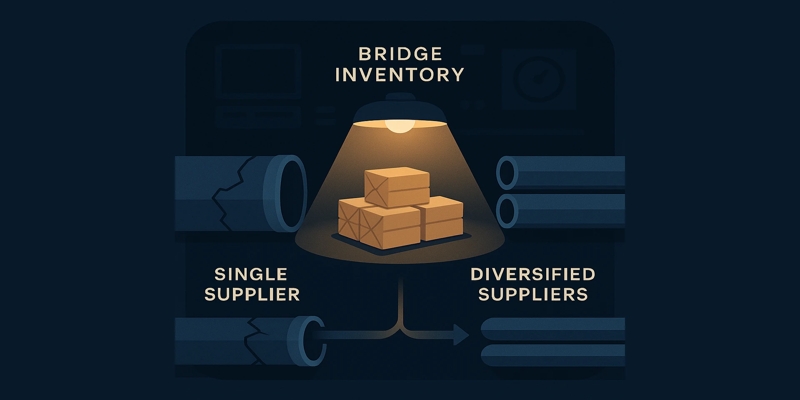
- Diversification Protects Operations: Keeping no single supplier above 60–70% of volume prevents one disruption from stopping your entire operation.
- Bridge First, Strategize Second: Secure 7–10 days of emergency inventory without long-term commitments, then build lasting supplier relationships during the recovery window.
- Compliance Cannot Wait: California-style plastic bag bans with recycled content requirements and mandatory charges make regulatory verification non-negotiable even under time pressure.
- Total Cost Beats Unit Price: Customer defection, rush freight, and quality failures often exceed the apparent savings from cheaper suppliers.
One stockout exposes fragility; the response determines whether it’s the last one.
Small retail owners and procurement managers sourcing wholesale paper bags will gain immediate crisis stabilization steps and a 90-day transformation framework, preparing them for the detailed implementation guide that follows.
Your last box of paper bags sits on the shelf.. The holiday weekend starts tomorrow.
Picture this: customers are lining up, your registers are humming, and somewhere between the checkout counter and the back room, you realize you’re about to run dry. Your usual supplier isn’t answering. The backup number goes to voicemail. That familiar knot tightens in your stomach.
You’ve been here before. Most small retail business owners have. The scramble to find whoever can ship bags tomorrow, whatever the cost. But here’s what that panic moment obscures: the price you pay today isn’t just the markup on an emergency shipment. It’s the long-term contract you sign under pressure, the quality you can’t verify, the supplier relationship built on desperation rather than strategy.
Distinct from standard troubleshooting manuals, this guide presents a transformative approach to inventory management. Not just a way out of today’s crisis, but a path that transforms this stockout into the last one you’ll face unprepared. Within the next few minutes, you’ll have a clear 24–72 hour recovery plan and a simple framework for building the kind of wholesale paper bag sourcing pipeline that prevents these emergencies from recurring.
When Shelves Go Empty: What a Stockout Really Costs You
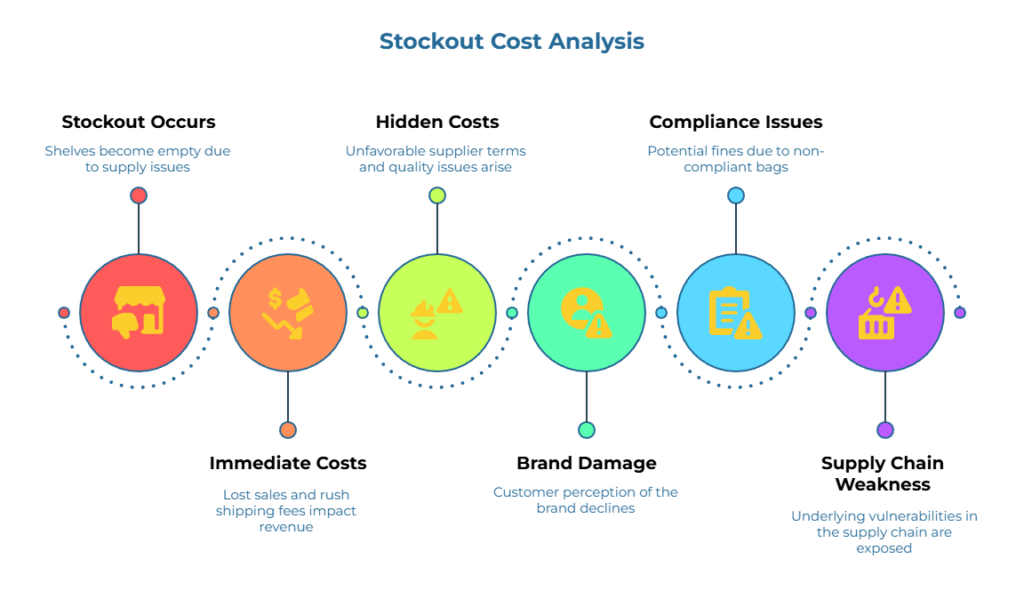
A stockout feels like a logistics problem. It’s actually a structural sourcing problem wearing a logistics disguise.
Industry analysis from firms such as the IHL Group suggests that stockouts can erode roughly 4% of potential retail revenue, varying by sector. For a small supermarket turning over $50,000 USD a week, even a 4% loss equates to $2,000 of revenue simply disappearing.
The visible costs hit immediately. Lost sales when customers walk out empty-handed. Rush shipping fees that can double or triple your per-bag cost. Emergency supplier markups because they know you have no alternatives.
The hidden costs run deeper and longer. When you commit to a supplier under pressure, you surrender leverage, often accepting unfavorable payment terms or minimum order quantities (MOQs) that persist well beyond the crisis. That desperate phone call often forces you into unfavorable terms—such as extended volume commitments or spot-market pricing that can sit significantly above negotiated contract rates.
Quality suffers too. Bags sourced in a rush rarely undergo proper vetting. When they tear at the handles or fail to meet local packaging regulations, your customers notice. Your brand takes the hit. And if those bags aren’t compliant with plastic ban requirements or food-safety standards in your jurisdiction, you’re looking at potential fines on top of everything else.
The real cost of a stockout isn’t the emergency shipment. It’s the fragile foundation it reveals underneath your entire supply chain.
Panic Buying vs. Strategic Sourcing: What’s the Difference?
Panic buying: the “foundation of sand” approach
Panic buying follows a predictable pattern. One local distributor holds most or all of your volume. When they can’t deliver, you have nowhere to turn except whoever happens to have inventory. Negotiations happen from a position of weakness. Terms favor the supplier because they hold all the leverage.
The consequences compound over time. Lead times remain unpredictable because you never have enough visibility into your supplier’s capacity or constraints. Pricing swings with every order because there’s no volume commitment or relationship stability to anchor it. Quality varies because you’re buying availability, not specifications.
This approach treats wholesale paper bag sourcing as a series of disconnected transactions rather than an ongoing business function.
Strategic sourcing: building your inventory “pipeline”
Think of strategic sourcing as building a pipeline for your store’s operational currency. If that pipeline runs dry, commerce stops. If it flows reliably, you can focus on growing your business instead of firefighting shortages.
Three pillars support a resilient sourcing approach.
Diversified supplier base. This means maintaining relationships with multiple suppliers across different categories: local distributors for speed and flexibility, regional wholesalers for moderate volume, and potentially cross-border options for better pricing on larger orders. No single supplier should control more than 60–70% of your volume.
Clear minimums and lead times mapped to your calendar. Understanding exactly how long each supplier needs to fulfill an order, and what their minimum quantities are, lets you plan purchases around your actual demand patterns rather than reacting to shortages. For businesses managing tight cash flow, a guide to sourcing low-MOQ kraft paper provides strategies to avoid the inventory trap that high minimums create.
Verification-first mindset. Before comparing prices, verify that a supplier can actually deliver what they promise. Check reliability, quality consistency, and compliance documentation. The lowest quote means nothing if the bags arrive late, damaged, or non-compliant.
Specialized B2B marketplaces designed for the paper industry can accelerate this diversification by providing curated access to verified suppliers across multiple geographies.
Step 1: Stabilize the Crisis (Next 24–72 Hours)
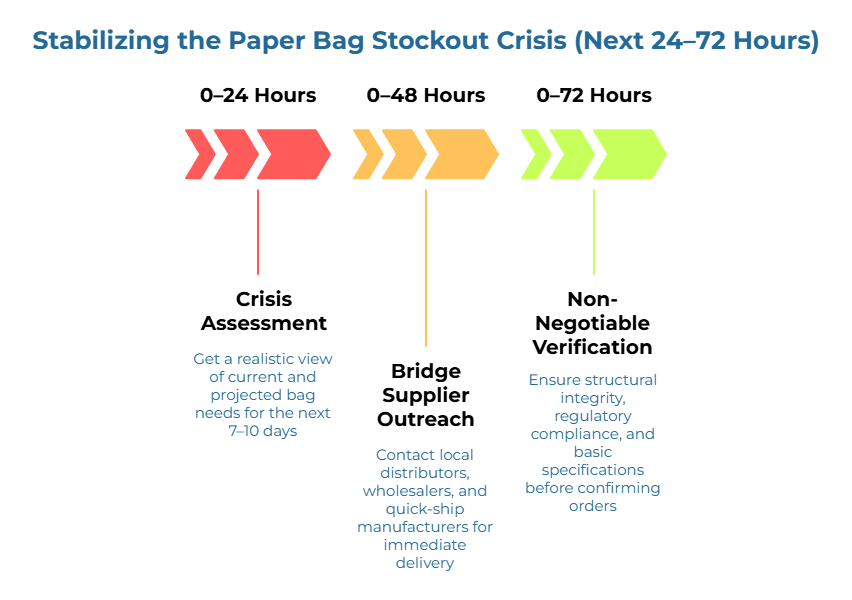
Right now, strategy can wait. You need bags on your shelves. But even in crisis mode, a few smart choices will prevent this emergency from creating the next one.
Get a realistic view of today plus the next 7–10 days
Before making any calls, know exactly what you’re dealing with. If you need quotes quickly from multiple suppliers, submit RFQs and receive quotes from multiple verified suppliers simultaneously, saving critical time during a crisis. Take your average daily bag usage and multiply by the number of days until you can reasonably expect a normal replenishment to arrive. If you have promotions, holidays, or local events coming up, adjust that number upward accordingly.
This gives you your bridge quantity: the minimum you need to cover the gap. Knowing this number prevents two common mistakes. Ordering too little and facing another scramble in five days. Or ordering too much under pressure and sitting on expensive emergency inventory for months.
Prioritize “bridge” options, not long-term commitments
Your goal right now is coverage, not optimization. Look for suppliers who can deliver quickly, even if their per-unit cost is higher than your usual source.
Local distributors with ready stock often carry a markup, but for businesses in or near major logistics hubs, they can typically expedite delivery within 24–48 hours. Nearby wholesalers may have existing inventory they can release without a full production run. Some manufacturers maintain quick-ship programs for exactly these situations.
When you contact these options, be clear about what you need: a small, time-bound quantity that covers only your bridge period. Avoid signing extended contracts or making volume commitments while you’re in crisis mode. Any supplier pressuring you toward long-term terms during an emergency is not a supplier you want a long-term relationship with.
Set non-negotiables even under pressure
Urgency doesn’t justify abandoning standards entirely. Some things remain non-negotiable regardless of how quickly you need bags.
Basic structural integrity matters. Bags that tear at the handles or split at the seams create customer complaints and potential liability. Even in a rush, request a sample photo or specification sheet before confirming an order.
Regulatory compliance isn’t optional. Many regions now ban specific types of plastic bags and define standards for paper carryout bags. Jurisdictions like California continue to tighten regulations; for example, recent legislation (SB 1053) will eliminate plastic film bags at checkout entirely starting in 2026, mandating a complete shift to paper or compliant reusable alternatives. Financial penalties and legal action are real possibilities where regulators actively enforce these rules. Quick verification checks include requesting product certifications, checking for food-contact compliance if relevant, and confirming the supplier understands your local requirements. For international suppliers, consider reviewing a systematic verification checklist to filter out unreliable vendors..
When reviewing specifications, pay attention to paper weight (in g/m²), handle type, and dimensions. For deeper understanding of structural requirements, guide to GSM and burst factor explains how different specifications affect bag performance under load. For businesses sourcing kraft paper for bag manufacturing, understanding grade selection and burst factor specifications is critical to preventing production issues.
Step 2: Turn This Stockout Into Your Last One (30–90 Day Plan)
Once the immediate crisis passes, resist the temptation to return to business as usual. The stress you just experienced is a symptom of structural fragility in your sourcing approach. Addressing it now, while the memory is fresh, prevents future recurrence.
Map your “bag dependency” risk
Start with a simple exercise. List every supplier you’ve purchased paper bags from in the past twelve months. For each one, note their approximate share of your total volume, their typical lead time, and your honest assessment of their reliability.
If any single supplier represents more than 60–70% of your volume, you’ve identified a single point of failure. That’s not a criticism of the supplier. It’s a recognition that any disruption on their end, whether capacity constraints, shipping delays, or price increases, flows directly through to your operations with no buffer.
Build a small “bench” of verified suppliers
You don’t need dozens of supplier relationships. Two to four verified options typically provide adequate resilience for most small retail operations.
The ideal mix includes one to two local or regional paper bag suppliers who prioritize speed and flexibility. These are your go-to sources for routine orders and your first call when you need fast replenishment. Add one to two larger or more export-focused suppliers who can offer better pricing on volume orders and provide geographic diversification. A comparative decision matrix helps small businesses evaluate marketplace, mill-direct, and local distributor options across seven criteria including flexibility, price-to-door cost, and working capital impact.
When evaluating potential suppliers, emphasize verification and transparency over chasing the lowest sticker price. A supplier who provides clear documentation, responds promptly to inquiries, and delivers consistently at a moderate price creates more value than a supplier who quotes low but delivers unpredictably.
For guidance on evaluating international suppliers specifically, verification checklist for safe online sourcing provides a systematic approach to vetting suppliers you can’t visit in person.
Align order cycles with your real demand spikes
Pull your sales data from the past six to twelve months and identify your peak periods. These might be holidays, local festivals, tourist seasons, or promotional events. Mark them on a calendar.
Now work backward from each peak. If your most reliable supplier needs three weeks to fulfill an order, you need to place that order at least three weeks before your peak begins, plus a buffer for shipping variability. Building this into your routine purchasing calendar transforms sourcing from reactive scrambling into predictable operations.
Larger retailers increasingly use advanced forecasting tools to manage this process, precisely because stockouts have measurable impacts on sales and customer loyalty. Smaller businesses don’t need complex software to benefit from the same logic: a calendar, a few simple ratios, and disciplined ordering cycles already reduce fragility.
Bring compliance into the sourcing discussion early
Regulatory requirements around packaging continue to evolve in most markets. Rather than treating compliance as a last-minute checkbox, make it part of your standard supplier onboarding.
Request documentation upfront: material certifications, food-contact compliance where applicable, and confirmation that the supplier understands the regulatory environment in your jurisdiction. The sourcing and compliance integration checklist provides an eight-step framework for pairing sourcing actions with compliance verification tasks. Suppliers who can’t or won’t provide this documentation may not be worth the risk, regardless of their pricing.
Making Strategic Sourcing Stick: Habits That Prevent the Next Crisis
Building a better supplier base is the foundation. Maintaining it requires a few ongoing habits that take minimal time but provide significant protection.
Quarterly “fragility check” on your bag supply
Set a recurring calendar reminder, perhaps at the start of each quarter, to review three questions.
What percentage of your volume went to your largest single supplier last quarter? If it’s creeping back toward that 60–70% danger zone, it’s time to redirect some orders.
How much backup stock do you keep on hand? This doesn’t need to be a massive safety stockpile, but having two to three weeks of coverage provides breathing room when disruptions occur.
Have any new regulations or material restrictions been announced that affect your packaging? Staying ahead of compliance changes prevents unpleasant surprises.
Track total cost, not just unit price
The lowest price per bag isn’t always the lowest cost per bag. Total cost includes shipping, potential customs or duties for international orders, the administrative time spent managing unreliable suppliers, and the cost of quality failures that result in customer complaints or returns.
Industry analyses emphasize that stockouts don’t just reduce sales; they also prompt customers to switch stores or channels, creating lasting damage beyond the immediate lost transaction.
When comparing suppliers, look beyond the quoted unit price. A supplier who charges slightly more per bag but delivers reliably, provides consistent quality, and requires minimal management time often represents better value than a cheaper alternative that creates ongoing headaches. Understanding the hidden costs of cheap paper reveals how quality variance can eliminate any upfront savings through waste and downtime.
The strategic sourcing approach that transforms fragile single-supplier dependency into fortified supply networks explores this total-cost perspective through a four-stage maturity model with specific implementation timelines.
Teach your team the difference between buying and sourcing
If you have staff involved in purchasing decisions, help them understand the distinction between buying and sourcing.
Buying is transactional. It focuses on fulfilling an immediate need at the best available price. There’s nothing wrong with this for occasional, low-stakes purchases.
Sourcing is strategic. It focuses on building and maintaining a reliable supply pipeline that serves your business over time. It considers supplier relationships, risk diversification, quality consistency, and total cost rather than just the number on today’s invoice.
When your team understands this distinction, they’re less likely to make decisions that optimize for today’s purchase at the expense of tomorrow’s supply security.
Building Your Sourcing Knowledge Base
Beyond immediate crisis response, developing procurement expertise helps prevent future disruptions. PaperIndex Academy offers comprehensive guides on international trading, supplier verification, compliance requirements, and working capital management—all designed specifically for the paper packaging industry.
Connecting Crisis Response to Long-Term Strategy
The stockout that brought you to this article isn’t a one-time event to be forgotten once the shelves are restocked. It’s a signal that your approach to wholesale paper bag sourcing has room to mature.
The steps outlined here—stabilizing the immediate crisis, mapping your dependency risk, building a verified supplier bench, and establishing ongoing review habits—represent the first stage of that maturity journey. They transform reactive firefighting into proactive management.
For a more comprehensive framework that addresses supplier qualification, compliance integration, and advanced risk management, explore the full sourcing strategy for reliable paper packaging. The sourcing strategy guide provides the complete roadmap from fragile, single-supplier dependency to a fortified, resilient sourcing operation.
Your next step doesn’t require a massive overhaul. Start by listing your current suppliers and noting which ones you’ve actually verified beyond their initial quote. If you’re working with international vendors, a five-step verification checklist shows how to conduct thorough vetting without site visits. Identify the gaps. Then begin building relationships with one or two alternatives who can provide backup capacity when your primary sources fall short.
The goal isn’t perfection. It’s progress from a foundation of sand toward something solid enough to weather the next disruption, whenever it comes.
Disclaimer:
This article provides general educational guidance on wholesale paper bag sourcing strategies. Specific regulatory requirements, supplier availability, and market conditions vary by location and change over time. Readers should verify current regulations and conduct their own supplier due diligence before making purchasing decisions.
Our Editorial Process:
Our expert team uses AI tools to help organize and structure our initial drafts. Every piece is then extensively rewritten, fact-checked, and enriched with first-hand insights and experiences by expert humans on our Insights Team to ensure accuracy and clarity.
About the PaperIndex Insights Team
The PaperIndex Insights Team is our dedicated engine for synthesizing complex topics into clear, helpful guides. While our content is thoroughly reviewed for clarity and accuracy, it is for informational purposes and should not replace professional advice.