

📌 Key Takeaways
Compliance requirements must filter supplier decisions from the start, not validate them at the end.
- Compliance Defines Supplier Viability: Treating compliance as a parallel filter—not a post-selection checkpoint—prevents late-stage rejections and emergency sourcing at premium prices.
- Eight-Step Integration Protocol Works: Pairing each sourcing action with a compliance task (from defining requirements through ongoing monitoring) eliminates the gaps that cause regulatory failures.
- Documentation Beats Promises: Requiring certifications (FSC, PEFC, food-contact declarations) and test reports at the RFQ stage forces suppliers who cannot comply to self-select out early.
- Two-Lens Evaluation Protects Operations: Scoring suppliers simultaneously on commercial fit and compliance strength ensures attractive pricing doesn’t override missing documentation that will halt operations later.
- Contract Clauses Formalize Expectations: Including certification maintenance obligations, change notifications, and audit rights converts email assurances into enforceable commitments that survive personnel turnover.
Integration catches problems when options are plentiful; separation catches them when options are scarce.
SMB retail procurement teams balancing speed and regulatory risk will gain a practical implementation framework here, preparing them for the detailed eight-step protocol that follows.
Empty shelves or a failed inspection. Neither outcome is acceptable, yet many SMB retailers find themselves racing toward one or the other.
Picture this: Your procurement manager just secured a great deal on paper bags from a new supplier. The price is right, lead times work, and the bags look perfect. Three months later, a regulatory inspector flags your bags for missing recycled-content documentation. Now you’re facing potential fines, scrambling for replacement stock, and explaining the situation to your operations team.
Supply chain fragmentation is a documented driver of procurement failure, where distinct sourcing and compliance workflows often result in late-stage regulatory disqualification.
This guide provides a practical, step-by-step integration checklist that folds compliance checks into each sourcing stage. By following this protocol, you can purchase bags quickly without risking fines, seizures, or reputational damage.
Why Sourcing and Compliance Must Run as One Process
Wholesale paper bag sourcing is the strategic process of identifying, vetting, and contracting bulk suppliers for paper bags. Think of your bag supply as a pipeline: if it dries up, commerce stops. Your checkout lanes go silent, your delivery operations stall, and your customers leave frustrated.
Sustainable packaging compliance means adhering to local and international environmental and packaging regulations. This includes plastic bans, recycled content requirements, food-contact safety rules, and proper documentation. Global frameworks, such as the ISO 18600 series on packaging and the environment—specifically ISO 18602 regarding system optimization—codify these technical requirements into auditable standards. Compliance is your license to operate.
The typical failure pattern looks like this: Procurement moves fast to secure supply. Quality and compliance checks happen at the end, almost as an afterthought. When problems surface, the bags are already ordered, shipped, or sitting in your warehouse.
“Compliance isn’t an afterthought; it’s the first filter in your sourcing funnel.”
Many SMBs learn this lesson the hard way. A late-stage compliance failure means rejected shipments, rush orders at premium prices, and potential regulatory penalties. The solution is straightforward: run one unified protocol where every sourcing step is mirrored by a compliance step.
The Unified Sourcing & Compliance Protocol
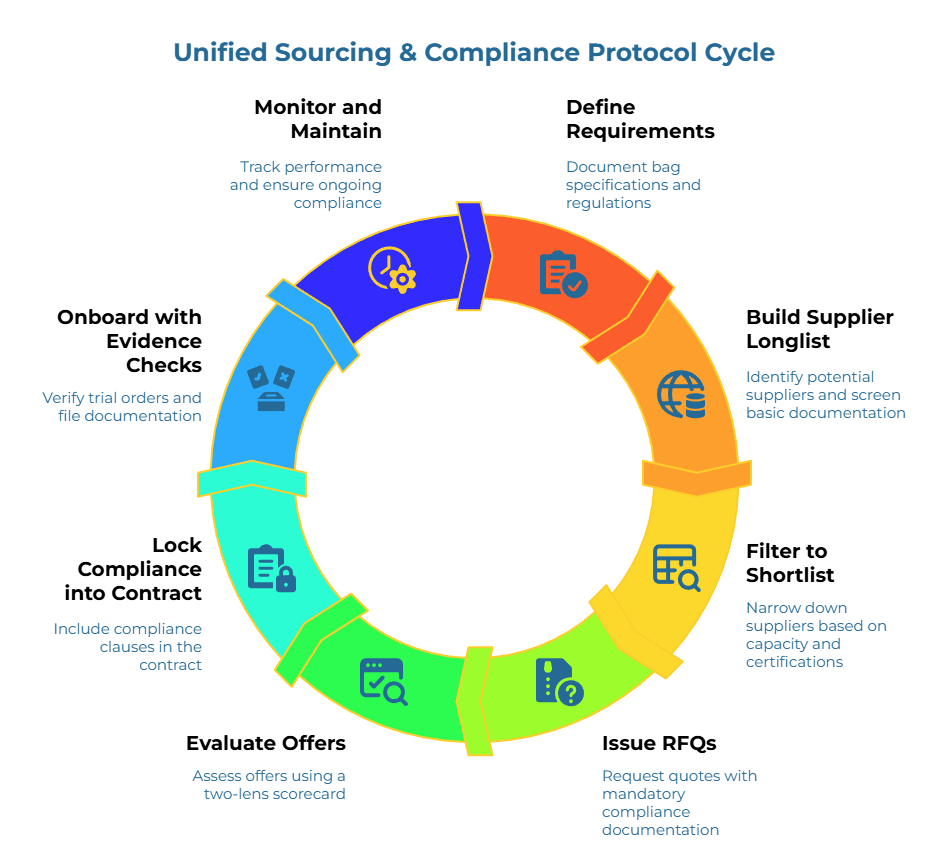
This eight-step protocol integrates compliance into every stage of your sourcing workflow. It’s designed as a self-contained checklist that stands alone—each step pairs a sourcing action with a compliance action, ensuring nothing falls through the cracks.
- Define Your “Compliant Bag” Requirements. Sourcing: Document bag specifications (dimensions, GSM, handle type, printing). Compliance: List applicable regulations (plastic bans, recycled content minimums, food-contact rules) and required certifications.
- Build a Supplier Longlist. Sourcing: Identify potential paper bag suppliers through marketplaces, trade networks, and referrals. Compliance: Screen for basic documentation capability (business registration, export licenses, quality certifications).
- Filter to a Shortlist. Sourcing: Narrow based on capacity, geography, and preliminary pricing. Compliance: Require proof of relevant certifications (FSC, PEFC, food-contact declarations) before advancing suppliers.
- Issue RFQs with Compliance Requirements. Sourcing: Define specifications, quantities, delivery schedules, and pricing structure. Compliance: Embed mandatory documentation requests (certificates, test reports, declarations of conformity) directly in the RFQ.
- Evaluate Offers Using a Two-Lens Scorecard. Sourcing: Assess capacity, lead times, price structure, and commercial fit. Compliance: Evaluate evidence completeness, certification scope, and audit history.
- Lock Compliance Into the Contract. Sourcing: Finalize pricing, payment terms, and delivery obligations. Compliance: Include clauses requiring maintained certifications, notification of changes, and audit rights.
- Onboard with Evidence Checks. Sourcing: Process trial orders and verify operational capacity. Compliance: Confirm first deliveries match certified specifications; file all documentation systematically.
- Monitor and Maintain Audit Readiness. Sourcing: Track supplier performance metrics (OTIF, quality consistency). Compliance: Schedule annual certificate reviews, conduct spot checks, and trigger corrective actions when needed.
Step-by-Step: How Each Stage of Sourcing Carries a Compliance Task
Step 1: Define “Compliant Bags” for Your Business
What “compliant” means varies by region and use case. A bag carrying groceries faces different requirements than one holding children’s toys or hot food. Start by mapping your specific regulatory baseline.
Key compliance questions to answer:
- Does your jurisdiction have plastic bag bans affecting paper alternatives?
- Are there recycled content minimums (e.g., 30% post-consumer fiber)?
- Will bags contact food? If so, food-contact safety standards apply. Compliance is strictly governed by regional mandates, such as US FDA 21 CFR 176 regarding indirect food additives and the Council of Europe’s technical guidance on paper and board materials.
- Are there labeling requirements for sustainability claims?
- What documentation must you keep on file for inspections? Use standardized PQQ templates and onboarding checklists to systematically collect and verify this information.
Ownership: Business Owner and Operations Manager should jointly define requirements. This removes ambiguity before procurement begins.
Step 2: Build and Filter Your Supplier Longlist
Cast a wide net initially. Look across B2B marketplaces, industry networks, trade shows, and referrals from other retailers. For kraft paper bags with food-contact requirements, compliance scrutiny increases significantly.
Minimum compliance filters for longlisting:
- Valid business registration and export licenses (where applicable)
- Basic quality management certification (ISO 9001 or equivalent). For international suppliers, learn how to verify suppliers without travel using desk-based verification methods.
- Ability to provide relevant product certifications upon request
Suppliers who cannot demonstrate these basics should not advance, regardless of attractive pricing. Learn how to verify international suppliers with systematic desk checks before advancing them. Certificate chasing after price agreements creates delays and exposes you to risk.
Step 3: RFQ and Specification Design with Compliance Built In
Your Request for Quotation should do double duty. Beyond bag specifications (dimensions, GSM, handle type, printing), embed your compliance requirements directly.
Include in every RFQ:
- Required certifications (FSC, PEFC, or equivalent chain-of-custody certification)
- Food-contact declarations where applicable
- Test reports for claimed specifications (burst strength, recycled content)
- Confirmation of compliance with your jurisdiction’s specific regulations. For technical specifications, specify exact ISO/TAPPI test methods and tolerances in your RFQ to ensure comparable responses.
This approach reduces later disputes. Suppliers understand compliance expectations upfront, and those who cannot meet them self-select out of the process.
Step 4: Evaluating Offers with a Two-Lens Scorecard
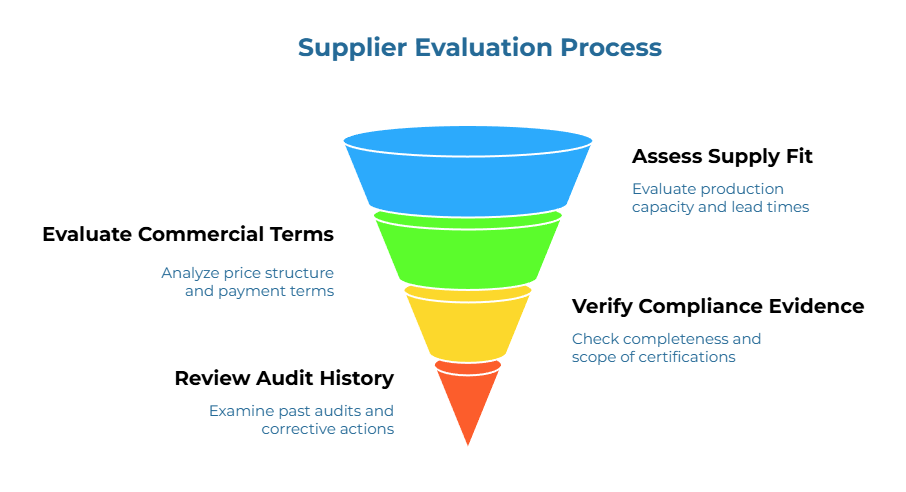
When quotes arrive, resist the temptation to rank purely on price. Use a simple two-lens evaluation:
Lens 1: Supply and Commercial Fit
- Production capacity relative to your volume needs
- Lead times that align with your inventory planning
- Price structure and payment terms that work for your cash flow
Lens 2: Compliance Strength
- Completeness of submitted evidence (all requested documents provided)
- Scope of certifications (do they cover your specific use case?)
- History of audits and any corrective actions taken
Critical rule: Reject incomplete compliance evidence, even if the price looks attractive. A supplier who cannot provide documentation at the quote stage is unlikely to improve after you have committed.
Step 5: Contracting and Locking Compliance Into the Agreement
Your contract should formalize compliance expectations, not leave them as informal understandings.
Key compliance clauses to consider:
- Supplier responsibility to maintain current certifications throughout the contract term
- Obligation to notify you of any certification changes, suspensions, or revocations
- Your right to request updated documents or conduct audits
- Clear remedies for non-compliance (replacement, recall support, liability allocation)
Note: This guidance is educational. Consult legal counsel to ensure contract terms align with your jurisdiction’s requirements and your specific business circumstances. For detailed guidance, review these contract clauses that protect against off-spec deliveries.
Step 6: Onboarding and First Delivery Checks
The contract is signed. Now verify that reality matches paperwork.
First delivery compliance checklist:
- Physical samples match certified specifications (dimensions, weight, material)
- Labeling and printing align with sustainability claims
- All required documentation accompanies the shipment
- Certificate of Analysis (COA) or test reports confirm claimed properties
File all documents in a structured manner using an incoming inspection evidence chain. Create a supplier folder containing contracts, certifications, test reports, and delivery records. This organization makes inspections straightforward rather than stressful.
Step 7: Ongoing Monitoring and Audit Readiness
Compliance is not a one-time achievement. Certifications expire. Regulations change. Supplier processes drift.
Establish a monitoring cadence as part of your supplier audit and compliance program:
- Annual certificate validity checks (set calendar reminders)
- Periodic supplier reviews (quarterly or semi-annually)
- Random spot checks on incoming bag batches
- Regulatory monitoring for changes in your markets
Adherence to Chain of Custody (CoC) standards, as mandated by certification bodies like FSC and PEFC, requires documented tracking of materials from forest to final product to maintain valid certification.
When issues arise, trigger a formal corrective action process. Document the problem, the root cause, the corrective measure, and verification that the fix worked. This discipline protects both brand reputation and operational continuity.
Practical Scenarios: Applying the Checklist to Common Risk Cases
Consider how this integrated approach prevents real-world failures:
Scenario 1: Switching from Plastic Due to a New Local Ban
A regional grocery chain must transition from plastic to paper bags within six months due to new legislation. Using the integrated protocol, the procurement team defines compliance requirements upfront (including the specific ban language and any recycled content thresholds). Suppliers are filtered early for certification capability. The contract includes a clause requiring ongoing compliance with the specific regulation. Result: The transition happens on schedule, every bag meets requirements, and the chain avoids the fines that hit competitors who scrambled at the last minute. This approach aligns with global policy guidance on single-use plastics from organizations like UNEP.
Scenario 2: Launching a Food Product Requiring Bag Contact
A D2C brand introduces a new line of artisan bread, sold in kraft bags that directly contact the food. The integrated checklist flags food-contact certification as a non-negotiable filter at the longlisting stage. RFQs explicitly require documentation proving compliance with food-contact regulations. First deliveries include COAs verifying migration limits. Result: The brand launches without compliance delays, and documentation is ready for any customer or regulatory inquiry.
Scenario 3: Scaling from One Store to Multiple Locations
A successful independent retailer opens three new locations in different municipalities. Each location may face slightly different packaging rules. The integrated protocol prompts the owner to map jurisdiction-specific requirements before scaling supplier relationships. The selected supplier can demonstrate flexibility to meet varying requirements, and contracts specify which documentation applies to which delivery destination. Result: Expansion proceeds smoothly without compliance surprises at any location.
Lesson from all scenarios: Integration catches problems early, when options are plentiful and costs are low. Separation catches problems late, when options are limited and costs are high.
How to Use This Checklist With Your Team
A checklist only works if everyone follows it. Turn this protocol into a shared internal tool:
- Share with key stakeholders. Operations, Procurement, and Brand/Marketing should all understand the process. Alignment prevents one function from undermining another’s work.
- Adapt to your jurisdiction. Run a 30 to 45 minute internal review to customize fields for your specific regulatory environment. Add your region’s particular requirements; remove irrelevant ones.
- Use consistently. Apply the protocol every time you evaluate new paper bag suppliers. Consistency builds institutional muscle memory.
- Review and update. Regulations evolve. Your checklist should evolve with them. Schedule an annual review to incorporate new requirements.
Once your Unified Sourcing & Compliance Protocol is finalized, apply it consistently whenever you evaluate new suppliers so every decision is defensible and audit-ready.
Building Confidence in Every Purchase Order
Fast sourcing and strong compliance are not opposing forces. They are two sides of the same discipline.
By integrating compliance checks into every sourcing stage, you achieve what most buyers struggle to balance: bags that keep your shelves stocked and inspectors satisfied. You replace last-minute scrambles with predictable processes. You trade anxiety for confidence.
Treat this checklist as a living document. As your business grows and regulations evolve, update your protocol. The goal is not perfection but continuous improvement. Each sourcing cycle that follows the integrated approach strengthens your organization’s capability and reduces your exposure.
Start with your next supplier evaluation. Map your requirements. Filter with compliance in mind. Build documentation from day one. The peace of mind that follows is worth far more than any discount gained by cutting corners.
References
- ISO – Packaging and the environment: guidance and standards such as ISO 18602 on optimization of packaging systems.
- Forest Stewardship Council (FSC) – Certification and tools to verify FSC-certified paper and packaging products.
- Programme for the Endorsement of Forest Certification (PEFC) – Certification for sustainably sourced forest-based products and guidance for key sectors including packaging.
- European Directorate for the Quality of Medicines & HealthCare (EDQM) – Technical guidance on paper and board materials for food-contact applications (regional example of regulatory thinking).
- UN Environment Programme (UNEP) – Policy guidance and toolkits on single-use plastic products, including carrier bags, and their regulation.
Disclaimer: This article is for educational purposes only and does not constitute legal advice. Consult qualified legal counsel and relevant regulatory bodies for requirements specific to your jurisdiction and business circumstances.
Our Editorial Process:
Our expert team uses AI tools to help organize and structure our initial drafts. Every piece is then extensively rewritten, fact-checked, and enriched with first-hand insights and experiences by expert humans on our Insights Team to ensure accuracy and clarity.
About the PaperIndex Insights Team
The PaperIndex Insights Team is our dedicated engine for synthesizing complex topics into clear, helpful guides. While our content is thoroughly reviewed for clarity and accuracy, it is for informational purposes and should not replace professional advice.