

📌 Key Takeaways
Valid FSC/PEFC certificates can fail your purchase order when scope boundaries exclude your specific product, activity, or documentation requirement.
- Valid Doesn’t Mean Usable: Certificates authorize claims only within defined product categories, activities, and document types—orders outside those boundaries fail regardless of validity.
- Three Predictable Mismatch Patterns: Product/category gaps, role mismatches between certificate holders and invoicing entities, and document continuity failures account for most scope-related claim rejections.
- Five-Minute Verification Prevents Failures: Confirm registry status, match scope lines to quoted products, and secure written invoice claim wording before approving purchase orders.
- Pressure Creates Shortcuts: Time zones, deadline compression, and “certified supplier” assumptions drive teams to skip scope checks—pre-RFQ gates and PO template fields prevent these mistakes.
- Build Defensibility Packs: Registry screenshots, relevant scope excerpts, and written claim confirmations create audit trails that prevent disputes after shipment.
Certificate scope verification takes minutes but prevents compliance failures that take weeks to resolve.
Procurement managers and buyers sourcing certified paper products will gain practical verification workflows here, preparing them for the detailed FSC/PEFC compliance framework that follows.
9:12 AM. The inbox pings: “Please send FSC/PEFC proof for this shipment.” You pull up the certificate PDF saved last month. Valid until next year. But then the question hits—does this certificate actually cover this order? And will the claim appear on the invoice your customer needs?
A certificate can be real, current, and still fail for your specific order. The difference between a defensible purchase and a compliance headache often comes down to one thing: certificate scope.
Certificate scope defines the boundaries of what a certificate holder can claim. If your product or documentation requirement sits outside those boundaries, the claim fails—even if the certificate is valid.
This guide walks through a 5-minute verification workflow to help confirm whether an FSC or PEFC claim is actually usable before approving a purchase order. For the complete verification process, see the buyer’s guide to paper certifications: FSC, PEFC, and beyond.
What “Certificate Scope” Means in Plain English
A certificate scope explains what the certificate holder is permitted to claim and sell as certified. Buyers must match that scope to the exact product and documentation requirements of their order.
Think of it this way: a certificate is a driver’s licence; scope is what vehicles you’re allowed to drive. Holding a valid licence doesn’t mean you can drive anything on the road.
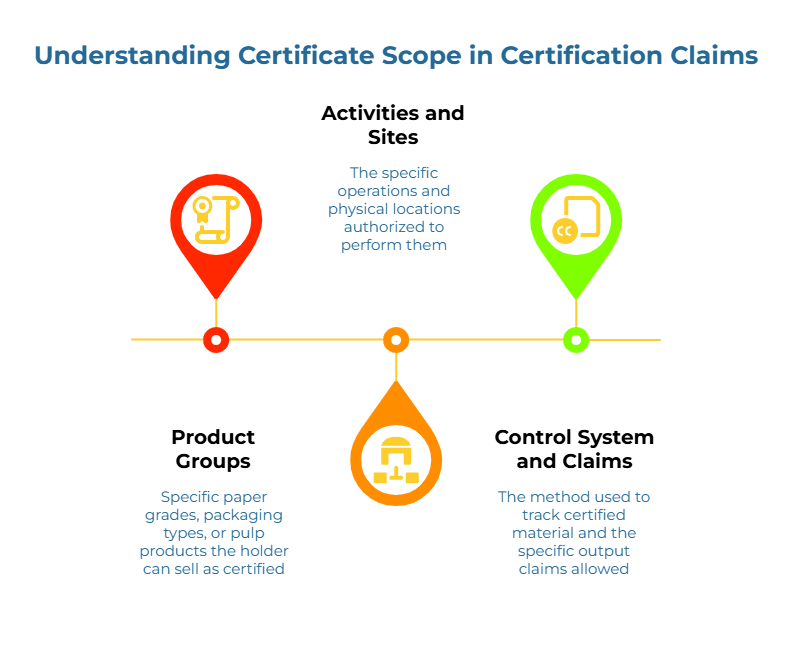
Scope typically limits certification by three dimensions:
- Product Groups: Specific paper grades, packaging types, or pulp products the holder can sell as certified (e.g., P2.3 Wrapping and packaging paper)
- Activities and Sites: The specific operations (e.g., Secondary Processor, Trader without physical possession) and the physical locations authorized to perform them
- Control System and Claims: The method used to track certified material (e.g., Transfer, Credit, or Percentage system) and the specific output claims allowed (e.g., FSC Mix, FSC 100%)
If an order sits outside any of these boundaries, the certification claim cannot be used for that transaction.
Why a Valid Certificate Still Fails: Three Common Mismatch Patterns
Even when a supplier holds a genuine, current certificate, buyers encounter claim failures for predictable reasons.
Pattern 1: Product or category mismatch. The certificate covers kraft linerboard, but the order is for corrugated boxes. The scope language simply doesn’t include the quoted product. This is surprisingly common when suppliers offer a broad product range but hold certification for only part of it.
Pattern 2: Role mismatch. A trader or distributor presents a mill’s certificate as proof—but their own sales documentation isn’t covered. Chain-of-custody certification requires each entity in the supply chain to hold their own valid certificate for the claim to travel correctly. A mill certificate alone doesn’t authorize a trader’s invoices.
Pattern 3: Document continuity failure. The claim appears on the supplier’s website and marketing materials, but when the purchase order and invoice arrive, the FSC or PEFC claim wording is missing. For FSC/PEFC compliance, a claim only exists if it is present on the specific invoice and delivery note for that batch.
For more on identifying misleading sustainability claims, see avoiding greenwashing: how to verify supplier sustainability claims.
Red Flags: How to Spot Out-of-Scope FSC/PEFC Claims
The following table summarizes common warning signs that a claim may be out-of-scope—and what to do next.
| Red Flag | Why It Matters | What to Do |
| Certificate holder name doesn’t match the seller on your invoice | The selling entity may not hold their own chain-of-custody certificate | Request the seller’s own certificate number and verify in the registry |
| Certificate status shows “Suspended” or “Terminated” in official registry | Claims from invalid certificates cannot be used | Do not proceed until status shows “Valid” or “Active” |
| Scope statement lists product categories unrelated to your order | The certificate doesn’t authorize claims for your specific product | Ask the supplier to confirm which scope line covers your quoted item |
| Supplier cannot confirm claim wording for invoice or packing list | The claim may not travel on transaction documents | Request written confirmation of exact claim wording before PO approval |
| Certificate covers manufacturing but seller is a trader | Trading activities require a separate chain-of-custody scope | Verify the seller’s own certificate includes trading/distribution |
| The supplier provides a “certificate screenshot” rather than a live registry link | Evidence may be incomplete or not verifiable | Ask for the registry link and a timestamped screenshot showing holder name and status |
Quick verification checklist—what to record:
- Certificate number and holder name (exactly as shown in registry)
- Registry status: Valid / Active / Suspended / Terminated
- Scope line that covers the quoted product
- Confirmation of claim wording on invoice and delivery documents
- Screenshot or PDF of registry entry with date checked
A practical habit: build a small “defensibility pack” for each certified order—registry evidence, the relevant scope excerpt, and written confirmation of invoice claim wording. This evidence chain prevents scrambles when customers challenge claims later.
Mini Examples: “Looks Valid, But Fails”
Three scenarios illustrate how legitimate certificates still fail scope checks:
Example 1: Mill certificate forwarded by a trader. A mill’s certificate is valid and active in the registry. The trader forwards it as proof. But the trader is the invoicing seller and cannot pass the certified claim onto the invoice under their own entity name. The buyer’s proof check fails at transaction time because the certificate holder doesn’t match the invoice entity.
Example 2: Scope covers a different product family. The supplier holds valid FSC certification for certain kraft paper grades. The buyer orders a testliner. The certificate covers P2.3 (Wrapping and packaging paper), but the order is for P4.1 (Linerboard or Testliner). For kraft paper buyers navigating grade-specific certification, see kraft paper manufacturers: an evidence-first capability matrix for consistent, compliant supply. Because these belong to different FSC Product Groups [1], the claim cannot be applied. The order is out-of-scope despite the supplier being “FSC certified.”
Example 3: Missing Claim on the Transaction Document. The quote includes “FSC Mix Credit” with the certificate code. The sample packaging shows the FSC label. But when the commercial invoice arrives, no FSC claim wording appears—just product description and price. The shipment may be physically identical, yet the proof requirement fails because the transaction document lacks the claim.
The 5-Minute Scope Relevance Check
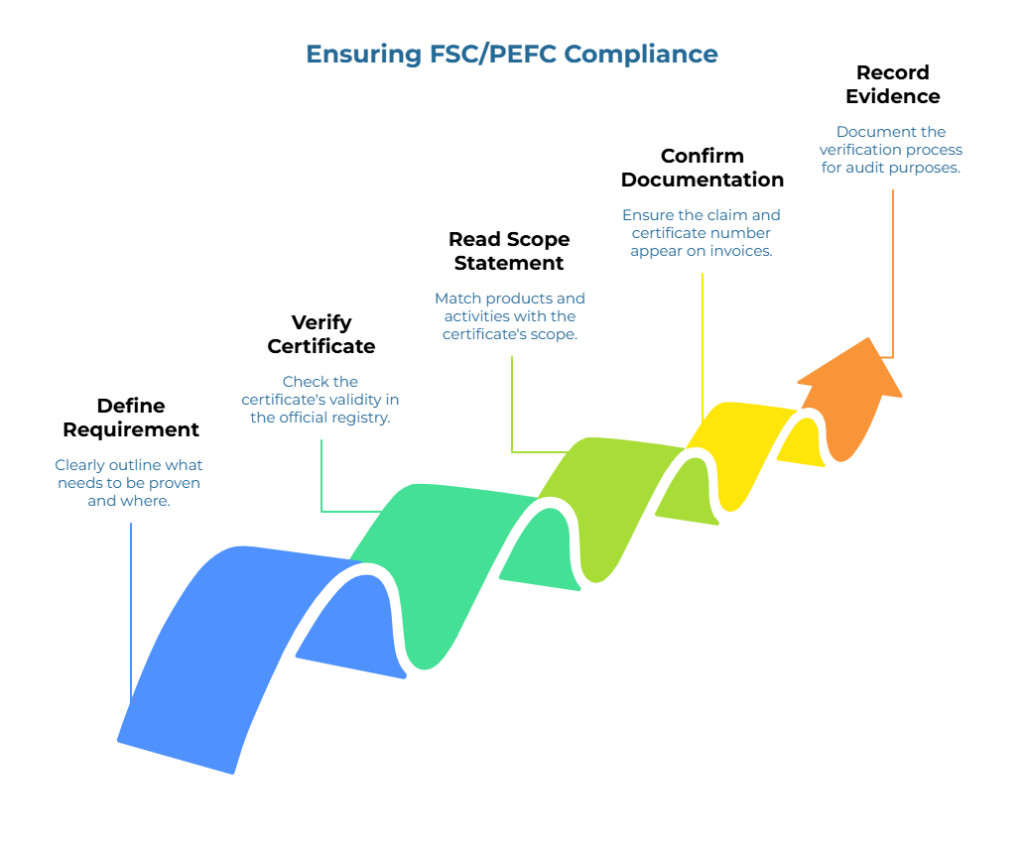
Before approving a purchase order, run through these five steps:
Step 1: Define your requirement. What exactly must be proven, and where? If a customer or auditor will check invoices or labels, the claim must appear on those documents—not just on the supplier’s website.
Step 2: Verify certificate status in the official registry. Use the FSC Certificate Database or PEFC Find Certified to confirm the certificate is currently valid. For detailed registry navigation steps, see how to run a quick registry check for FSC/PEFC certificates.
Step 3: Read the scope statement like a filter. Match the products and material categories listed in the scope against your quoted item. Check whether the activities (manufacturing, trading, distribution) and sites align with how your order will be fulfilled.
Step 4: Confirm transaction documentation continuity. Ask the supplier directly: “Will the FSC/PEFC claim and certificate number appear on the invoice and packing list for this order?” If they cannot confirm, the claim may not survive an audit.
Step 5: Record your evidence. Screenshot the registry entry, save the certificate number, and note your scope-match decision. This creates an audit trail showing due diligence was performed.
For comprehensive documentation protocols beyond certificates, see the trust protocol: a system for supplier verification & risk mitigation.
When Scope Checks Fail Under Real-World Pressure
The workflow above takes five minutes under calm conditions. Real procurement rarely works that way.
Three “chaos dimensions” drive scope verification failures:
Environmental friction: Time zones and document delays compress verification windows. When a supplier is twelve hours ahead and the PO deadline is tomorrow morning, waiting for registry confirmation or scope clarification feels impossible. Teams skip checks they know they should run.
Human error pattern: Under deadline pressure, the instinct is to accept whatever document is already on file. A certificate PDF saved six months ago gets attached to the order without checking whether it’s still valid, whether the scope covers this product, or whether the claim wording will appear on the invoice.
False diagnosis trap: The assumption that buying only from “certified suppliers” prevents claim failures is common—and wrong. A supplier can be certified and still deliver an order where the claim doesn’t travel on transaction documents. The certification status of the supplier is necessary but not sufficient.
Two mitigations help prevent deadline-driven mistakes:
- Pre-RFQ scope gate: Before sending an RFQ to a supplier claiming certification, spend two minutes verifying their certificate is valid and their scope includes your product category. This filters out mismatches before pricing discussions begin.
- PO template field for claim wording: Add a required field to purchase order templates asking suppliers to confirm the exact claim wording that will appear on the invoice. This surfaces document continuity gaps before the order ships.
Supplier Inquiry Protocol
When requesting certification evidence, use specific language to avoid ambiguity. For comprehensive RFQ specifications that include certification requirements, see anatomy of a perfect kraft paper RFQ: a step-by-step guide for converters. Copy and paste this request:
Please provide the following for our records:
- Certificate scheme and certificate number (FSC/PEFC) exactly as shown in the registry
- Certificate holder legal name exactly as shown in the registry
- The scope statement excerpt that covers the quoted product family
- Confirmation of which documents will carry the certified claim wording (invoice / delivery note / labels)
- The exact claim wording and certificate code format that will appear on the invoice
- If you are not the certificate holder: explain the relationship and how claim continuity is maintained on transaction documents
Suppliers who can answer these questions quickly are demonstrating their process is set up correctly. Hesitation or confusion often signals a scope gap worth investigating further.
For Suppliers: How to Avoid Being Flagged “Out-of-Scope”
Buyers are increasingly rigorous about scope verification. Suppliers can reduce friction by proactively providing:
- A direct link to the registry entry (or a dated screenshot showing current status)
- The specific scope line that covers the quoted product, not just the full certificate PDF
- Written confirmation of the claim wording that will appear on invoice and delivery documents
This approach speeds up buyer approvals and reduces back-and-forth clarification requests. Ready to demonstrate certification compliance to global buyers? Join PaperIndex Free to connect with procurement teams seeking verified suppliers.
Frequently Asked Questions
Does a valid FSC/PEFC certificate guarantee the shipment is certified?
Not automatically. The certificate must be in-scope for the specific product being purchased, and the certified claim must appear correctly on the transaction documents required for proof.
What should match between registry evidence and the paperwork?
At minimum: certificate status, certificate number, and the legal name of the certificate holder. If a different entity invoices the order, claim continuity must be explicitly confirmed.
What if the seller is not the certificate holder?
This is common with traders. The key question is whether the invoicing entity can pass the certified claim and print the required claim wording and certificate code on the invoice (and labels, if applicable). for broader supplier verification methods, see how to verify supplier capability (when the price list isn’t the risk).
What evidence should be kept for defensibility?
A registry screenshot, the relevant scope excerpt, and written confirmation of invoice/label claim wording are a practical minimum for most buyer teams.
Why do registry fields look different across certificates?
Registry displays and field labels can vary by scheme and certificate type. Focus on the substance: certificate status, holder identity, and the scope statement that maps to the product and activity being quoted.
Next Steps
Certificate scope verification is one step in a broader buyer workflow for FSC and PEFC claims. For the complete framework, see The Buyer’s Guide to Paper Certifications: FSC, PEFC, and beyond.
For more buyer verification playbooks, browse PaperIndex Academy. Ready to apply these principles? Find suppliers with verified certifications and start building a shortlist on PaperIndex.
Disclaimer:
This article provides educational guidance only.
Our Editorial Process:
Our expert team uses AI tools to help organize and structure our initial drafts. Every piece is then extensively rewritten, fact-checked, and enriched with first-hand insights and experiences by expert humans on our Insights Team to ensure accuracy and clarity.
About the PaperIndex Insights Team:
The PaperIndex Insights Team is our dedicated engine for synthesizing complex topics into clear, helpful guides. While our content is thoroughly reviewed for clarity and accuracy, it is for informational purposes and should not replace professional advice.