
📌 Key Takeaways
Grease stains on food wrappers cost you customers—not because the food is bad, but because stains make people think your kitchen is dirty.
- Stains Signal Carelessness: Customers see grease soaking through paper and assume you cut corners, even when the food inside is perfect.
- Small Savings Cause Big Losses: A wrapper saving $0.02 per order can cost $1,500 daily in lost repeat customers when stains trigger complaints and quiet churn.
- Thickness Doesn’t Equal Protection: Heavier paper without proper grease-blocking treatment still lets oil soak through—ask suppliers for Kit Level ratings, not just weight.
- Fix Your Worst Items First: Focus on fried foods and items held hot for delivery; upgrading wrappers for these solves most visible failures.
- Test Before You Buy: Wrap actual menu items, hold them for real delivery times, then check for breakthrough—a five-minute test prevents months of complaints.
Match your wrapper specifications to your menu, and customers stop seeing stains that make them doubt your standards.
Food service operators and QSR managers dealing with delivery complaints will find practical fixes here, preparing them for the specification guides that follow.
~ ~ ~ ~ ~ ~ ~ ~ ~ ~ ~ ~ ~ ~ ~ ~ ~ ~
A dark spot spreads across the wrapper.
The customer opens their delivery bag and sees grease soaking through the paper, pooling against the cardboard beneath. The burger inside might be perfect—but they don’t know that yet. What they see is a stain. What they think is something far more damaging: This place cuts corners.
This rapid heuristic—associating food packaging paper aesthetics with kitchen sanitation—is difficult to override once the ‘contamination’ signal is sent. The wrapper held the food together, but it failed at something more important—protecting the hygiene story your brand tells with every order.
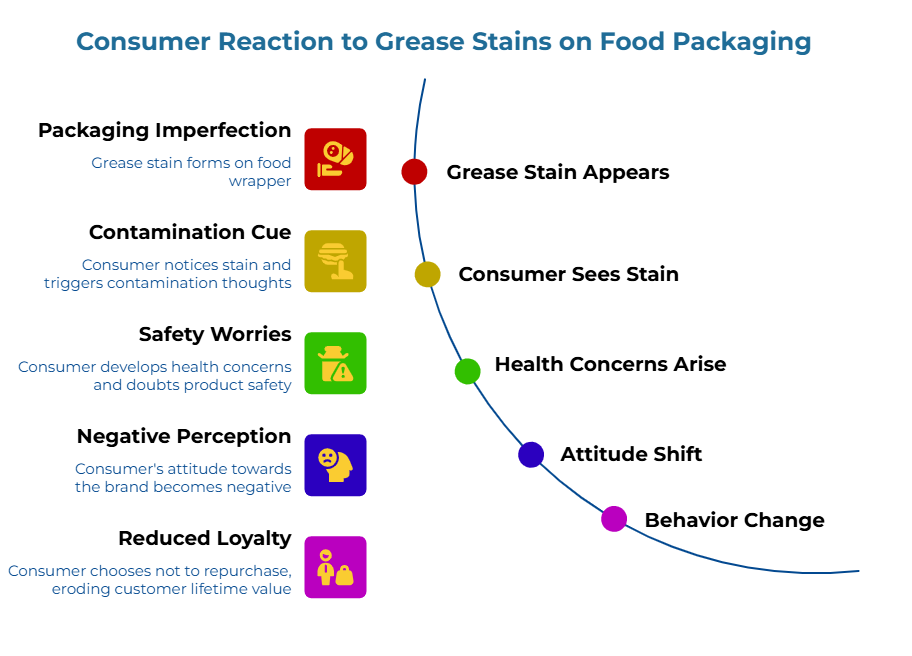
Grease stains on food packaging paper function as contamination cues. Consumer behavior research demonstrates that superficial packaging imperfections—including stains—trigger contamination thoughts and health concerns in consumers, shaping attitudes and behavior even when the underlying product remains unaffected. Studies on product contagion and food packaging paper aesthetics show that consumers unconsciously equate external damage or messiness with compromised internal safety. For food service operators, this creates an uncomfortable reality: the few cents saved per wrapper may be eroding customer lifetime value faster than any spreadsheet reveals.
Do Customers Care About Food Packaging Paper? Yes—Because It’s Part of the Hygiene Story
Food packaging paper sits at the intersection of food safety cues, product quality cues, and brand trust. Your customers make quality judgments before the first bite, and a grease-stained wrapper tells a story you never intended to write.
Consumer research consistently shows that people use food packaging paper to judge risk when they cannot directly verify a product’s condition. In McKinsey’s recent global consumer insights on packaging, “food safety and shelf life” ranked among the top food packaging paper concerns alongside durability and usability. For a food service operator, that translates into a simple operational reality: if food packaging paper arrives clean and intact, the customer assumes the process was controlled. If packaging arrives visibly compromised—wet, greasy, leaking—the customer assumes something in the system failed.
When oil soaks through paper, customers don’t think about barrier treatments or grease resistance ratings. They think about carelessness. They wonder what else might be cutting corners back in the kitchen. This isn’t because customers are difficult. It’s psychology. Visible stains activate the same mental pathways as actual contamination. Once that association forms, it colors everything else about the experience.
The owner, scrolling through reviews, sees it again: “greasy packaging,” “wrapper was soaked,” “looked like it had been sitting around.” Each mention chips away at the brand perception built through consistent food quality and service.
Why This Matters for Your Operation
Grease stains don’t just trigger customer concern—they create measurable business risk:
- Refund requests and replacement orders (direct cost)
- Negative reviews mentioning packaging (reputation cost)
- Reduced repeat visit frequency (LTV erosion)
- Staff time spent on workarounds like double-wrapping (operational cost)
- Audit and inspection exposure: grease-stained packaging can create a “loss of process control” impression—not because a stain automatically fails an inspection, but because it invites questions about sanitation discipline
These costs scatter across different line items, making the true impact invisible until revenue trends downward without obvious cause.
The Hidden Cost Chain: Stain → Story → Churn
A single grease stain rarely destroys a customer relationship. But it contributes to a pattern that does.
The chain works like this: A stain appears (visible cue). The customer assigns meaning—”messy,” “low quality,” “not hygienic,” “cutting corners.” Their behavior shifts: a complaint, a refund request, a negative review, or quietly choosing another brand next time. Most won’t complain directly, but their perception shifts. The next minor issue—a lukewarm order, a missing sauce packet—now feels like part of a pattern rather than an isolated incident. Trust erodes quietly. Eventually, they simply stop ordering.
This mechanism is supported by research analyzing food delivery review data. Recent analyses of food delivery review data suggest that packaging failures—including spillage and leakage—are strongly tied to customer dissatisfaction and negative sentiment, independent of food quality itself.
Picture a typical lunch rush. Orders stack. Delivery holds stretch. A staff member reaches for a second wrapper because they already know the first one won’t hold. That’s your team building workarounds for a specification problem — doubling material costs while still risking stains on the orders where they forget or run short. Costs rise quietly: extra sheets, extra bags, more waste. Speed drops slightly. The stain still appears on some orders because the underlying performance requirement—grease resistance under time, heat, and pressure—was never matched to the menu.
This is the hidden cost pattern: savings that exist on paper but evaporate through operational friction, customer churn, and brand erosion that nobody tracks in a single report.
Quantify It in 60 Seconds: The Lost Customer Calculator
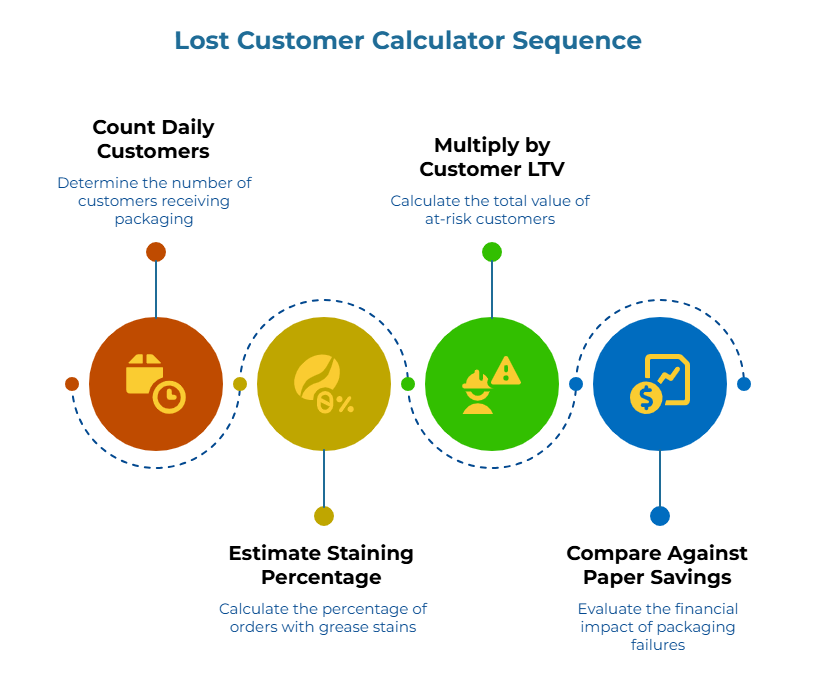
Before changing suppliers or upgrading specifications, you need clarity on what food packaging paper failures actually cost. This framework helps compare paper “savings” against potential losses from customer churn.
The Lost Customer Calculator
Step 1: Count daily customers receiving packaging prone to grease-through (delivery orders, takeout with fried items).
Step 2: Estimate what percentage of those orders show visible grease staining. Audit your actual return/complaint data to establish a realistic baseline.
Step 3: Multiply by average customer lifetime value.
Step 4: Compare against daily paper savings.
The Comparison:
(Daily Customers × % Impacted by Staining × Estimated Churn Rate % × Customer LTV)
vs.
(Daily Sheets Used × $ Savings per Sheet)
Illustrative Example:
A quick-service location serves 200 delivery orders daily. If 5% experience visible grease staining, that’s 10 customers per day. With a modest LTV of $150 per customer (roughly 10 repeat visits at $15 average), the risk exposure becomes clear:
- At-risk customer value: 10 customers × $150 = $1,500 daily
- Paper savings: 200 sheets × $0.02 savings = $4.00 daily
Even if only a fraction of those customers actually churn, the math doesn’t favor the cheaper wrapper. Small retention losses can outweigh material savings very quickly.
Technical Note: Why Some Paper Fails
Thickness alone doesn’t determine grease resistance. A heavier paper (higher GSM) feels sturdier but without proper barrier treatment, grease migrates through the fibers over time—especially with hot, fatty foods.
The specification that matters is grease resistance rating, measured using standardized Kit tests on a scale of 1–12. Lower ratings work for dry goods; fried foods need higher ratings. Many operators fall into the wax paper trap — assuming any coated paper handles grease, when what they actually need is properly specified greaseproof paper with verified barrier treatment. But wax breaks down under heat. What works for a cold sandwich fails for hot fried chicken.
Some wraps pass a quick counter test but fail during a 20–30 minute hold. That gap is driven by grease resistance performance under heat and time—not by how “premium” the paper looks.
Similarly, assuming thicker paper means better performance leads to overspending on GSM when the actual gap is barrier treatment.
Three Practical Moves to Reduce Grease Stains Today
You don’t need to overhaul your entire packaging program. Start with targeted adjustments that address the highest-risk items first.
1. Treat grease stains as a retention problem, not a paper problem.
When requesting quotes, ask food packaging paper suppliers specifically about grease resistance ratings (Kit Level) alongside paper weight. A lighter paper with a Kit Level of 8 will outperform a heavier paper with a Kit Level of 3 for greasy items—understanding which Kit level fits specific menu items prevents costly mismatches. This is the most common specification mistake—and the easiest to fix.
Operationally, the goal is not “better packaging.” The goal is fewer moments that trigger hygiene doubts.
2. Match wrapper specifications to your messiest menu items first.
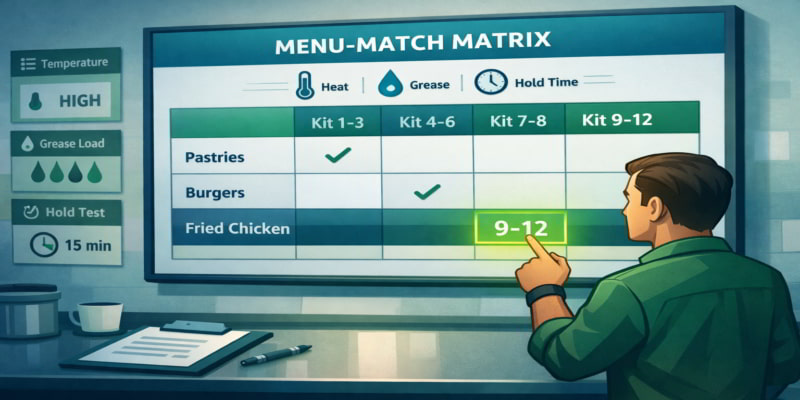
Identify the items most likely to cause grease-through: fried foods, items held at temperature, anything with exposed oils or heavy sauces. The Menu-Match Matrix provides a systematic approach to classifying items by heat, grease load, and hold time. These items drive a disproportionate share of packaging complaints. Upgrade packaging for these items before worrying about everything else. One wrapper specification for your top-selling fried items often solves the majority of visible failures.
Define pass/fail based on time, temperature, and product type—for example: “no visible grease breakthrough after 20 minutes for fried chicken.” Run a short in-kitchen trial using a DIY oil drop test: wrap the item, hold it for the target time window, then inspect for visible breakthrough and bag soak-through. Document with photos so results are not subjective.
3. Standardize the specification for consistency across shifts and locations.
Even a good wrap fails when execution varies. Standardization reduces “operator variability”:
- Use one agreed wrap for each high-risk item category rather than “whatever is available”
- Align the wrap choice with realistic holding times, especially for delivery batching
- Train to a simple standard: consistent wrap tension plus consistent bagging method
Request samples and test under real conditions—actual menu items, actual hold times, actual temperatures. A wrapper that looks great with room-temperature fries tells you nothing about performance with fresh-from-the-fryer product held 15 minutes during delivery.
Comparing Your Options
| Approach | What Usually Happens | Hidden Costs | Confidence Level |
| Buy cheapest generic wrap | Works for some items; fails visibly on fried/fatty products | Refunds, complaints, double-wrapping waste | Low |
| Specify thicker paper only | Better feel, but grease still migrates without barrier treatment | Overspending on GSM that doesn’t solve the problem | Low-Medium |
| Double-wrap or extra bag | Looks safer short-term; slows line | Higher material use; labor drag; still not guaranteed | Low-Medium |
| Match grease resistance rating to menu needs | Consistent performance for target items; controlled spend | Requires supplier conversation about specifications | High |
| Standardize specification plus simple verification test | More consistent outcomes across shifts | Needs discipline and supplier alignment | High |
How to Reduce the Risk of Overpaying While Upgrading:
- Upgrade only where staining is most costly (high-LTV items, high complaint risk)
- Request technical data sheets (TDS) specifying the Kit Level (TAPPI T 559), as GSM measures weight, not barrier efficacy
- Require performance proof that matches real use conditions, not just a generic “greaseproof” claim
- Pilot upgraded food packaging paper on 1–2 high-risk menu items before full rollout
- Standardize one wrapper specification for top-selling greasy items to simplify ordering and negotiation
- Roll out in phases: pilot, confirm, expand
Protect Your LTV by Standardizing a Performance Specification
Cheap food packaging paper looks like cost savings right up until you calculate what customer churn actually costs. The grease stain that seems like a minor nuisance is a visible signal shaping how customers perceive your entire operation—your kitchen standards, your attention to detail, your respect for their experience.
The fix isn’t complicated. Stop buying paper based on price and thickness alone. Start specifying based on actual grease resistance performance matched to your menu, then find suppliers who can deliver against those specifications. Run the numbers with your own customer count and LTV estimates. Test samples under real kitchen conditions. Then standardize a specification that protects the repeat business keeping your operation profitable.
To understand how grease resistance ratings work and what to specify for different food types, explore the complete guide to food packaging paper kit levels 1–12.
Disclaimer:
This article is provided for educational purposes only. The calculator and examples above are illustrative frameworks to help operators evaluate their own situations—actual results will vary based on specific business circumstances.
Our Editorial Process:
Our expert team uses AI tools to help organize and structure our initial drafts. Every piece is then extensively rewritten, fact-checked, and enriched with first-hand insights and experiences by expert humans on our Insights Team to ensure accuracy and clarity.
About the PaperIndex Insights Team:
The PaperIndex Insights Team is our dedicated engine for synthesizing complex topics into clear, helpful guides. While our content is thoroughly reviewed for clarity and accuracy, it is for informational purposes and should not replace professional advice.