
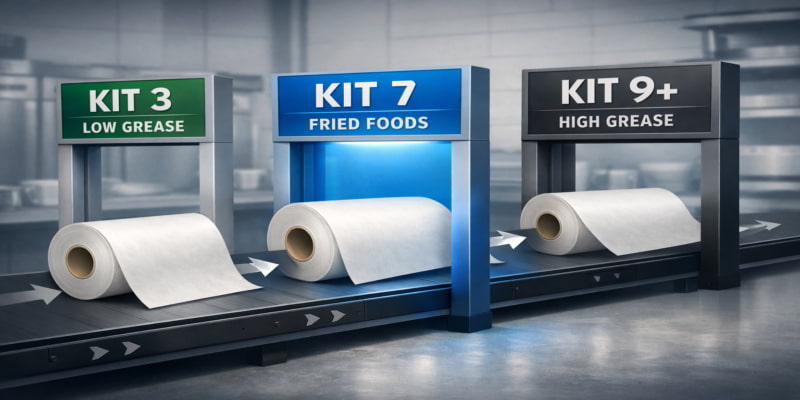
📌 Key Takeaways
Matching your food wrapper to your menu’s heat, grease, and hold time prevents stains and complaints.
- Kit Level Beats Labels: A numbered grease rating (Kit 1–12) tells you more than “food safe” or “greaseproof” ever will.
- Kit 3 Handles Light Duty: Dry pastries, bread, and cold sandwiches work fine with Kit 3 because grease stays minimal.
- Kit 7 Covers Most Fried Foods: Burgers, fried chicken, and greasy sandwiches need Kit 7 to resist heat and fat together.
- Test Before You Buy in Bulk: Wrap real menu items, hold them as long as delivery takes, then check for grease bleed at folds and seams.
- Lock Two to Four House Specifications: Stop ordering by vague names like “wax paper” and instead set standard Kit levels for your menu categories.
The right specification means clean bags—the wrong one means greasy fingers and wasted money.
Kitchen managers and food service buyers sourcing wraps for fried or greasy menu items will find a clear decision framework here, preparing them for the detailed menu-matching guidance that follows.
~ ~ ~ ~ ~ ~ ~ ~ ~ ~ ~ ~ ~ ~ ~ ~ ~ ~
10:00 AM. Tuesday. The kitchen manager pulls a stack of burger wraps from the shelf and spots the problem before the first patty hits the grill—grease is already wicking through the paper. The invoice said “food safe.” The supplier promised quality. But now there’s a lunch rush in 90 minutes and food packaging paper that won’t hold.
It’s ordering paper by label instead of by specification—a pattern that leads to the failure of generic sourcing in food packaging paper. The fix comes down to understanding one number: the Kit level.
Match it to your menu’s grease aggression—the combination of heat, grease load, and hold time—and wraps stay clean. Get it wrong, and you get stained bags, oily fingers, and customer complaints that have nothing to do with the food itself.
This guide provides a starting framework: when Kit 3 is enough, when Kit 7 becomes the safer default, and how to verify performance before committing to a bulk order. With this approach, you can move from guessing at labels to specifying with confidence—adopting the specifications-first protocol that turns food packaging paper from a recurring headache into a solved problem.
The Quick Answer: Kit 3 vs. Kit 7 in One Minute
Kit 3 serves as a starting point for dry and low-grease items. Bakery goods, bread rolls, cold sandwiches without heavy sauces—these generate minimal grease and sit for short periods before consumption.
Kit 7 serves as a starting point for standard fried and greasy foods. Fried chicken, burgers with cheese and bacon, hot sandwiches—these combine environmental stressors—elevated temperatures, lipid volume, and extended duration—that necessitate a robust barrier
Kit 9+ may be considered for heavy grease loads. Items sitting in pooled oil, saucy fried foods, or delivery orders with extended transit times create conditions that can overwhelm even Kit 7 barriers.
These are starting references, not guarantees. While paper construction and folding methods play a role, thermal transfer and lipid saturation are the primary drivers of real-world failure. Always verify with samples and a kitchen trial before finalizing supplier orders.
What Kit Level Measures (and What It Does Not)
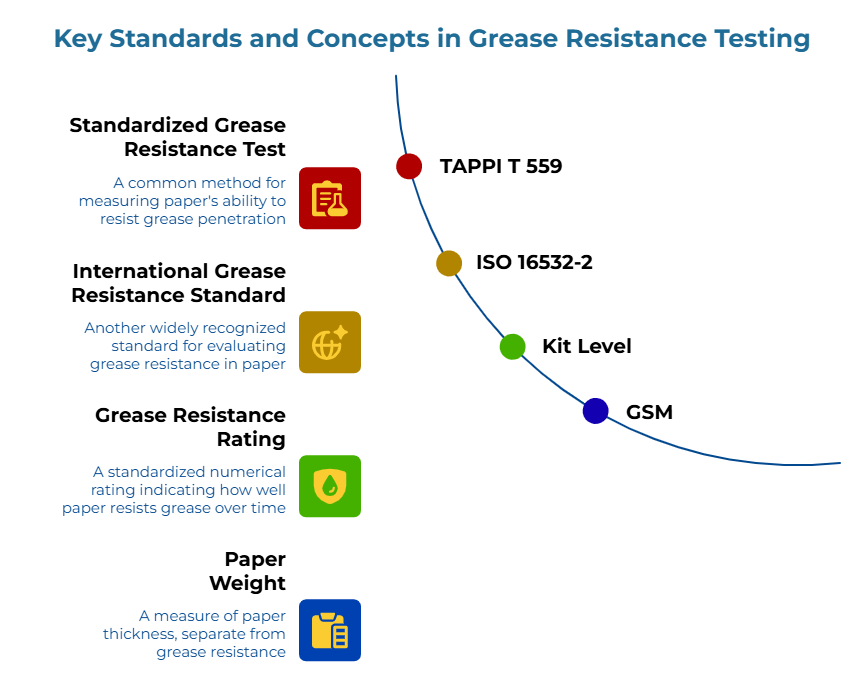
A Kit level is a standardized way to rate how well paper resists grease penetration through the sheet over time. Think of it like the SPF rating for sunscreen—a higher number offers protection against more intense exposure, such as hotter, greasier foods. Picture a customer holding a fried snack; a high Kit level ensures their fingers stay dry, while a low level leads to an unappetizing oil leak. To prevent this, you must match your menu’s grease aggression to the correct Kit level.
A critical distinction: Kit level is a performance rating tied to a standardized test method—not a measure of paper thickness. The two primary standards are TAPPI T 559 and ISO 16532-2. A heavy 80 GSM sheet without grease treatment will fail faster than a lighter 45 GSM sheet rated at Kit 7. Understanding food packaging paper GSM as separate from barrier performance prevents this common specification error. Weight and grease resistance are separate specifications that must be evaluated independently.
When reviewing a supplier’s Technical Data Sheet (TDS), look for two elements: the named test method and the stated Kit level. If neither appears, the paper’s grease resistance remains unverified. For guidance on interpreting supplier documentation, see how to read a food packaging paper supplier’s TDS.
Menu-Match Table: Fried Chicken vs. Sandwich vs. Bakery
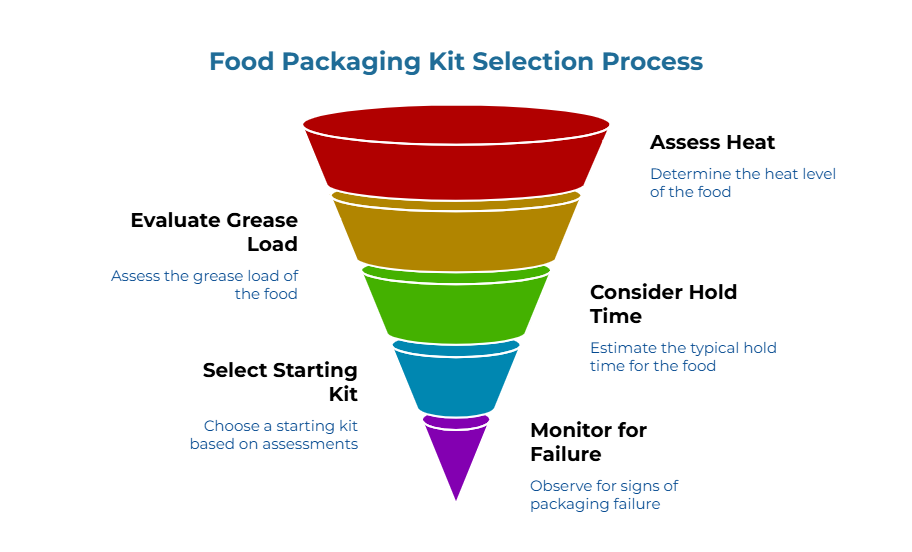
The following table provides general starting guidance for matching food types to Kit levels. Use it as a reference point, not a specification guarantee.
| Food Type | Heat | Grease Load | Typical Hold | Starting Kit | What Failure Looks Like |
| Bread, dry pastries | Low | Minimal | Under 5 min | Kit 1–3 | Rarely fails at appropriate spec |
| Cold sandwiches (no sauce) | None | Low | Short–medium | Kit 3 | Slight translucency at fold lines |
| Warm sandwiches, light cheese | Medium | Low–Medium | 5–15 min | Kit 5 | Grease halo forming around filling |
| Burgers with cheese/bacon | High | Medium–High | 10–20 min | Kit 7 | Oil wicking visibly at seams |
| Fried chicken, wings | High | High | Medium–long | Kit 7–9 | Visible exterior staining |
| Heavy-oil fried, saucy items | High | Very High | Long/delivery | Kit 9+ | Paper saturation, structural softening |
The “What Failure Looks Like” column helps diagnose whether current wraps are under-specified. Translucent spots, grease halos, and seam wicking all indicate the Kit level may not match the menu’s demands. For a more comprehensive matrix covering your full menu, see the Menu-Match Matrix for food packaging paper.
Low-Aggression Applications (Kit 3)
Kit 3 works where grease is incidental rather than central to the food. Bakery wraps, bread bags, dry pastry sleeves, and cold sandwiches without heavy dressings fall into this range. The grease load stays minimal. Temperatures remain ambient or barely warm. Hold times are short—customers typically consume the item within minutes of receiving it.
What failure looks like at Kit 3: Translucent spots develop at fold lines or where the wrap contacts the food. A faint grease halo appears around the fillings. The paper doesn’t fall apart, but it looks unappetizing. If these signs appear on bakery items, the paper may be below Kit 3, or the issue may be moisture rather than grease—a different problem requiring a different solution.
Procurement often defaults to Kit 3 for cost-efficiency for low-grease applications. That logic holds until the menu changes. Adding a hot breakfast sandwich or a grilled cheese transforms the grease profile entirely, and wraps that performed adequately yesterday begin failing today.
Why Fried Chicken Pushes Beyond Generic Wraps
The tipping point arrives when heat, fat, and time combine. Standard wax paper or basic poly-lined sheets work for cold and low-grease items, but fried chicken exposes their limits through three compounding factors.
Paper rarely fails uniformly. It fails at weak points—seams, folds, crinkles. These are the exact places where hot oil gets pressure and time to wick through.
Heat accelerates grease migration. Hot oil behaves differently than room-temperature fat—it’s thinner, more mobile, and penetrates paper fibers faster. A wrap that holds at 20°C (68°F) can fail at 70°C (158°F) because the grease moves more aggressively.
Fat content increases pressure on the barrier. A fried chicken thigh releases substantially more grease than a cold turkey sandwich. That volume of oil needs somewhere to go, and it finds every weakness in the paper’s defense.
Hold time extends exposure. A burger handed directly to a customer faces two minutes of stress. The same burger sitting in a warming drawer for 15 minutes faces continuous assault on the grease barrier. Time multiplies the other factors.
Standard wax coatings soften under high heat—they’re designed for cold applications. Lower Kit levels allow hot oil to wick through seams and folds, which are the structural weak points where paper layers meet. The result is visible staining on the exterior, greasy fingers for customers, and bags that look wet before they’re opened. This pattern leads many operators to blame suppliers when the actual problem is specification mismatch.
Modern Kit 7 treated papers use advanced PFAS-free aqueous coatings, biopolymers, or highly refined mechanical barriers to resist this combination.¹ While historical wrappers relied heavily on fluorochemicals, sweeping global regulations—including the US FDA’s recent phase-outs and the EU’s 2026 Packaging and Packaging Waste Regulation (PPWR) mandate—have rendered them obsolete for compliant procurement.² Today’s safe grease barriers maintain integrity under heat stress without relying on restricted substances. Seams and folds stay cleaner through the hold window. For most food service operations serving fried foods, Kit 7 represents the practical default that handles burgers, fried chicken sandwiches, and similar items reliably. For deeper context on why generic wraps fail hot applications, see The Wax Paper Tra.
When to Consider Kit 9+
Some menu items create conditions that push beyond what Kit 7 reliably handles.
Heavy-oil fried foods like fried fish, tempura, or items emerging from the fryer saturated with oil present extreme grease loads. Even brief contact can challenge a Kit 7 barrier.
Saucy items with pooled liquid—buffalo wings sitting in sauce, loaded nachos with melted cheese pooling at the bottom—create sustained exposure. The paper isn’t just blocking surface grease; it’s containing liquid.
Extended delivery holds for 30–45 minutes during transit test barriers continuously. The longer food sits, the more opportunity grease has to find weaknesses.
Higher is not automatically better. Specifying Kit 9+ when Kit 7 suffices adds unnecessary cost. Some high-barrier constructions can also affect how steam escapes from wrapped hot foods, potentially changing texture. The goal is matching specification to actual stress—not maximizing the number on the TDS.
What Goes Wrong When Specifications Miss the Mark
Under-specified: Visible staining forces rewrapping during service, slowing operations. Greasy bags damage brand perception before customers taste the food. Repeated complaints erode trust that has nothing to do with food quality.
Over-specified: Higher-barrier papers cost more without delivering additional value for the application. Some constructions trap steam differently, potentially affecting food texture in enclosed packaging. A budget spent on unnecessary specification is a budget unavailable elsewhere.
How to Specify and Verify with Suppliers
Before finalizing any paper order, three questions and one practical test separate verified performance from marketing claims.
Question 1: What is the stated Kit level? The supplier should provide a specific number. Vague terms like ‘grease resistant’ or ‘food safe’ indicate the paper hasn’t been tested to a recognized standard—a pattern explored in why ‘food safe’ is a meaningless label. Vague terms like “grease resistant” or “food safe” indicate the paper hasn’t been tested to a recognized grease-resistance standard. A label indicating compliance with 21 CFR 176.170 (for fatty foods) or 21 CFR 176.180 (for dry foods) confirms food-contact safety but says nothing about grease-resistance performance.
Question 2: What test method was used? Look for TAPPI T 559 or ISO 16532-2. A named standard confirms the rating came from an actual test procedure, not a marketing estimate.
Question 3: Can you provide documentation? Request the TDS showing the Kit level and test conditions. This document becomes the reference point if performance doesn’t match the claim.
How to Run a Quick Kitchen Trial
This is not a lab method. It’s a practical check that mirrors what happens during service, including the weak points where folds and seams face real pressure.
- Select two stress items: Pick a fried item (fried chicken sandwich or fried snack) and a burger build that matches your actual menu. These represent your highest grease-aggression scenarios.
- Wrap each item as normal: Use the same folding style and tightness your staff applies during service. Consistency matters—loose folds and tight folds behave differently.
- Hold for realistic intervals: Test a short hold matching dine-in flow (5–10 minutes) and a longer hold matching delivery or warming drawer conditions (20–40 minutes).
- Inspect for failure signals: Check the outside surface and folds for translucency at contact zones, wicking at seams and folds, oil halo formation over time, and tearing or weakening when unwrapped.
- Document pass or fail: Record results with photos and a short note on conditions—item temperature, hold duration, stacked versus unstacked. This creates an evidence trail for supplier discussions.
One trial run prevents months of complaints and the costly process of switching suppliers mid-operation. For a simple receiving-style method that complements trial work, the 5-minute grease spot test provides an additional screen.
5 Things to Verify Before Switching Wraps
- Identify the highest grease-aggression menu item (often fried chicken or a greasy grilled sandwich)
- Set the starting Kit target: Kit 3 for low-grease, Kit 7 for hot/greasy, Kit 9+ only when real holds demand it
- Require the Kit level and named test method on the supplier’s TDS
- Run a quick kitchen trial using real folds, stacking, and hold times
- Lock 2–4 house specifications so procurement stops ordering by vague labels like “wax paper”
Common Misconceptions
“Higher GSM means better grease protection.” GSM (grams per square meter) measures paper weight, not grease resistance. A thick, heavy paper without barrier treatment fails faster than a lighter paper with the right Kit rating. Weight provides structural rigidity, while the Kit rating dictates chemical barrier integrity; they are independent variables. For more on how GSM and Kit level interact, see the operator’s guide to GSM and Kit levels.
“Wax paper and greaseproof paper are the same thing.” Wax coatings soften at temperatures above approximately 65°C (150°F), which means they can fail on hot fried foods. Greaseproof papers utilizing modern PFAS-free polymer coatings, silicone, or dense mechanical barriers maintain integrity under heat. The terms describe fundamentally different products with different performance envelopes. For a detailed comparison of coating options, see Poly vs. Wax vs. Greaseproof.
“‘Food safe’ means the paper works for my menu.” A “food safe” label indicates regulatory compliance for food contact—the materials won’t leach harmful substances. It does not indicate performance for specific temperatures, grease loads, or hold times. A paper can be perfectly safe and still let grease bleed through in eight minutes. Kit level and food safety are separate questions requiring separate verification. The PaperIndex Academy explains why ‘food safe’ isn’t enough for specifying packaging performance.
From Specification Confusion to Operational Confidence
The path from greasy bags to clean wraps runs through specification, not supplier switching. Kit 3 handles dry and low-grease items. Kit 7 handles typical fried foods where heat, fat, and hold time combine. Kit 9+ may be appropriate for extreme grease loads and extended holds.
Start with the menu-match table to identify a starting point. Ask suppliers for the named Kit level and supporting documentation. Run a kitchen trial with actual menu items before committing to volume. That sequence transforms specification confusion into a repeatable, verifiable process—and wraps that hold up through the lunch rush without drama.
For a complete reference across all twelve Kit levels, see the full Kit Levels 1–12 guide. To consolidate your menu into 2–4 standardized paper specifications, use the Menu-Match Matrix.
Disclaimer:
This article provides educational guidance on food packaging paper specifications. Kit level recommendations represent general starting references based on typical food service conditions and widely accepted industry practices. Actual performance depends on specific paper construction, application methods, hold times, and operating conditions. Always consult local regulations or qualified professionals for compliance guidance.
Our Editorial Process:
Our expert team uses AI tools to help organize and structure our initial drafts. Every piece is then extensively rewritten, fact-checked, and enriched with first-hand insights and experiences by expert humans on our Insights Team to ensure accuracy and clarity.
About the PaperIndex Insights Team:
The PaperIndex Insights Team is our dedicated engine for synthesizing complex topics into clear, helpful guides. While our content is thoroughly reviewed for clarity and accuracy, it is for informational purposes and should not replace professional advice.