
📌 Key Takeaways
Audit-ready food packaging paper means having proof documents that match how you actually use the packaging—not just a “food safe” label.
- Labels Don’t Equal Proof: A “food safe” stamp tells inspectors nothing useful—they need documents showing test conditions that match your real food, temperature, and contact time.
- FDA and ISEGA Serve Different Roles: FDA references show U.S. food-contact rules were followed; ISEGA certificates prove an outside lab tested the material under specific conditions.
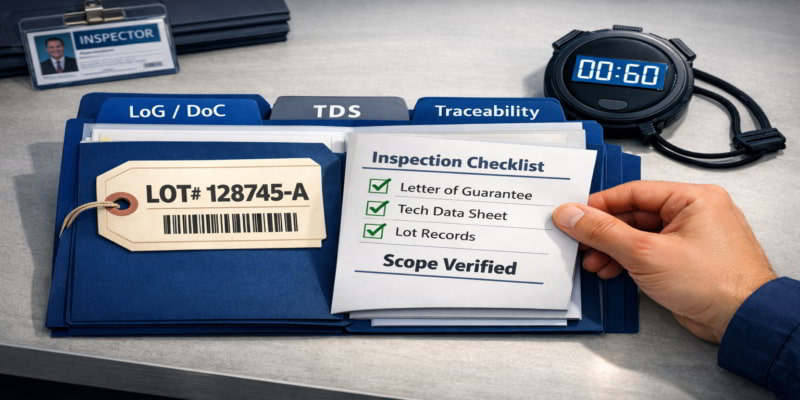
- Build a Three-Document Pack: Keep a compliance letter, a technical data sheet, and lot-number records together so you can pull proof within a minute during an inspection.
- Run a 60-Second Scope Check: Before approving any supplier, confirm the legal name matches, every material layer is covered, and test conditions meet or exceed your actual use.
- Certificates Go Stale: Supplier changes to coatings, formulas, or factories can make old documents invalid—refresh annually and after any process change.
Proof that matches reality beats paperwork that looks official.
Food service operators and procurement managers sourcing food packaging paper for hot or greasy foods will find a ready-to-use documentation system here, preparing them for the detailed compliance workflow that follows.
~ ~ ~ ~ ~ ~ ~ ~ ~ ~ ~ ~ ~ ~ ~ ~ ~ ~
An inspector requests food packaging paper documentation. The supplier certificate shows “FDA compliant” and “ISEGA certified.” Then comes the follow-up question: does this certificate cover the specific wrapper used for hot fried items held at 80°C for 15 minutes?
That single question separates operators who are audit-ready from those scrambling for answers.
When a delivery bag shows grease on the outside or a wrap looks questionable, the next question is practical: can proof be shown, right now, for this exact food packaging paper? Audit readiness is the difference between a calm answer and a scramble through inboxes.
Audit-ready food packaging paper means having verifiable documentation that matches actual food-contact conditions—the specific food type, contact time, and temperature used in daily operations. FDA 21 CFR references indicate alignment with U.S. food-contact rules for paper components. ISEGA indicates third-party testing evidence, often aligned with European frameworks. In both cases, the practical requirement is scope: confirming the documentation covers the specific paper, any coatings or inks, and real operating conditions—then filing it for fast retrieval.
This guide explains what FDA and ISEGA references actually signal, how to build a simple 3-document evidence pack, and how to verify that supplier documentation matches real-world use. For additional context on what FDA vs ISEGA really means (and what to ask suppliers), the PaperIndex Academy provides detailed guidance.
Important: This content is provided for educational purposes and does not constitute legal advice. Compliance requirements can vary by jurisdiction and by your specific food-contact conditions (food type, contact time, and temperature). For guidance tailored to your operation and market, consult a qualified regulatory or food-safety professional.
What “Audit-Ready Food Packaging Paper” Means in Food Service
Audit-ready food packaging paper is paper supported by retrievable documentation that an inspector can verify against actual use conditions. This describes a state of preparedness, not a certification or label.
The Distinction Between Audit Readiness and ‘Food Safe’ Marketing
A ‘food safe’ label is a claim; audit readiness is a file. For a deeper examination of why generic labels fall short, see why ‘food safe’ isn’t enough: the hidden risks of generic food packaging paper. The phrase “food safe” on food packaging paper provides little that an inspector can act upon. It lacks regulatory definition—it carries no specified scope, no test conditions, and no traceable evidence chain.
Inspectors verify documentation trails, not marketing claims. They look for a Declaration of Compliance or Letter of Guarantee naming a specific regulatory framework, check whether stated conditions match actual use, and may request traceability records linking the delivered lot to compliance documents. A generic stamp cannot answer these questions. The documentation behind the food packaging paper can.
The Minimum Standard: Documentation That Matches Real Use
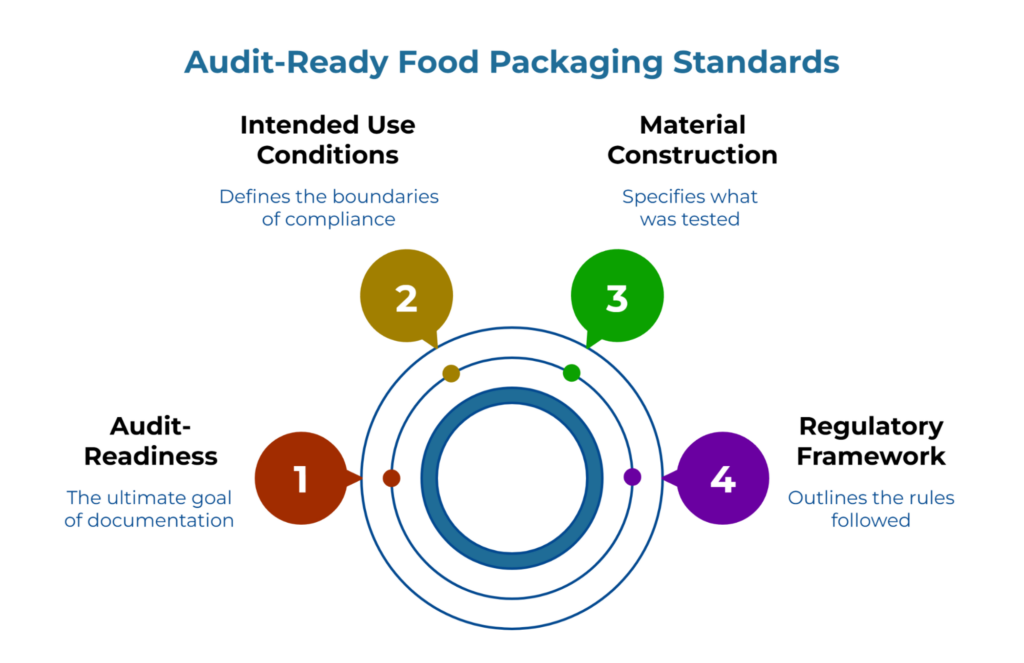
The minimum standard for audit-readiness is documentation covering three elements: the regulatory framework, the material construction, and the intended use conditions.
Regulatory framework tells the inspector which rules the supplier claims to follow. For U.S. operations, this typically means FDA 21 CFR Part 176. For European markets or suppliers using EU-aligned testing, references to Regulation (EC) 1935/2004 may appear.
Material construction specifies exactly what was tested. Paper alone is rarely the complete picture. If a wrapper has a grease-resistant coating, that coating must be included in the compliance scope. If printing is present, the inks must be covered.
Intended use conditions define the boundaries of the compliance claim: food type (dry, aqueous, fatty, or acidic), contact time, and temperature. A wrapper tested for dry goods at room temperature is not validated for a hot sandwich held for 15 minutes. If hot, oily food is held for delivery, then the documents must cover contact conditions that resemble hot and oily use, not only dry-food handling.
FDA for Paper Packaging: What “21 CFR” References Typically Signal
When a supplier references FDA compliance for food packaging paper, they typically point to Title 21 of the Code of Federal Regulations, Part 176. This part addresses indirect food additives—substances that may migrate from food packaging paper into food. The FDA’s packaging and food contact substances program provides the regulatory foundation.
Where Paper Fits in FDA’s Food-Contact Framework
Within Part 176, two sections are particularly relevant for food service packaging. Section 176.170 covers components of paper and paperboard intended for contact with aqueous and fatty foods—burger wrappers, sandwich papers, and containers for saucy items. Section 176.180 covers components intended for contact with dry food—bread bags, bakery tissue, and similar applications.
This distinction matters. A paper evaluated and found compliant under 176.180 for dry food contact is not automatically suitable for a greasy fried chicken wrapper. Conditions of use differ, and migration behavior may change under fatty or high-temperature conditions.
Why Conditions-of-Use Matter
FDA compliance is condition-specific. The regulations recognize that a material’s safety depends on how it will be used, not just what it is made of. A coating posing no migration concern at room temperature with dry bread may behave differently in prolonged contact with hot grease. A statement can be “true” and still be unusable if it does not cover the way the food packaging paper is actually used.
When reviewing supplier documentation referencing FDA 21 CFR Part 176, look for explicit statements about intended use conditions. If documentation says “compliant per 21 CFR 176.170” without specifying conditions, request confirmation that stated compliance covers specific menu conditions.
FDA is commonly referenced in supplier paperwork, but the FDA does not actually “certify” food packaging paper at all. What matters operationally is whether the supplier can provide a clear declaration and supporting documentation that matches the product’s actual food-contact scope.
ISEGA: Independent Testing and Certification Standards
When a supplier presents an ISEGA certificate, they are providing third-party testing evidence—typically aligned with European regulatory frameworks. The ISEGA food contact materials testing page outlines the scope of their evaluation services.
ISEGA as a Testing Institute
ISEGA is not a regulatory body. It does not write rules for food contact materials. Instead, it tests materials against existing frameworks. While this often includes the European Union’s Regulation (EC) 1935/2004 for general safety principles, because the EU lacks a harmonized standard specifically for paper, ISEGA typically evaluates paper materials against the German BfR (Bundesinstitut für Risikobewertung) Recommendation XXXVI.
The value of an ISEGA certificate lies in independent verification. Rather than relying solely on a manufacturer’s self-declaration, buyers have evidence that an accredited laboratory evaluated the material. However, an ISEGA certificate is only as useful as its scope—it applies to the specific material tested under the specific conditions simulated.
What to Look for Inside an ISEGA Certificate
When receiving an ISEGA certificate, reading beyond the headline is essential. If elements are unclear, asking is appropriate. For a structured approach to verify compliance beyond certificates, consider implementing a verification model with defined checkpoints. Key elements to verify:
- Material description: The certificate should identify the tested material in sufficient detail—paper type, basis weight, any coatings or treatments.
- Test conditions: Food simulants used, contact time, and temperature. A certificate testing contact at 40°C does not validate use at 85°C.
- Scope statement: Confirming the scope covers actual use is essential.
- Date and version: A certificate from several years ago for an earlier product version may no longer apply.
An ISEGA certificate typically means there is third-party testing evidence for a specific material under specific conditions; it does not guarantee suitability for every product build or every use case without checking scope.
The 3-Document Evidence Pack to Become Audit-Ready
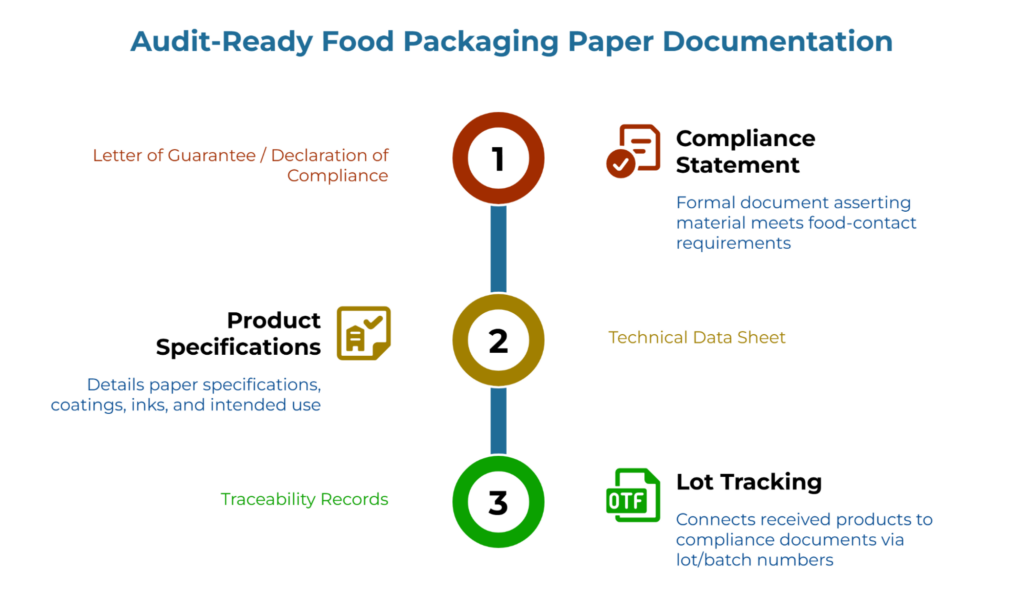
Audit-readiness comes down to having the right documents organized for fast retrieval. For detailed guidance, see the related resource on 3 documents needed to pass a health inspection.
1) Letter of Guarantee / Declaration of Compliance
The Letter of Guarantee (LoG) or Declaration of Compliance (DoC) serves as the primary compliance document—a formal statement asserting that the material meets specified food-contact requirements. Required fields to verify:
- Regulatory framework reference (FDA 21 CFR 176.170/176.180, EU Regulation 1935/2004, or other)
- Material scope with sufficient specificity to match the purchase
- Conditions of use (food types, temperature range, contact time)
- Issuing entity (legal name and contact information)
- Date and authorized signature
2) Technical Data Sheet
The Technical Data Sheet (TDS) provides product specifications. While the LoG addresses compliance, the TDS addresses identity—confirming that the material ordered is the material received. Key elements: paper specifications (basis weight/GSM, caliper), coating or treatment details, ink specifications for printed food packaging paper, and intended use statements.
3) Traceability Records
Traceability records connect physical products received to compliance documentation on file. Without this link, an inspector may question whether documents apply to the actual food packaging paper in use. Capture lot/batch numbers from packing slips, cross-reference each lot to corresponding LoG and TDS versions, and note receiving dates.
A simple folder structure makes this manageable: [Supplier Name] / [Product Code] / [Lot Number] / [LoG, TDS, Receiving Note]. Name folders so a non-expert can find them quickly—for example: supplier name + SKU + use case + month-year. When an inspector asks for documentation, relevant files become retrievable within a minute.
Supplier Communication Protocol
Subject: Documentation Request for Food Contact Compliance – [Product Name/Code]
Dear [Supplier Contact],
We are requesting the following documentation to support our food contact compliance file:
- Letter of Guarantee or Declaration of Compliance – Include regulatory framework reference, material scope, and conditions of use.
- Technical Data Sheet – Covering paper specifications, coatings/treatments, and ink declarations if applicable.
- Traceability information – How lot/batch numbers link delivered shipments to the above documents.
Our intended use: [e.g., “wrapping hot fried chicken at approximately 80°C with contact times up to 20 minutes”]. Please confirm documentation covers these conditions.
[Your Name / Company]
Scope Check: A 60-Second Triage Before Approving Any Supplier
Before approving any new food packaging paper supplier—or re-approving after a product change—running a quick scope check prevents common documentation failures. For a complete workflow, see the guide on how to audit food packaging paper suppliers for FDA & ISEGA safety.
Identity match: Confirm the legal entity name on compliance documents matches the purchasing entity. If buying from a distributor, verify the documentation chain traces back to the manufacturer. When ready to source compliant materials, explore verified food packaging paper suppliers through specialized B2B marketplaces.
Material match: Verify every component falls within compliance scope—base paper, barrier coatings, inks, and adhesives. A certificate covering uncoated paper does not extend to coated paper.
Use-case match: Confirm stated compliance conditions meet or exceed actual use. If fried chicken sits in a wrapper at 80°C for 15 minutes but documentation only covers dry foods at room temperature, a mismatch exists.
Common Failure Modes That Break Audit-Readiness
Even well-intentioned documentation efforts can fail. Understanding why food-safe labels fail over time helps prevent compliance decay. Three patterns represent the most common reasons buyers discover gaps:
Out-of-scope certificates: The certificate is real but does not cover what is actually being used. This happens when buyers assume a supplier’s general compliance extends to all products. Prevention requires always verifying material and condition scope before filing.
Stale documents after process changes: The supplier changed coating suppliers, adjusted formulation, or moved production. Documentation can lag behind reality when suppliers change inputs or processes but older evidence keeps circulating. For a systematic approach to catching these gaps, implement the supplier verification model that tracks formulation changes. The old certificate remains on file but no longer applies. Prevention requires establishing a refresh cadence and noting document dates.
Missing traceability: Valid LoG and TDS exist, but when the inspector asks which lot is currently in use, no link to the documents can be established. Prevention requires capturing lot numbers at receiving and filing them alongside corresponding compliance documents.
How to Connect Safety Standards with Performance Specifications (Without Confusing Them)
Safety documentation and performance specifications serve different purposes. Conflating them creates gaps in both compliance and product function.
Safety standards address whether a material is legally permitted for food contact, focusing on migration limits. A material passing FDA or EU requirements is cleared for use, but that clearance says nothing about performance. Grease resistance, moisture resistance, and structural durability are performance characteristics. A wrapper can be fully compliant with food-contact regulations and still allow grease to soak through within minutes.
Kit Levels (rated 1–12) measure paper’s resistance to grease penetration—a performance specification, not a safety certification. If specifications require grease resistance for fried foods or butter-heavy items, Kit Levels belong in procurement requirements alongside compliance documentation. For detailed guidance, see the Kit Levels 1–12 grease resistance guide.
Maintaining the Evidence Pack: Internal Routines
Documentation valid at purchase can become invalid through supplier changes, regulatory updates, or shifts in menu conditions. A simple maintenance routine keeps evidence packs current.
Refresh cadence: Setting a baseline refresh cycle—annually represents a reasonable starting point—establishes a pattern suppliers come to expect. At each cycle, request updated LoG/DoC and TDS, verify documents still cover current use conditions, and note the refresh date.
Trigger events: Certain events should trigger immediate documentation review:
- New supplier or product (request documentation before the first order ships)
- Supplier notification of formulation or facility change
- Food packaging paper construction changes (new coating, ink, adhesive, laminate, or liner)
- Menu changes introducing hotter or greasier items
- Regulatory updates
For teams dealing with multi-market compliance questions, the specific migration limits (SML) workflow provides a deeper, global lens.
Moving Forward
Acronyms on a supplier document do not create audit-readiness. Documentation matching actual use conditions does. The gap between “FDA compliant” and “compliant for my specific wrapper at my specific temperature” is where inspection failures live.
Start with the three-document evidence pack: a Letter of Guarantee naming the framework and conditions, a Technical Data Sheet specifying the material, and traceability records linking delivered lots to those documents. Run the 60-second scope check on every supplier. Refresh annually and on trigger events. When documentation matches reality, the inspector’s follow-up question becomes straightforward to answer. To begin building your compliant supply chain, find food packaging paper suppliers who can provide the documentation standards outlined in this guide.
Disclaimer:
This information serves an educational purpose and is not legal advice. Compliance requirements vary by jurisdiction and by your specific food-contact conditions (food type, contact time, and temperature). For guidance tailored to your operation and market, consult a qualified regulatory or food-safety professional.
Our Editorial Process:
Our expert team uses AI tools to help organize and structure our initial drafts. Every piece is then extensively rewritten, fact-checked, and enriched with first-hand insights and experiences by expert humans on our Insights Team to ensure accuracy and clarity.
About the PaperIndex Insights Team:
The PaperIndex Insights Team is our dedicated engine for synthesizing complex topics into clear, helpful guides. While our content is thoroughly reviewed for clarity and accuracy, it is for informational purposes and should not replace professional advice.