
📌 Key Takeaways
Most audit failures happen because the right paperwork can’t be found fast enough—not because it doesn’t exist.
- Match Documents to Shipments: A Letter of Guarantee only works when it’s linked to the exact grade, lot, and supplier for each delivery.
- Build Evidence Bundles: Pair every Letter of Guarantee with spec sheets, test reports, traceability records, and change logs in one folder.
- Name Files Consistently: Use supplier name, product grade, document type, and date in every filename so anyone can find proof in under three minutes.
- Assign Clear Ownership: One person per supplier keeps folders current—shared responsibility means nobody checks for updates.
- Run Retrieval Drills: Practice finding documents before inspections reveal gaps in your system.
Organized paperwork is faster paperwork—and speed is what audits demand.
Procurement managers and QA teams handling food-contact packaging compliance will gain a ready-to-use folder system here, preparing them for the detailed checklist that follows.
~ ~ ~ ~ ~ ~ ~ ~ ~ ~ ~ ~ ~ ~ ~ ~ ~ ~
A restaurant chain fails a health inspection. Not because the food packaging paper was non-compliant—but because nobody could find the paperwork proving compliance. The Letter of Guarantee existed somewhere in an email thread from seven months ago.
Where did we save that file?
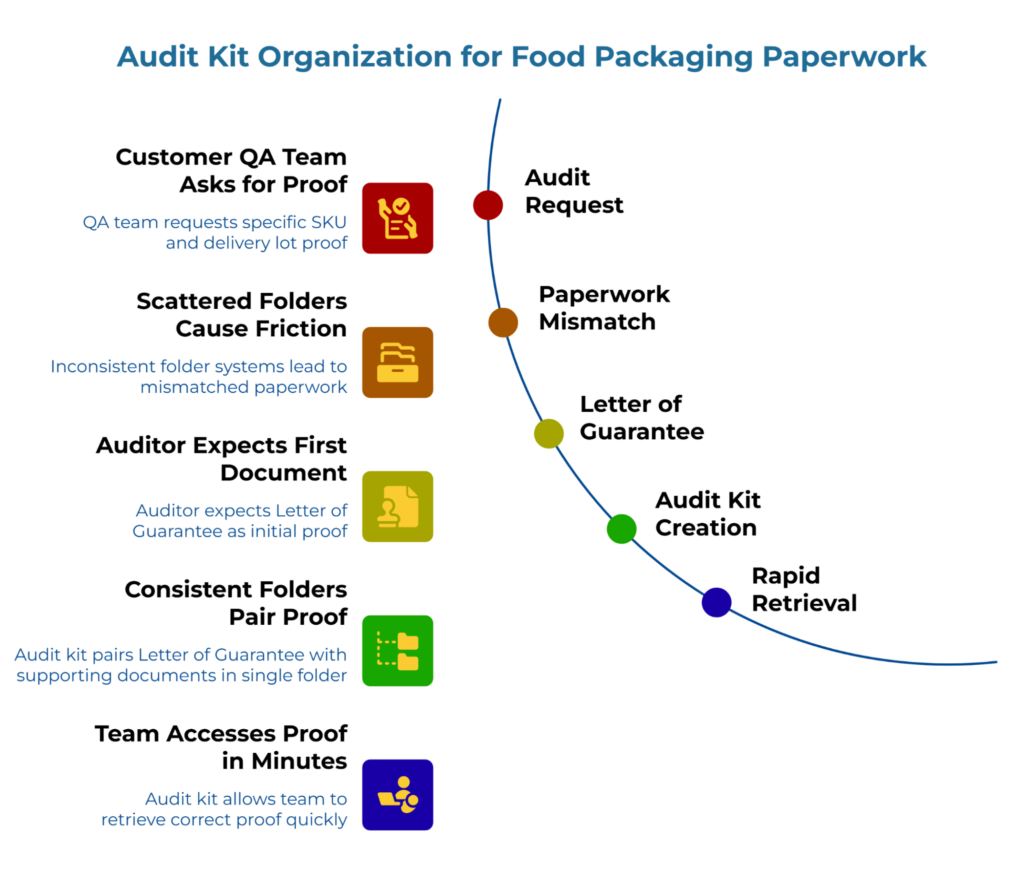
Quality assurance professionals frequently note that a leading cause of audit friction is not missing paperwork, but mismatched paperwork—the wrong letter, the wrong grade, or the wrong lot. When a customer’s QA team requests proof for a specific SKU and delivery lot, scattered folder systems break down.
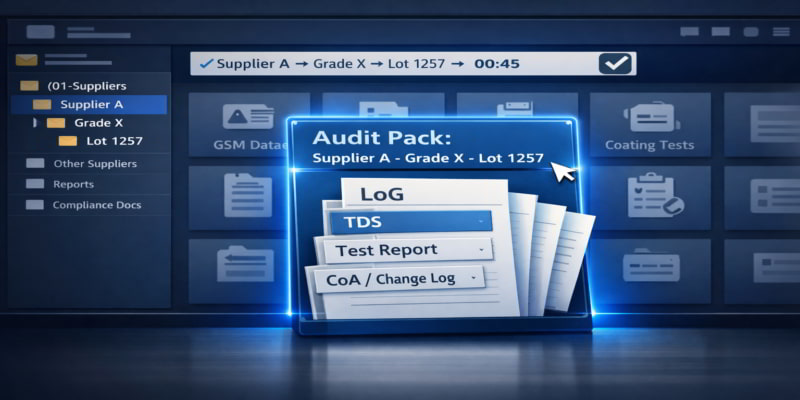
A Letter of Guarantee is the document an auditor expects to see first—but it rarely stands alone. The real risk in inspections is not that paperwork does not exist; it is that the right document cannot be matched to the right supplier, grade, and shipment fast enough. An “audit kit” fixes that by pairing each Letter of Guarantee with its proof (spec sheets, evidence, and traceability) in a single, consistently named folder that anyone on the team can retrieve in minutes.
The audit kit answers one question: Which Letter of Guarantee covers this exact material, from this supplier, for this intended use—and what proof supports it?
What a Letter of Guarantee Is (and What It Is Not)
A Letter of Guarantee (LoG) is a supplier-provided assurance document stating that a specific packaging material is suitable for intended food-contact use under stated conditions, within a defined scope.
A usable LoG typically references product identity (grade, SKU), intended use conditions (temperature, fat exposure, contact duration), applicable regulations such as 21 CFR Part 176 to 189 or EU Regulation (EC) No 1935/2004, scope limitations, and supplier accountability. For a deeper understanding of what these regulatory references mean in practice, see FDA vs. ISEGA for takeout food packaging paper: what the acronyms really mean.
What an LoG does not replace: test reports, Technical Data Sheets specifying GSM and barrier properties, traceability records linking lots to shipments, or change control evidence when formulations shift. The LoG is a declaration. Supporting evidence makes that declaration credible.
The Supporting Evidence Bundle: 5 Document Types
A Letter of Guarantee becomes audit-ready when paired with documentation that substantiates its claims.
1. Technical Data Sheet (TDS) — Defines what the product actually is: grade name, basis weight range, coating type, intended applications, barrier properties. Learn how to interpret these documents in migration testing: how to read your food packaging paper supplier’s technical data sheet.
2. Compliance Evidence — Test reports from accredited laboratories. Migration testing results (e.g., Overall Migration Limit (OML) and Specific Migration Limit (SML)). Compliance with EU GMP requirements (Regulation (EC) No 2023/2006). Some customer audits also reference packaging certification frameworks such as the BRCGS Packaging Materials Standard.
3. Traceability Documents — Lot and batch identification. Certificates of Analysis (CoA) or Certificates of Conformance (CoC) tied to specific shipments. Delivery notes linking paperwork to physical inventory.
4. Change Control Evidence — Revision history documenting when suppliers changed plants, formulations, or processes. An LoG issued in January may not cover a product reformulated in March.
5. Fit-for-Use Notes — In-house receiving checks confirming the product performs as expected under actual conditions. A 5-minute grease spot test provides a practical verification method.
The Compliance Folder Structure
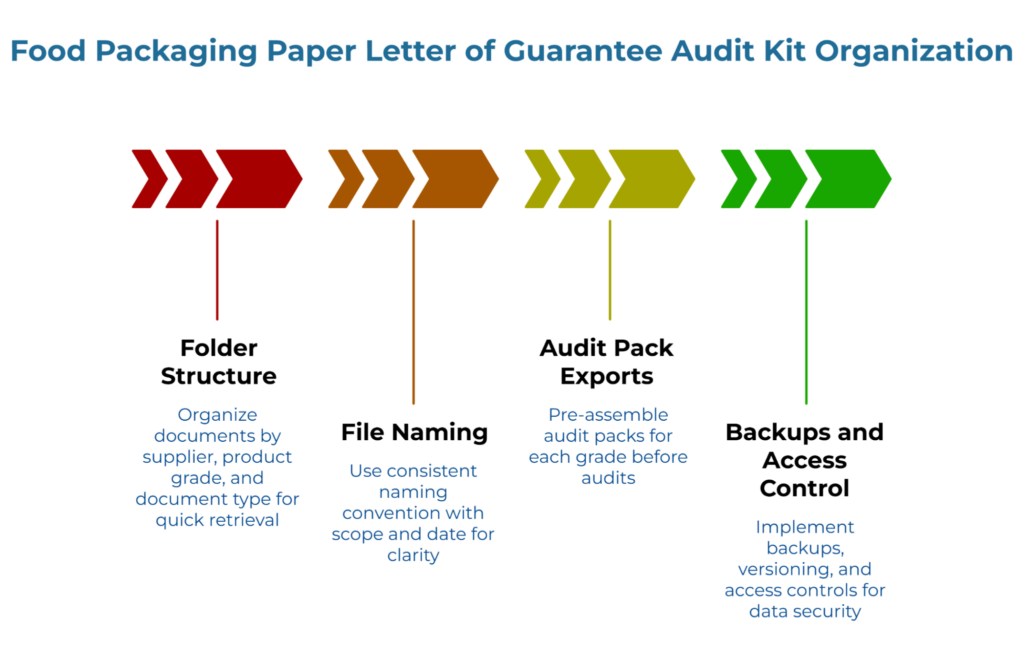
Organization determines retrieval speed. This folder tree prioritizes finding the right document in under three minutes.
/Compliance-Audit-Kit/
/01-Suppliers/
/Supplier-Name/
/Product-Grade-or-SKU/
/01-Letter-of-Guarantee/
/02-Technical-Data-Sheet-TDS/
/03-Compliance-Evidence/
/04-Traceability-CoA-CoC/
/05-Change-Control/
/06-Audit-Pack-Exports/
File Naming Convention
Filenames must encode scope and freshness. For operations spanning multiple markets, add a short scope tag (EU, US, Global) based on what the document explicitly states:
Supplier_ProductGrade_LoG_[ScopeTag]_YYYY-MM-DD.pdf
Supplier_ProductGrade_TDS_YYYY-MM-DD.pdf
Supplier_ProductGrade_TestReport_[ScopeTag]_YYYY-MM-DD.pdf
Supplier_ProductGrade_CoA_Lot-XXXXX_YYYY-MM-DD.pdf
Folder /06-Audit-Pack-Exports/ holds pre-assembled bundles. Build the audit pack before needing it.
Backups and Access Control
Three operational safeguards protect the system: backups and versioning prevent silent loss or rollback to older files; access control limits editors while maintaining broad read access for on-the-floor retrieval; and the audit pack export in /06-Audit-Pack-Exports/ creates a “ready to share” bundle per grade (LoG + TDS + key evidence + traceability for the relevant lot). A single hardware failure should not eliminate compliance documentation.
Build a Baseline Kit (Estimated 60 Minutes Per Supplier)
Step 1 (Estimated 15 min): Create a master supplier index for a targeted supplier. Assign one owner responsible for keeping that folder current.
Step 2 (Estimated 20 min): Collect LoG and TDS for each grade from this supplier. Save with standardized filenames.
Step 3 (Estimated 15 min): Attach compliance evidence and traceability documents. Match lot numbers to current inventory.
Step 4 (Estimated 5 min): Set renewal triggers for new grades, site or process changes, and coating or formulation changes. Schedule quarterly 15-minute reviews.
Step 5 (Estimated 5 min): Run a retrieval drill. If locating a document takes longer than three minutes, adjust the structure.
Note: These timeframes are estimated baselines for organizing a single supplier profile. Total time will scale depending on organizational size, the number of active suppliers, and existing data silos.
Diagnosing the System
Most audit failures trace to system problems, not missing documents.
Environmental friction scatters attention—busy operations, email threads burying attachments, shared drives with inconsistent naming, supplier turnover introducing new formats. Human error compounds the problem: PDFs misfiled under wrong supplier names, LoGs going stale because nobody tracks revision dates, lot numbers on CoAs not matching inventory.
Fixes require a single source of truth, standardized filenames, clear ownership (one person per supplier), and quarterly audits catching drift before inspections do.
For verification frameworks, see the compliance shield: how to audit your food packaging paper suppliers for FDA & ISEGA safety.
Key Questions for LoG Usability
When requesting a Letter of Guarantee, specificity determines usefulness:
- What is the exact product identifier? (Grade name, SKU)
- What are the intended use conditions? (Temperature, fat exposure, contact duration) These factors determine which Kit level and specifications your packaging requires.
- Which regulations does this LoG reference?
- What is the scope of coverage? (Grades, plants, markets)
- What supporting evidence is available?
- When was it last revised?
- How are changes communicated?
If a supplier cannot answer clearly, the LoG’s audit value is limited.
Common Failures
Generic LoGs with no grade scope leave gaps inspectors will question. This mirrors the broader problem of generic “food safe” labels that prove nothing without named standards. Certificates not matching actual test conditions create vulnerability—a problem explored in why food-safe labels fail: how compliance decay happens in food-grade packaging paper. No revision tracking means outdated documentation persists. No traceability link between CoA and inventory becomes an audit question mark.
See Food packaging paper trail: 3 documents you need to pass a health inspection for additional guidance.
Frequently Asked Questions
What should a Letter of Guarantee include for food-contact packaging?
Product identifiers, intended use conditions, applicable regulatory references, scope of coverage, and supplier accountability information.
Is an LoG enough for a health inspection?
It is a starting point. Inspectors typically request supporting evidence—TDS, test reports, and traceability documents.
How often should Letters of Guarantee be renewed?
Review annually at minimum. Update immediately when suppliers communicate changes to grades, sites, processes, or formulations.
What documents should be attached to a Letter of Guarantee?
Commonly: TDS, scope-matched evidence, traceability artifacts, and change-control records. For a governance model covering these elements, see beyond the certificate: a governance model for pharmaceutical packaging compliance.
How do you organize compliance documents for audits?
Folder structure by Supplier → Product Grade → Document Type. Standardized filenames with dates and scope tags where relevant. Pre-assembled audit packs for rapid sharing.
For international sourcing challenges, see importing food packaging paper? how to verify international safety certifications. For evaluating what supplier claims actually mean, why “food safe” is a meaningless label for food packaging paper provides verification frameworks. Explore more compliance and verification guides in the PaperIndex Academy.
Disclaimer:
This content is for educational purposes only.
Our Editorial Process:
Our expert team uses AI tools to help organize and structure our initial drafts. Every piece is then extensively rewritten, fact-checked, and enriched with first-hand insights and experiences by expert humans on our Insights Team to ensure accuracy and clarity.
About the PaperIndex Insights Team:
The PaperIndex Insights Team is our dedicated engine for synthesizing complex topics into clear, helpful guides. While our content is thoroughly reviewed for clarity and accuracy, it is for informational purposes and should not replace professional advice.