

📌 Key Takeaways
Wrapper waste across multiple locations drops when you map real food conditions to a small set of tested performance tiers.
- Classify by Food Stress, Not Brand: Group menu items by heat, grease, and hold time before talking to suppliers—this prevents vague specifications that invite guesswork.
- Kit Level Beats Paper Weight: A lighter paper with higher grease resistance outperforms heavy paper with weak barrier coating—always specify kit level, not just GSM.
- Three Tiers Cover Most Menus: Low, medium, and high grease-resistance specifications handle everything from dry pastries to fried chicken with 20-minute delivery holds.
- Double-Wrapping Signals Specification Failure: When staff reach for extra sheets, treat it as evidence of mismatch—not a paper quality problem or operator preference.
- Exceptions Need Proof, Not Preferences: Route special requests through the same logic that built your house specifications: documented performance reasons and trial data.
Fewer SKUs = simpler training, cleaner forecasts, and wrappers that actually work.
QA managers, procurement directors, and franchise operators managing multi-unit food packaging will find a step-by-step consolidation method here, preparing them for the detailed framework that follows.
~ ~ ~ ~ ~ ~ ~ ~ ~ ~ ~ ~ ~ ~ ~ ~ ~ ~
The wrapper looked fine when it left the counter. Twenty minutes later, during the lunch rush, it turned translucent and greasy—and a customer snapped a photo. That image landed in a group chat with franchise managers across multiple regions, all asking the same question: “Why is our food packaging paper failing?”
Staff respond by double-wrapping. Franchise managers request “their own” wrapper, adding another SKU to the purchase order. Before long, what started as a single packaging problem became a sprawling mess of wrapper variations—each one a guess at solving a failure that was never properly diagnosed.
The real waste isn’t excess paper. It’s excess uncertainty. A SKU consolidation chart fixes this by replacing guesswork with a controlled system that maps your menu’s actual conditions to a small set of validated wrapper specifications—making it easier to find suppliers who can consistently meet those specifications.
Why SKU Sprawl Creates Waste in Multi-Unit Packaging
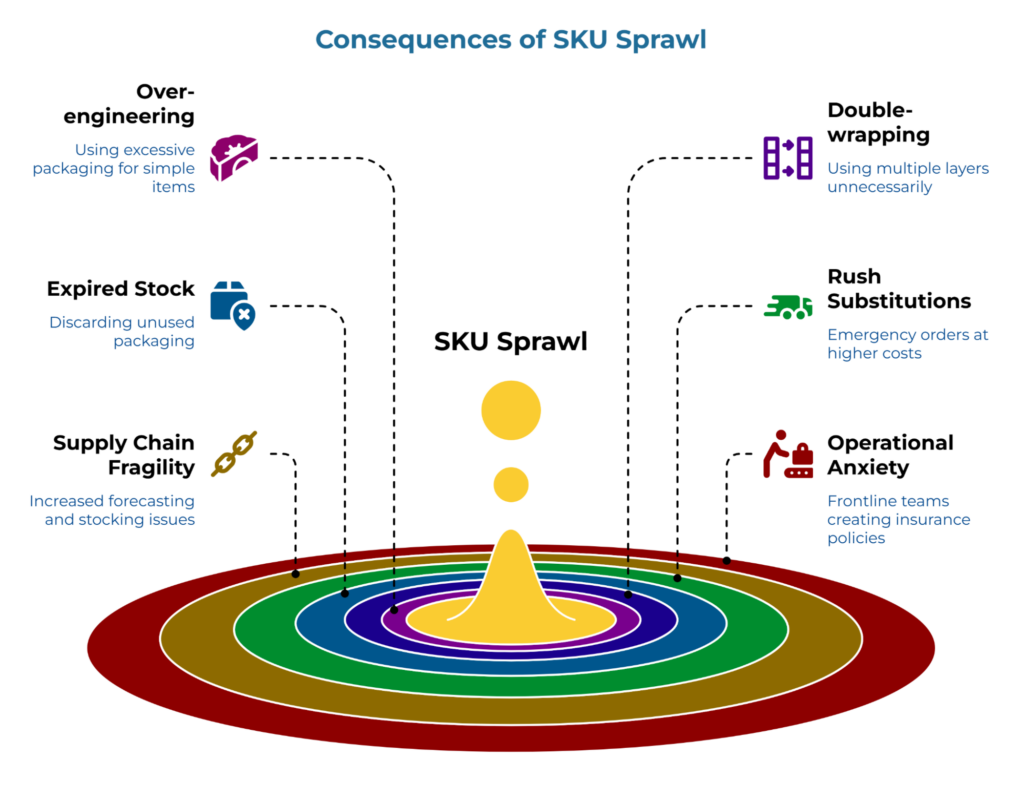
SKU sprawl happens when minor wrapper variations—different sizes, printed logos, or vague ‘greaseproof’ labels—become separate purchase lines, a problem equally common in kraft paper bags and food wrapping paper alike. Each location stocks slightly different items. Some hoard extras. Others run out and substitute whatever is on hand.
The hidden waste shows up in four forms. First, over-engineering: locations using high-barrier wrappers for low-grease items like toast or plain buns. Second, double-wrapping: staff using two sheets when one correct specification would do, because the stocked wrapper fails during hold time. Third, expired stock: rarely-used SKUs sitting in storage until they’re discarded. Fourth, rush substitutions: emergency orders at premium freight when the “local favorite” runs out.
Across a network, SKU sprawl also creates supply chain fragility: more items to forecast, more chances to stock out, and more training friction when new staff must learn “which roll for which item” instead of following one consistent rule. The hidden cost is operational anxiety. When frontline teams cannot trust wrapper performance under real hold time, they create their own insurance policy—extra sheets, extra layers, extra SKUs.
None of this appears as “packaging waste” in a standard report. It hides inside freight invoices, labor hours, and customer complaints. The US EPA’s sustainable packaging framework emphasizes source reduction as the preferred waste prevention strategy—SKU consolidation acts as the central mechanism for source reduction within wrapper inventory management.
What a SKU Consolidation Chart Is (and What It Isn’t)
A SKU consolidation chart is a controlled mapping: menu item → required performance tier → approved house specification. It translates the chaos of “we’ve always ordered this one” into a defensible system anchored to actual food conditions.
Think of it as a pairing guide. Just as a sommelier matches wine to a meal, this chart matches the chemistry of the paper to the physics of the food. The objective is specification alignment rather than mere price reduction. Prematurely reducing wrapper costs without validating performance just moves the failure downstream into customer experience and brand damage.
For QA managers, this means a defensible, scientific test method to prevent grease leaks and health code violations. For procurement directors, it creates a standardized benchmark to force suppliers to quote on exact performance, not ambiguous categories. For franchise operators, it ends the chaos of double-wrapping and keeps customer hands clean.
Step 1: Build Your Baseline Inventory and Failure Log
Start by collecting a single master list of every wrapping paper SKU currently ordered across all locations. Include “local” items that individual managers have added.
For each SKU, add a failure-log column with simple categories: grease bleed, tearing, soggy texture, customer complaint, or double-wrap observed. This baseline reveals patterns. You may find five SKUs that all fail the same way, or three SKUs that are functionally identical but named differently by region.
If multiple locations report different fixes for the same menu item—double-wrap here, switch roll there—treat that as evidence of specification mismatch rather than operator preference.
Step 2: Classify Your Menu by Heat, Grease, and Hold Time
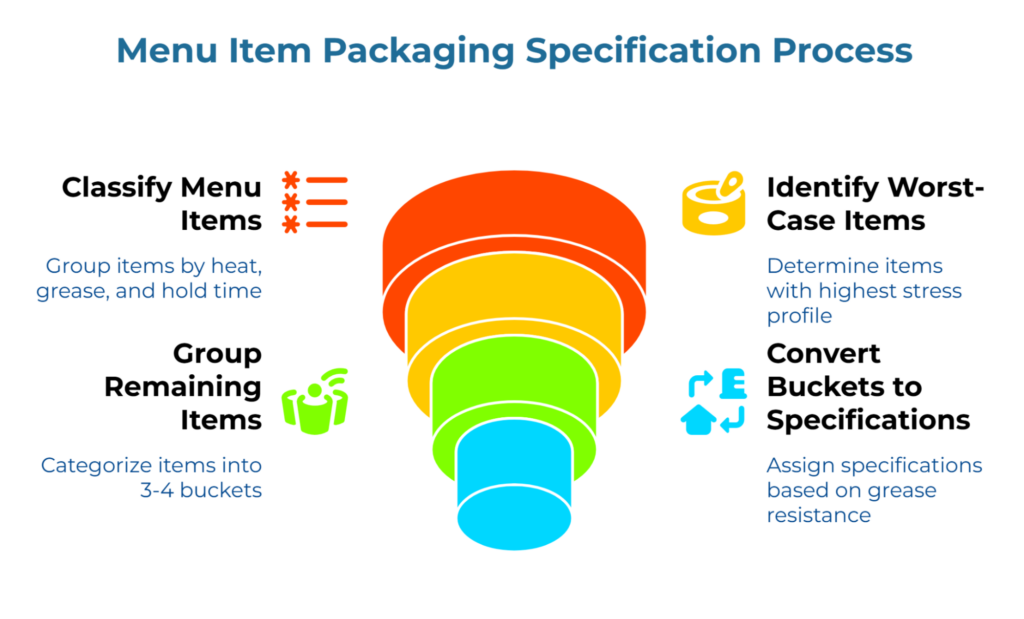
Use Menu-Match Matrix logic to group menu items by their stress profile: serving temperature when wrapped, fat content and surface oil, and maximum expected time in a warming drawer or delivery bag.
Identify your worst-case items—the greasiest foods held the longest. These set the ceiling for your highest-tier house specification. Group remaining items into three or four buckets before you talk to suppliers. This prevents suppliers from quoting against vague requirements.
This simple grid maps grease level against hold time to assign house specifications. “Hold time” and “grease resistance” are terms frontline teams recognize immediately; using their language reduces friction during rollout.
| Short Hold | Medium Hold | Long Hold | |
| Low Grease | House Specification A | House Specification A | House Specification B |
| Medium Grease | House Specification A | House Specification B | House Specification B |
| High Grease | House Specification B | House Specification C | House Specification C |
This matrix drives consistency across locations without replacing actual testing. It serves as a starting point for classification before validation.
Conventional procurement logic often defaults to a universal ‘greaseproof’ specification for all fried items. But when operators end up double-wrapping high-heat items while wasting money over-engineering wrappers for low-heat items, the universal approach has failed. Without mapping precise kit levels to specific grease profiles, buyers overspend on margin or risk catastrophic wrapper failure.
Step 3: Convert Buckets into Three House Specifications
Translate your menu buckets into three validated performance tiers:
| Tier | Description | Typical Kit Level | Example Menu Items |
| House Specification A | Low grease resistance | Kit 3–5 | Bread rolls, toast, dry pastries |
| House Specification B | Medium grease resistance | Kit 6–8 | Burgers, grilled sandwiches, light-fried items |
| House Specification C | High grease resistance | Kit 9–12 | Fried chicken, bacon wraps, items with 20+ minute delivery holds |
Each house specification should include a named test method and a target kit-level range, particularly when sourcing food grade kraft paper substrates that must meet both barrier and compliance requirements. This gives QA managers defensible language for barrier testing and gives procurement directors a clear specification to quote against—achieving true specification alignment across supplier negotiations.
Step 4: Draw the Consolidation Chart (15 → 3 Example)
Here is a worked example showing how fifteen scattered wrapper SKUs collapse into three validated house specifications:
| Current SKU | Menu Use | Failure/Workaround | Target Tier | Replacement |
| WRP-001 | Breakfast sandwich | Grease bleed after 10 min | B | House Specification B |
| WRP-002 | Toast sleeve | None | A | House Specification A |
| WRP-003 | Fried chicken wrap | Double-wrap observed | C | House Specification C |
| WRP-004 | Burger wrap (East) | Soggy after delivery | B | House Specification B |
| WRP-005 | Burger wrap (West) | None | B | House Specification B |
| WRP-006 | Bacon wrap | Grease bleed | C | House Specification C |
| WRP-007 | Plain bun sleeve | Excessive barrier | A | House Specification A |
| WRP-008 | Grilled cheese | Soggy | B | House Specification B |
| WRP-009 | Fried fish wrap | Double-wrap observed | C | House Specification C |
| WRP-010 | Pastry bag | None | A | House Specification A |
| WRP-011 | Chicken tenders | Grease bleed | C | House Specification C |
| WRP-012 | Veggie wrap | None | A | House Specification A |
| WRP-013 | Loaded fries liner | Grease bleed | C | House Specification C |
| WRP-014 | Kids meal wrap | Substitute used often | B | House Specification B |
| WRP-015 | Regional promo | Untested | B | House Specification B (trial required) |
The consolidation reduces the inventory to three house specifications, streamlining ordering catalogs and training protocols while eliminating double-wrapping waste.
Step 5: Roll Out Across Locations
Standardization efforts collapse if perceived as a rigid mandate lacking a functional variance protocol. Establish an exception protocol that evaluates special requests against the original performance logic.
Exception Policy Checklist
☐ Document the specific performance reason (not “we prefer this one”)
☐ Identify which menu condition the current house specification fails to meet
☐ Run a one-week trial with documented grease-resistance observation
☐ If validated, add as Tier D or revise the relevant house specification; if not, deny the exception
Update ordering catalogs to show only approved house specifications, whether sourced from paper bag suppliers or food packaging converters. Train staff to recognize that double-wrapping signals a specification mismatch—not a paper quality problem. When new menu items launch, run them through the Menu-Match Matrix before ordering wrappers.
Common Failure Modes and How to Avoid Them
Incomplete validation against maximum stress variables. If you validate house specifications against average conditions, you’ll see failures during extended delivery holds or promotional items with extra grease. Test against the longest hold time and highest grease load in each tier.
Letting print variations recreate sprawl. Custom branding for regional promotions can quietly rebuild your SKU list. Require all printed wrappers to use an approved house specification as the base substrate.
Treating “greaseproof” as proof. When evaluating greaseproof paper, supplier claims mean nothing without a named test method. Standard GSM does not account for dynamic heat and grease interactions over time. Require formal validation—such as kit-level certification per TAPPI T 559 for legacy papers, or real-world oil penetration tests like TAPPI T 507 or ISO 16532-1 for modern PFAS-free alternatives—before approving any wrapper.
Next Steps: Lock Your House Specifications into Supplier Qualification
A consolidation chart is only as durable as the qualification process behind it. Connect your house specifications to ongoing supplier management: require the same test methods in RFQs from greaseproof paper suppliers, verify kit levels on incoming shipments, and re-qualify when suppliers change substrates or coatings. This replaces ad-hoc purchasing with a documented, specification-first vetting process. Ready to put your validated specifications to work? Submit an RFQ to receive quotes from verified food packaging paper suppliers.
For a deeper methodology on matching wrapper specifications to your menu, see the Menu-Match Matrix guide on PaperIndex Academy. When you’re ready to source wrappers that meet your validated kit-level tiers, explore food packaging paper suppliers on PaperIndex.
Frequently Asked Questions
Does higher GSM mean higher grease resistance?
No. GSM measures weight, not barrier performance. A lighter paper with a higher kit level will block more grease than a heavier paper with a lower kit level.
How do we allow exceptions without losing control?
Subject each variance request to the established validation protocol: mandate a technical performance justification, isolate the specific menu variable unmet by current house specifications, and execute a controlled trial. Approval is contingent upon empirical data.
What performance tier do we actually need for our worst-case items?
Identify your greasiest menu items with the longest hold times. For traditional fluorochemical-treated papers, these typically require Kit 9–12. If using compliant PFAS-free papers, request equivalent high-barrier validation (e.g., passing TAPPI T 507 for prolonged hold times). Test against actual delivery conditions before finalizing.
How do we validate a new supplier specification quickly?
Request formalized test reports (TAPPI T 559 for traditional papers, or TAPPI T 507/ISO 16532-1 for sustainable substrates). Run a one-week operational trial on your highest-stress menu items. Compare results against your current house specification performance.
Key Definitions
SKU sprawl: Many wrapper SKUs that differ slightly (size, print, coating claim) but behave the same—or worse, behave unpredictably.
House specifications: A small set of approved wrapper performance tiers that all locations can order without debate.
Barrier Performance vs. Basis Weight (GSM): GSM (grams per square meter) measures paper weight. Kit level is the traditional benchmark for grease resistance on a scale from 1 to 12, tested per TAPPI T 559. However, because modern PFAS-free coatings often fail this solvent-heavy test despite effectively blocking actual food fat, alternative validations like TAPPI T 507 are increasingly required. Generally, a lighter 50 GSM wrapper functionally validated for high grease will easily outperform a heavy 60 GSM wrapper with weak barrier protection.
Disclaimer:
This content is educational and informational purposes only.
Our Editorial Process:
Our expert team uses AI tools to help organize and structure our initial drafts. Every piece is then extensively rewritten, fact-checked, and enriched with first-hand insights and experiences by expert humans on our Insights Team to ensure accuracy and clarity.
About the PaperIndex Insights Team:
The PaperIndex Insights Team is our dedicated engine for synthesizing complex topics into clear, helpful guides. While our content is thoroughly reviewed for clarity and accuracy, it is for informational purposes and should not replace professional advice.