
📌 Key Takeaways
Supplier documents look complete but prove nothing until they answer your specific requirements.
- Define Proof Before You Ask: Build your evidence checklist before suppliers respond, so every document answers a named requirement—not just a broad category.
- Match Proof to Stage: Request only basic screening evidence early, then deepen requirements as suppliers advance to shortlist and final approval.
- Name the Test Method: Without a specific test standard (like ISO 536 or ISO 2758), two “compliant” documents can mean completely different things.
- Assign One Reviewer per Category: When nobody clearly owns sign-off, everyone assumes someone else approved it—and gaps hide until the final review.
- Filing Isn’t Qualifying: Collecting documents without checking them against acceptance criteria creates false confidence that collapses under pressure.
Documents without requirement links are just paper—proof with purpose is what earns trust.
Procurement managers, packaging engineers, and brand operations teams qualifying folding carton suppliers will find a ready-to-use proof-pack builder here, preparing them for the detailed RFQ process that follows.
~ ~ ~ ~ ~ ~ ~ ~ ~ ~ ~ ~ ~ ~ ~ ~ ~ ~
Three supplier files sit on the desk.
Each response looks complete. Certificates are attached. Capability statements describe modern equipment. Quality management documentation fills the appendix. On paper, all three suppliers appear qualified to produce the folding cartons your next product launch requires.
Yet the team cannot answer a straightforward question: what proof actually supports each response? The procurement manager sees comparable documents. The packaging engineer sees gaps in technical validation. Brand operations see risk to the launch timeline. Everyone agrees the suppliers look qualified, but no one can confirm they are qualified.
This is the real problem. Approval pressure rises before proof logic is stable. Teams feel exposed because decisions start moving faster than the specification architecture underneath them. Once that happens, persuasive supplier language starts filling gaps that named proof standards should have filled first.
This guide, part of the PaperIndex Academy, introduces a structured approach to replacing vague supplier claims with requirement-linked proof. It explains what belongs in a supplier evidence pack, how to sequence proof depth across qualification stages, and who should own sign-off for different proof categories. The goal is a defensible, repeatable process that procurement, packaging engineering, and brand operations can share before supplier comparison begins.
Better qualification starts before supplier persuasion, not after.
What A Folding-Carton Supplier Evidence Pack Actually Is
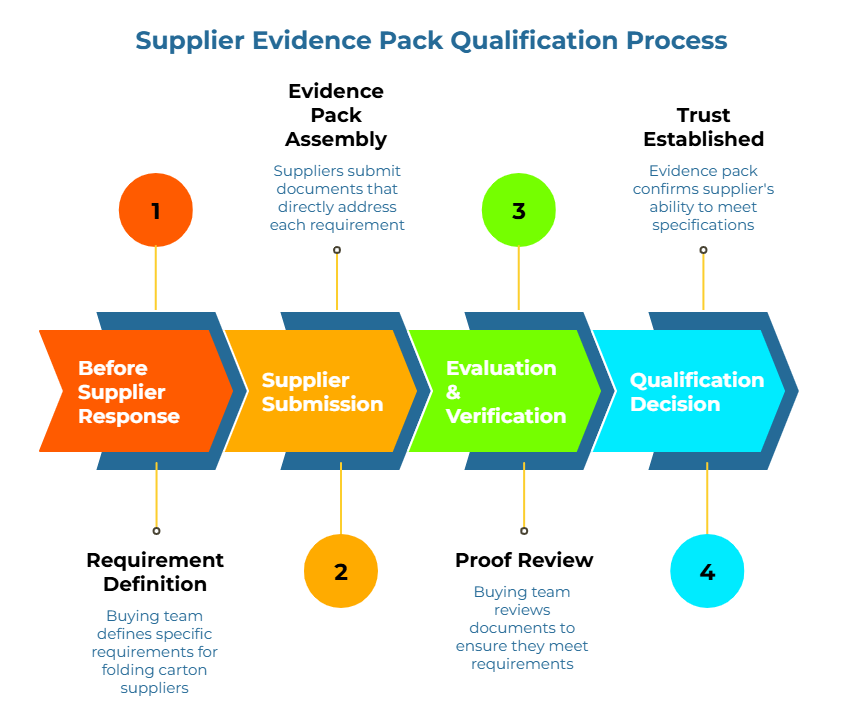
A supplier evidence pack is not a folder of certificates. It is not a collection of documents gathered after a supplier responds to a request for quotation. It is a qualification structure built around named requirements.
Think of it as the proof folder that turns a promise from folding carton suppliers into something the buying team can actually trust.
The distinction matters. A document collection grows passively as suppliers submit materials. An evidence pack is designed actively, before suppliers respond, to ensure every document answers a specific requirement field. When a packaging engineer asks whether the supplier can hold a caliper tolerance, the evidence pack should contain proof that addresses that exact specification. When procurement needs to compare two suppliers on coating capability, the pack should include test results measured against the same standard.
Without this structure, teams accumulate paperwork that looks comprehensive but proves little. The supplier provides an ISO certificate. The team files it. The supplier provides a general capability statement. The team files that too. Months later, during a qualification review, someone asks what proof confirms the supplier can actually meet the folding carton specification. The answer is unclear because no one mapped the documents to the requirements.
Completion only exists when the documents answer the right requirement fields in the right way.
An evidence pack prevents this by defining proof expectations before supplier evaluation begins.
Why Paper-Complete Supplier Responses Still Create Approval Anxiety
A supplier response can include every document a buyer requested and still fail to prove qualification. This happens when proof expectations remain unnamed.
Consider a common scenario. The buying team asks suppliers to demonstrate coating capability. Supplier A submits a certificate showing their coating line meets a general food-contact standard. Supplier B submits a test report showing water vapor transmission rate under specific temperature and humidity conditions. Both responses address “coating capability.” But only one answers the actual requirement: whether the coating will protect the product under the buyer’s distribution conditions.
Without named proof expectations, the team cannot distinguish between these responses. Both look complete. Both seem professional. The false equivalence creates approval anxiety because the comparison basis is unstable.
Three misconceptions often reinforce this problem:
A response is comparable because the broad folding carton description sounds similar. Similar descriptions do not guarantee similar capabilities. One supplier’s “SBS folding carton” might differ substantially from others in caliper tolerance, coating weight, or print registration accuracy.
A stronger supplier promise can repair a weak definition problem. If the requirement field is vague, a confident supplier response simply inherits the vagueness. The team ends up approving based on persuasion rather than proof.
A file full of documents automatically means qualification is complete. Document presence is not proof presence. Certificates confirm that a supplier participates in a quality system. They do not confirm that the supplier meets the buyer’s specific folding carton requirements.
These misconceptions persist because they feel efficient. Asking for general documentation is faster than defining precise proof requests. But the efficiency is illusory. Teams that skip requirement-linked proof often discover gaps during pilot runs, line trials, or worse, after product launch.
The Field-To-Proof Principle: Proof Only Works When Requirements Are Named
Proof requests become useful only when they anchor to named requirement fields. This is the field-to-proof principle.
A requirement field is a specific, measurable parameter in the folding carton specification. Grammage (often colloquially referred to as basis weight) expressed in grams per square metre with a stated tolerance. Caliper expressed in micrometres with upper and lower limits. Burst strength expressed in kilopascals with a minimum threshold and a named test method.
When the requirement field is named, the proof request becomes precise. Instead of asking for “quality documentation,” the team asks for a test report showing basis weight results within the specified tolerance, tested per the named standard, dated within the past twelve months. The supplier either provides this proof or they do not. Evaluation becomes straightforward.
When the requirement field is unnamed, proof requests drift toward generality. The team asks for “coating certificates” without specifying which barrier property matters. The supplier provides something. The team cannot evaluate whether it answers the actual need.
This principle connects directly to specification normalization. If requirement fields shift between RFQ rounds, or if different team members define the same field differently, proof requests will be inconsistent. The evidence pack inherits whatever instability exists in the underlying specification. Teams that struggle with proof often discover their real problem is upstream, in requirement definition. Without stable requirement fields, supplier documentation becomes a performance of alignment rather than evidence of it. For guidance on establishing buyer-owned specification logic, see The Danger of Vendor-Led Data Sheets: Establishing Rigid Folding Carton Specification Requirements.
What Belongs In A Useful Evidence Pack
A useful evidence pack organizes proof into three categories. Each category answers a different qualification question.
Requirement-linked proof
This category answers whether the supplier can meet the buyer’s named specification fields. It is the most direct form of evidence.
Requirement-linked proof typically includes test reports showing results for basis weight, caliper, burst strength, or other measurable parameters. The proof should reference the same test method named in the buyer’s specification and show results within the stated tolerance.A grammage requirement of 275 ± 10 g/m² tested per ISO 536 should be answered with a test report citing ISO 536 and showing a result between 265 and 285 g/m².
Coating certifications, print registration samples, and board grade documentation from packaging paper suppliers also fall into this category when they address specific requirement fields.
Capability-linked proof
This category answers whether the supplier has the process controls, equipment, and systems to deliver consistently over time. A single good sample does not guarantee repeatable production.
Capability-linked proof typically includes ISO 9001 or equivalent quality management certification, with verification that the scope covers folding carton production at the relevant facility. Suppliers seeking to demonstrate such credentials to global buyers can list their company free on verified B2B platforms. Equipment specifications for presses, die-cutters, and coating lines demonstrate that the supplier’s machinery—whether from paper manufacturers or converters—can handle the buyer’s format and substrate requirements. Statistical process control records or historical consistency data provide evidence that the supplier maintains stable production over time.
This proof category matters because capability gaps often emerge only after repeated orders. A supplier might produce an excellent sample batch but struggle with consistency at volume.
Validation-linked proof
This category answers whether the supplier has demonstrated performance under conditions similar to the buyer’s application. It bridges the gap between theoretical capability and practical execution.
Validation-linked proof typically includes trial run reports from similar folding carton formats, shelf-life validation data relevant to the buyer’s product type, and transit simulation results that match the buyer’s distribution profile. Customer references describing comparable production runs may also contribute, though they require verification. Buyers can contact suppliers directly to request such references.
Validation-linked proof is often the hardest to obtain at early qualification stages. It may require pilot orders or structured trials. The evidence pack should note where validation proof is pending and specify what conditions would complete it.
These three categories should work together. Requirement-linked proof tells the team what is being answered. Capability-linked proof shows whether control exists. Validation-linked proof shows whether the answer holds when the folding carton is actually examined.
How To Sequence Proof Depth Across Qualification Stages
Not all proof belongs at the same stage of qualification. Treating early-stage and deeper-stage proof as identical creates inefficiency and delays.
Early-stage proof answers threshold questions. It filters suppliers who cannot meet basic requirements before deeper evaluation begins. At this stage, the evidence pack might request only high-level capability proof and requirement-linked proof for the buyer’s two or three most critical specification fields. A supplier who cannot demonstrate ISO certification or who lacks equipment for the required folding carton format should be filtered early, before anyone invests time in detailed qualification.
Deeper-stage proof answers precision questions. It confirms that shortlisted suppliers can meet the full requirement set with documented consistency. At this stage, the evidence pack expands to include validation-linked proof, statistical process data, and method-specific test reports for all critical parameters. A document set that was acceptable for early screening may be too thin here.
A practical sequencing model uses three stages:
| Qualification Milestone | Purpose | Standardized Proof Depth |
| Screening | Filter suppliers who cannot meet threshold requirements | Quality management certification, general capability statement, confirmation on 2-3 critical requirements |
| Shortlist qualification | Confirm shortlisted suppliers can meet full requirement set | Full requirement-linked proof, capability documentation, method-named test reports |
| Pre-award validation | Verify consistency and application-specific performance | Trial run results, statistical consistency data, validation-linked proof |
This sequencing allows the evidence pack to grow with the supplier relationship. Early requests remain light to encourage broad participation. Later requests deepen to ensure thorough qualification before contract award.
How To Set Acceptance Criteria, Test Method Naming, Recency, And Document Relevance
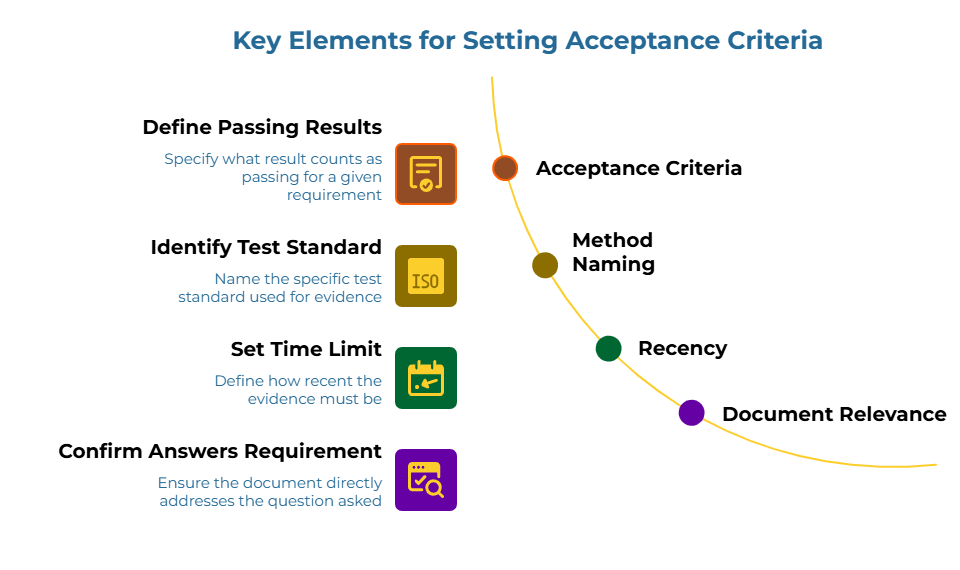
Proof becomes actionable only when the team defines what counts as acceptable evidence. Four elements shape this definition.
Acceptance criteria specify what result counts as passing. If the requirement is a caliper of 350 ± 15 μm (Range: 335μm to 365μm), then a test report showing 348 μm passes. A report showing 330 μm does not. Without stated acceptance criteria, evaluation becomes subjective. Different reviewers may interpret the same result differently.
Test method naming specifies which test standard applies. A burst strength result tested per ISO 2758 differs from one tested per TAPPI T 403 due to variations in sample conditioning and test geometry. Naming the test method in the proof request prevents mismatched evidence and ensures comparability across suppliers. Test method naming also protects the team from soft equivalence, where two documents look similar while actually meaning different things because they were generated using different test standards.
Recency defines how recent the evidence must be. A test report from three years ago may not reflect current production capability, especially if the supplier has changed equipment or raw material sources. A common practice is to require test reports dated within twelve months, or within the last three production runs of a similar folding carton type.
Document relevance confirms that the document actually answers the requirement in question. A generic ISO 9001 certificate proves that the supplier has a quality management system. It does not prove that the supplier can hold a specific caliper tolerance. The document must address the named field, not a related but different field.
Consider a supplier who submits a broad quality certificate and a general board description for a folding carton program with named stiffness, print, and line-performance requirements. The file looks complete. But the documents do not name the test method used for the performance field, and they do not clearly show whether the proof applies to the actual folding carton build under review. That supplier has submitted documents. The supplier has not yet submitted decision-grade proof.
These four elements should be stated explicitly in proof requests rather than assumed. When the supplier understands what counts as acceptable, their response becomes easier to evaluate.
Who Signs Off On What: Governance For Packaging, Procurement, And Brand Operations
Missing decision rights create repeated debate and late-stage approval friction. When no one owns sign-off for a proof category, everyone assumes someone else has approved the document. The assumption often proves false during final qualification review.
An evidence pack works best when each proof category has a named review owner—a practice increasingly expected by sophisticated folding carton buyers in global markets. This does not mean one person reviews everything. It means accountability is explicit.
A simple governance model assigns sign-off by proof category and organizational function:
| Proof Category | Primary Review Owner | Sign-Off Confirms |
| Requirement-linked proof | Packaging Engineering | Technical specification compliance |
| Capability-linked proof | Procurement | Supplier qualification and commercial viability |
| Validation-linked proof | Brand Operations | Application fit and launch readiness |
Organizational structures vary, and roles may be assigned differently depending on company size and team composition. The principle remains constant: each proof category should have one accountable reviewer, and that reviewer’s sign-off should be documented before supplier comparison proceeds.
Documenting sign-off ownership within the evidence pack itself, alongside each proof request, prevents the ambiguity that leads to qualification delays.
The Three Most Common Evidence-Pack Failures
Even teams that build evidence packs can fall into patterns that reduce their usefulness.
Passive document collection. The team requests documents, receives them, and files them without evaluating whether they answer the requirement. The pack grows in volume but not in qualification confidence. Each document should be reviewed against its acceptance criteria and signed off before being marked complete. Filing without evaluation is not qualification.
Generic certificates used as proof substitutes. The team accepts an ISO certificate or a broad capability statement as proof of requirement compliance. These documents prove that the supplier has systems in place. They do not prove that the supplier meets the buyer’s specific folding carton fields. Requirement-linked proof for each critical specification field should be required separately from general capability documentation.
Proof requests not anchored to named folding carton fields. The team asks for “coating documentation” or “print quality evidence” without specifying the requirement. The supplier provides something. The team cannot evaluate whether it answers the actual specification. Anchoring every proof request to a named field from the buyer’s requirement structure prevents this ambiguity.
These failures share a common root: the evidence pack is treated as a filing exercise rather than a qualification tool. Addressing them requires treating the pack as a working checklist where each line must be answered, reviewed, and signed off.
A Simple Proof-Pack Builder Your Team Can Use Before Supplier Comparison
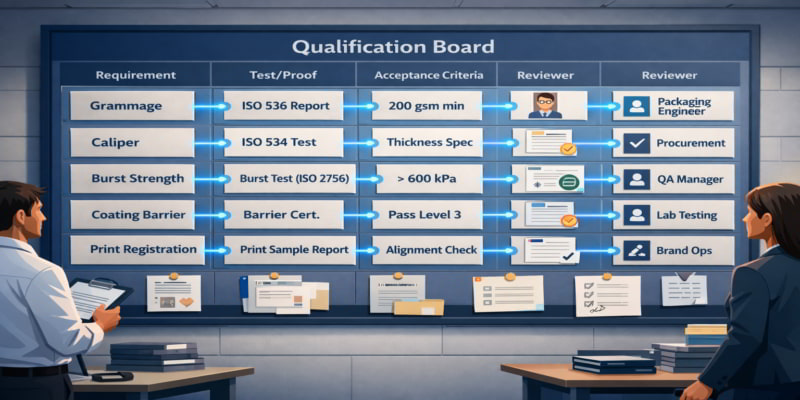
The following builder provides a reusable structure for mapping requirement fields to evidence requests. Use it before supplier comparison begins to define what proof is needed, what counts as acceptable, and who owns review.
Think of it as the technical substrate that converts a salesperson’s pitch into verifiable procurement data. Adapt the template to your specific requirement set. Add rows for additional fields. Remove rows that do not apply to your folding carton specification.
| Requirement Field | Proof Request | Acceptance Criteria | Review Owner | Stage |
| Grammage (Basis Weight) | Test report per ISO 536, dated within 12 months | Result within stated tolerance (e.g., 275 ± 10 g/m²) | Packaging Engineering | Shortlist |
| Caliper | Test report per ISO 534, dated within 12 months | Result within stated tolerance (e.g., 350 ± 15 μm) | Packaging Engineering | Shortlist |
| Burst strength | Test report per ISO 2758, dated within 12 months | Result meets or exceeds threshold (e.g., ≥ 250 kPa) | Packaging Engineering | Shortlist |
| Coating barrier | Test report per ASTM E96, conditions matching buyer spec | Result below stated threshold (e.g., WVTR < 15 g/m²/day) | Packaging Engineering | Pre-award |
| Print registration | Sample inspection report or press capability data | Deviation within stated limit (e.g., ≤ 0.5 mm) | Packaging Engineering | Pre-award |
| Quality system | ISO 9001 certificate, current, scope includes folding cartons | Certificate valid and scope-relevant | Procurement | Screening |
| Equipment capability | Equipment list with specifications for relevant lines | Equipment matches buyer’s format requirements | Procurement | Screening |
| Production consistency | SPC data or historical run records for similar folding carton type | Evidence of stable, repeatable production | Packaging Engineering | Pre-award |
| Application validation | Trial run report or shelf-life data for similar product type | Results confirm fit for buyer’s application | Brand Operations | Pre-award |
Use this builder during RFQ preparation to draft evidence requests that accompany the specification. Use it during supplier triage to confirm whether responses include the required proof. Use it during pre-approval review to document sign-off before finalizing the supplier selection.
What To Do Next After The Pack Structure Is Defined
Defining the evidence pack structure is the starting point. Execution follows.
If preparing to issue a request for quotation—which buyers can submit free to receive quotes—use the proof-pack builder to draft evidence requests that will accompany the RFQ. Name the requirement fields. State the acceptance criteria. Indicate which proof is required at screening versus shortlist versus pre-award. This prevents suppliers from responding with generic documentation that does not answer the specification.
Suppliers preparing responses should ensure their documentation meets these standards to successfully connect with buyers who use structured qualification processes. For each requirement field, confirm whether the supplier’s response includes proof that meets the acceptance criteria. Document the review owner’s sign-off. Flag gaps before ranking suppliers.
If preparing for internal approval, use the pack to demonstrate qualification completeness. Show which proof has been reviewed, who signed off, and which validation items remain pending. This gives procurement, packaging engineering, and brand operations a shared factual basis for the approval decision.
Requirement clarity is the prerequisite that makes proof review possible. For a deeper guide on how requirement fields should be structured before proof requests become possible, review The Baseline Packaging Parameter Checklist: Structuring Your Folding Carton Specification Requirements.
For guidance on buyer-owned specification logic, see the danger of vendor-led data sheets: establishing rigid folding carton specification requirements. And for managing requirement consistency across product portfolios, see cross-SKU material standardization: preventing folding carton collapse during product expansion.
Replace document volume with requirement-linked proof. Replace late-stage debate with early review logic. Replace claims with proof.
Disclaimer:
This article is for educational purposes only. PaperIndex does not sell market intelligence or publish pricing indices. Specification tolerances, test methods, and acceptance criteria are illustrative examples—verify applicability for your specific requirements. Always consult qualified packaging engineers and conduct independent supplier verification before making procurement decisions.
Our Editorial Process:
Our expert team uses AI tools to help organize and structure our initial drafts. Every piece is then extensively rewritten, fact-checked, and enriched with first-hand insights and experiences by expert humans on our Insights Team to ensure accuracy and clarity.
About the PaperIndex Insights Team:
The PaperIndex Insights Team is our dedicated engine for synthesizing complex topics into clear, helpful guides. While our content is thoroughly reviewed for clarity and accuracy, it is for informational purposes and should not replace professional advice.