

📌 Key Takeaways
Control your folding carton specifications before asking suppliers to quote—otherwise you’re comparing guesses, not offers.
- Baseline First, Quotes Second: Define your own technical fields, tolerances, and test methods before suppliers send data sheets with their own definitions.
- Ten Parameter Groups Cover Everything: SKU context, carton style, dimensions, board type, weight, moisture, coatings, print specifications, performance needs, and test methods form a complete checklist.
- House Specifications Create One Source of Truth: Lock a controlled template per carton family so suppliers, quality teams, and procurement all work from the same document.
- Three Gaps Cause Most Failures: Missing tolerances, undefined coatings, and unnamed test methods create disputes that surface as line stops or rejected shipments.
- Start Small and Expand: Build one high-impact template, test it through an RFP cycle, then assign shared ownership across packaging, procurement, and operations.
When you own the specification, you own the outcome.
Procurement managers and packaging engineers preparing RFPs for new product lines will find a ready-to-use framework here, setting up the parameter-by-parameter details that follow.
~ ~ ~ ~ ~ ~ ~ ~ ~ ~ ~ ~ ~ ~ ~ ~ ~ ~
You are drafting an RFP for a new product line. The supplier list is ready. But one question stops you cold: what technical fields actually belong in this specification document?
Miss a critical parameter and you risk structural failures, incomparable quotes, or production-line disruption weeks from now. Get the baseline right, and every supplier responds against the same standard from day one.
Folding carton specification requirements are the standardized set of material, structural, and performance criteria required to consistently manufacture paperboard packaging across diverse product lines. These parameters function as the technical control document that enforces manufacturing uniformity across your vendor base. Without this blueprint, each vendor interprets your needs differently. With it, you control the conversation. Exact values, tolerances, and test methods will vary by board grade, converting process, end use, and internal quality system—but the parameter categories themselves remain consistent.
This checklist gives you the 10 baseline parameter groups that belong in every folding carton specification. Use it to structure your next RFP before comparing a single quote.
Why a Baseline Parameter Checklist Comes Before Supplier Comparison
When buyers rely on supplier-led data sheets, each vendor defines fields differently. One supplier reports a caliper in millimeters. Another uses points. One includes moisture testing. Another omits it entirely.
This discrepancy results in price-parity on paper that masks divergent manufacturing assumptions.
Supplier-led fields create inconsistent assumptions because each manufacturer prioritizes the metrics that favor their production capabilities. A standardized baseline shifts ownership back to you. You define the fields. You set the tolerances. You name the test methods. Suppliers then respond against your structure, not their own.
A rigid specification document reduces ambiguity across SKUs and prevents the slow accumulation of inconsistencies that cause trouble downstream. Measurable properties such as grammage, thickness, and water absorptiveness become far more useful when they are paired with named test methods and clear acceptance logic—a principle explored in depth in the quality blueprint for defining and enforcing specs.
The 10 Baseline Parameter Groups Every Folding Carton Specification Should Cover
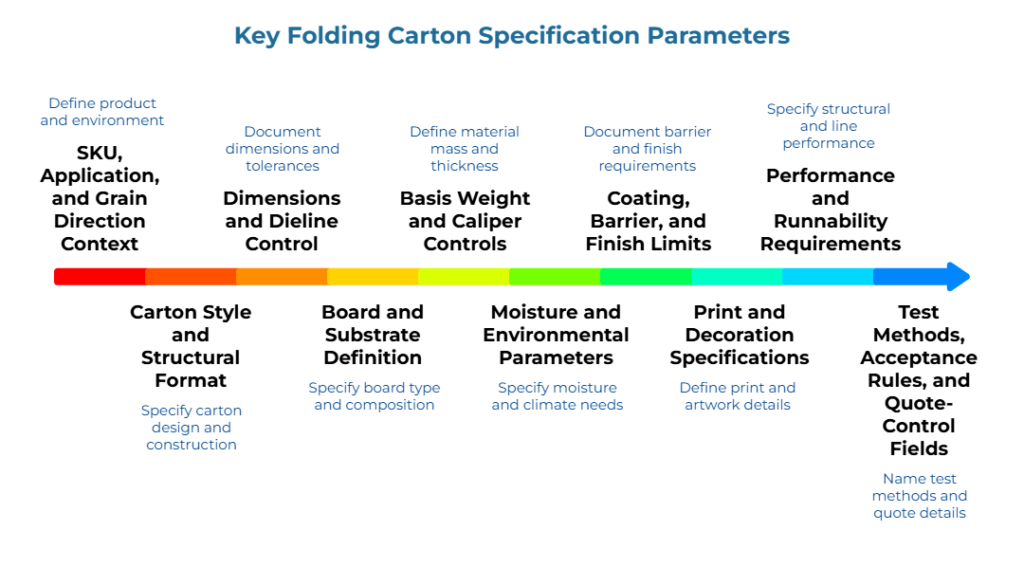
Structure your specification document around these 10 field groups. Each group ties directly to a failure-prevention outcome. Present these as categories to check off, not as a dense essay to read once and forget.
1. SKU, Application, and Grain Direction Context. Define what the carton must support: the product being packed, fill weight, handling conditions, and end-use environment. A carton for refrigerated dairy faces different stresses than one for ambient personal care products. State the application clearly so suppliers understand the real-world stress profile before quoting.
2. Carton Style and Structural Format. Specify the carton style code, construction logic, pack orientation, and closure format. Whether you need a straight tuck, reverse tuck, or auto-bottom design affects tooling, material usage, and line speed. Lock this early to prevent mid-project redesigns.
3. Dimensions and Dieline Control. Document internal and external dimensions, dieline references, fold and seam logic, and tolerance expectations. Ambiguity here creates fit failures at filling. Include a dieline file reference and state acceptable dimensional variance—for example, ±0.2 mm to ±0.4 mm on critical dimensions.
4. Board and Substrate Definition. Specify the board type, grade family, fiber composition, and any approved alternatives. Whether you require solid bleached sulfate (SBS), coated natural kraft (CNK), or recycled board changes cost, printability, and structural performance. Understanding how different kraft paper grades affect durability and cost can inform your substrate selection. Name the grade explicitly rather than leaving it to supplier interpretation.
5. Basis Weight and Caliper Controls. Define the material mass and thickness targets with tolerance windows. Basis weight (grams per square meter) and caliper (thickness) describe different aspects of the sheet and should be controlled separately when the application demands it—a distinction that also applies when choosing the right trade-off for clean converting runs. Basis weight governs material mass; caliper governs physical thickness and stiffness. State your target values and acceptable ranges so suppliers cannot deliver at the low end of an unstated range.
6. Moisture and Environmental Parameters. Specify moisture profile expectations and any climate or storage sensitivities. Paperboard performance can shift when humidity exposure changes, especially across warehousing, shipping, and filling conditions. A board that absorbs moisture loses stiffness—a phenomenon that can cause warp and line stops when moisture profiles shift even slightly. If your supply chain includes humidity exposure, define the moisture range the board must maintain. The exact target range is application-specific, but the field itself should not be left blank.
7. Coating, Barrier, and Finish Limits. Document barrier type, coating constraints, finish expectations, and exclusions. If you need grease resistance, moisture barrier, or specific varnish compatibility, state it here. Also note what you exclude—certain coatings may conflict with recycling streams or food-contact requirements.
8. Print and Decoration Specifications. Define print surfaces, color and finish dependencies, and artwork-critical constraints. Specify ink systems, varnish requirements, and any limitations on print registration tolerances. If brand colors are critical, reference Pantone standards or provide Delta E tolerances.
9. Performance and Runnability Requirements. Specify structural integrity on your filling line, compression and handling performance, and failure definitions. What stacking load must the carton withstand? Understanding why burst strength alone isn’t enough and how ECT relates to compression performance helps you specify the right structural requirements. What line speed must it run without jamming? Define pass/fail thresholds so suppliers understand your performance floor.
10. Test Methods, Acceptance Rules, and Quote-Control Fields. Name the specific test methods, sampling protocols, and acceptance criteria. Common industry standards include ISO 536 for grammage, ISO 534 for thickness and density, ISO 535 for water absorptiveness (Cobb method), and TAPPI methods such as TAPPI T 410 for grammage and TAPPI T 411 for caliper. For guidance on which TAPPI and ISO test methods to require in your RFQ, see our detailed breakdown. Include document version control and commercial fields needed for quote comparability—lead time expectations, minimum order quantities, and pricing basis. This final group ensures every supplier responds in the same language.
For a deeper look at structuring RFQ documents, see anatomy of a perfect kraft paper RFQ and the procurement-engineering alignment checklist.
How to Turn the Checklist into a Supplier-Ready House Specification Sheet
A checklist is useful. A formatted house specification sheet is operational.
Group the 10 parameter categories into four sections: structural requirements, material requirements, performance requirements, and control fields. This organization mirrors how suppliers review specifications internally and speeds their response.
Lock one controlled template per carton family or program. For guidance on creating mill spec sheets that prevent disputes, see our step-by-step guide. Version-control the document so every revision is traceable. Enforce response parity by requiring all vendors to populate your controlled house specification; do not accept data in the supplier’s native format. This eliminates the translation work that creates errors.
The house specification becomes your single source of truth. Suppliers quote against it. Quality teams audit against it. Procurement compares quotes against it. When everyone works from the same document, disputes drop and decisions accelerate.
How to Operationalize the Checklist Across Future Launches
A checklist used once is a document. A checklist embedded in your workflow is a system.
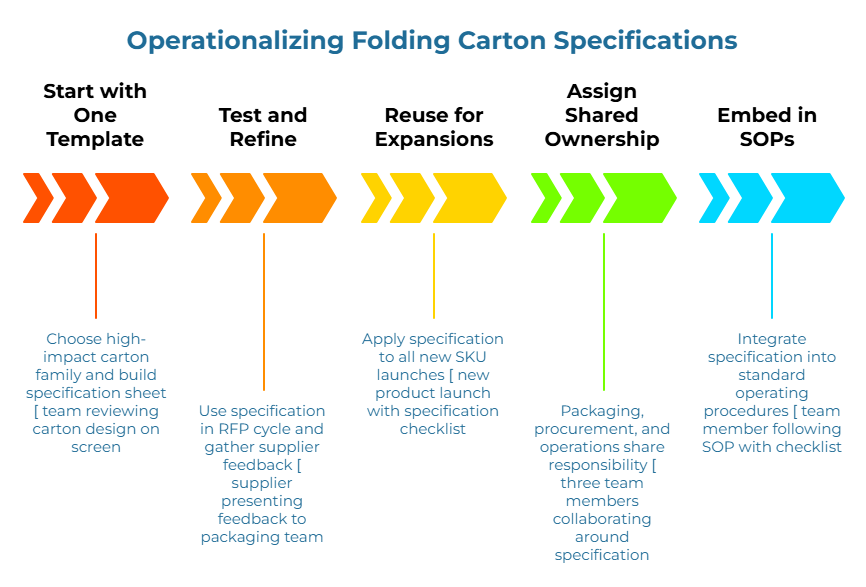
Start with one high-impact template rather than overhauling your entire portfolio at once. Choose a carton family with high volume or high complexity. Build the specification sheet, test it through one RFP cycle, and refine based on supplier feedback. This low-friction first step builds confidence without overwhelming your team.
Reuse the checklist at every product-line expansion moment. When a new SKU enters development, the specification review becomes a gate—not an afterthought. The same 10 parameter groups apply whether you are launching one product or fifty.
Assign shared ownership across packaging, procurement, and operations—following the principle that aligning these priorities before RFQs go out prevents downstream failures. Packaging engineering defines the technical fields. Procurement manages the commercial fields. Operations validates runnability requirements. When all three functions own the baseline, no single team can shortcut it. That cross-functional habit is the real gain.
Over time, the checklist becomes embedded in your SOPs. New team members inherit a proven structure. Supplier onboarding follows a consistent path. Specification drift stops before it starts.
Three Omissions That Cause Immediate Downstream Trouble
Even experienced buyers miss fields that seem minor until they cause failures.
Missing board or caliper tolerance. Without a stated tolerance window, a supplier may deliver material at the low end of an unstated range—a common source of vendor non-compliance disputes that could be prevented with data-backed specs. The carton technically meets the nominal specification but fails under stacking load. What looked like compliance becomes a line stop.
Missing coating or barrier limit. If you need grease resistance but do not specify it, the supplier may quote an uncoated board. The carton arrives, contacts your oily product, and stains through on the retail shelf. The omission creates a quality failure that no inspection caught because no one defined the requirement.
Missing named test method or acceptance criteria. Two suppliers both claim their board meets ‘industry standard’ compression. Without a named test method, you cannot verify the claim or compare results. This is why setting method-named tolerances at quote time eliminates post-award disputes. Property data only becomes decision-grade when it is anchored to a defined method. The quotes look equivalent, but the products perform differently.
Each omission creates ambiguity that surfaces as line failures, quality disputes, or incomparable quotes. The checklist exists to close these gaps before they cost you.
Conclusion
This checklist is not paperwork overhead. It is the minimum structure required for spec-true vendor compliance and safer multi-SKU expansion. Define your 10 parameter groups, lock them into a house specification sheet, and require every supplier to respond against the same standard.
When you control the specification, you control the outcome.
Ready to connect with folding carton suppliers who can meet your baseline? Browse folding cartons or explore the PaperIndex Academy for more frameworks that turn packaging complexity into operational clarity.
References
The following industry standards are commonly referenced in folding carton specifications. Exact selection depends on substrate, converting process, and quality framework:
- ISO 536:2019 — Determination of grammage
- ISO 534:2011 — Determination of thickness, density and specific volume
- ISO 535:2023 — Determination of water absorptiveness (Cobb method)
- TAPPI T 410 — Grammage of paper and paperboard
- TAPPI T 411 — Thickness (caliper) of paper, paperboard, and combined board
Disclaimer:
This checklist provides general guidance for structuring folding carton specifications and is not exhaustive. Specific parameter values, tolerances, and test methods should be determined based on your product requirements, converting processes, and quality systems. Consult packaging engineers and qualified professionals for specifications tailored to your application. Referenced standards may be updated; verify current versions before use.
Our Editorial Process:
Our expert team uses AI tools to help organize and structure our initial drafts. Every piece is then extensively rewritten, fact-checked, and enriched with first-hand insights and experiences by expert humans on our Insights Team to ensure accuracy and clarity.
About the PaperIndex Insights Team:
The PaperIndex Insights Team is our dedicated engine for synthesizing complex topics into clear, helpful guides. While our content is thoroughly reviewed for clarity and accuracy, it is for informational purposes and should not replace professional advice.