

📌 Key Takeaways
Screen packaging suppliers for proof before asking for prices—once you see a low quote, your objectivity is already compromised.
- Verify Before You Quote: Checking supplier credentials after prices arrive makes weak suppliers look acceptable for too long.
- Demand Proof of Similar Work: Ask for anonymized records of past food-grade runs that match your barrier, substrate, and compliance needs.
- Confirm Specification Alignment First: Suppliers should acknowledge your exact requirements before pricing—otherwise quotes reflect guesswork, not capability.
- Check Certificate Scope: A valid certificate means nothing if it covers the wrong product, facility, or legal entity.
- Request Mapped Evidence Packs: Every document should answer a specific requirement—a thick folder without relevance is just noise.
No filter, no RFQ—that single rule protects your objectivity.
Procurement managers, QA teams, and packaging engineers sourcing international folding cartons will gain a repeatable screening method here, preparing them for the detailed verification steps that follow.
~ ~ ~ ~ ~ ~ ~ ~ ~ ~ ~ ~ ~ ~ ~ ~ ~ ~
Before you compare prices, compare proof. Use this five-step pre-RFQ filter to screen international packaging suppliers for fit, evidence quality, and specification readiness.
You’re comparing quotes. One supplier is 18% cheaper. Technical documentation appears uniform across all bids. But one of those mills has never run your barrier specification.
You don’t know which.
If you are vetting compliance after you see the price tag, you have already lost your objectivity.
That is the sequencing problem most teams never name clearly enough. Late-stage vetting occurs only after price has anchored the evaluation, skewing objectivity. That sequence forces QA concerns to surface “late,” when the real failure happened much earlier. The problem isn’t diligence. It’s timing.
Efficiency is gained by front-loading the verification process—linking empirical proof to specification logic to isolate high-risk suppliers before fiscal anchors impair decision-making. This approach forms the foundation of a comprehensive folding carton supplier verification methodology. The five checks below give procurement managers, QA teams, packaging engineers, and regulatory specialists a repeatable method to reject weak suppliers before RFQs go out.
Pre-RFQ Qualification Filter
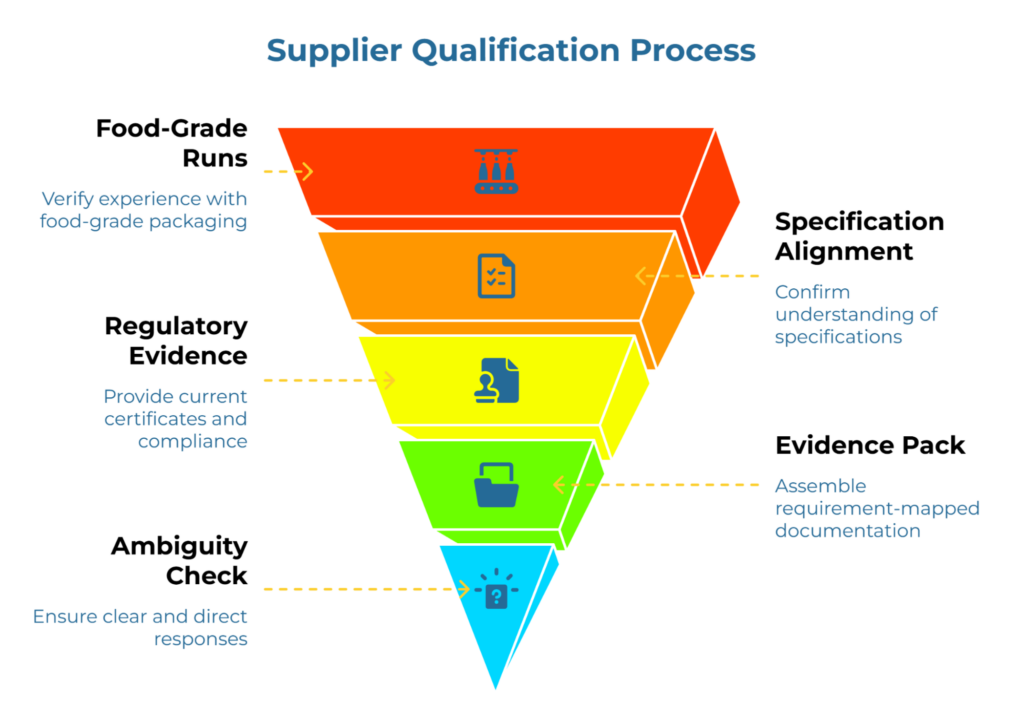
Before inviting any international packaging supplier to quote, confirm they can answer “yes” to these five questions:
- Can the supplier show proof of similar food-grade runs?
- Can the supplier confirm alignment to named specification fields before pricing?
- Can the supplier provide current, scope-relevant certificate and regulatory evidence?
- Can the supplier assemble a requirement-mapped evidence pack?
- Can the supplier complete this filter without ambiguity or evasion?
A supplier who clears these gates is qualified to quote. A supplier who cannot is filtered out before pricing clouds the conversation.
Why Verification Must Happen Before the Quote
Price-first evaluation creates false comparability.
When three suppliers submit quotes against a vague RFQ, the numbers look like direct comparisons. They aren’t. One supplier may quote against assumptions about barrier requirements. Another may substitute a different board grade. A third may lack the food-contact compliance history the application demands.
Weak suppliers hide behind vague claims until the buyer asks for proof. By then, the cheapest quote has shaped internal expectations. Pushing back feels like “extra work” rather than baseline diligence.
Pre-RFQ verification is not additional overhead. It prevents specification misalignment, late-stage rejections, and the discovery that a favored supplier cannot produce the documentation QA requires. The goal: no supplier receives an RFQ until they demonstrate basic qualification.
1. Ask for Proof of Similar Food-Grade Runs
Start with precedent, not presentation.
A supplier’s general manufacturing capability reveals little about readiness for a specific application. The question isn’t whether they make folding cartons. The question is whether they’ve successfully produced folding cartons with similar barrier requirements, similar substrate demands, and similar compliance documentation for food-contact use.
Request anonymized examples of comparable food-grade production runs. Ask for proof tied to use case similarity, not generic manufacturing credentials. A supplier who has run moisture-resistant folding cartons for frozen bakery goods is more relevant to a frozen-food line than a supplier with decades of experience in non-food industrial packaging. The risks of assuming capability without this precedent-based proof are examined in stop assuming specifications: the hidden dangers of imported folding cartons.
“We’ve supplied packaging for years” is a brochure claim. “Here’s an anonymized production record showing barrier coating performance on a similar frozen-food application” is evidence.
Past compliance records for similar food-grade runs are stronger indicators of capability than generic sales materials. Ask for historical, anonymized proof of success in the same or similar application. This precedent-based screening serves as the initial tier of a multi-stage ‘proof ladder,’ ensuring subsequent evidence requests are targeted and relevant. For a complete methodology on structuring these tiers, see building a proof ladder for folding carton suppliers.
This is a practical screen, not a legal conclusion. Past success does not guarantee future performance. It is still stronger evidence than generic claims.
2. Require Specification Alignment Before Pricing Starts
A supplier should confirm the requirement before pricing the requirement. Otherwise, the quote is built on guesswork.
Before any supplier prices a job, they should confirm understanding of named requirements: barrier expectations, moisture performance targets, grease resistance levels, substrate specifications, and relevant test-method references. Send specification fields first. Ask suppliers to acknowledge alignment—or flag gaps—before they quote.
This surface mismatches early. A supplier who cannot confirm alignment to a moisture-barrier threshold shouldn’t quote alongside suppliers who can.
Specification alignment before pricing also protects against “interpretation drift,” where suppliers read ambiguous specifications differently and submit prices that aren’t comparable. One supplier prices a high-performance interpretation. Another prices a thinner or simpler interpretation. Both look competitive on paper. Only one may actually match the requirement.
Forcing clarity benefits both sides. The supplier avoids quoting a job they can’t deliver. The buyer avoids comparing quotes that represent different assumptions. That is why specification discipline sits at the center of building a proof ladder for folding carton suppliers.
3. Check Certificate Scope and Regulatory History
The right question is not “Does this supplier have certificates?” The right question is “Do the current documents match this requirement, this product context, and this producing entity?”
Holding a certificate is not the same as holding the right certificate for a specific application. A supplier may have ISO 9001 registration, but the scope may exclude food-contact packaging. A food-safety certificate may be valid but issued to a different legal entity than the one quoting the job. A certification may have lapsed, or the product category covered may not include the specific folding carton type required.
Separate “has a certificate” from “has the right scope for this requirement.”
Verify that certificates are current, that scope covers the product and application needed, and that the certified entity matches the supplier under evaluation. Where sustainability claims are relevant, public registries allow direct confirmation of chain-of-custody status—a process detailed in how to run a quick registry check for FSC/PEFC certificates.
Regulatory history matters too. Has the supplier faced compliance issues in the destination market? Are they familiar with the regulatory frameworks that govern food-contact materials in key markets?
For U.S.-bound shipments, Title 21 of the Code of Federal Regulations (specifically Parts 174-186) dictates the actual legal compliance framework for food-contact substances. The FDA webpage is a helpful summary resource, but your evidence pack must map to the specific CFR citations, not the website overview. For European markets, food-contact materials must comply with the framework Regulation (EC) No 1935/2004 and be manufactured under good manufacturing practices as strictly governed by Regulation (EC) No 2023/2006. Relying merely on general EC overviews rather than the specific GMP legal directive invites compliance gaps. Under the FSSC 22000 framework, certification must specifically encompass the manufacture of food and feed packaging—explicitly including paperboard, folding cartons, and corrugated materials.
Generic certificates create false confidence. The wider strategy challenges the assumption that generic certificates equal specific product compliance—and positions proof tied to actual specifications as the safer method. For deeper exploration of this principle, see why certificates alone do not qualify a folding carton supplier.
4. Request Evidence Packs Tied to Specific Specification Fields
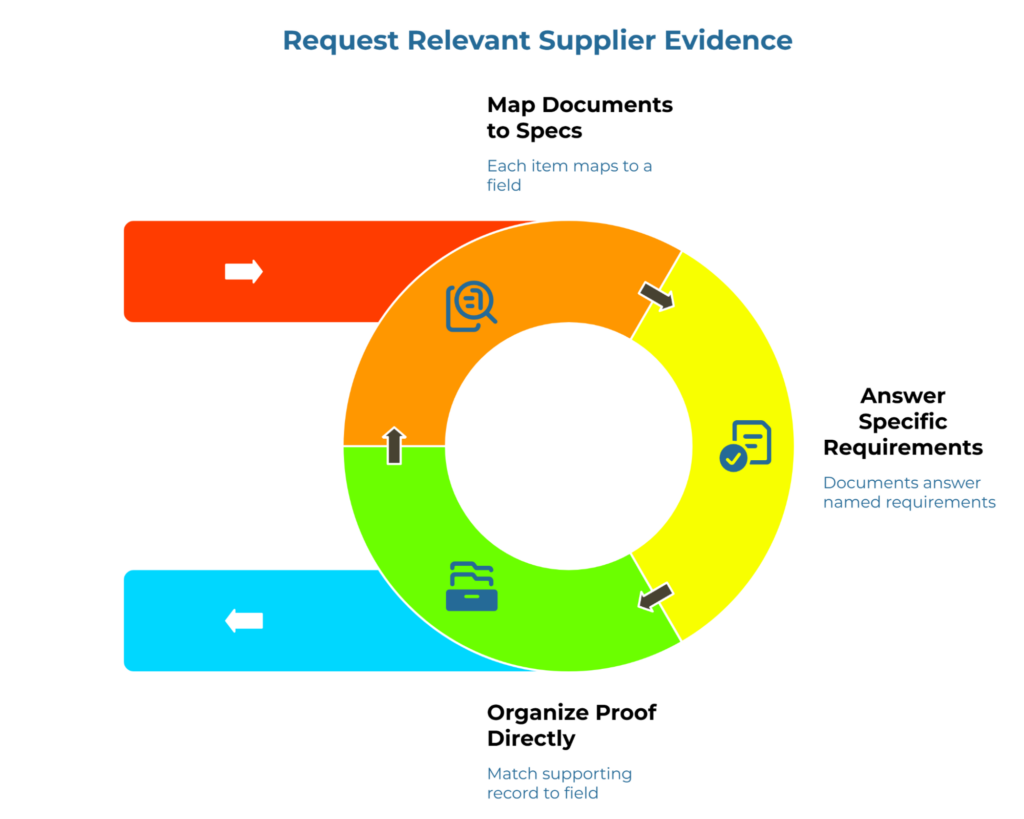
Relevance is what turns paperwork into proof.
A thick folder of supplier documents creates false confidence when none of those documents tie back to actual requirements—a problem explored in from claims to proof: a practical guide to supplier evidence packs for folding cartons. The shift from “document pile” thinking to “evidence pack” thinking is critical. An evidence pack is a set of proof documents where each item maps to a named specification field.
Each document should answer a named requirement. If a specification requires a grease-resistance rating, the evidence pack should include a test report showing that rating—not a generic product brochure. If a specification names a particular barrier coating, the pack should include documentation confirming that coating’s compliance under relevant food-contact conditions. If the requirement is migration suitability, the evidence should point there. If the requirement is material specification, test method, or declaration scope, the supporting record should match that field directly.
Ask suppliers to organize proof this way before quoting. This makes comparison possible. It also reveals which suppliers can produce requirement-mapped documentation—and which are hoping no one asks.
That shift changes the whole review process. Buyers stop being impressed by volume. Suppliers stop sending bundles designed to overwhelm. Gaps become visible faster.
5. Evaluate Communication Clarity and Technical Transparency
Turn these verification steps into a repeatable gate.
A supplier does not receive the RFQ until they pass the filter. That single rule protects objectivity. This protects Procurement from subjective back-and-forth later (“Why did we invite that supplier?”) and protects QA from late-stage surprises (“They never had the right certification scope”).
The filter creates process discipline. It transforms supplier screening from an informal judgment call into a documented, defensible workflow. When questions arise about why a particular supplier was or wasn’t included, the filter provides the answer.
Objections will arise. Yes, stricter upfront screening takes effort. Yes, some suppliers will push back. And yes, price-led habits are hard to break. But those are process frictions, not reasons to skip qualification. The more disciplined move is to make the entry gate explicit, consistent, and buyer-controlled.
Adopting a ‘No Filter, No RFQ’ mandate ensures process discipline and mitigates late-stage QA friction.
What a Good Pre-RFQ Qualification Workflow Looks Like
The five checks synthesize into a compact sequence:
- Build initial shortlist of potential international packaging suppliers
- Send qualification filter before any RFQ distribution
- Review supplier responses against the five screening criteria
- Surface specification gaps and remove suppliers who cannot demonstrate alignment
- Invite only qualified suppliers to submit pricing
This workflow positions verification where it belongs: before the quote, not after. It aligns Procurement and QA on a shared standard. When quotes arrive, they represent comparable, qualified suppliers—not a mix of capable mills and hopeful brochures.
The parent methodology—a structured framework for evaluating international folding carton suppliers against exact specifications and proof stages—treats this pre-RFQ filter as the entry gate to a larger proof ladder. For more detail on structuring proof requests once suppliers pass pre-qualification, see what proof to request at RFQ stage for folding cartons.
When ready to explore qualified suppliers, browse folding carton suppliers on PaperIndex or visit PaperIndex Academy for additional methodology-first sourcing resources.
Disclaimer:
Educational content only. This article does not constitute legal advice, certification guidance, or supplier endorsement. PaperIndex does not certify or approve individual suppliers. Regulatory requirements vary by destination market, substrate, coating system, and intended food-contact conditions. Always verify compliance requirements with qualified professionals and relevant regulatory authorities.
Our Editorial Process:
Our expert team uses AI tools to help organize and structure our initial drafts. Every piece is then extensively rewritten, fact-checked, and enriched with first-hand insights and experiences by expert humans on our Insights Team to ensure accuracy and clarity.
About the PaperIndex Insights Team:
The PaperIndex Insights Team is our dedicated engine for synthesizing complex topics into clear, helpful guides. While our content is thoroughly reviewed for clarity and accuracy, it is for informational purposes and should not replace professional advice.