
📌 Key Takeaways
Matching proof depth to each qualification stage prevents both early friction and late-stage surprises when vetting folding carton suppliers.
- Stage Discipline Beats Volume: Asking for the right proof at the right time matters more than collecting the biggest file stack.
- Light Proof Works Early: Initial screening needs only basic category fit and credentials—save deep evidence requests for later.
- Requirement-Linked Proof Unlocks Comparison: Suppliers should respond to your specific specifications, not just send generic data sheets.
- Fit-for-Use Evidence Comes Third: Test reports and trial data prove real-world performance once you reach the shortlist stage.
- Pre-Approval Means No Open Gaps: The final checkpoint requires complete, current, and defensible evidence before sign-off.
Right proof, right stage, right decision.
Procurement managers and packaging engineers qualifying new folding carton suppliers will find a ready-to-use four-stage framework here, preparing them for the detailed evidence requirements that follow.
~ ~ ~ ~ ~ ~ ~ ~ ~ ~ ~ ~ ~ ~ ~ ~ ~ ~
A folding carton supplier sends a certificate, a few data sheets, and a sample folding carton. The procurement manager glances at the package. The packaging engineer asks whether test reports exist. The brand team wants to know if the supplier can handle a second SKU next quarter.
Nobody agrees on whether the evidence is enough—or whether it is too much for this stage of the conversation.
This is the proof-depth problem. It appears whenever a team requests supplier documentation without first deciding how much proof is appropriate at each qualification step. Under compressed launch timelines, frequent SKU changes, line constraints, and reused legacy assumptions, proof often arrives at the wrong depth for the decision being made. Inconsistent evidence creates friction during cross-functional reviews, destabilizing the comparison of competitive bids.
Three misconceptions make that worse. A full folder does not mean a supplier is effectively qualified. More proof is not always better. And one fixed proof request does not work across every qualification step.
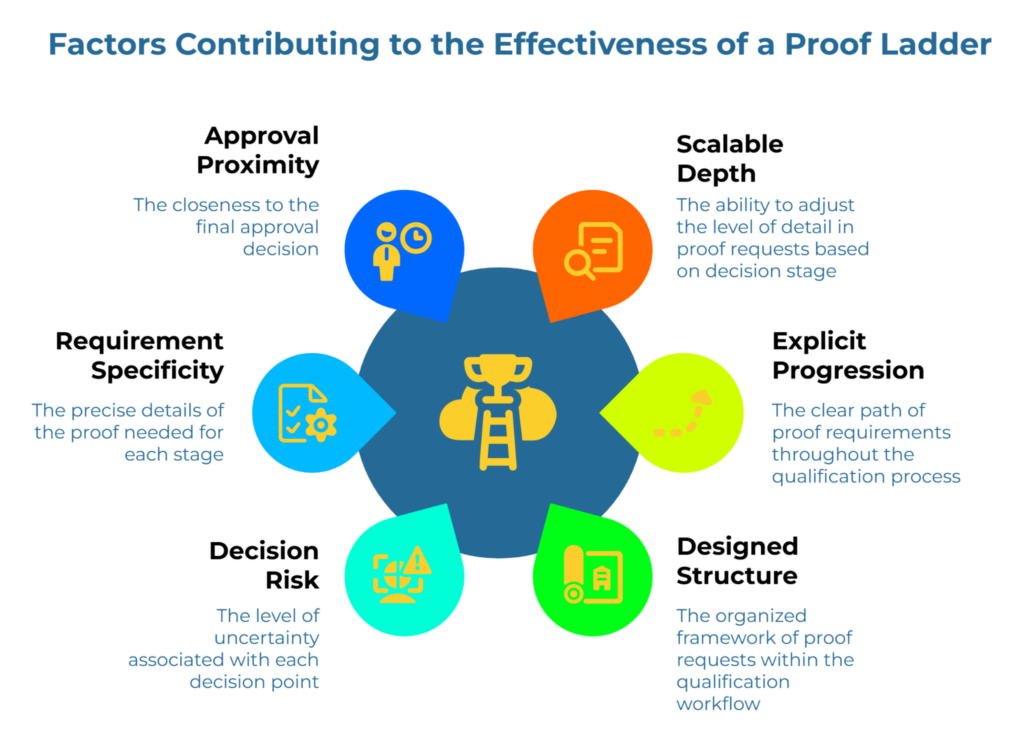
A proof ladder addresses this by matching evidence requests to the decision being made at each stage. Early stages need lighter proof—enough to justify continued attention. Later stages need deeper proof—enough to defend an approval decision. The ladder rises in step with decision risk, requirement specificity, and approval proximity.
Why A Proof Ladder Works Better Than One Fixed Proof Request
Most qualification processes treat proof as a single block. The team defines a checklist—certificates, test reports, samples, capability statements—and sends it to every supplier at the start.
This approach creates two opposite failures.
Under-requesting early-stage risk signals. A light checklist designed for initial filtering lacks the depth needed later. By the time the team reaches a shortlist, it realizes that method-named test results, batch consistency data, or tolerance documentation were never requested. The team scrambles to collect evidence under time pressure or moves forward with unresolved gaps.
Over-requesting before the team is close to approval. A comprehensive checklist sent too early creates friction. Suppliers still in the exploratory stage receive dense evidence requests before the buying team knows whether basic category fit or lead time even works. Capable suppliers delay responses, send incomplete packages, or decline to participate. The supplier pool shrinks before meaningful comparison begins.
The underlying problem is that one static proof request cannot serve multiple decision stages. Depth must scale with decision risk, requirement specificity, and approval proximity.
A proof ladder makes this progression explicit. It treats supplier qualification as a designed proof structure inside the broader evidence-pack and qualification workflow, not as random file collection.
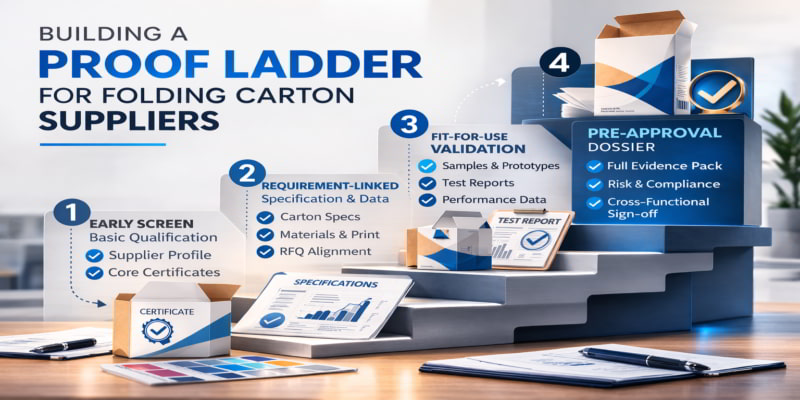
The Four-Stage Proof Ladder For Folding Carton Suppliers
The ladder below organizes proof requests across four qualification stages. Each stage has a distinct decision goal, a different proof burden, and a clear trigger for moving forward. The proof items listed are illustrative examples, not a universal sufficiency checklist. In practice, the exact evidence set varies by folding carton design, board choice, print and finishing requirements, filling-line conditions, and internal approval logic.
| Qualification Stage | Decision Goal | Typical Proof Depth | Example Proof Items | Primary Reviewer | Trigger to Advance |
| Stage 1: Early Screen | Decide if deeper review is justified | Light | Company profile, category-fit confirmation, basic certifications (ISO, FSC status) | Procurement or sourcing lead | Supplier meets category, geography, and minimum capability thresholds |
| Stage 2: Requirement-Linked | Confirm alignment with named folding carton requirements | Moderate | Board grade data sheets referencing buyer specifications, sample quotes responding to RFQ fields, initial tolerance statements | Packaging engineer + procurement | Evidence addresses specific requirement fields, not just general capability |
| Stage 3: Validation & Fit-for-Use | Verify real-world performance confidence | Deep | Method-named test reports, trial run data, batch consistency evidence | Packaging engineer (lead), QA if applicable | Test evidence supports fit-for-use under actual production conditions |
| Stage 4: Pre-Approval Readiness | Defend final qualification decision | Full | Complete evidence pack, documented gap closure, recency-verified test data, cross-functional sign-off readiness | Cross-functional review team | No unresolved proof gaps; approval risk is acceptable |
The principle remains constant: proof depth rises as the supplier moves closer to approval.
Stage 1: Early Screen Proof
The first stage answers one question: does this supplier deserve a closer look?
At this point, the buying team is filtering, not qualifying. The goal is to confirm basic category fit, geographic relevance, and minimum operational credibility. Deep technical requests at this phase yield diminishing returns on decision clarity.
Early-screen proof typically includes a company profile or capability statement, confirmation that the supplier produces the relevant folding carton category, and evidence of foundational certifications. These items signal that the supplier operates within expected industry frameworks. They do not prove the supplier can meet specific folding carton requirements.
A useful Stage 1 review often looks for four things: supplier identity that can be verified internally, evidence that the supplier actually operates in the folding carton category in scope, a plausible match to the folding carton type or process complexity, and enough initial material to judge whether deeper review will be productive.
The primary reviewer at this stage is usually the procurement or sourcing lead. The trigger to advance is straightforward: the supplier meets basic thresholds for category, geography, and general capability. If so, the team moves to Stage 2. If not, the supplier exits the funnel without consuming cross-functional time.
Prioritizing lean documentation at the outset ensures the team focuses resources on viable candidates before committing to exhaustive technical validation.
Stage 2: Requirement-Linked Proof
Stage 2 is where proof begins answering named folding carton requirements rather than general capability claims.
The shift matters. A supplier may have excellent credentials, but credentials alone do not confirm whether the supplier can meet the specific board grade, caliper tolerance, coating type, or structural requirements in the buyer’s specification. This stage forces the conversation from “we produce folding cartons” to “here is how we address your actual specification.”
Requirement-linked proof typically includes board grade data sheets that reference the buyer’s specified parameters, sample quotes that respond to quote-ready folding carton fields rather than generic pricing, and initial tolerance statements acknowledging the buyer’s acceptance windows. The evidence does not need to be exhaustive, but it must be specific.
A data sheet describing a board grade without referencing the buyer’s caliper or burst requirements is not requirement-linked proof. It is a marketing document.
The primary reviewers at this stage are the packaging engineer and procurement working together. Advancement to the next phase occurs once the supplier’s documentation explicitly correlates with the defined requirement fields. If the evidence does, the team can justify deeper technical review.
This stage is also where the risk of vendor-led data sheets becomes visible. When suppliers use their own parameter definitions rather than responding to the buyer’s requirement structure, comparability across suppliers breaks down. Requirement-linked proof depends on buyer-owned requirement logic.
As a general principle, repeatable verification improves when the team names the quality framework or test-method family it expects to see. Resources such as ISO 9001, TAPPI‘s standardized test methods and laboratory guidelines, and ASTM‘s paper and packaging standards can support consistent test method naming and comparable test selection. They do not, however, replace buyer-owned folding carton requirements or acceptance logic.
Stage 3: Validation And Fit-For-Use Proof
Stage 3 moves from paper to performance. The question shifts from “does the supplier understand our requirements?” to “can we trust that the supplier will meet those requirements under real production conditions?”
This stage requires deeper technical evidence. Method-named test reports—citing recognized standards such as those from ISO or TAPPI—replace generic data sheets. Trial run data or production batch evidence demonstrates consistency, not just capability. When the folding carton will be used across multiple SKUs, evidence of cross-SKU material standardization may become relevant.
The packaging engineer typically leads review at this stage, with QA involvement if the product category requires it. Technical validation ensures the folding carton maintains integrity under the buyer’s specific filling, handling, and storage stressors.
The trigger to advance is that test evidence supports fit-for-use under real-world conditions. This is a judgment call, not a checklist. A supplier may have strong test results but limited evidence of batch-to-batch consistency. Another may have extensive production history but test reports using non-standard test methods. The team weighs the evidence against the specific risks of the folding carton application.
Tolerance control often becomes a focus at this stage. A supplier may quote a board grade that nominally matches the buyer’s specification, but board grade tolerances can vary significantly across suppliers. Stage 3 proof should clarify how the supplier defines and controls tolerance, not just what the target values are.
Stage 4: Pre-Approval Readiness Proof
Stage 4 is the final checkpoint before qualification or award. The goal is ensuring that the evidence pack is complete, defensible, and ready for cross-functional sign-off.
Stage 4 consolidates the verified dossier: all requirement fields must be addressed, test data recency confirmed, and all specification deviations formally accepted via the change control protocol. Building a structured supplier evidence pack for folding cartons ensures this consolidation follows a repeatable methodology.
The primary reviewer is the cross-functional team—packaging engineering, procurement, QA, and any other stakeholders with approval authority. The trigger to advance is that no unresolved proof gaps remain and approval risk is acceptable.
Pre-approval readiness proof is not about perfection. It is about ensuring that the qualification decision can be defended. If an issue arises after award, the team should be able to point to the evidence pack and show that the decision was made on a sound factual basis.
A defensible final-stage dossier requires three attributes: explicit requirement-linking, recency-verified data, and transparent exception reporting.
What Changes From Stage To Stage
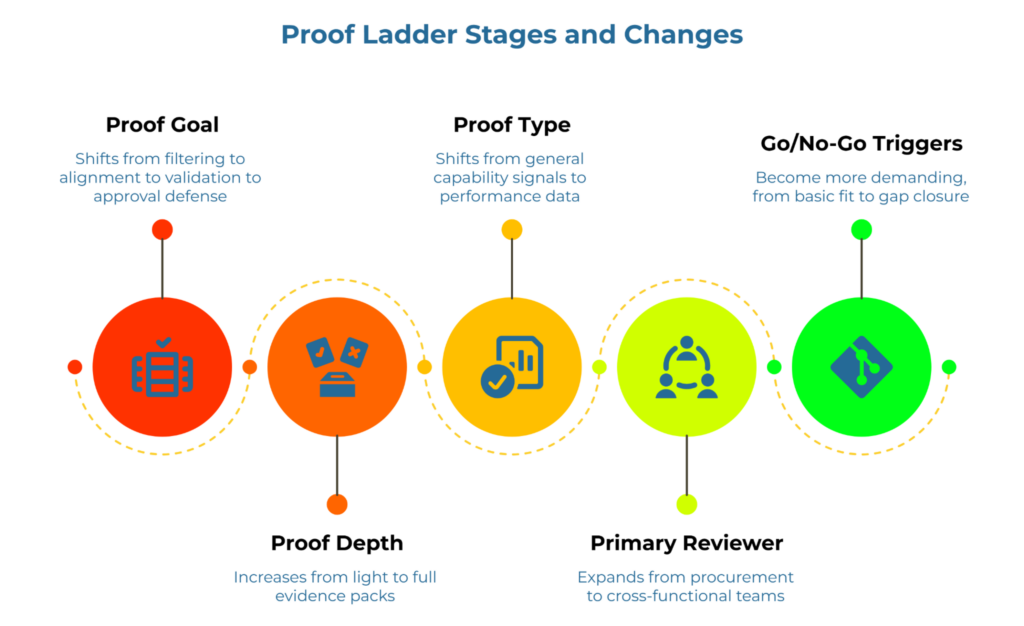
The ladder’s efficiency depends on five shifting variables across the qualification lifecycle:
Proof goal moves from filtering to alignment to validation to approval defense. Each stage answers a different question, and the proof should be scoped to that question.
Proof depth increases from light (company profile, basic certifications) to full (complete evidence pack with method-named test reports and documented gap closure).
Proof type shifts from general capability signals to requirement-specific evidence to performance data to cross-functional review-ready documentation.
Primary reviewer expands from procurement alone to procurement plus packaging engineering to engineering-led review to full cross-functional sign-off.
Go/no-go triggers become more demanding. At Stage 1, the trigger is basic category fit. At Stage 4, the trigger is that no unresolved proof gaps remain.
Teams that internalize these shifts make faster decisions. They know what to ask for at each stage and when to escalate proof depth.
The Two Common Failure Modes
The proof ladder exists to prevent two failure patterns that appear in most qualification processes.
Over-requesting happens early when the team sends a full evidence request to suppliers still in the exploratory stage. Suppliers delay responses, send incomplete packages, or decline to participate. The buying team interprets non-response as disqualification, even though the real cause was an unreasonable proof burden. The supplier pool shrinks before the team has meaningful data to compare.
The consequence is unnecessary friction. Capable suppliers exit before the team learns whether they could have met requirements.
The fix is scoping early-stage proof to the decision being made. At Stage 1, the team is filtering, not qualifying. Light proof is sufficient.
Under-requesting late happens when the team uses the same proof checklist from Stage 1 through Stage 4. The early-stage checklist was designed for filtering, not approval. By the shortlist stage, the team realizes that critical evidence—method-named test results, batch consistency data, tolerance control documentation—was never requested.
The consequence is false confidence followed by late-stage debate and approval delay.
The fix is defining what “complete” means at each stage. Pre-approval readiness proof is deeper than early-screen proof by design. The ladder makes the progression explicit.
Stage friction is a stage-discipline problem, not a proof-volume problem. Requesting more proof does not solve the issue. Requesting the right proof at the right time does.
Who Should Review What At Each Stage
Ownership clarity is part of ladder design, not an afterthought.
At Stage 1, procurement or the sourcing lead typically owns reviews. The evidence is light, and the decision is binary: does the supplier meet basic thresholds?
At Stage 2, packaging engineering joins procurement. Requirement-linked proof requires technical judgment—someone must verify that the supplier’s evidence actually addresses the specification, not just the product category.
At Stage 3, packaging engineering leads. Validation and fit-for-use proof is technical by nature. QA may join if the product category involves food contact, pharmaceutical, or other regulated applications.
At Stage 4, the cross-functional team reviews together. Pre-approval readiness affects procurement (contract terms), engineering (technical risk), QA (compliance), and sometimes brand or operations (launch timing). Sign-off authority should match decision accountability.
Different stages and proof types need different owners. The ladder introduces this principle. Full sign-off governance—who escalates what, when, and to whom—is a related but separate topic that teams can address as a natural next step.
How The Proof Ladder Connects Back To Folding Carton Requirements
The proof ladder only works when it connects to a clear requirement architecture.
Proof depth is meaningless without a defined requirement set. A supplier cannot provide requirement-linked evidence at Stage 2 if the buyer has not defined the requirements. A packaging engineer cannot validate fit-for-use at Stage 3 if tolerance windows and test methods were never specified. A cross-functional team cannot close proof gaps at Stage 4 if nobody documented what “complete” looks like.
Proof logic and requirement logic belong together. A specification bridge formalizes this connection by creating a shared blueprint that both proof requests and supplier responses can reference. Teams that invest in structuring their folding carton specification requirements before qualification begins find the proof ladder easier to apply. Teams that skip requirement definition find that proof requests become vague, supplier responses become inconsistent, and qualification decisions become harder to defend.
The next level of maturity involves three follow-on needs: RFQ-stage proof requests (what to ask for when quotes arrive), field-to-proof mapping (linking each requirement field to a specific proof type and test method), and sign-off ownership and escalation (who approves what, and when issues require higher authority). From claims to proof: a practical guide to supplier evidence packs for folding cartons and how to build quote-ready folding carton fields without making suppliers guess are natural next reads for that deeper work. Each layer builds on the ladder.
The framework communicates progression without making the process feel heavy. Define the stages. Match proof depth to decision risk. Assign reviewers. Use the structure to reduce friction without weakening qualification quality.
Frequently Asked Questions
How much proof should be requested at the first qualification stage?
Enough to judge whether deeper qualification is justified, but not enough to simulate final approval. Light screening proof should help the team assess relevance, basic capability, and initial document sufficiency.
When should folding carton supplier proof move beyond certificates and samples?
When requirement-linked proof becomes necessary. Certificates and samples may support early confidence, but they do not replace requirement-linked evidence, test method naming, fit-for-use logic, or late-stage approval proof.
What changes between an early proof request and a pre-approval proof request?
The goal, depth, type, owner, timing, and go-or-no-go threshold all change. Early requests test relevance. Late requests support defensible approval confidence.
Who should review supplier proof at each stage?
Procurement can often lead to early screening. Engineering becomes more important when proof must answer named folding carton requirements. Quality and operations matter more once fit-for-use validation begins. Final-stage review needs clear sign-off ownership.
How does a proof ladder connect back to carton requirements?
It turns a flat file request into a requirement-linked qualification process. The stronger the requirement architecture, the stronger the ladder. Buyers refining their requirement architecture can explore active folding carton RFQ activity to benchmark specification patterns across the market.
Explore folding carton suppliers |Review folding carton buyer and RFQ activity |Browse the PaperIndex Academy
Disclaimer:
This article is educational and methodology-first. It is designed to help readers structure supplier qualification more clearly; it does not constitute supplier approval, product certification, or price guidance. The final qualification decision should remain tied to the buyer’s own requirement set, proof standards, and internal review process.
Our Editorial Process:
Our expert team uses AI tools to help organize and structure our initial drafts. Every piece is then extensively rewritten, fact-checked, and enriched with first-hand insights and experiences by expert humans on our Insights Team to ensure accuracy and clarity.
About the PaperIndex Insights Team:
The PaperIndex Insights Team is our dedicated engine for synthesizing complex topics into clear, helpful guides. While our content is thoroughly reviewed for clarity and accuracy, it is for informational purposes and should not replace professional advice.