
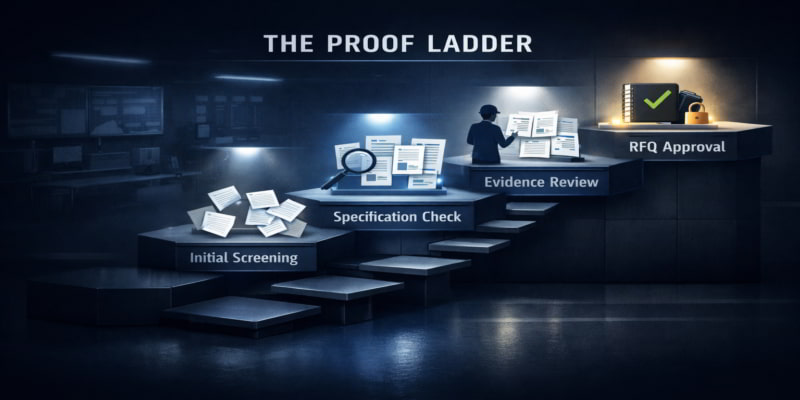
📌 Key Takeaways
Supplier qualification works when you check proof in stages—not when you collect every document at once and hope it adds up.
- Certificates Prove Systems, Not Folding Cartons: A company-wide quality badge confirms the supplier has processes—it doesn’t prove they can make your specific folding carton to your exact specifications.
- Stage Your Requests: Ask only what each gate requires—light screening first, deeper proof later—so you don’t waste time on suppliers who fail basic questions.
- Link Every Document to a Requirement: Scattered files aren’t proof; a document becomes evidence only when it’s matched to a named specification field with an assigned reviewer.
- Resistance Is a Signal: Suppliers who can’t answer clear, requirement-linked questions early are warning you about the quality of later-stage proof.
- RFQ-Ready Means Controlled Unknowns: Final approval doesn’t require perfect certainty—it requires that remaining gaps are small, visible, and shared across all bidders.
Governed verification replaces doubt with documented confidence before price ever enters the conversation.
Procurement managers, QA leads, and packaging engineers qualifying folding carton suppliers will find a ready-to-use four-stage framework here, preparing them for the detailed stage-by-stage guidance that follows.
~ ~ ~ ~ ~ ~ ~ ~ ~ ~ ~ ~ ~ ~ ~ ~ ~ ~
Forty-three pages of certificates, test reports, and quality statements land on the desk with reassuring weight. An ISO 9001 badge. A declaration of food-contact compliance. A letter confirming the supplier has been audited. The procurement file looks complete.
If folding cartons subsequently fail barrier testing on the production floor, the failure often traces back to this documentation gap.
If all of this is real proof, why does approval still feel like a gamble? That question is the real starting point for supplier qualification. Not paperwork. Not price. Not urgency. Doubt—the kind that surfaces when a thick folder still cannot answer whether this supplier can build this folding carton, to these requirements, for this product environment.
This scenario haunts cross-functional teams responsible for qualifying folding carton suppliers. The problem is not a lack of paperwork. The problem is paperwork that never connects to the actual folding carton requirements the business needs to verify. Generic certificates confirm that a supplier has systems in place. They do not confirm that the supplier can hold the exact caliper tolerance, barrier performance, or migration limits a specific product line demands.
A folding carton supplier verification methodology changes this dynamic entirely. Instead of collecting documents and hoping they add up to confidence, a governed approach sequences proof against named requirements. By the time quotes arrive, every supplier on the shortlist has already demonstrated capability against the specifications that matter. The result is not more bureaucracy. The result is a set of defensible decisions and comparable quotes.
The Proof Ladder: From Unverified Claim to RFQ-Ready Approval
Before exploring each stage in detail, consider the framework as a whole. The Proof Ladder sequences verification into four escalating stages, with proof depth increasing and ambiguity decreasing at each level:
| Stage | Purpose | Gate Question | Proof Depth |
| 1. Claim Screening | Filter obvious mismatches before technical review | Does stated capability align with requirement categories? | Questionnaire reviewed against checklist |
| 2. Specification Match | Confirm documentation aligns with named requirements | Does evidence map to each specification field? | Test reports indexed to specification matrix |
| 3. Evidence Pack Assembly | Organize documents with review ownership | Is every document collected, indexed, and assigned? | Version-controlled pack with sign-offs |
| 4. RFQ-Ready Approval | Authorize quote comparison | Are all reviews recorded and verified? | Formal approval record |
The value of this model is not in the adding process. The value is in sequencing proof so that each stage serves a defined purpose—and no supplier reaches final comparison without verified capability.
This stage reinforces the principle that folding carton clarity matters before supplier review starts—ambiguity at this point cascades into incomparable quotes and late-stage failures.
A common objection surfaces here: suppliers will resist. Some will. That resistance is useful information. A supplier that cannot answer clear, requirement-linked questions early is warning the team about the quality of later-stage proof. A supplier that engages with stage-appropriate requests is showing operational maturity. The ladder is not only a filter for documents. It is a filter for supplier behavior.
Why Supplier Verification Fails When It Starts with Generic Certificates
The instinct to lead with certificates is understandable. ISO certifications, food-safety management credentials, and supplier self-declarations are easy to request and easy to receive. They arrive as polished PDFs. They carry the visual language of authority.
And they answer a question that feels important: does this supplier have quality systems in place?
The trouble is that this question sits several steps removed from the question that actually matters: can this supplier consistently produce folding cartons that meet our barrier requirements, our caliper tolerances, our migration limits, and our print registration standards—at the volumes and lead times our production schedule requires?
A company-level ISO 9001 certificate confirms that a supplier operates a quality management system. It does not confirm that the system has been applied to the specific board grade, coating, or die configuration a buyer needs. A generic declaration of food-contact compliance confirms awareness of regulatory frameworks. It does not confirm that the specific folding carton construction—substrate, barrier coating, printing inks, adhesives—has been tested against the migration scenarios relevant to a buyer’s product.
Regulatory frameworks governing food-contact materials, including those enforced by the U.S. Food and Drug Administration and the European Commission, establish specific requirements for substances that may migrate from packaging into food. A governed verification process confirms that the supplier’s testing evidence aligns with the buyer’s specific use case—not merely that the supplier is aware such frameworks exist.
This gap between system-level assurance and run-level proof is where verification failures originate. Teams collect documents that look right, assume the stack represents qualification, and discover the mismatch only after tooling is cut, production is scheduled, or—worse—product is on shelves.
The pattern is predictable: certificates alone do not qualify a supplier for a specific application. Generic certificates confirm participation in a framework. Governed verification confirms performance against a named specification—a distinction explored in depth in the analysis of why certificates alone do not qualify a folding carton supplier.
What a Folding Carton Supplier Verification Methodology Actually Is
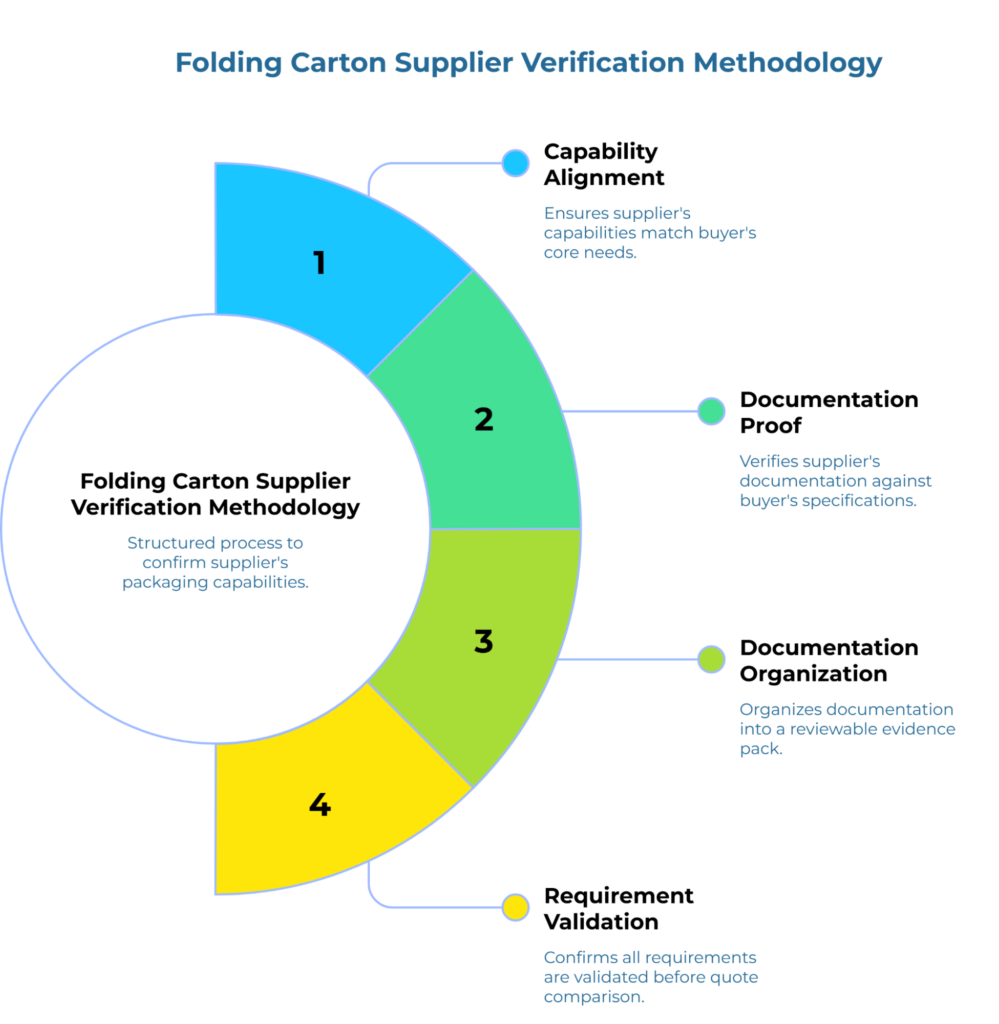
A folding carton supplier verification methodology is a structured, repeatable process for confirming that a supplier can meet documented packaging requirements before that supplier is invited to compete on price.
Think of it as a rigorous background check for a supply-chain partner. A background check does not ask whether someone seems trustworthy. It asks whether documented evidence supports specific claims—employment history, credentials, references that can be verified. A verification methodology applies the same logic to supplier qualification: it defines what must be proven, sequences when each proof is required, and assigns accountability for reviewing each element.
Consider a practical scenario. A bakery brand needs folding cartons for a new frozen pastry line. The folding cartons must maintain structural integrity at freezer temperatures, provide grease resistance rated to at least Kit Level 7 per TAPPI T 559, and comply with FDA food-contact requirements for the specific contact conditions—frozen storage followed by microwave reheating. While formal regulatory documents, such as an EU Declaration of Compliance (DoC), detail the specific testing parameters used, a generic ‘food-safe’ certificate typically tells the buyer nothing about whether the supplier has tested folding cartons under these exact end-use conditions.
A governed verification methodology answers four questions in a fixed order:
First, does the supplier’s stated capability align with the buyer’s requirement categories? This screening question filters out suppliers who cannot plausibly meet core needs before detailed technical review begins.
Second, does the supplier’s documentation prove capability against the buyer’s named specifications? This matching question requires proof—test reports, material certifications, process records—that maps directly to the fields in the buyer’s specification alignment checklist.
Third, is the documentation assembled, indexed, and assigned to reviewers? This governance question ensures that evidence is organized into a reviewable evidence pack with clear ownership—not scattered across email threads.
Fourth, has every requirement been validated before the supplier enters final quote comparison? This approval question confirms that the supplier is truly RFQ-ready—comparable to other approved suppliers on a factual, specification-linked basis.
The Proof Ladder — A 4-Stage Governance Model
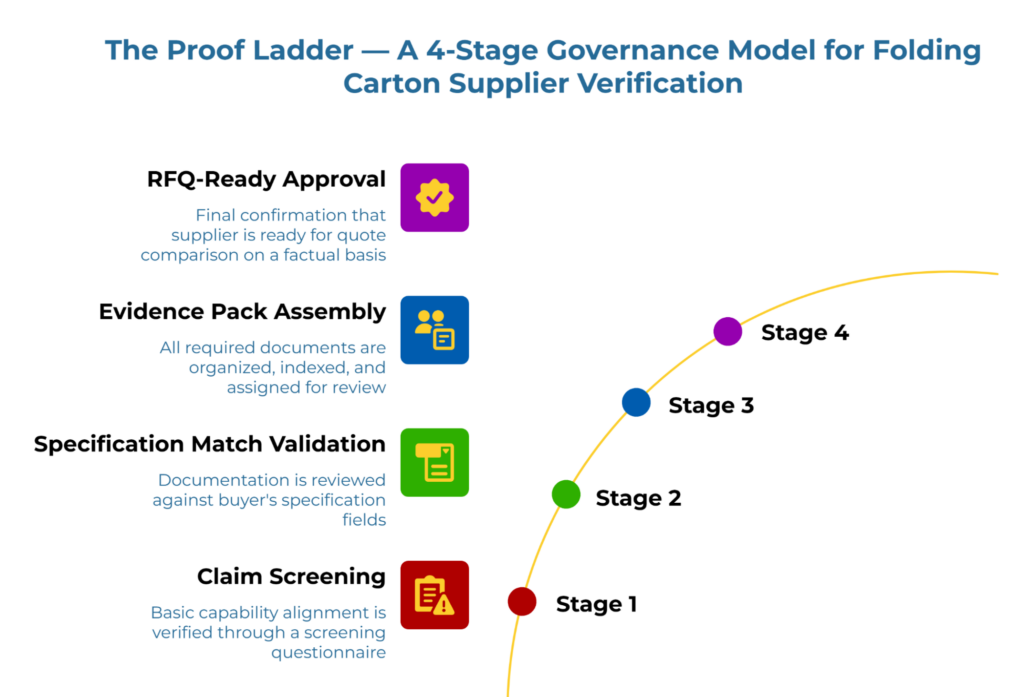
The Proof Ladder sequences verification into four escalating stages. Each stage has a defined purpose, a defined gate, and a clear signal for whether the supplier advances or exits the process.
The logic is simple: light screening first, deeper validation later. This approach prevents two common mistakes. The first mistake is over-requesting—demanding full technical dossiers from suppliers who fail basic capability screening, wasting both buyer and supplier time. The second mistake is under-requesting—allowing suppliers into final comparison without ever confirming that their documentation matches the buyer’s actual requirements.
Stage 1 — Claim Screening
What to verify: Basic capability alignment. Does the supplier claim to produce folding cartons in the relevant board grades, coating types, and volume ranges? Are there immediate disqualifiers—geographic constraints, minimum order quantities that exceed buyer needs, absence of food-contact capability for food-packaging applications?
Why it matters: Screening removes obvious mismatches before technical resources are engaged. A supplier who cannot plausibly meet core requirements should not consume the time required for specification-level review. This addresses the common objection that verification “takes too much time”—staged proof prevents wasted effort on suppliers who will fail later anyway.
What weak proof looks like: Accepting a supplier’s website claims or sales-deck language as sufficient screening evidence. Phrases like “food grade,” “high quality,” “export ready,” and “customizable to any need” sound polished but drift away from the requirement. None of these phrases confirm plant-level clarity, substrate family, barrier approach, or converting capability.
What governed proof looks like: A short screening questionnaire—completed by the supplier—that maps stated capabilities to the buyer’s requirement categories. Responses are reviewed against a predefined checklist. Suppliers who pass screening advance to Stage 2; suppliers who fail are flagged with a documented reason.
Stage 2 — Specification Match Validation
A supplier does not qualify against a mood, a reputation, or a certificate bundle. A supplier qualifies against named folding carton requirements.
What to verify: Proof that the supplier’s documentation aligns with the buyer’s named specification fields. This includes board grade and caliper tolerances, barrier performance requirements, migration testing protocols, print registration standards, and any application-specific parameters.
Why it matters: This stage exposes whether evidence is specification-linked or merely generic. A supplier may hold an ISO 22000 credential for food-safety management—a system-level assurance—but that credential does not confirm whether the specific folding carton construction has been tested for migration under the temperature and time conditions relevant to the buyer’s product.
The FDA’s inventory of effective Food Contact Substance notifications illustrates why substance-level verification matters: compliance is contingent upon material-specific testing under defined conditions.
What weak proof looks like: Weak proof at this stage takes three common forms. The first is broad company documentation with no direct link to the folding carton requirement. The second is a technical sheet with no named test method or no stated relevance to the actual use condition. The third is a non-specific compliance claim—accurate in isolation but detached from the specific substance or application. A supplier submitting a certificate of compliance that references “FDA regulations” without specifying which sections, which substances, or which test conditions fit this pattern exactly.
What governed proof looks like: The buyer provides a specification matrix listing each requirement field. The supplier returns documentation—test reports, certifications, process capability data—indexed to each field. The buyer reviews for alignment, flags gaps, and requests clarification before advancing the supplier.
Another objection often surfaces here: the team usually starts with the cheapest landed cost. That instinct is understandable. It is also risky. Price comparison only produces meaningful results when all suppliers are quoting against identical, verified requirements. Otherwise, the lowest price often correlates with the loosest interpretation of specifications.
Stage 3 — Evidence Pack Assembly
What to verify: Completeness, organization, and review ownership. Have all required documents been collected? Are they indexed against the specification matrix? Has each document been assigned to a reviewer with the expertise to evaluate it?
Why it matters: Documents scattered across email threads and shared drives are not governed—a failure pattern addressed by the methodology for building supplier evidence packs for folding cartons. Governance requires that evidence be assembled into a single, version-controlled pack with clear accountability.
A QA manager reviews migration reports. A packaging engineer reviews caliper and structural data. A procurement lead confirms commercial documentation. Without assigned ownership, reviews drift, gaps go unnoticed, and suppliers enter final comparison with incomplete validation.
What weak proof looks like: Documents exist, but no one can confirm whether the full set has been reviewed. The barrier test report sits in someone’s inbox. The certificate of analysis was attached to a different email thread. When a question arises during final quote comparison, the team scrambles to locate proof that should have been verified weeks earlier. A supplier may appear document-rich yet still be governance-poor.
What governed proof looks like: A centralized evidence pack—physical or digital—organized by specification field. Each section includes the relevant document, the name of the assigned reviewer, and a sign-off confirming that the document meets the requirement or noting exceptions. The pack is version-controlled so any late-arriving documents are logged with timestamps.
Stage 4 — RFQ-Ready Approval
RFQ-ready does not mean perfect certainty. It means controlled ambiguity.
What to verify: Final confirmation that the supplier has passed all prior stages and is ready for quote comparison on a factual, specification-linked basis. The unresolved questions must be small enough, visible enough, and contained enough that suppliers are now responding to the same factual baseline.
Why it matters: RFQ-ready status is a gate, not a formality. A supplier who reaches this stage has demonstrated—through documented evidence reviewed by accountable individuals—that they can meet the buyer’s named requirements. Quotes from RFQ-ready suppliers are comparable because they are anchored to the same specification baseline—a state achievable only when teams build quote-ready folding carton fields before requesting quotes.
What weak proof looks like: A supplier is invited to quote because they “seem qualified” or because a timeline is pressing. The decision to include them is based on convenience rather than verified capability. Later, the lowest-priced quote comes from this supplier—and the team discovers post-award that the supplier cannot hold the required caliper tolerance. The team thinks it has three options. In reality, it has three interpretations—each supplier assumes a different baseline. The quotes arrived, but the comparability never existed.
What governed proof looks like: A formal approval record confirms that the supplier passed Stages 1 through 3. The record lists the reviewers, the date of approval, and any conditional notes. Only suppliers with this approval status receive RFQs for the relevant specification scope.
For detailed guidance on what to request before final comparison, the guide on what proof to request at RFQ stage for folding cartons outlines the specific evidence categories that distinguish RFQ-ready suppliers from those still requiring validation.
How QA, Procurement, and Packaging Engineering Share the Governance Load
Verification fails when ownership is unclear. If procurement assumes QA is reviewing barrier test reports, and QA assumes procurement is handling that as part of supplier onboarding, the reports go unreviewed.
Governed verification assigns explicit accountability to each function:
QA and Regulatory Affairs own the review of compliance-critical documentation: migration testing reports, food-contact declarations, certificates referencing specific regulatory frameworks such as EU food-contact materials legislation. Their gate question: does this evidence demonstrate that the folding carton construction is safe for its intended food-contact application?
Packaging Engineering owns the review of technical performance documentation: caliper and basis weight tolerances, barrier performance data (including Cobb values and grease resistance ratings), print registration capability, structural integrity testing. Their gate question: does this evidence demonstrate that the supplier can hold our specification tolerances in production?
Procurement owns the process governance: ensuring that the evidence pack is assembled, that reviewers complete their assessments by defined deadlines, and that approval status is documented before RFQs are issued. Their gate question: has every required review been completed and recorded?
This division does not mean each function works in isolation. Cross-functional alignment before supplier review begins—agreeing on requirement fields, tolerance ranges, and acceptable evidence types—prevents late-stage friction. A 45-minute alignment session at the start of a supplier qualification cycle can eliminate weeks of rework caused by unstated assumptions.
For smaller teams without dedicated specialists in each function, the same framework applies with consolidated ownership. The critical principle remains: every specification field needs a named proof owner, even if one person owns multiple fields.
Failure Modes the Proof Ladder Prevents
A governed verification methodology is not valuable because it adds process. It is valuable because it prevents specific, costly failures.
- Misaligned shipments. Without specification-linked verification, a supplier may interpret requirements differently than the buyer intended. The folding cartons arrive. They do not fit the filling line. The mismatch traces back to a caliper tolerance that was never explicitly confirmed—a failure mode preventable through rigorous attention to board grade tolerances.
- Barrier mismatches. A supplier’s generic food-contact declaration does not specify which barrier treatments are included. The folding cartons pass visual inspection but fail grease resistance under the buyer’s actual product conditions. The failure is discovered after the product is packaged—triggering rework, delays, or recalls.
- False comparability. Two suppliers submit quotes. One has been verified against the buyer’s specification matrix. The other submitted a generic capability statement. The quotes appear comparable, but they are not. One is anchored to proven capability; the other represents assumptions. Awarding based on price alone invites post-award surprises.
- Late-stage rework. A supplier is onboarded without completing specification match validation. Production begins. Problems emerge. The team scrambles to requalify or source alternatives under time pressure. Costs escalate. Timelines slip.
- Compliance anxiety. An audit approaches. The team cannot locate documentation proving that the folding carton supplier was verified against food-contact requirements. The evidence may exist, but it is scattered, unindexed, and unassigned. Audit preparation becomes an emergency rather than a retrieval exercise.
Each failure mode traces back to the same root cause: verification that was improvised rather than governed. The Proof Ladder prevents these failures not by adding documents, but by ensuring that existing documents are sequenced, linked to requirements, and reviewed by accountable individuals.
Moving from Document Collection to Governed Verification
Generic certificates create the appearance of control. Governance creates actual control.
The shift from ad hoc document collection to a governed verification methodology requires no new technology and no specialized training. It requires a decision to sequence proof by stage, link evidence to named specifications, and assign review ownership before suppliers enter final comparison.
The diagnosis is straightforward. If the current process still depends on whether a document looks professional, the first rung of the Proof Ladder needs work. If technical review keeps turning into circular debate about what the supplier actually proved, the second and third rungs need work. If quote comparison still rewards assumption gaps rather than verified capability, the fourth rung needs work. The methodology stays the same. Only the pressure point changes.
For teams beginning to implement governed verification, the guide on building a proof ladder for folding carton suppliers provides detailed stage-by-stage instructions. The folding carton specification alignment checklist offers a starting framework for defining the requirement fields that drive Stage 2 validation.
The methodology must work for global, cross-functional teams without becoming bloated or theoretical. Governance is not “more documents.” Governance is better sequencing and better linkage—so that by the time a supplier quote lands on the desk, the team already knows that the supplier can build the vault, not just talk about it.
Explore more methodology-first packaging guidance in PaperIndex Academy, or connect with verified folding carton suppliers and folding carton manufacturers through the PaperIndex marketplace.
Disclaimer
This article is educational and methodology-first.
Our Editorial Process:
Our expert team uses AI tools to help organize and structure our initial drafts. Every piece is then extensively rewritten, fact-checked, and enriched with first-hand insights and experiences by expert humans on our Insights Team to ensure accuracy and clarity.
About the PaperIndex Insights Team:
The PaperIndex Insights Team is our dedicated engine for synthesizing complex topics into clear, helpful guides. While our content is thoroughly reviewed for clarity and accuracy, it is for informational purposes and should not replace professional advice.