
📌 Key Takeaways
Incomplete toilet tissue specs slow approvals before they cause supplier failures because teams start debating assumptions instead of comparing facts.
- Clarity Beats Speed: Vague requirements may feel faster at first, but they create slower reviews and more rework later.
- Drift Starts Quietly: Missing fields, late use-case details, and generic labels let each reviewer picture a different requirement.
- Comparability Breaks Down: Supplier quotes stop being truly comparable when vendors answer unclear requirements in different ways.
- QA Needs Clear Limits: Quality teams lose confidence when limits, proof rules, and end-use context stay unclear during review.
- Defensibility Is The Real Cost: A buyer-owned specification makes choices easier to explain, approve, and defend across stakeholders.
Clear requirements reduce friction, strengthen approval logic, and keep supplier comparison grounded in one shared standard.
AFH (away from home) toilet tissue procurement managers, sourcing heads, QA managers, and category buyers will gain a clearer approval path here, guiding them into the specification details that follow.
~ ~ ~ ~ ~ ~ ~ ~ ~ ~ ~ ~ ~ ~ ~ ~ ~ ~
Two quotes are on the table. They look close enough to compare. Then someone asks a simple question about fit, dispenser context, or threshold expectations. Procurement thought the requirement was already clear. QA did not. Approval now depends on definition work that should have happened earlier. Pre-contractual friction—manifesting as internal misalignment and elongated approval chains—often serves as the leading indicator of an ill-defined requirement set.
In AFH procurement, an effective specification framework for AFH toilet tissue rolls is a buyer-owned method for defining and comparing requirements before supplier comparison begins. Conceptually, the specification serves as the blueprint before construction begins. Without that blueprint, the team is not comparing suppliers against one requirement set. It is comparing multiple interpretations of what the requirement might have been.
Why Incomplete AFH Toilet Tissue Specifications Create Costs Before Supplier Problems Appear
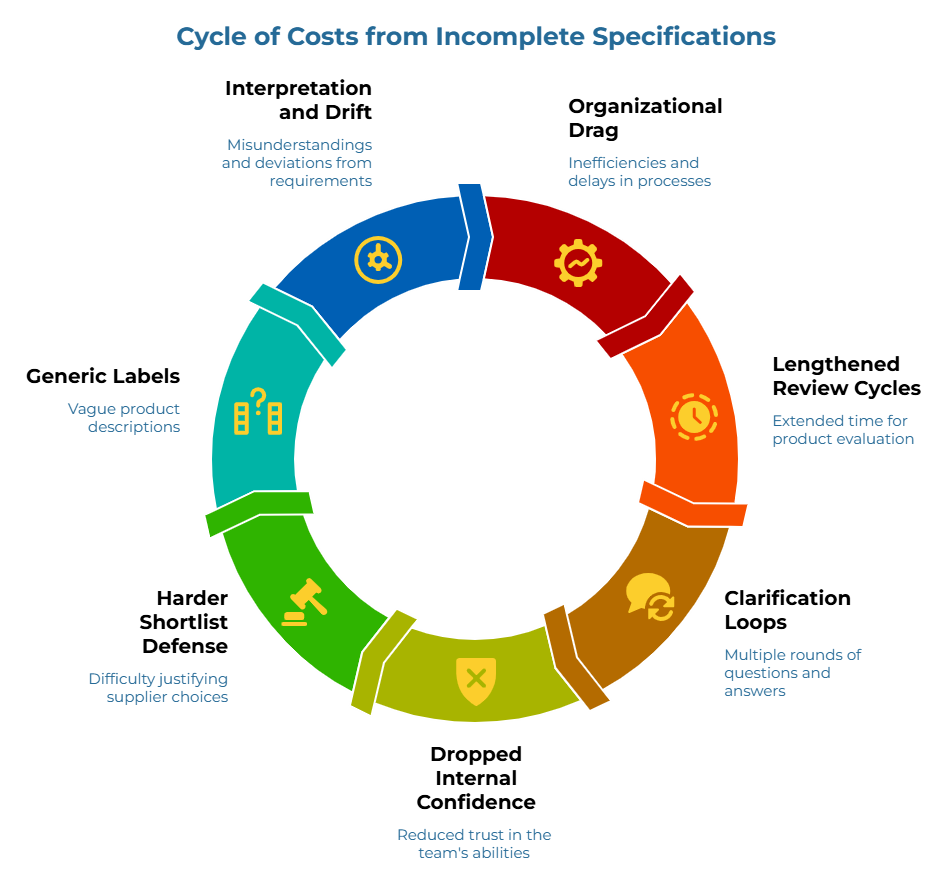
An incomplete specification does not need to cause an immediate product failure to create damage. It creates organizational drag first. Review cycles lengthen. Clarification loops multiply. Internal confidence drops. The shortlist becomes harder to defend because the team is no longer working from one named requirement set. This issue therefore belongs in the business-case conversation even at the awareness stage.
This matters even more in AFH environments such as jan-san, hospitality, healthcare, education, and public institutions, where usability, continuity, and fit can vary by site and by dispenser context. A generic label such as “standard toilet tissue” or “premium roll” may sound usable, but it does not tell reviewers enough about the actual operating requirement. Those examples are illustrative, but the principle is general: generic labels invite interpretation. Interpretation invites drift.
How Requirement Drift Starts
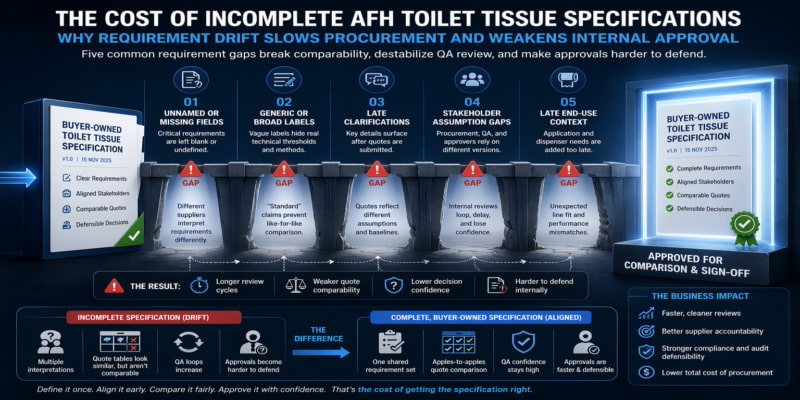
Requirement drift usually begins quietly. A few fields remain unnamed. A few assumptions stay unstated. End-use context arrives late. One stakeholder reads a supplier sheet as complete because it looks polished, while another notices that decision-critical details are still missing. The document appears finished, but the requirement logic is still open.
Requirement drift typically stems from five primary sources:
- Unnamed fields that should have been mandatory.
- Generic labels that hide threshold differences.
- Late clarifications after quotes are already in review.
- Stakeholder assumption gaps between Procurement, QA, and approvers.
- End-use context introduced too late, after supplier comparison has already started.
As a general procurement principle, any field that depends on measurement becomes more defensible when the method is named, not implied. That is why standards such as ISO 536 for grammage and ISO 287 or TAPPI T 412 for moisture content are examples of method clarity. For tissue-specific applications, procurement teams often lean on ISO 12625-6, which specifically outlines the determination of grammage for tissue paper and tissue products, ensuring the measurement accounts for the unique bulk and compressibility of AFH stock.A shared review discipline also benefits from documented process control, which is why the ASQ overview of ISO 9001 is a useful secondary reference. Standardizing these metrics ensures that ‘quality’ is an objective variable rather than a subjective interpretation, shielding the procurement cycle from late-stage QA vetoes.
What Procurement Loses When the Requirement Set is Incomplete
Procurement loses comparability first. When AFH bathroom tissue suppliers respond to loosely defined requirements, the buying team spends more time translating formats, reconciling language, and asking follow-up questions that should have been resolved before outreach. The quote table may still look organized, but it is no longer comparing like with like.
This degradation of comparability forces procurement into a ‘translation’ role, where objective evaluation is replaced by subjective reconciliation, ultimately undermining the shortlist’s defensibility. In a fast-moving sourcing cycle, that rework is expensive in process terms even when no operational incident has occurred yet.
What QA and Approvers Lose When the Requirement Set is Incomplete
QA loses threshold stability. Procurement may believe the requirement is specific enough to compare offers, while QA may see missing limits, missing context, or missing proof logic. Both teams may be acting reasonably. The problem is not effort. The problem is that they are reviewing different versions of the requirement in their heads.
Approvers lose sign-off confidence for the same reason. When the rationale cannot be explained cleanly, approval weakens. Questions arrive late in the cycle. Internal reviewers ask why one supplier is better suited than another, and the team cannot answer with one stable requirement set. That weakens the decision long before any shipment, complaint, or inconsistency appears downstream.
The Hidden Cost is Weaker Defensibility, Not Just Slower Process
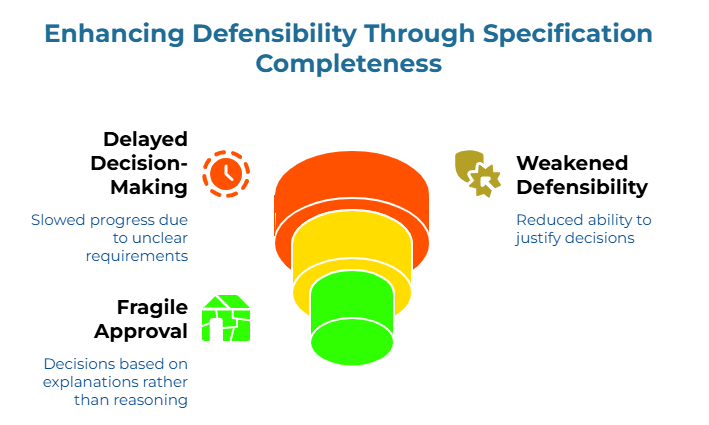
This is the real shift. The hidden cost of incomplete specification work is not only delay. It has weaker defensibility.
A slower process is visible. A weaker decision logic is harder to spot. Yet it is often the larger problem. When the team cannot show that every supplier was reviewed against the same named requirements, internal approval becomes fragile. The decision may still move forward, but it rests on explanation gaps instead of structured reasoning.
That is why specification completeness should be treated as process control, not bureaucratic overhead. It gives Procurement, QA, and approvers one reference point. It creates language the team can circulate internally. It makes the final choice easier to explain, easier to approve, and easier to defend later.
How to Stop Requirement Drift Before the Next Quote Round
The solution is not endless documentation. It is earlier clarity.
Start by defining the mandatory fields before you contact suppliers. Then separate mandatory detail from optional detail. Align Procurement and QA on thresholds before review begins. Preserve one buyer-owned requirement version for comparison before you submit your buying requirements. Finally, require supplier responses to map back to that version. Those five moves do not slow procurement. They reduce the friction that slows procurement later.
For teams that want a practical next step, the strongest companion resources in the PaperIndex Academy include the specification-to-normalization checklist. Teams working specifically on cross-functional alignment may also find value in the QA/procurement framework. And when the main challenge is quote comparability under time pressure, the global quote standardization guide and comparative decision matrix provide the specific technical structure needed to close the gap between initial quote and final approval.
Ultimately, a specification is not a bureaucratic hurdle but a defensive asset; it ensures that when the ‘simple questions’ arise during final approval, the data is already in place to answer them. Once the team can see the hidden cost of incompleteness, the priority for procurement leads is therefore the establishment of a robust requirement structure rather than immediate commercial negotiation.
Frequently Asked Questions
What counts as an incomplete toilet tissue specification?
A specification is incomplete when it does not give Procurement, QA, and approvers one shared basis for comparison. In practical terms, if a simple fit, threshold, or use-case question forces the team to reopen the requirement set, the specification was not complete enough for defensible review.
Why does requirement drift slow procurement?
It slows procurement because the team starts comparing supplier interpretations instead of one buyer-defined requirement. That creates more clarification, more translation, more back-and-forth, and less confidence in the shortlist.
Why does vague specification work weaken internal approval?
Vague specification work weakens approval because it makes the final recommendation harder to explain. Approvers are more likely to challenge a decision when the underlying criteria shift during review or remain partly implied.
Is the main cost delay or bad product fit?
For this article’s business-case framing, the main cost is broader than delay. It includes duplicated discussion, weaker sign-off confidence, harder internal explanation, and more avoidable rework. Product-fit problems may appear later, but organizational drag usually appears first.
Disclaimer:
This content is provided for educational and informational purposes only. It outlines general procurement and specification principles for AFH toilet tissue and should not be treated as technical, legal, regulatory, or purchasing advice. Specific requirements, test methods, approval criteria, and supplier decisions should be reviewed by qualified internal stakeholders based on the actual use case.
Our Editorial Process:
Our expert team uses AI tools to help organize and structure our initial drafts. Every piece is then extensively rewritten, fact-checked, and enriched with first-hand insights and experiences by expert humans on our Insights Team to ensure accuracy and clarity.
About the PaperIndex Insights Team:
The PaperIndex Insights Team is our dedicated engine for synthesizing complex topics into clear, helpful guides. While our content is thoroughly reviewed for clarity and accuracy, it is for informational purposes and should not replace professional advice.