
📌 Key Takeaways
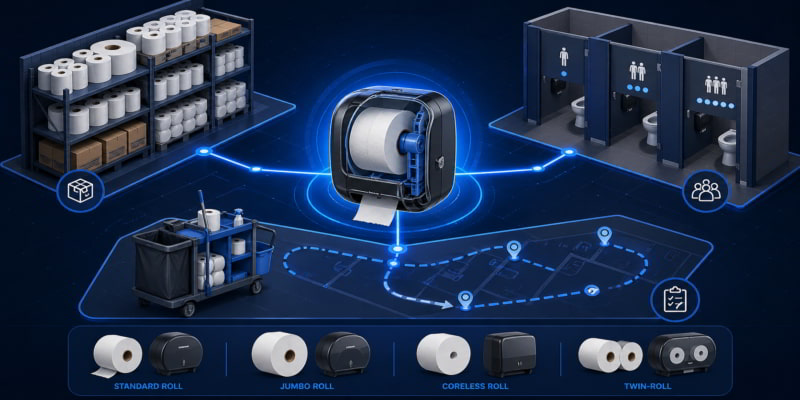
Toilet tissue planning works best when roll type, dispenser format, and custodial service routines are planned together.
- Match The Dispenser: The wrong roll-dispenser fit can cause jams, waste, unusable stock, and more refill work.
- Capacity Cuts Labor: Jumbo, coreless, and twin-roll systems can reduce refill visits in busy restrooms.
- Traffic Drives Format: High-use restrooms often need more capacity than small offices with predictable restroom use.
- Control Prevents Waste: Controlled-use dispensers can make consumption more predictable without leaving users under-supplied.
- Pilot Before Switching: Test new formats in different restroom types before changing the whole facility.
Better replenishment starts at the dispenser, not just the supply closet.
Facility managers, janitorial buyers, and AFH procurement teams will gain a clearer planning lens here, preparing them for the detailed overview that follows.
~ ~ ~ ~ ~ ~ ~ ~ ~ ~ ~ ~ ~ ~ ~ ~ ~ ~
The custodian opens the dispenser — the third one this shift — and stares at a bare spindle. Down the hall, a growing stack of half-used rolls clutters the janitorial cart, pulled too early from other restrooms. On the second floor, a facilities manager’s phone buzzes with another complaint.
You’ve managed some version of this. Stockouts that shouldn’t happen. Restrooms burn through tissue faster than consumption numbers suggest. Custodial routes that can’t keep pace despite adequate supply in the closet. The root cause is rarely volume. Operational friction stems from the decoupling of procurement specifications and the mechanical realities of the point-of-use dispenser.
Toilet tissue replenishment planning is not only about how many cases a facility buys. It depends on how tissue is dispensed, how much capacity each roll provides, how quickly users consume the product, and how often custodial staff can check restrooms. The wrong roll-dispenser combination creates avoidable problems: frequent refills, partial-roll waste, higher labor demand, storage complications, and stockouts. Roll type and dispenser format are operational decisions — not just product specifications. Once you understand how each format interacts with your facility’s traffic, staffing, and restroom layout, replenishment becomes less reactive and far more predictable.
How Dispenser Format Shapes Toilet Tissue Replenishment
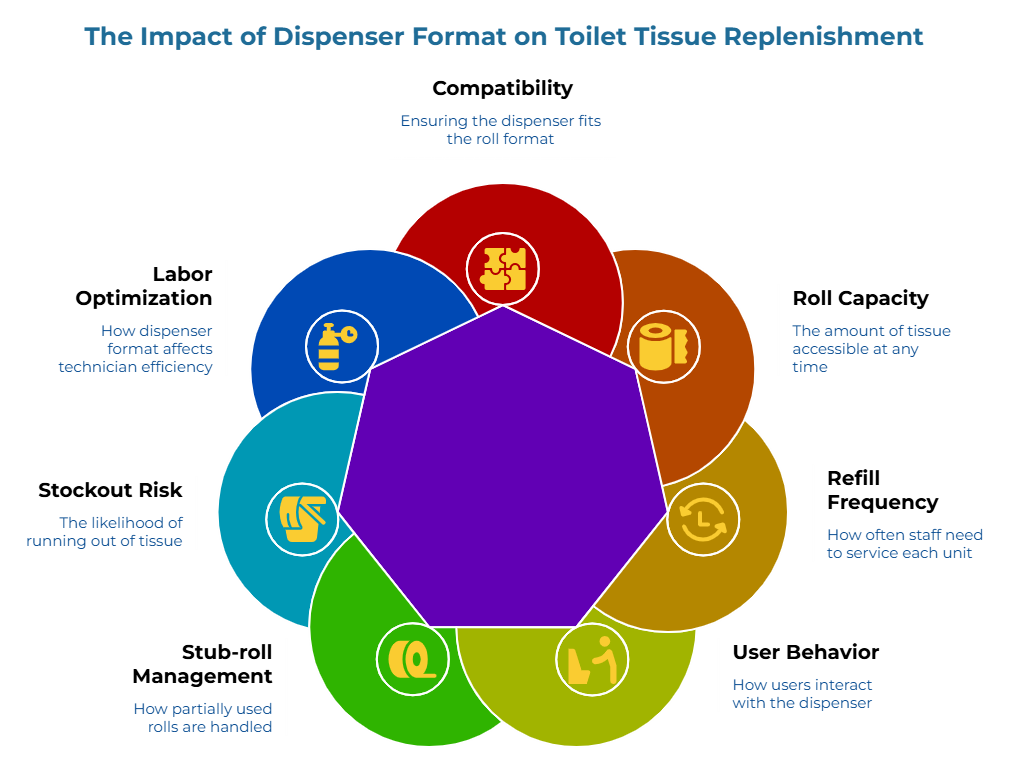
Dispensers act as the link between inventory and actual restroom usage. A facility can purchase the right volume of toilet tissue, stock it correctly, and still experience chronic restocking problems if the dispenser format doesn’t match the restroom’s operating conditions.
The dispenser controls several variables that directly affect replenishment planning:
- Roll capacity — how much tissue is accessible at any given time.
- Refill frequency — how often staff need to service each unit.
- User behavior — an open, free-spinning dispenser invites faster consumption than an enclosed, controlled-access system.
- Stub-roll Management — Certain dispenser configurations incentivize ‘pre-depletion swapping,’ while others utilize secondary spindles to ensure 100% consumption before roll cycling.
- Stockout risk — single-roll dispensers carry higher depletion risk between service rounds than twin-roll or high-capacity units.
- Labor Optimization — Format selection dictates replenishment cycle frequency, which determines the total restroom count a technician can manage within a standard shift.
- Compatibility with specific roll formats — a standard-roll dispenser won’t accept a jumbo roll, and a coreless system requires its own hardware.
When procurement changes the roll format without verifying dispenser fit, the result can be unusable inventory, jammed dispensers, or rolls that waste tissue at twice the expected rate. Dispenser selection should match the facility’s operating conditions, not simply the lowest product cost.
A small office restroom with predictable traffic may perform well with a basic standard-roll dispenser. A school, healthcare facility, or public restroom — where usage spikes are harder to control — will typically need a higher-capacity or multi-roll system. The dispenser isn’t just hardware. It’s the operating interface between your supply chain and the restroom floor.
Integrated planning ensures that AFH (Away-From-Home) specifications align with field-service logistics. Dispenser fit, roll dimensions, case quantity, and refill practice all affect whether a purchasing decision works in daily operation.
For U.S. workplace contexts, the Occupational Safety and Health Administration (OSHA) strictly mandates sanitary and immediately available toilet facilities under standard 29 CFR 1910.141. Furthermore, specific agency interpretations—notably the 1998 memorandum on Section (c)(1)(i)—explicitly require employers to provide toilet paper. This makes supply availability a binding compliance issue in those settings, rather than a mere convenience. The same principle applies more broadly as an operational standard: restroom supplies must be available when users need them. (OSHA)
Standard Roll vs. Jumbo Roll Toilet Tissue
The standard roll is the format most facilities know. It’s widely available, fits common dispensers, and works well in environments where restroom traffic is moderate. Standard rolls may be a practical choice when custodial teams check restrooms frequently, dispenser space is limited, facilities want product flexibility across multiple suppliers, and storage areas are small. For a small office with eight or nine people sharing a restroom, standard rolls offer a low-complexity option.
The operational limitation surfaces when traffic increases. Standard rolls deplete faster in busy restrooms, which means more frequent refills, more dispenser service events per shift.
Jumbo rolls address this by extending service life per dispenser fill. The core benefit isn’t simply “more tissue.” It’s fewer interruptions. Each jumbo roll holds significantly more sheet length, so the dispenser stays functional longer before staff intervene. Jumbo rolls may work well when restrooms experience heavy traffic, staff cannot refill dispensers frequently, stockouts are a recurring issue, labor efficiency is a priority, or the facility wants fewer dispenser service events.
Jumbo systems come with their own planning requirements, though. They need compatible dispensers — a standard holder won’t accommodate the larger diameter. Storage footprint changes, since jumbo cases take more shelf space per unit even though fewer cases may be needed over time. They also require more disciplined purchasing to avoid ordering the wrong dimensions. And for restrooms with genuinely low traffic, jumbo rolls may sit in the dispenser for weeks, which introduces hygiene and perception concerns without operational upside.
Format selection is a function of traffic volume, staffing overhead, and servicing cadence.
How Coreless Rolls Affect Usage, Waste, and Restocking
Coreless toilet tissue rolls are manufactured without the cardboard tube at the center. That difference — seemingly minor — has real implications for waste, usable tissue volume, storage, and janitorial handling.
The benefits are practical. Coreless rolls eliminate cardboard core waste entirely, removing a disposal step from every refill event. They reduce the frequency of empty-core disposal across large facilities where dozens of tubes accumulate daily. In some systems, coreless formats increase usable tissue per roll because manufacturers can wind more sheet length into the same diameter. Storage density can improve since coreless rolls are sometimes more compact. Coreless systems also enable cleaner janitorial handling in environments where loose cores create clutter.
From a sustainability perspective, the U.S. EPA identifies source reduction — preventing waste at the source — as the preferred approach in the waste management hierarchy. Coreless systems should be evaluated through that lens, but only when they genuinely reduce waste in the facility’s actual setup rather than on paper alone. (US EPA)
The planning considerations are equally real. Coreless rolls require dedicated coreless dispensers. The roll sits and rotates differently inside the unit compared to a cored roll on a spindle — dispenser performance matters because this difference in roll movement can cause jams, uneven dispensing, or premature roll collapse if the wrong hardware is used. Staff need to understand how to load coreless rolls correctly and how to recognize when a coreless roll is truly depleted. Without a core to signal “empty,” less experienced team members sometimes pull rolls before they’re fully used.
Procurement teams must also be careful with ordering. If a facility’s bulk toilet tissue specification doesn’t clearly distinguish between cored and coreless requirements, suppliers may ship the wrong format — creating unusable inventory and forcing emergency reorders. When supplier data arrives in different formats, teams can use a structured method to normalize commercial toilet tissue specification inputs before comparing options.
Coreless systems appeal to facilities that want to reduce waste, simplify disposal, or improve storage efficiency. They can be useful in schools, offices, healthcare facilities, and other sites where janitorial teams manage many restrooms.
Twin-Roll Dispensers and Stockout Prevention
Stockouts are the most visible failure in restroom replenishment. An empty dispenser during business hours triggers complaints, damages facility perception, and creates unplanned labor as custodians rush to respond.
Twin-roll dispensers address this through redundancy. The unit holds two rolls simultaneously. When the first roll is depleted, the second becomes available immediately — no custodial intervention required. This built-in buffer protects the facility during traffic spikes, shift transitions, or periods when custodial coverage is thin.
The benefits extend across several dimensions of replenishment planning. Twin-roll systems reduce the chance of an empty dispenser between service rounds, support longer intervals between restroom checks, and help custodial teams manage multiple restrooms more efficiently. They provide a built-in buffer during traffic spikes — in a school, usage surges during class-change breaks; in a hotel lobby, traffic clusters around check-in windows; in an office, the post-lunch period creates predictable peaks. A single-roll dispenser can run dry during any of these spikes, while a twin-roll system absorbs them. Twin-roll configurations can also reduce emergency restocking calls, which are among the most disruptive unplanned events in a custodial shift.
Twin-roll systems still require clear refill rules. Staff should know whether to replace only empty rolls during each service round, move partial rolls to a secondary position, or refill both positions during scheduled service. Without a defined protocol, twin-roll dispensers can create their own form of waste — rolls pulled before depletion, uneven usage between positions, or backup rolls sitting untouched because the dispenser mechanism wasn’t properly set.
Controlled-Use Dispensing and Consumption Management
Consumption is not determined only by restroom traffic. Dispenser behavior also affects how much tissue users take. An open, free-spinning dispenser makes it easy to pull long sheets quickly. A controlled-use dispenser changes that dynamic by limiting access, sheet output, or roll exposure.
Depending on the product system, controlled-use dispensing may involve enclosed housings that restrict direct roll access, limited roll exposure, sheet-by-sheet dispensing, reduced free-spinning mechanisms, systems designed to discourage excessive pulling, or dispensers that protect backup rolls until the primary roll is depleted.
Controlled-use systems are especially relevant for facilities trying to reduce waste, improve consumption predictability, or manage restroom supply budgets. When each user takes a more uniform amount, usage data becomes more reliable and reorder timing easier to forecast. That predictability translates directly into more accurate replenishment planning.
The important word is precision: control systems prioritize managed delivery over arbitrary limitations. A system that limits usage too aggressively may lead to complaints, dispenser tampering, or poor restroom perception — particularly in guest-facing environments like hotel lobbies or client-facing offices. The goal is controlled access, not under-supply. Controlled-use dispensers work well in high-traffic, cost-sensitive environments like schools, retail locations, public facilities, and large commercial buildings. In low-traffic or premium restrooms, the restriction may not be necessary and could create a negative impression that outweighs supply savings.
Roll Capacity and Custodial Labor Planning
Every dispenser refill is a labor event. Each one includes checking the restroom, opening the dispenser, replacing rolls, removing waste, recording supply needs, and moving to the next location. Across a 30-restroom building, those events compound into a significant share of the custodial workday.
Higher-capacity systems — jumbo rolls, high-capacity coreless rolls, twin-roll dispensers — can reduce the number of refill visits, shorten emergency restocking events when they occur, help staff cover more restrooms per route, support evening or overnight shifts when staffing is lighter, and reduce disruption in guest-facing or public areas.
Lower-capacity systems, by contrast, may require more frequent checks, increase partial-roll replacements, and create higher stockout risk in busy restrooms. They can still work acceptably in low-traffic or staff-monitored areas where the restroom count is small and checks are built into existing routines.
The practical takeaway for buyers: evaluate cost per case alongside cost to service. A lower-cost roll format may not be the most efficient choice if it increases labor time, stockout complaints, or waste. The format that reduces total replenishment cost — not just purchase price — is typically the stronger operational fit.
CDC cleaning guidance notes that high-traffic areas may require more frequent cleaning or disinfecting. The same traffic-based thinking applies to supply planning: busier restrooms need closer attention to check frequency, dispenser capacity, and backup stock. (CDC)
Matching Roll Type to Facility Needs
The right toilet tissue format depends on traffic level, restroom count, staffing model, storage space, and service expectations. No single format fits every restroom, and those variables can differ significantly even within a single building.
A small office or small business with predictable traffic may find standard rolls sufficient, provided staff check restrooms regularly. High-traffic public restrooms — including retail and public-facing facilities — often need jumbo or high-capacity twin-roll systems to reduce stockout risk between custodial rounds. Hotel lobbies and event areas benefit from twin-roll or controlled-use systems that can support traffic surges during check-in periods, conferences, or dining hours.
School restrooms face heavy use concentrated in short time windows, with limited custodial coverage during instructional hours. Durable, controlled-use, higher-capacity systems can help manage both the volume and consumption behavior typical in these environments. Healthcare facilities should prioritize reliable capacity, hygiene, and predictable replenishment in their format selection. Commercial real estate properties may need different formats across restrooms, varying by restroom traffic, tenant mix, and cleaning schedule.
Distributors have a related but different concern. They may need to support multiple customer environments — offices, schools, clinics, hotels, public-facing sites — without creating confusion across roll formats, dispenser requirements, or case quantities. For distributors, format matching is not only about one facility. It’s also about helping customers avoid misorders and incompatible systems across their sites.
Facilities with limited storage can benefit from coreless or higher-density roll formats that reduce the physical volume of backup stock. Facilities with limited custodial coverage — whether due to staffing constraints, extended operating hours, or weekend gaps — may find that jumbo or twin-roll systems reduce refill frequency enough to keep restrooms stocked without adding labor.
The key principle is fit-for-purpose planning. Evaluate each restroom or restroom category on its operating conditions rather than defaulting to one format facility-wide.
Purchasing Considerations for Roll and Dispenser Compatibility
A format switch that looks sensible on paper can create problems if procurement doesn’t verify compatibility first. Moving from standard to jumbo, core to coreless, or single-roll to twin-roll requires more than a product substitution on the purchase order.
Before committing to a format change, buyers should confirm:
- Roll diameter — Does the new roll physically fit inside the existing dispenser?
- Roll width — Will the roll sit correctly without jamming or leaving gaps?
- Core size or coreless requirement — Does the dispenser accept cored rolls, coreless rolls, or both?
- Dispenser capacity — Can the installed unit accommodate the new format’s dimensions?
- Number of rolls per case and sheets or length per roll — How does the new format affect case quantities, storage, and reorder frequency?
- Storage requirements — Does the new format fit existing janitorial closet space?
- Supplier availability and lead times — Can preferred bath tissue suppliers deliver the new format reliably?
- Staff training needs — Do custodial teams know how to load the new rolls and follow updated refill protocols?
- Whether existing dispensers need replacement — If the new format requires new hardware, what’s the installation cost and timeline?
Changing roll formats affects purchasing, storage, custodial routines, and user experience. Incompatible roll dimensions can create dispensing problems or unusable inventory. A facility that switches without checking these variables risks wasted spend and disruption.
The practical recommendation: pilot the new format in a small set of restrooms representing different traffic levels before a full-facility conversion. A hotel might test one lobby restroom and one staff restroom. A school might test one cafeteria-adjacent restroom and one lower-traffic corridor restroom. A healthcare site might test a public waiting-area restroom alongside a staff-only restroom. The pilot should answer practical questions: Does the roll fit? Does it dispense cleanly? Does the dispenser protect backup stock? Do users complain? Do staff refill it correctly? Does the format reduce emergency restocking? Does storage become easier or harder?
For buyers evaluating new suppliers during a format switch, a structured supplier verification process for multi-site AFH buying can confirm product fit across site types.
Building a Replenishment Plan Around Dispenser Format
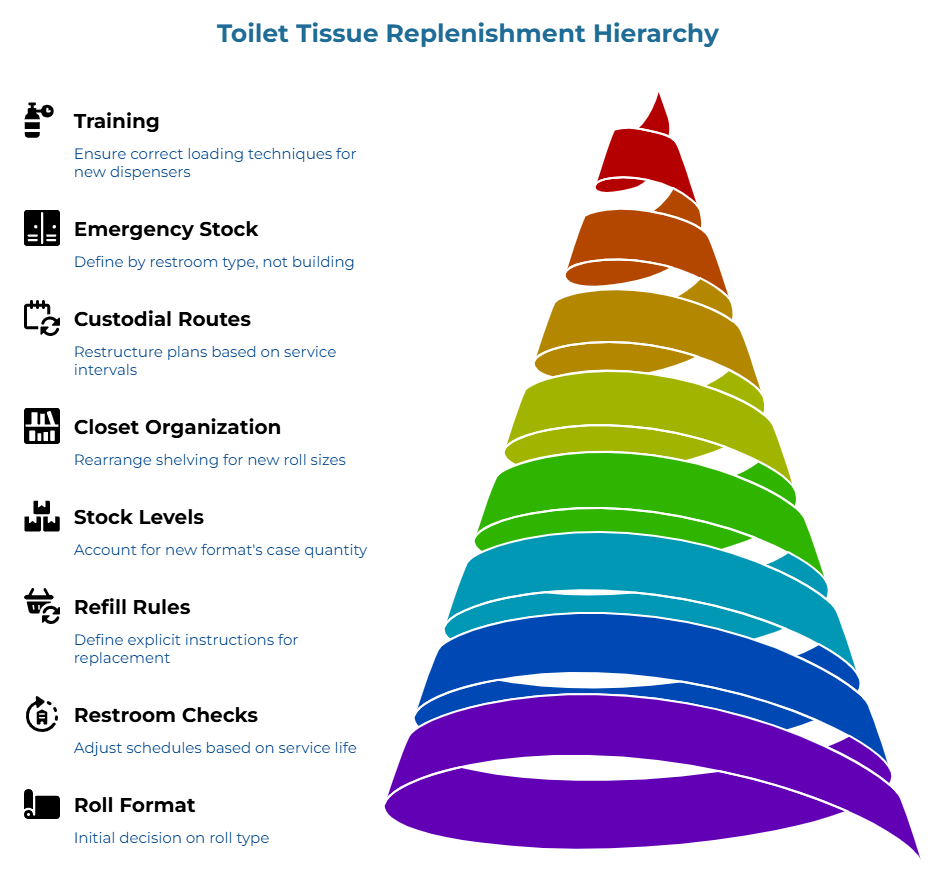
Selecting a roll format is the first half of the decision. Adjusting the replenishment plan to match is where the format change either improves operations or creates new problems.
When a facility introduces a new format, existing assumptions about check frequency, par levels, reorder points, and custodial instructions no longer apply. Par levels define the minimum amount of stock that should be available in a location before replenishment is triggered. Reorder points define when central inventory should be reordered from the supplier. Emergency backup stock is different from normal par stock — it exists to protect service during unusual traffic spikes, missed deliveries, or schedule gaps. All three need to be recalculated when the roll format changes.
Facilities should update:
Restroom check schedules to reflect the new roll’s expected service life. Switching from standard to jumbo rolls may allow less frequent checks, but custodians still need to monitor cleanliness, dispenser function, and backup stock — even when the roll itself lasts longer.
Refill trigger rules should be explicit and documented. For twin-roll dispensers, define when staff replace the first roll, when they leave partial rolls, and how they prevent unnecessary waste. For coreless rolls, clarify how custodians identify a truly depleted roll. “Refill if needed” is too vague for a busy route — a better instruction explains what “needed” means for each dispenser format.
Minimum stock levels and reorder points should account for the new format’s case quantity and delivery cadence. A facility that ordered 20 cases of standard rolls monthly may need 12 cases of jumbo rolls on a different schedule.
Janitorial closet organization often needs rearrangement — jumbo rolls don’t stack like standard rolls, and coreless rolls may need different shelving.
Custodial route plans may need restructuring when format changes affect service intervals, since custodians may now cover restrooms in a different sequence or frequency.
Emergency backup stock should be defined by restroom type, not just by building.
Training for replacing rolls correctly is essential with any format change. New dispensers require different loading techniques, and untrained staff will fall back on old habits — creating more waste and jams.
Common Mistakes to Avoid
Even when product supply is adequate, poor roll-format planning creates operational friction. These mistakes appear frequently — and they’re all avoidable.
Choosing rolls based only on case price. Buyers should also consider labor, waste, storage, and stockout risk. A lower-cost roll that doubles refill events may cost more once total service impact is calculated.
Installing dispensers without checking roll compatibility. Incompatible roll dimensions can create dispensing problems or unusable inventory. A “jumbo” roll from one manufacturer may not match a “jumbo” dispenser from another — always verify specific dimensions against specific models.
Using the same roll format in every restroom. Low-traffic and high-traffic restrooms have fundamentally different usage profiles. A 200-person lobby and a 4-person back office shouldn’t default to the same system.
Replacing partial rolls too early. This increases waste and distorts usage data, making it harder to forecast reorder timing or identify genuine consumption patterns.
Ignoring custodial shift patterns. A dispenser system that works well during daytime coverage may fail overnight or during weekend gaps. The replenishment plan should account for the shift with the thinnest coverage, not just the busiest.
Failing to train staff after switching systems. New dispensers often require updated refill practices, and assumptions that carry over from the old format are a common source of jams, waste, and frustrated custodians.
How to Decide Which Format Is Right
Facilities should make roll-format decisions using usage data, restroom traffic, labor availability, and service expectations.
Procurement and facilities teams should work through these questions for each restroom or restroom category:
- How many people use each restroom per day?
- Which restrooms run out most often?
- How often can custodial staff check each restroom?
- Are stockouts happening during specific shifts or traffic periods?
- Is partial-roll waste a problem?
- Is storage space limited?
- Are current dispensers compatible with preferred rolls?
- Would higher-capacity systems reduce labor pressure?
- Do users have complaints about current dispensers?
- Can the facility pilot a new system before full rollout?
The answers won’t point to one universal format. They’ll point to format-per-restroom-type logic — a lobby gets a twin-roll jumbo system, a back office stays with standard rolls, a school corridor gets controlled-use high-capacity dispensers. The replenishment plan follows the format, not the other way around.
The best toilet tissue system is the one that supports reliable restroom service with the least avoidable labor, waste, and stockout risk.
Strategic Integration
Toilet tissue roll format and dispenser choice have a direct impact on replenishment planning. Standard rolls, jumbo rolls, coreless systems, twin-roll dispensers, and controlled-use dispensers each affect usage, refill frequency, storage, labor, and purchasing differently. For AFH buyers, the goal is not to choose the largest roll or the lowest-cost case — it’s to match each restroom’s usage pattern with a dispenser system that supports consistent supply, efficient service routes, and predictable inventory planning.
Start with the restrooms that generate the most complaints. Audit the dispenser format, the roll type, and the refill protocol. Pilot a new configuration. Adjust based on what the data shows. The system that works is the one that keeps dispensers stocked and custodial routes on schedule.
When you’re ready to compare bulk AFH toilet tissue rolls or connect with verified commercial bath tissue suppliers, a structured specification process helps ensure the format you select fits the restrooms you’re stocking. The AFH toilet tissue specification normalization guide provides a practical starting framework. Buyers can also find suppliers or submit buying requirements through PaperIndex’s RFQ process. PaperIndex generally functions as a B2B connector, typically allowing buyers and suppliers to handle pricing, negotiation, and transactions directly.
Frequently Asked Questions
How does toilet tissue dispenser type affect replenishment planning?
Dispenser type affects how much toilet tissue is available at one time, how quickly users consume it, and how often custodial staff need to refill the unit. Higher-capacity or twin-roll dispensers may reduce refill frequency, while controlled-use dispensers may help manage consumption.
Are jumbo toilet tissue rolls better than standard rolls?
Jumbo rolls can be better for high-traffic restrooms because they provide more capacity and may reduce refill frequency. Standard rolls may still be suitable for smaller restrooms, offices, or facilities where usage is predictable and custodial checks are frequent.
Do coreless toilet tissue rolls reduce waste?
Coreless rolls can reduce cardboard core waste and may provide more usable tissue per roll in some systems. However, they require compatible dispensers and proper purchasing controls to avoid ordering the wrong roll type.
How do twin-roll dispensers help prevent stockouts?
Twin-roll dispensers hold a second roll inside the dispenser, giving users access to backup tissue when the first roll runs out. This helps reduce the risk of an empty dispenser between custodial service rounds.
What is controlled-use toilet tissue dispensing?
Controlled-use dispensing refers to dispenser systems designed to limit excessive tissue use. These systems may restrict roll access, reduce free-spinning, dispense sheets more deliberately, or protect backup rolls until needed.
How does roll capacity affect janitorial labor?
Higher roll capacity can reduce the number of times custodial staff need to refill dispensers. This can improve route efficiency, reduce emergency restocking, and help teams manage restrooms with fewer service interruptions.
Should all restrooms in a facility use the same toilet tissue roll format?
Not in most cases. High-traffic restrooms may need jumbo, twin-roll, or controlled-use systems, while low-traffic restrooms may perform well with standard rolls. Facilities should match roll format to restroom traffic and service frequency.
What should buyers check before switching toilet tissue roll formats?
Buyers should confirm dispenser compatibility, roll diameter, roll width, core size, case quantity, storage requirements, supplier lead times, and custodial training needs before switching formats.
Which toilet tissue format is suited for high-traffic restrooms?
High-traffic restrooms often benefit from jumbo rolls, high-capacity dispensers, twin-roll systems, or controlled-use dispensers. The specific choice depends on traffic volume, refill frequency, storage space, and user expectations.
Can dispenser choice reduce toilet tissue consumption?
Controlled-use dispensers can help reduce unnecessary consumption by limiting access or improving dispensing control. However, facilities should balance usage control with user comfort and restroom satisfaction.
Disclaimer: This content is provided for educational and informational purposes only. It does not constitute professional facility management, procurement, or operational advice. Facilities should consult with qualified operations professionals and conduct their own assessments before making purchasing or equipment decisions. Specific product performance, roll specifications, and dispenser compatibility vary by manufacturer and system — always verify with your supplier.
Our Editorial Process:
Our expert team uses AI tools to help organize and structure our initial drafts. Every piece is then extensively rewritten, fact-checked, and enriched with first-hand insights and experiences by expert humans on our Insights Team to ensure accuracy and clarity.
About the PaperIndex Insights Team:
The PaperIndex Insights Team is our dedicated engine for synthesizing complex topics into clear, helpful guides. While our content is thoroughly reviewed for clarity and accuracy, it is for informational purposes and should not replace professional advice.