

📌 Key Takeaways
Telling your supplier exactly what your warehouse environment looks like prevents new boxes from collapsing during humid storage.
- Share Your Storage Reality: Tell your supplier about your specific warehouse humidity and storage timelines before they suggest a box type.
- Demand Exact Material Details: Refuse vague labels like standard quality and ask the supplier for the exact paper layers and flute sizes.
- Ask for Storage Instructions: Keep new boxes wrapped and strictly off the floor to prevent moisture damage without buying expensive protective upgrades.
- Inspect at the Loading Dock: Check every delivery pallet for torn shrink wrap or visible dampness before moving boxes into your storage area.
- Rethink Large Bulk Orders: Buying too many boxes at one time leaves your unused inventory exposed to warehouse humidity for much longer.
Clear and honest communication with your packaging supplier stops seasonal warehouse humidity from silently destroying your expensive containers.
Procurement and warehouse managers will gain highly practical sourcing strategies here, setting up the detailed implementation guide that follows.
~ ~ ~ ~ ~ ~ ~ ~ ~ ~ ~ ~ ~ ~ ~ ~ ~ ~
Corrugated boxes are usually purchased based on three factors: price, size, and delivery date. That works until the boxes sit in a warehouse where humidity softens the board, weakens the stack, and turns a routine reorder into an urgent problem.
The issue is rarely that the box was defective. More often, the buyer never told the supplier where the boxes would be stored — and the supplier never asked. When procurement and warehouse teams operate separately, the RFQ describes the product going inside the box but says nothing about the environment holding it.
This article is written for packaging buyers, procurement managers, warehouse managers, quality teams, supply chain managers, and operations managers sourcing corrugated boxes for B2B storage and fulfillment operations. It defines the critical technical parameters procurement teams must evaluate when sourcing containers for humid warehouse conditions.
What follows is a practical set of questions to use before requesting quotes, changing suppliers, or committing to a box specification. The goal is not to turn every buyer into a packaging engineer—it is to make the supplier conversation specific enough that the boxes arriving at your dock match the warehouse they are going into.
Start by Describing Your Storage Reality Before Asking for a Quote
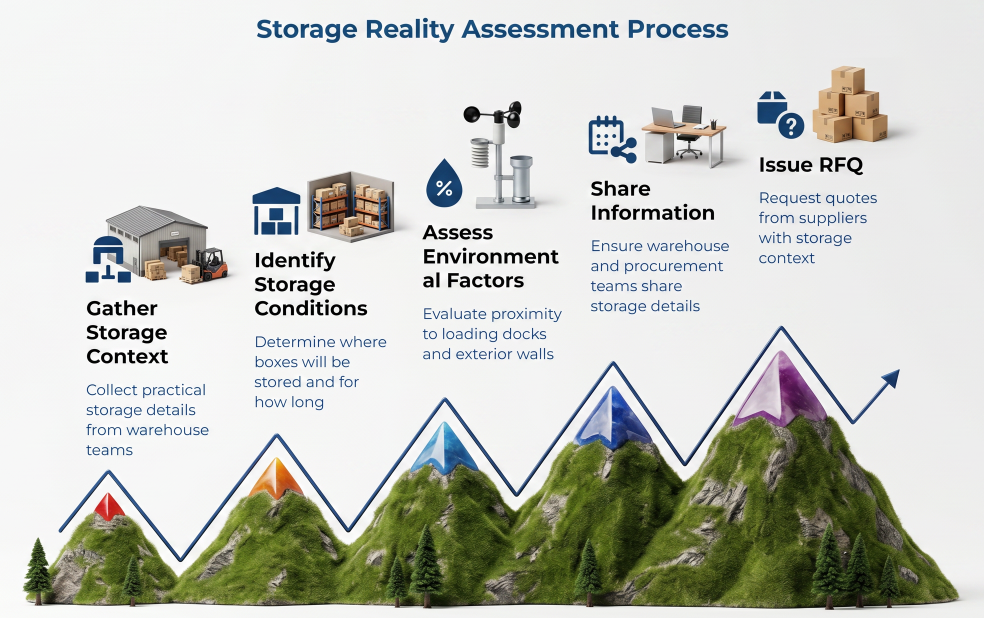
Suppliers can only recommend a suitable box if they understand the conditions it will face after delivery. Before contacting a supplier, gather basic storage context from your warehouse or operations team — not lab reports, just practical answers about where boxes will sit, for how long, whether they are stacked, and whether the storage area is near loading docks, exterior walls, or other corrugated box storage zones with higher humidity risk.
If your warehouse and procurement teams operate separately, they must share this information before issuing the RFQ. This is especially important in growth-stage SMB operations, where procurement and warehouse teams may not always share the same storage context before a supplier conversation.
Questions to ask the supplier:
- What storage conditions should we describe before you recommend a board grade?
- How long can these boxes typically be stored under normal, protected warehouse conditions before performance may change?
- What assumptions are being made about stacking load, box use, and handling?
- Are there storage conditions — such as proximity to loading docks, exterior walls, or unventilated zones — where this specification should be reviewed before ordering?
Document the storage details shared with the supplier and any acknowledgment they provide. Avoid treating supplier guidance as a universal storage rule unless the supplier provides verified, use-case-specific evidence.
Ask What Board Construction the Supplier Is Actually Quoting
A corrugated box is made from a fluted middle layer (the medium) sandwiched between flat outer layers (the liners). The liner is the flat paper layer on each face. The medium is the fluted paper layer between them. The flute is the wave-shaped structure that gives the corrugated board its cushioning and stacking strength. Single-wall board has one fluted layer between two flat liners, while double-wall board has two fluted layers. The combination of liner weight, medium type, flute size, adhesive, and wall construction determines how the box performs under load and moisture exposure. For a deeper explanation, see this guide to corrugated box flute and wall types.
Vague descriptions like “heavy-duty,” “standard quality,” or “export quality” do not tell you what is actually being supplied. Two suppliers quoting the same dimensions may be offering different board constructions.
Questions to ask the supplier:
- What board grade, flute profile, and wall construction are you quoting?
- Are the liner, medium, and adhesive specifications documented in the quote or product data sheet?
- Is this a standard construction, or was it selected based on our described storage and use case?
- What stacking and storage assumptions are built into this recommendation?
Document the board construction in your RFQ notes or purchase specification to make future comparisons easier. When comparing across corrugated box suppliers, match the same construction details — not only price and delivery schedule.
Ask Which Performance Evidence Matters for Your Use Case
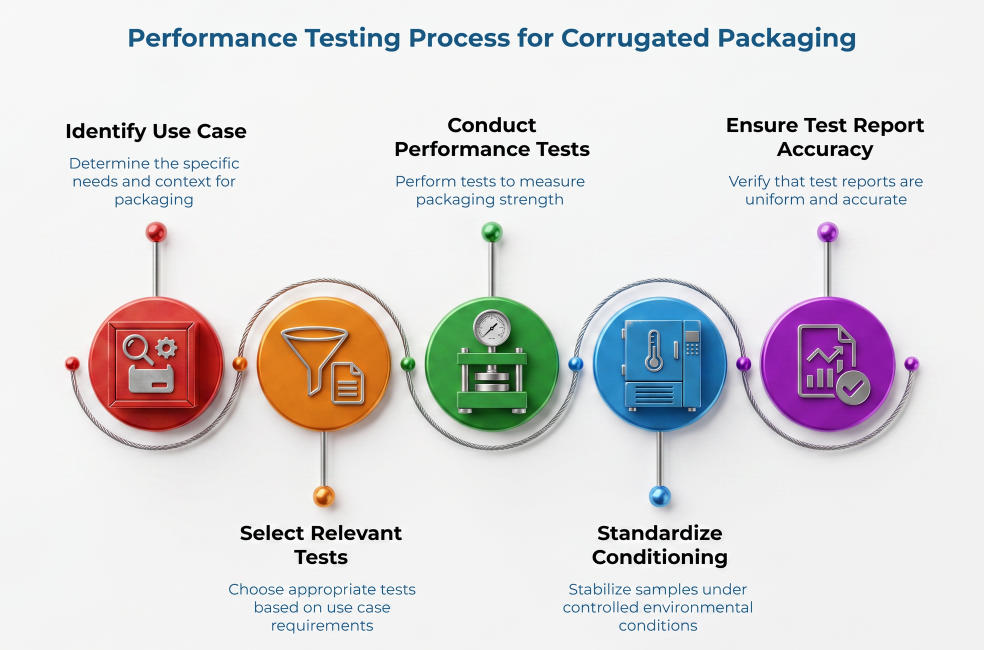
Performance testing helps buyers compare supplier claims to documented results. Edge crush test (ECT) measures board resistance to compression along the edge. TAPPI T 811 describes procedures for determining edgewise compressive strength of single-, double-, or triple-wall corrugated fiberboard. Burst strength measures the force required to rupture the face of the corrugated board. Box compression testing (BCT) evaluates the full box under stacking load. The right test depends on stacking height, handling, transit, and end use; none should be treated as the single correct answer for every humid-storage situation. For more on how these relate, see this guide to corrugated box ECT and flute profiles.
Cellulosic packaging materials change physical properties under fluctuating temperature and humidity. Standardized conditioning—the process of stabilizing samples under controlled environmental parameters prior to testing—ensures measurements are reproducible. ASTM D4332 from ASTM International details specific environmental protocols required to make test reports uniform and accurate for real-world applications. If test reports matter, confirm whether the supplier’s results were based on conditioned samples.
Questions to ask the supplier:
- Which test reports can you provide for this box construction?
- Were the samples conditioned before testing, and under what conditions?
- Does the test report match the exact board construction being quoted, or is it based on a different specification?
- If boxes will be stacked after storage in our warehouse, what evidence supports that stacking use?
Request test documentation only where the risk justifies the effort. A short-storage, low-value application may not need a full test package, but a high-stack or damage-sensitive application probably does.
Ask About Storage Guidance, Not Just Moisture-Resistant Options
Many buyers jump straight to asking about moisture-resistant treatments when humidity is a concern. A better first step is understanding what the supplier recommends for storing the boxes you are already buying.
Practical storage guidance — keeping boxes off the floor, away from exterior walls and dock openings, wrapped until use — can reduce risk without changing the specification. A buyer storing boxes near a loading dock may need different supplier guidance than a buyer storing sealed bundles in a protected dry zone.
Questions to ask the supplier:
- What storage practices do you recommend after delivery for the boxes you are quoting?
- Should bundles or palletized packs remain wrapped until use?
- Are there visible warning signs that stored boxes should be inspected before use?
- Do you recommend any stock-rotation guidance or maximum storage periods for our use case?
- What does “moisture resistant” mean in your quote, if that term is used?
If the supplier recommends a moisture-resistant treatment, confirm what that means in practice. It may refer to a coating, a treatment, a material change, or another supplier-specific construction choice. Ask whether it affects printability, recyclability, lead time, cost, or the supplier’s ability to provide supporting documentation.
Document the supplier’s storage recommendations in your purchase notes — if performance issues arise later, having their guidance on record helps clarify accountability.
Ask When Standard Corrugated Is Enough and When It Needs Review
Standard corrugated boxes work well in many warehouses, including those with moderate humidity exposure. The goal is not to upgrade every box by default but to know when the current specification deserves a closer look. A stronger or coated box may increase cost without solving the actual issue if the real problem is poor storage practice, excessive order quantity, damaged delivery wrapping, or weak receiving checks.
Questions to ask the supplier:
- Under what conditions would you recommend reviewing the standard box specification we currently use?
- What moisture-resistant or upgraded options exist, and what trade-offs do they create in cost, lead time, printability, or recyclability?
- Are those upgraded options supported by test data, supplier experience, or both?
- If our storage risk increases, what would be the lowest-friction upgrade you would suggest as a starting point?
| Situation | Standard Corrugated May Be Enough When | Review or Upgrade May Be Worth Discussing When | Next Question to Ask |
| Protected storage | Bundles remain protected and are used within normal internal planning assumptions. | Storage exposure is recurring or poorly controlled. | What storage conditions are assumed for this quote? |
| Stacking | Loads are modest and internal handling is controlled. | Boxes will be stacked after long or uncertain storage. | What evidence supports stacking after storage? |
| End use | Product rejection risk is low. | Product, shipment, or customer rejection risk is high. | Should QA or packaging engineering review this specification? |
| Order size | Usage rate matches protected storage capacity. | Bulk orders may sit longer than planned. | Can supply cadence be adjusted? |
Ask About Delivery, Receiving, and Dispute Documentation
Humidity risk does not begin only after boxes reach your warehouse shelves. Damaged shrink wrap, damp pallets, outdoor staging at the dock, and poor handling can introduce moisture exposure before boxes are even put away.
Questions to ask the supplier:
- How are boxes protected during shipping and delivery?
- What delivery conditions should we check and document upon receiving?
- What photos or records help resolve moisture or handle disputes after delivery?
- What batch, lot, or production references should appear on delivery documents for traceability?
A simple corrugated box delivery checklist for humidity exposure — wrapper condition, pallet integrity, visible moisture, delivery documentation — makes it easier to catch issues early. Documenting visible dampness, warped bundles, crushed edges, or torn wrapping before materials enter storage establishes an indisputable baseline. While this verification step does not automatically resolve disputes, it creates a transparent log for both logistics teams and vendors. For a broader look at evaluating suppliers, see this guide on how to vet corrugated box suppliers for technical competence.
Red Flags in Supplier Answers: “Moisture resistant” without defining the treatment or trade-offs. No test report for the quoted construction. No storage guidance after delivery. Board descriptions like “heavy-duty” without documented specifications. Test reports that do not match the quoted box. No receiving documentation process. A supplier claims that it treats one box type as suitable for every humid-storage scenario. These are not necessarily signs of a bad supplier — but they are gaps to resolve before ordering.
Ask Reorder and Stock-Rotation Questions Before Buying in Bulk
Larger orders reduce unit cost, but they also extend the time boxes sit in storage. If the warehouse has recurring humidity exposure, bulk orders may face longer moisture contact than the supplier’s recommendation assumes.
Questions to ask the supplier:
- What order quantity fits our likely usage rate and protected storage capacity?
- Are there storage recommendations for slower-moving stock that may sit longer than a typical order cycle?
- How should older stock be inspected before use if it has been stored longer than expected?
- Can supply cadence or delivery scheduling be adjusted to reduce extended storage exposure?
Aligning order quantities with true box usage and storage conditions affects box performance, not just inventory cost. For more structured cross-functional RFQ preparation, see this guide on aligning procurement and engineering for corrugated box RFQs.
Supplier Question Matrix for Humid Storage Conditions
| Question Area | Question to Ask | Why It Matters | Good Answer Should Include | What to Document | Escalate When |
| Storage exposure | What conditions should we describe before you recommend a grade? | Guidance depends on knowing your warehouse reality. | Warehouse details: humidity zones, dock proximity, duration. | Conditions shared; supplier acknowledgment. | Supplier cannot advise without context. |
| Board construction | What board grade, flute, and wall type are you quoting? | Vague descriptions hide spec differences between quotes. | Specific liner, medium, flute, wall type, and adhesive notes where relevant. | Exact construction in RFQ or purchase spec. | Specs vague or inconsistent across quotes. |
| Performance evidence | Which test reports can you provide? Were samples conditioned? | Results may not reflect humid-storage conditions. | Named test type, conditioning note, match to quoted spec. | Test reports on file. | High-stack, long-storage, or sensitive use case. |
| Storage guidance | What storage practices do you recommend after delivery? | Proper storage may reduce risk without changing spec. | Floor contact, wrapping, inspection triggers, rotation. | Supplier recommendations in purchase notes. | The supplier offers no guidance. |
| Moisture-resistant claims | What does “moisture resistant” mean in this quote? | The term can mean different things across suppliers. | Coating, treatment, material change, or process explanation, plus trade-offs. | Definition, evidence basis, and cost/lead-time impact. | Claim is used to justify a major cost increase. |
| Standard vs. upgraded | When should we review the standard spec? | Avoids under-specifying and over-specifying. | Conditions triggering review; upgrade trade-offs. | Upgrade discussion and cost notes. | Regulated, sensitive, or high-value product. |
| Delivery and receiving | How are boxes protected in transit? What should we check at receiving? | Damage can start before storage. | Packaging method, inspection checklist, dispute process, visual rejection triggers. | Receiving notes, photos, batch references. | Recurring damage or moisture at receiving. |
| Reorder and rotation | What order quantity fits our usage and storage capacity? | Bulk buying extends storage time and exposure. | Order size, rotation advice, reorder trigger. | Order cadence aligned with storage. | Stock sits longer than recommended. |
What to Do If Supplier Answers Are Vague
A supplier who answers with “it’s good quality” or “moisture resistant” without further detail is not necessarily a bad supplier — but the answer is not useful for procurement decisions in humidity-sensitive storage.
When answers lack specifics, ask for the response in writing so it can be compared across suppliers. Request the exact board construction and the test basis behind any performance claim. Compare against another supplier’s answer for the same specification. If the use case involves high stacking, long storage, or sensitive products, escalate to your quality manager or packaging engineer.
“Heavy-duty” is a description, not a specification.
Use Humidity Questions to Make the RFQ Clearer
The point of these questions is not to buy the strongest box available. It is to buy a box matched to your storage conditions, stacking requirements, handling environment, and documentation needs.
Start with the question matrix above before your next RFQ or supplier conversation. Share storage details before asking for a quote, document what the supplier recommends, and review the specification when conditions change.
Copy-ready RFQ note: “Please include storage guidance for boxes stored in humidity-sensitive warehouse conditions. Confirm the quoted board construction, recommended storage practices, relevant test documentation, incoming inspection checks, and any conditions where the standard specification should be reviewed before purchase approval. If moisture-resistant options are available, note trade-offs in cost, lead time, and recyclability.”
When you are ready to compare corrugated box suppliers, utilizing neutral, non-transactional B2B packaging networks can help procurement teams directly connect with global manufacturers equipped to meet specific atmospheric requirements. You can also submit your corrugated box buying requirements when your storage questions are ready.
Disclaimer:
This article is for general informational purposes only and does not constitute technical, safety, compliance, or professional packaging advice. Corrugated box performance can vary by material, supplier, storage conditions, handling, stacking load, and end use. Confirm important specifications, test requirements, and storage recommendations with your supplier, packaging engineer, quality team, or another qualified professional before making purchasing decisions.
Our Editorial Process:
Our expert team uses AI tools to help organize and structure our initial drafts. Every piece is then extensively rewritten, fact-checked, and enriched with first-hand insights and experiences by expert humans on our Insights Team to ensure accuracy and clarity.
About the PaperIndex Insights Team:
The PaperIndex Insights Team is our dedicated engine for synthesizing complex topics into clear, helpful guides. While our content is thoroughly reviewed for clarity and accuracy, it is for informational purposes and should not replace professional advice.