
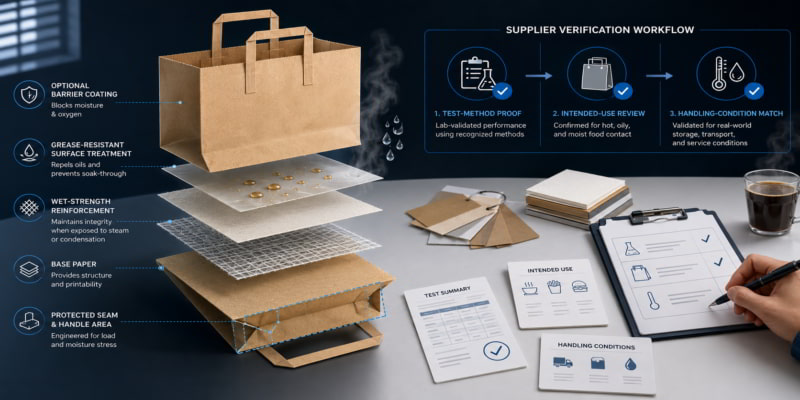
📌 Key Takeaways
Match the bag to the job it actually faces—not to a heavier paper weight.
- Heavier Paper Won’t Fix Grease: A thicker sheet does not block oil; only surface treatments or coatings stop grease from soaking through.
- Document the Failure First: Record what actually goes wrong—stains, soft handles, torn bases—before asking suppliers for upgrades.
- Wet Strength Is Not Waterproofing: Moisture-treated paper holds its shape better in steam, but it still cannot contain pooled liquids.
- Check the Whole Packaging System: Inner wraps, containers, packing steps, and hold times all affect whether the outer bag survives delivery.
- Demand Test-Method Proof: Ask suppliers for named test methods, tested conditions, and intended-use statements—not just marketing labels like “greaseproof.”
Name the problem before you name the fix.
Takeaway and delivery operations teams responsible for packaging procurement will gain a clear method for matching bag features to real handling conditions, preparing them for the detailed overview that follows.
~ ~ ~ ~ ~ ~ ~ ~ ~ ~ ~ ~ ~ ~ ~ ~ ~ ~
Oil stains through a paper bag before the delivery rider leaves the counter. A second bag’s base fails under a stacked order after sitting for 25 minutes in a warm staging zone. Yet a third holds its structure perfectly all shift—same kitchen, same supplier, but a completely different menu item.
These scenarios point to a common problem in takeaway packaging: the bag was not matched to the conditions it actually faced. In most cases, the paper is not defective. The mismatch is between what the bag was designed to handle and what the operation exposed it to—grease, steam, condensation, stacking, hold time, or a combination of all five. This article provides a practical method for operations and procurement teams to assess when functional features—grease resistance, wet strength, or barrier coatings—are justified by real handling conditions, and when a standard bag may be sufficient.
Paper Bag Performance Is More Than Paper Weight
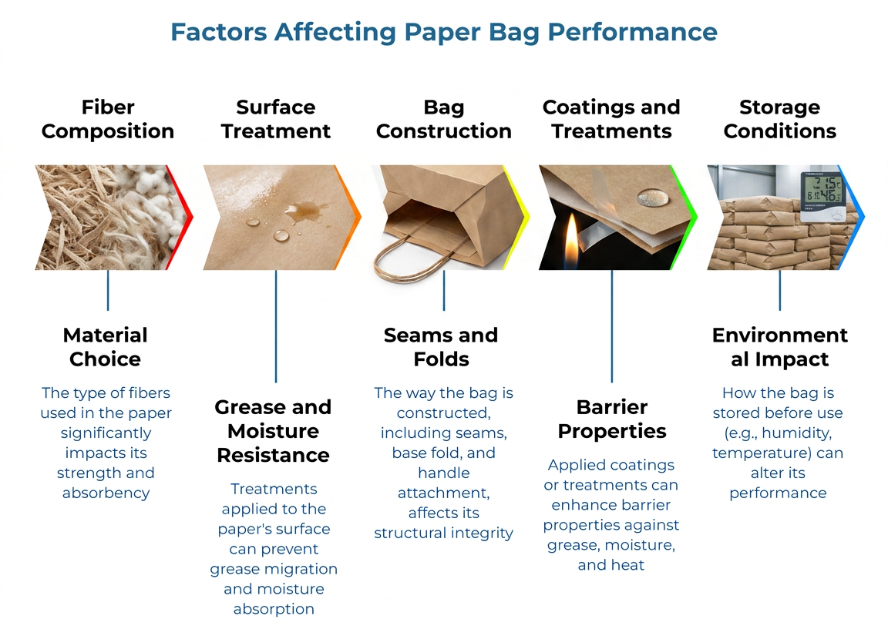
One of the most persistent assumptions in food-service packaging procurement is that heavier paper means a stronger, more reliable bag. GSM (grams per square meter) describes the mass of the paper per unit area. It often correlates with stiffness. But it does not determine whether a bag can resist grease migration, tolerate moisture, or maintain integrity through a 30-minute delivery window with hot, sauced food inside.
Bag performance depends on several factors beyond paper weight: fiber composition, surface treatment, bag construction (seams, base fold, handle attachment), any applied coatings or treatments, and storage conditions before use. A bag stored on a humid kitchen shelf may perform differently from the same bag stored in a climate-controlled stockroom. Upgrading to a higher GSM will not solve a grease-transfer problem, and a thicker bag will not resist condensation any better than a thinner one unless the paper itself has been treated for moisture exposure.
For background on how GSM, coatings, and pulp work together in food packaging paper specifications, a foundational overview is available.
The core rule: align the bag’s functional engineering with the operational failure point. Do not use higher GSM as a substitute for grease resistance.
Quick Decision Matrix: Match the Failure Risk to the Feature
The matrix below connects common takeaway handling conditions to functional features worth evaluating. Use it as a starting framework—not a specification sheet.
| Handling Condition | Likely Failure Mode | Feature to Consider | Evidence to Request | Caution |
| Hot, greasy foods in direct or near-direct bag contact | Grease staining, oil wicking, surface weakening | Grease resistance or greaseproof treatment | Named test method (e.g., Kit Test per TAPPI T 559), intended-use statement | Grease resistance does not confirm suitability for all food-contact scenarios. |
| Steam-heavy foods or condensation inside the bag | Paper softening, handle weakness, base-seam failure | Wet strength or moisture-resistant construction | Technical data sheet with tested exposure conditions, storage guidance | Wet strength is not waterproofing. It measures tensile retention under vapor exposure, not liquid containment. |
| Long delivery window (over 20–30 minutes with hot food) | Combined grease, heat, moisture, and stacking stress | Feature combination; possibly reinforced construction | Trial results under actual hold time and load conditions | Avoid single-feature thinking. Extended hold times compound multiple stresses. |
| Dry, lightweight takeaway items | Low exposure risk | Standard paper bag may be sufficient | Basic specification and construction details | Do not specify coatings or treatments the operation does not need. |
| Mixed hot and cold items, sauced containers, condensing drinks | Condensation, moisture transfer, load imbalance | Inner wrap, liner, barrier system, or packaging redesign | Complete packaging-system validation | The bag alone may not solve the problem. Inner wraps, containers, and packing workflow all matter. |
This assessment should include frontline input. Counter teams often know which items cause double-bagging. Delivery staff may know whether bags soften during longer handoffs. Procurement teams may know whether supplier claims lack test methods. Together, those observations help separate a paper specification issue from a packing workflow issue.
When Grease Resistance Matters
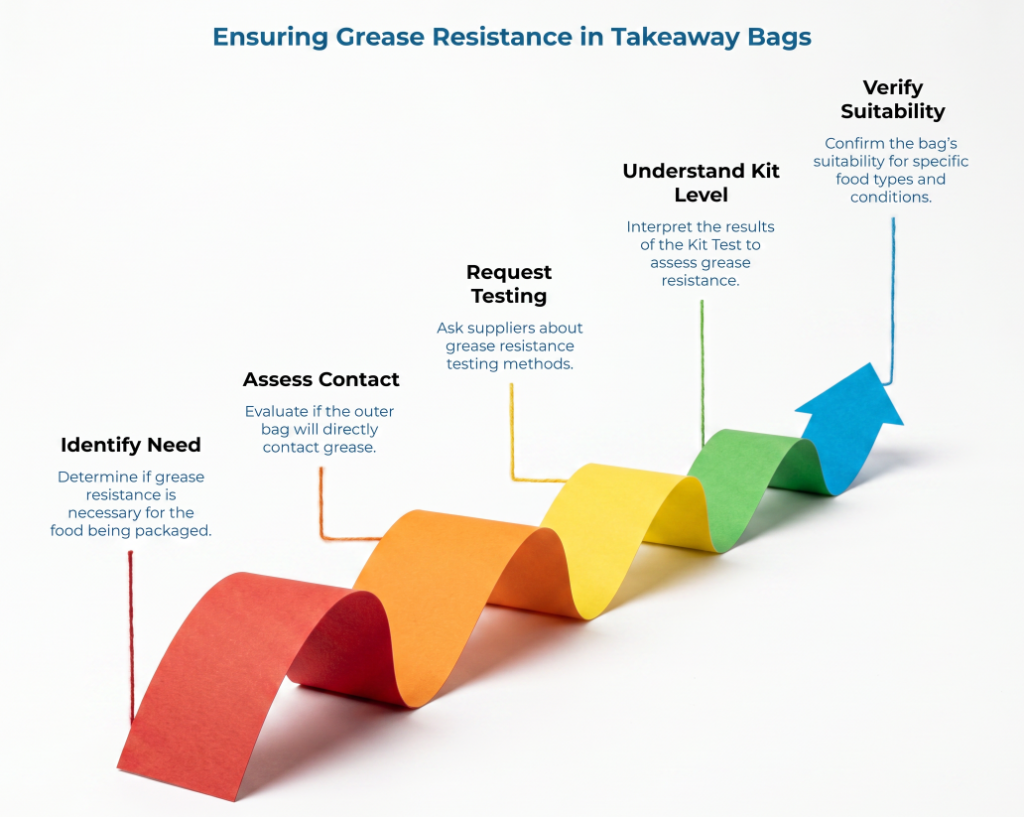
Grease resistance becomes relevant when oily or fatty foods can stain, wick through, or weaken the bag during normal handling—fried items, sauced foods, oily baked goods, or any order where grease migrates from food or inner packaging to the outer bag surface.
Not every takeaway bag needs this feature. Consider a fried food order packaged in a grease-blocking inner wrap or sealed carton: if the inner packaging controls grease transfer effectively, the outer bag may face little direct oil exposure. The buyer should assess whether the bag itself contacts grease—not just whether the food is greasy.
When grease resistance is relevant, buyers should ask how it was tested. TAPPI T 559, commonly known as the Kit Test, is a widely recognized method for evaluating grease resistance in paper and paperboard. It assigns a Kit Level based on how the surface responds to reagent mixtures of increasing aggressiveness. Educational resources are available that detail what a Kit Level means and provide a comprehensive guide to food packaging paper Kit Levels.
A Kit Level result alone does not confirm suitability for a specific food type, temperature, or contact duration. Buyers should ask suppliers what foods, temperatures, and hold times the treatment is intended to support—and request documentation that ties the test result to the intended use. Avoid asking for a specific Kit Level by food category unless that value is supported by a qualified technical source or product-specific supplier documentation.
When Wet Strength Matters
Standard paper loses a significant portion of its dry strength when wet. In takeaway operations, moisture can come from steam trapped inside a closed bag, condensation, wet countertops, chilled containers, sauced items, or handling by wet hands during a busy shift.
Wet-strength paper is treated to retain more of its original strength under moisture exposure. This can help prevent softened handles, weakened base folds, and bag tears during delivery or customer handoff. But wet strength does not make the bag waterproof or capable of containing liquids. It describes strength retention under moisture conditions—nothing more.
A practical example: a hot container placed in a closed paper bag creates steam and condensation during a 20-minute delivery. If the base or handles soften, the failure is moisture-related, and wet strength may be worth evaluating. But dry bakery items bagged at a cool counter and handed directly to the customer may perform well in a standard bag with no moisture treatment at all.
Moisture exposure should also be assessed alongside load, seams, handles, base design, storage, and delivery time. A wet-strength material may help in some cases, but a better container, separator, venting approach, or packing workflow change may also be needed.
When evaluating wet-strength claims, buyers should ask suppliers how wet strength was tested and under what exposure conditions. For reference, methods like ISO 3781 or TAPPI T 456 provide standardized testing for the tensile strength of paper after moisture exposure, and can serve as useful reference points in supplier discussions about wet-strength performance. For guidance on how humidity and moisture affect barrier performance in food-service environments, see this resource on managing kitchen humidity and paper barrier coatings.
When Barrier Coatings Matter
Barrier coatings are applied to paper to resist grease, moisture vapor, liquids, or other substances beyond what untreated paper can block. In takeaway operations, coatings may be considered when exposure conditions—prolonged grease contact, high humidity, or liquid exposure—exceed what uncoated or lightly treated paper can handle.
Coatings vary widely in formulation and purpose. Some target grease resistance, others address moisture vapor, and some create a liquid barrier. Coating choice must match the specific use condition: food type, expected contact time, temperature range, and any disposal or recycling pathway the buyer requires. Comparing poly-coated and kit-treated greaseproof paper clarifies the practical differences between these two common approaches.
Critically, a coated paper bag is not automatically certified for food contact. Food-contact suitability depends on the exact material, coating type, adhesive, ink, food type, temperature, contact duration, and the regulatory requirements of the relevant jurisdiction. Buyers may also need to verify claims about food-contact suitability, migration, PFAS status, recyclability, or compostability with current, product-specific documentation and appropriate professional or regulatory review. In the United States, the FDA’s framework for food-contact substances governs materials intended to contact food. In the European Union, Regulation (EC) No 1935/2004 establishes baseline requirements for food-contact materials. Requirements vary by jurisdiction, and buyers should verify applicable rules with the appropriate authority or qualified professional.
Coatings may also affect recyclability, compostability, and end-of-life pathways. These outcomes depend on the coating material, local waste infrastructure, and applicable certification standards. Do not assume a coated bag is recyclable or compostable without product-specific documentation and confirmation from the relevant facility or certification body.
What Buyers Should Ask Suppliers Before Changing Bag Specifications
Before upgrading paper bag specifications, document the actual handling conditions—food types, hold time, grease exposure, moisture exposure, temperature. Then bring those details into supplier conversations. The following questions can help verify whether a supplier’s product matches real operating needs:
- What food types, temperatures, and handling conditions is this bag designed for?
- Is the grease-resistance claim supported by a named test method? If a Kit Test was used, what Kit Level was achieved and under what conditions?
- If wet strength is claimed, what moisture exposure was tested, and for how long?
- What coating is used, and what food-contact documentation supports its use with the intended food, temperature, and contact time?
- Does the documentation apply to the exact paper grade, coating, ink, adhesive, handle material, and bag construction being supplied?
- What storage and handling conditions does the supplier recommend to maintain the bag’s stated performance?
- Has the bag been tested or trialed under the buyer’s actual hold time, load, and delivery conditions?
For detailed guidance on requesting formal documentation, see this guide on how to request a letter of guarantee from a food packaging paper supplier. Understanding the difference between food grade and food safe can also help procurement teams ask sharper questions during supplier discussions.
Procurement documentation must be current and specific to the exact bag being supplied. A general certificate or broad product-line statement does not automatically prove that the bag is suitable for a specific food, temperature, contact time, or jurisdiction.
Common Mistakes to Avoid
Upgrading GSM when the real problem is grease or moisture. A heavier bag is not a grease-resistant bag. If oil wicks through the paper, the fix is a surface treatment or coating—not a thicker sheet.
Assuming “food safe” means performance-fit. Food-contact suitability is material-, condition-, and jurisdiction-specific. A general label does not replace documentation tied to the actual food, temperature, and contact time.
Treating grease resistance as leak resistance. Greaseproof paper may resist oil transfer through its surface but is not designed to contain liquids or pooled condensation.
Requesting coated bags before documenting the failure mode. Without understanding the actual exposure, specifying the right treatment is guesswork. Document the failure condition first. If the real breakdown stems from kitchen workflow, structural handle failures, or inadequate inner containers, a coating adds unnecessary per-unit cost without resolving the underlying vulnerability.
Ignoring the rest of the packaging system. Inner wraps, containers, absorbent pads, and packing workflow all influence whether the outer bag performs. A mixed hot-and-cold order may need a packaging-system change rather than a paper-treatment upgrade.
Relying on supplier claims without test-method evidence. Terms like “greaseproof” or “moisture resistant” mean different things depending on the product and testing behind them. Verify against named test methods and intended-use documentation.
Key Terms at a Glance
GSM (g/m²): A measure of paper mass per unit area. Higher GSM means a heavier sheet but does not indicate grease resistance, moisture resistance, or barrier performance.
Grease resistance: The ability of paper to resist penetration or transfer of oils and fats. Typically achieved through chemical treatment, fiber refinement, or coating.
Wet strength: The ability of paper to retain a portion of its dry strength when exposed to moisture—not waterproofing or liquid containment.
Barrier coating: A layer applied to paper to resist grease, moisture vapor, liquids, or other substances. Performance varies by formulation and intended use.
Frequently Asked Questions
Do all takeaway paper bags need grease resistance?
No. Grease resistance should be considered when the food type, wrapping method, hold time, and handling conditions create a realistic grease-transfer risk. Many dry or well-wrapped takeaway items perform adequately in standard bags without additional treatment.
Is wet strength the same as waterproofing?
No. Wet strength refers to the paper’s ability to retain structural strength when exposed to moisture—not to contain liquids or resist immersion. Buyers should ask suppliers to specify the exposure conditions under which the claim was tested.
Does higher GSM prevent grease stains?
Not necessarily. GSM affects paper mass and often stiffness, but grease resistance depends on surface treatment, fiber structure, coating, and tested performance—not weight alone. A lighter paper with an effective grease-resistant treatment may outperform a heavier untreated sheet.
Are barrier-coated paper bags automatically food-safe?
No. Food-contact suitability depends on the material, coating, adhesive, ink, food type, temperature, contact time, and regulatory requirements of the applicable jurisdiction. Buyers should request food-contact documentation matching the exact product and confirm requirements with the relevant authority.
What should buyers request before approving a grease-resistant or coated paper bag?
Request a technical data sheet, the named test method and result, an intended-use statement, food-contact documentation where relevant, storage and handling guidance, and—where possible—trial evidence under the operation’s actual conditions. All claimed properties should be tied to the specific bag grade, coating, and construction being offered, not to generic product-line descriptions.
Conclusion
Paper bag performance in takeaway operations is not a single-variable problem. GSM, grease resistance, wet strength, barrier coatings, bag construction, and the packaging system as a whole each play a different role—and none is universally necessary.
The practical starting point: document the food type, grease exposure, moisture exposure, hold time, stacking load, and handoff conditions. Match those conditions to the relevant feature. Then verify supplier claims with named test methods, intended-use documentation, and real-condition trials.
Before comparing paper bag options, define the handling conditions the bag must withstand. Then use those details to discuss suitable specifications with qualified bag suppliers.
Disclaimer:
This article is for general informational purposes only and does not constitute compliance, safety, technical, or professional advice. Requirements, risks, and best practices may vary by context, jurisdiction, product, supplier, and use case. Confirm important packaging decisions with the appropriate qualified professional, supplier documentation, regulatory authority, or technical expert.
Our Editorial Process:
Our expert team uses AI tools to help organize and structure our initial drafts. Every piece is then extensively rewritten, fact-checked, and enriched with first-hand insights and experiences by expert humans on our Insights Team to ensure accuracy and clarity.
About the PaperIndex Insights Team:
The PaperIndex Insights Team is our dedicated engine for synthesizing complex topics into clear, helpful guides. While our content is thoroughly reviewed for clarity and accuracy, it is for informational purposes and should not replace professional advice.