
📌 Key Takeaways
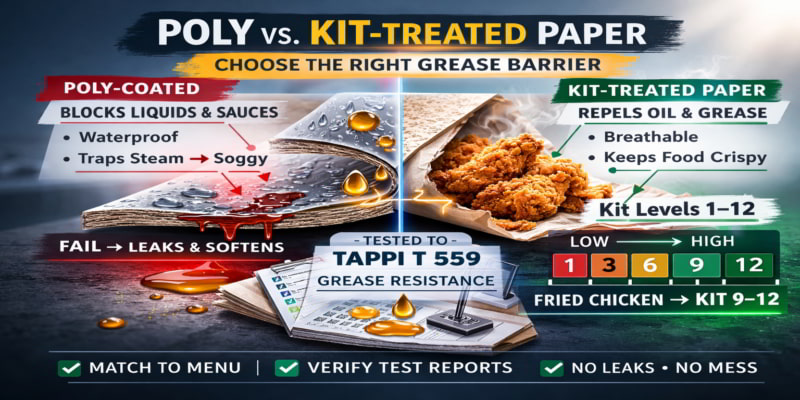
Fixing soggy delivery bags starts with matching the right grease barrier to your food—poly for wet sauces, kit-treated for fried foods.
- Poly Blocks Liquid, Kit Blocks Oil: Poly-coated paper creates a plastic-like wall for sauces and gravies, while kit-treated paper chemically repels oil from fried foods.
- Kit Levels Work Like Sunscreen Numbers: Higher Kit numbers (1–12) handle greasier foods—Kit 3 for pastries, Kit 9 for fried chicken.
- Soggy Food Often Means Trapped Steam: Breathable paper keeps food crisp; poly traps moisture and can cause sogginess even when grease stays out.
- Thicker Paper Won’t Fix Grease Problems: GSM (paper weight) adds stiffness, not grease protection—an untreated heavy sheet still soaks through.
- Request Test Data That Matches Your Menu: Ask suppliers for Kit level certifications (TAPPI T 559), compliance documents, and trial guidelines for your actual hold times.
Choose barriers based on what makes food messy—not what makes paper thick.
Food service operators and QSR procurement managers troubleshooting delivery packaging failures will find actionable selection criteria here, preparing them for the detailed supplier verification steps that follow.
~ ~ ~ ~ ~ ~ ~ ~ ~ ~ ~ ~ ~ ~ ~ ~ ~ ~
The bag falls apart.
It’s 12:15 PM during the lunch rush, and a customer hands back a delivery bag that has disintegrated from grease, leaving a stain on the counter. Thicker paper hasn’t fixed it. Switching suppliers hasn’t fixed it. The problem persists because the diagnosis is wrong.
Poly vs. Kit: The 60-Second Selection
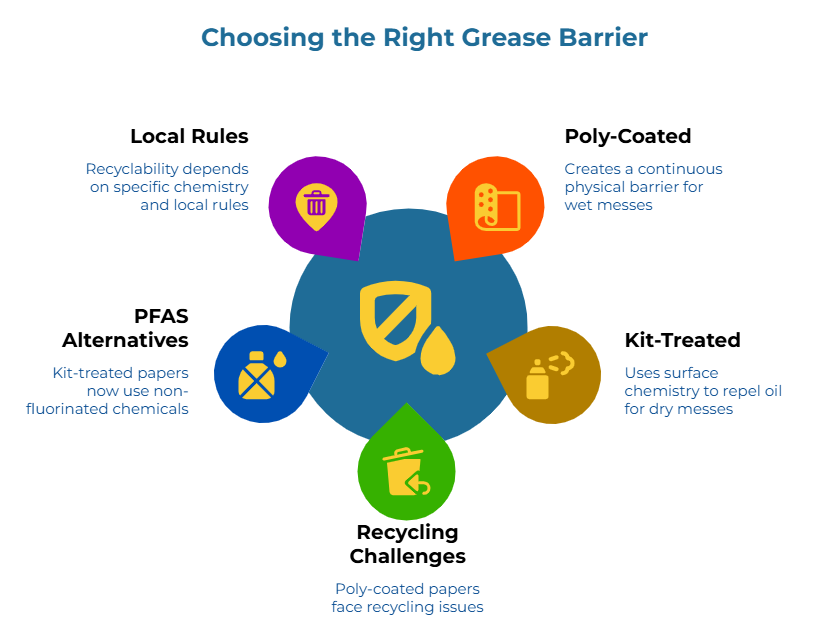
Choose poly-coated when the mess is wet—sauces, curries, gravies. Poly creates a continuous physical barrier that blocks liquids.
Choose kit-treated (greaseproof) when the mess is dry—fried chicken, burgers, fries. Kit treatment uses surface chemistry to repel oil and prevent wicking.
Poly-coated papers face recycling challenges in many local systems. Historically, kit-treated papers relied on PFAS (fluorinated chemicals), but due to extensive global bans (including the EU and numerous U.S. states as of 2026), the industry has shifted to non-fluorinated (non-PFAS) alternatives. Modern non-PFAS kit-treated papers typically remain recyclable, though this strictly depends on the specific barrier chemistry and your local collection rules.
What Each Barrier Is (in Plain English)
Poly-coated paper has a thin plastic layer that creates a physical wall liquids cannot penetrate. The coating acts as a non-porous laminate.
Kit-treated (greaseproof) paper uses chemical treatment that makes fibers repel oil molecules.
Kit Levels (1–12) measure this resistance. Kit Levels are like SPF for paper—you need a higher number for intense exposure. Kit 3 handles pastries; Kit 9 resists hot fryer oil.. Grease resistance is quantified via the TAPPI T 559 standard.
Both can meet food-contact compliance under FDA 21 CFR 176.170 or EU Regulation 1935/2004. Think of certification as the “Passport” for your packaging—without it, the material fails to meet legal safety standards for transport and service.
Performance Comparison: Poly vs. Kit
| Factor | Poly-Coated | Kit-Treated |
| Best for | Wet grease (sauces, curries) | Dry grease (fried foods, burgers) |
| Mechanism | Physical barrier blocks liquids | Chemical treatment repels oil |
| Failure mode | Leaks at seams/folds; trapped steam | Soak-through on extended holds |
| Steam behavior | Traps moisture—can cause sogginess | Breathable—keeps food crisp |
| Recyclability | Varies by local system | Typically recyclable |
Performance depends on coat weight, treatment level, and use conditions. Recyclability depends on local collection systems.
Wet vs. Dry Grease: Performance Variables
Wet grease pools and leaks as liquid. Curries, sauced pasta, gravies. Failure looks like a leak.
Dry grease migrates slowly. Fried chicken, fries, burgers. Failure looks like a spreading stain.
This explains why wax paper fails on hot, greasy food—wax softens above 150°F (65°C), losing barrier properties exactly when needed.
The exception triggers: delivery times exceeding 20 minutes or high-oil foods. Under these conditions, generic paper wicks grease via capillary action.
Here’s a surprise many operators miss: soggy delivery is often trapped steam, not weak grease protection. Breathability can matter as much as grease holdout for hot foods. For a deeper steam-focused explanation, see the guide on poly-coated vs uncoated for hot and steamy foods.
Performance and Sustainability Trade-offs
The top-right quadrant (High Performance + High Sustainability) is the target—kit-treated paper handles dry grease while remaining recyclable.
The top-left quadrant may be necessary for wet, saucy items where leakage risk outweighs recyclability concerns.
Consult your local municipal waste authority or specific Materials Recovery Facility (MRF) guidelines to confirm local diversion rates, as national trade bodies generally track macro-level recovery statistics rather than county-by-county capabilities.
When neither is enough: For very wet items with 30+ minute holds, request lab test data matching your actual use conditions.
What to Ask Your Supplier
It’s 9:00 AM on inspection day, and the manager is frantically searching for a ‘Letter of Guarantee‘ that doesn’t exist. Don’t let that be you.
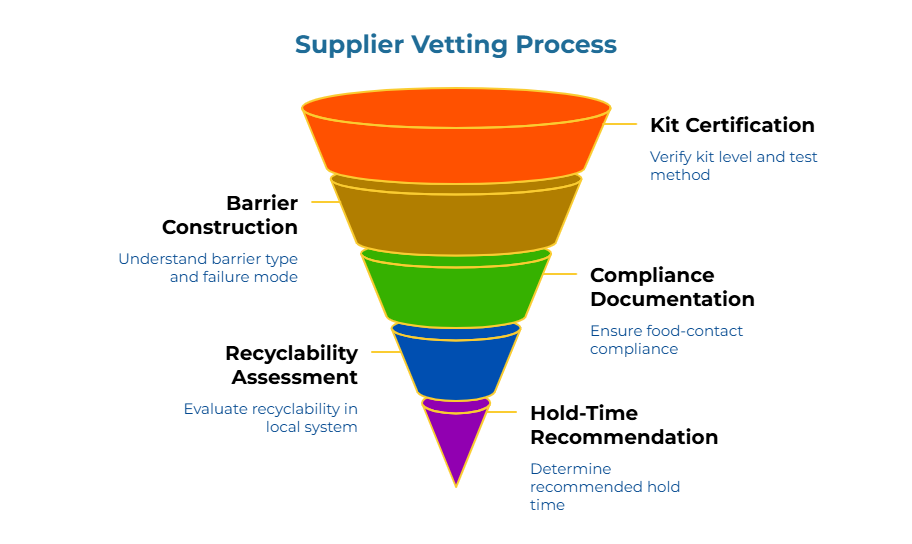
Suppliers should be vetted using the following criteria:
- “What Kit level do you certify, and what test method is used (e.g., TAPPI T 559)?”
- “What barrier construction is this, and what failure mode does it prevent?”
- “Provide food-contact compliance documentation for our market and use conditions.”
- “How does this affect recyclability in our local system?”
- “What hold-time window do you recommend before staining becomes likely?”
Suppliers must provide a Continuing Letter of Guarantee or a Declaration of Conformity tied to the specific product line. Having this continuous certification ready on file when an inspector arrives eliminates the scramble. To source verified food packaging paper suppliers with documented compliance credentials, buyers can explore the PaperIndex supplier directory.
Specifying on an RFQ
Effective RFQ specifications require measurable parameters:
- Use case line: Describe your menu items using a menu-match matrix approach, noting whether grease is wet or dry, hot/steamy conditions, and delivery hold time.
- Barrier line: Specify poly-coated construction or kit-treated with minimum Kit level per TAPPI T 559.
- Evidence line: Request compliance documents and, when needed, lab evidence aligned to use conditions.
- Trial line: Run a kitchen trial with pass/fail criteria: “No visible grease stain after 20 minutes at service temperature.”
GSM doesn’t equal grease resistance — a lighter, treated paper outperforms heavy, untreated paper.
Critical Oversight: Procurement Errors
Procuring based on ‘food safe’ claims rather than verified evidence. A stamp is a claim, not proof. Procurement must prioritize named specifications and start buying on named specifications and documents. For more on this distinction, see why ‘food safe’ is a meaningless label for food packaging paper.
Assuming higher GSM stops grease. Staff compensate by double-wrapping, doubling costs unnecessarily. Higher GSM improves stiffness and handling, but GSM alone does not equal grease resistance.
Using Wax-coated substrates fail in hot delivery. The barrier degrades as the wax reaches its melting point, allowing grease migration
Optimizing for “recyclable” without checking performance. Match barrier to menu first. Recoverability varies locally; performance must still be proven under menu conditions.
Operational Frequently Asked Questions
Is poly better than wax paper?
For hot, greasy items, poly provides more reliable performance since wax softens at high temperatures.
Does higher Kit level always beat poly?
Not for wet grease. Kit-treated paper cannot block free liquid like poly can. Performance depends on Kit level and hold time.
Can poly-coated paper be recycled?
Depends on your local system. Check with your waste hauler.
What proves food-contact compliance?
A Declaration of Compliance referencing FDA 21 CFR 176.170 or EU 1935/2004, batch-linked and available on request.
Disclaimer:
This article provides general information about choosing a grease barrier for delivery packaging paper for educational purposes. Individual circumstances vary based on menu type, heat levels, hold time, and local compliance requirements. For personalized guidance, consult a qualified professional.
Our Editorial Process:
Our expert team uses AI tools to help organize and structure our initial drafts. Every piece is then extensively rewritten, fact-checked, and enriched with first-hand insights and experiences by expert humans on our Insights Team to ensure accuracy and clarity.
About the PaperIndex Insights Team:
The PaperIndex Insights Team is our dedicated engine for synthesizing complex topics into clear, helpful guides. While our content is thoroughly reviewed for clarity and accuracy, it is for informational purposes and should not replace professional advice.