
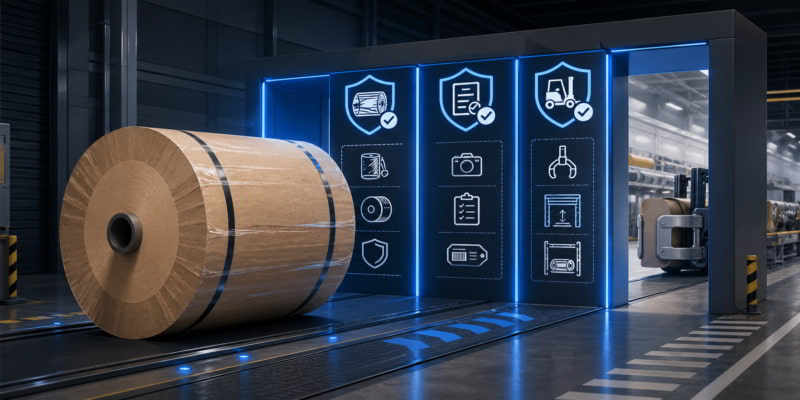
📌 Key Takeaways
Checking your supplier’s paper specs means nothing if your warehouse can’t safely receive, move, and store what you ordered.
- Spec the Protection, Not Just the Paper: A roll can meet every quality standard and still cause losses if packaging, loading, and handling details weren’t agreed on before the order shipped.
- Your Warehouse Gets a Vote: Clamp capacity, dock layout, aisle clearance, and storage conditions must match the roll’s weight and size — confirm these internally before approving any new supplier or roll spec.
- Build the Evidence Chain Early: Agree on dispatch photos, receiving inspection steps, and claim deadlines before the first delivery, because damage disputes without proof almost always land on the buyer.
- Don’t Treat Packaging as the Supplier’s Problem: You bear the cost when wrapping, moisture protection, or labeling fails — so make packaging specs part of your RFQ and purchase order, not an afterthought.
- Claims Don’t Recover Real Losses: Insurance payouts miss lost production time, rush sourcing, and customer delays — prevention and documentation cost far less than recovery.
Specify the roll, the protection, and every handoff — that’s what keeps paper moving from dock to converting line.
Kraft paper parent roll buyers and procurement teams responsible for converter supply chains will gain a ready-made checklist for closing logistics gaps, preparing them for the detailed overview that follows.
~ ~ ~ ~ ~ ~ ~ ~ ~ ~ ~ ~ ~ ~ ~ ~ ~ ~
Unchecked logistics risks can break your supply chain. A 1,500 mm diameter brown kraft paper jumbo roll sits at the dock edge, too heavy for the equipment, too wide for the staging area. The spec sheet looked clean. The purchase order was correct. And yet here you are — watching a forklift operator improvise because nobody asked whether your warehouse could actually handle what procurement just ordered.
The GSM is right. The burst strength is right. So why is the roll just sitting there?
You’ve done the hard work of evaluating suppliers on grade, price, lead time, and payment terms. But if you haven’t asked how those rolls will be wrapped, loaded, delivered, and received, you’ve evaluated only half the supply chain. The other half — the variables that transform a compliant product into a liability, unresolvable claims, and converting line downtime — lives in packaging, delivery readiness, and warehouse alignment. That’s where this gap analysis starts.
With a practical set of handling-readiness questions built into your existing procurement workflow, you can filter out avoidable damage before the first shipment arrives, not after the third quality incident.
When the Spec Is Right but the Roll Still Fails
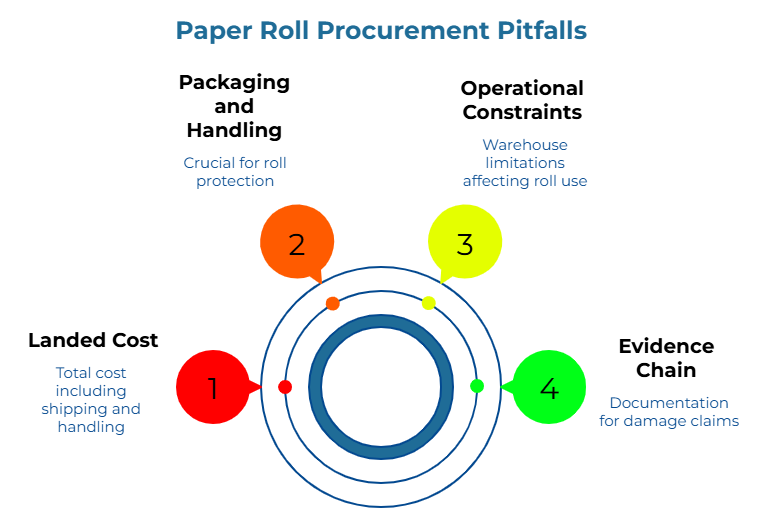
A common pitfall: buyers compare brown paper parent roll suppliers mainly on GSM, grade, and price per metric ton while treating packaging and handling as the supplier’s internal business. Packaging and handling aren’t the supplier’s internal business. They’re yours — because you bear the consequences when they fail.
Roll protection is part of landed performance. A lower-priced roll becomes more expensive the moment it triggers receiving delays, claim disputes, rework, trimming loss, emergency sourcing, or production downtime. PaperIndex’s guide on kraft paper landed cost and to-door comparability provides the framework for judging price against freight, handling, and operational risk.
Consider a procurement manager who switches to a new supplier offering larger-diameter rolls at a better per-ton price. The rolls meet every line item on the purchase order. But the warehouse’s roll clamps can’t safely grip the larger diameter, and the staging area floor wasn’t rated for that concentrated load. The technically correct roll becomes an operational liability. Not because the supplier failed, but because procurement never checked handling constraints before placing the order.
Here’s a second scenario, which illustrates the critical nature of the evidence chain. A shipment arrives with torn outer wrapping. The receiving team accepts the delivery, signs the bill of lading, moves the rolls to storage. Eleven days later, production reports edge damage on three rolls. The supplier asks for receiving photos. There are none. Because you signed a clear delivery receipt, the legal burden of proof immediately shifts to you. While carriers typically allow a brief window for concealed damage claims, proving the damage occurred in transit after acceptance is notoriously difficult. In most cases, you absorb the loss.
Technical Association of the Pulp and Paper Industry (TAPPI) standards validate these logistics risks: roll wrapping and handling materials serve a defined protective function — shielding kraft paper parent rolls from physical damage, moisture intrusion, and foreign debris during transit and storage. When you don’t verify that your supplier’s protective approach matches your actual supply chain conditions, the risk transfers silently to your operation.
That silent transfer is exactly what handling-readiness questions are designed to prevent.
Packaging Questions to Ask Your Supplier
Start here. Before evaluating delivery logistics or warehouse compatibility, confirm that the roll’s first line of defense — its packaging — matches the hazards it will face. Don’t ask “Do you provide good packing?” That invites a vague answer. Ask specific questions that expose how the supplier thinks about protection, traceability, and claims.
What wrapping method and materials protect each roll?
Ask for the specific wrapping specification: material type (kraft wrapper sheets, polyethylene film, stretch wrap, or a combination), number of layers, and whether end caps or plugs protect the roll faces and cores. A roll shipped via short-haul domestic trucking faces different exposure than one loaded into a sea freight container crossing tropical humidity zones for thirty-seven days. A supplier who can’t articulate their wrapping standard hasn’t standardized it — and our guide on the five myths about ‘seaworthy packing’ that ruin paper cargo unpacks why vague packing claims fail in practice. A robust response specifies outer wrapping materials, roll-end protection, edge guards, and core plugs, ideally supported by technical drawings.
Are cores plugged or reinforced?
Core damage — crushing, ovality, moisture ingress through open ends — creates unwind problems you won’t detect until the roll is mounted on the converting line. End caps and core plugs are inexpensive protections. Their absence is a signal worth noting during supplier pre-qualification.
How does the supplier address moisture protection for your specific route — and does packaging vary by route, season, or transport mode?
Don’t accept a generic “moisture-resistant” claim. A roll wrapped in polyethylene may resist direct water contact but still suffer condensation damage inside a container with significant temperature swings — a phenomenon the container rain defense framework for paper shipments addresses with route risk diagnosis and desiccant specifications. The question is whether the packaging accounts for your actual transit conditions — and whether the supplier adjusts protection for long-distance, humid, export, or multi-modal movements. A supplier who ships identical wrapping for a domestic 200 km truck run and a 37-day sea freight container through the tropics hasn’t thought about this carefully enough. The storage and conditioning guide for kraft reels covers conditioning benchmarks worth reviewing alongside this question.
What types of damage is the wrapping designed to prevent?
“Standard packing” means different things across suppliers and routes. Pin the supplier down: scuffing, dirt and debris intrusion, handling abrasion, edge impact, moisture exposure. The answer should separate cosmetic packaging damage from damage that signals potential product risk.
What packaging damage should trigger inspection or quarantine at receiving?
Receiving teams should not have to guess under dock-time pressure. Ask the supplier to define acceptance, quarantine, and rejection criteria — and the claim timeline and evidence required for each. A supplier who provides written criteria gives your warehouse team confidence. One who deflects with “we’ve never had a problem” leaves your receiving clerk making commercial decisions without a framework.
Does the supplier provide dispatch photos?
Dispatch photos document roll condition at loading — wrapping integrity, labeling visibility, loading position. Without them, any damage claim becomes assertion against assertion. This isn’t an unusual request. It’s a basic element of a defensible evidence chain, and the article on verifiable evidence replacing supplier promises explains why documentation at each point of custody transfer is critical.
What labeling and handling instructions appear on the outer wrap?
Identification labeling should include, at minimum: roll number or lot ID, GSM, width, diameter, gross weight, batch reference, production date, and supplier or PO reference. Missing labels create receiving delays and increase the risk of misidentified rolls, incorrect storage, or wrong converting jobs. Beyond identification, the outer wrap should also carry visible handling instructions — clamp guidance, lifting restrictions, storage orientation, and moisture warnings where applicable. Your warehouse team shouldn’t have to phone the supplier to find out how to handle a roll that’s already on the dock.
For RFQ structure, PaperIndex’s kraft paper RFQ guide for converters can help buyers turn these questions into quote-time requirements — so packaging expectations are documented before the purchase order is issued, not negotiated after the first incident.
Delivery and Loading Questions to Settle Before the First Shipment
The space between your supplier’s warehouse and your dock is where problems originate and documentation gaps evolve into liability disputes. Settle these questions during supplier onboarding, not after the first damaged roll arrives.
- How are rolls oriented and secured during loading?
Rolls loaded on their eye (horizontally) behave differently under braking forces than rolls loaded on their end (vertically). Ask the supplier to confirm their standard loading orientation and whether they use choking, bracing, or dunnage to prevent movement. The loading method should match the unloading equipment available at your facility.
- What is the carrier’s handling protocol for kraft paper parent rolls?
Whether you nominate a forwarder or use supplier-managed freight, the carrier should have explicit instructions for paper roll handling — not just general cargo practices. OSHA materials handling guidance emphasizes that proper work practices, equipment suitability, and training are essential for safe material movement. A carrier unfamiliar with paper rolls introduces avoidable risk.
- Will the supplier provide advance shipment notices?
Your warehouse team shouldn’t learn about roll dimensions and weights when the truck backs into the dock. Advance notices — specifying individual roll weights, diameters, widths, core sizes, and total shipment weight — let the receiving team stage the right clamp attachment and clear floor space. The shipment file should also include the purchase order reference, roll list with individual identification, dispatch date, vehicle or container details, packaging method, loading photos where available, handling notes, delivery exception process, and claim-contact details. For export shipments, supporting documentation should align with commercial and transport records; PaperIndex’s kraft paper export documentation checklist covers that wider documentation discipline.
- What’s the agreed evidence chain for damage claims?
Before the first delivery, agree on a protocol: who photographs what, at which handoff points, within what time window, and how claims get submitted. A supplier who resists documenting this process is transferring risk, not reducing it. The logistics transparency scorecard provides a structured method for evaluating these practices.
Remember that torn-wrapping scenario from earlier? Without dispatch photos on one side and receiving photos on the other, that dispute has no resolution path. The supplier claims damage happened after delivery. You claim it arrived damaged. Neither side can prove anything.
The evidence chain prevents exactly that standoff. A practical way to mitigate this is through a formalized Responsibility Assignment Matrix (RAM) that clarifies ownership at each stage:
| Activity | Supplier | Carrier | Buyer | Warehouse | Quality |
| Packaging specification | Responsible | — | Approves | Consulted | Consulted |
| Loading and restraint method | Responsible / Consulted | Responsible where applicable | Informed | Consulted | — |
| Pre-dispatch photos | Responsible if agreed | Optional | Requests | — | — |
| Receiving inspection | — | Present if applicable | Informed | Responsible | Consulted |
| Damage documentation | Consulted | Consulted | Accountable | Responsible | Responsible |
| Claim submission | Consulted | Consulted | Responsible | Provides evidence | Provides evidence |
Treat this as a working template, not a universal legal rule. Claim liability, transfer of risk, and delivery responsibility depend on contract terms, Incoterms, carrier terms, supplier policy, and local law. The point is that when roles are defined before the first delivery, disputes become collaborative investigations rather than adversarial standoffs.
Warehouse Readiness Questions to Ask Internally
Supplier evaluation is only half the equation. If your own warehouse isn’t prepared to receive, inspect, and store kraft paper parent rolls correctly, even perfectly packaged rolls can be damaged before they reach the converting line.
Can your roll clamps handle the dimensions and weights you’re ordering?
Check the clamp’s rated capacity for diameter range, weight, and surface pressure. Run a physical test: mount the clamp attachment, set the pressure to the supplier’s specified range, and grip a test roll. A 1,500 mm diameter roll at 2,200 kg requires a fundamentally different clamping force than a 1,000 mm roll at 900 kg. Unless your forklift fleet is equipped with modern Automatic Pressure Control (APC) systems that dynamically adjust grip based on roll dimensions, your operators must manually recalibrate the equipment. If you’re switching suppliers or changing roll specifications, verifying your equipment’s specific capabilities isn’t optional.
Is your dock layout compatible with the delivery method?
Walk the path from the dock door to the storage area. Check overhead clearance, turning radii for the forklift, and whether side-loading access is required. HSE warehousing guidance reinforces that storage and handling assessments should account for equipment suitability, layout, and safe access. Rolls moved by improvised methods are rolls at elevated damage risk.
Can production actually use the roll size you’re ordering?
A purchasing gain can disappear on the converting line. Before confirming roll dimensions with a new supplier, verify that the roll size works without extra trimming, rewinding, or production downtime. A larger parent roll may lower your per-ton cost but create waste if the converting line can’t accommodate the width or diameter efficiently.
Do you have a documented receiving inspection process?
Receiving inspection should cover four checks: a visual scan of wrapping integrity, a label-to-PO comparison, a weight verification against the advance shipment notice, and photographic documentation of any anomaly — torn wrapping, staining, visible deformation, wet packaging. Photos taken at receiving are your first line of defense in any subsequent claim. PaperIndex’s guide on verifying kraft paper quality upon arrival is a useful companion to this inspection process.
Now imagine this scenario. A roll arrives with stained, wet outer packaging after a transit that crosses two climate zones. Your receiving clerk isn’t sure whether to reject it outright, quarantine it for testing, or release it to storage. Without a pre-defined protocol, the decision falls to whoever happens to be at the dock — and their judgment may not align with your quality team’s criteria.
A clear quarantine procedure specifies: what conditions trigger rejection, what triggers quarantine, who has authority to decide, and what documentation each step requires. Build this protocol before your first delivery, not after the first dispute.
Are storage micro-climates aligned with hygroscopic requirements?
Kraft paper absorbs and releases moisture in response to ambient conditions. Rolls stored near exterior walls or adjacent to dock doors that open frequently will condition differently than expected, affecting unwind performance downstream. Monitor temperature and humidity in your storage zones — or at minimum, flag conditions outside the 23°C / 50% RH range referenced in ISO 187 conditioning standards. The moisture windows guide for kraft paper converting explains why staying within range matters more than hitting an absolute value. Does the receiving team have a roll-readiness file before the truck arrives?
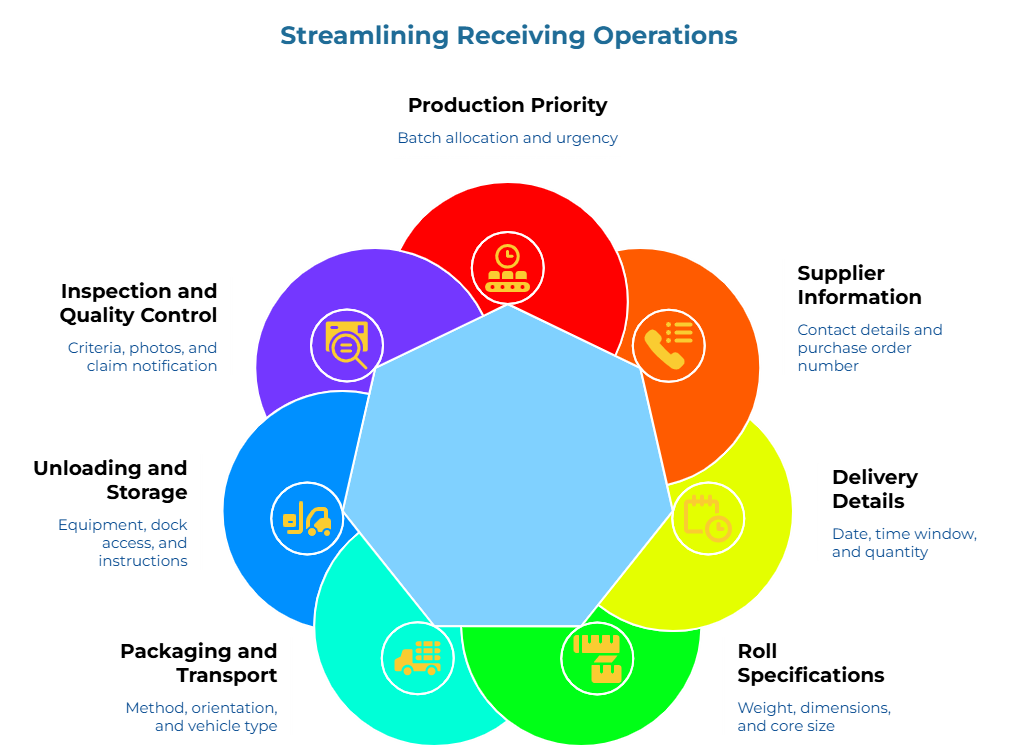
The warehouse team needs information, not a surprise. Before the first delivery from any supplier, share a roll-readiness file that includes: supplier name and contact, purchase order number, delivery date and window, number of rolls, individual roll weights, widths, diameters, and core sizes, packaging method, roll orientation during transport, vehicle or container type, unloading method, equipment required, storage instructions, inspection criteria, required photos, claim notification deadline, and production priority or batch allocation.
The workflow from that point should follow a clear sequence: buyer confirms supplier packaging and delivery details, buyer shares roll data with warehouse, quality, and production, warehouse confirms unloading equipment, dock access, and staging space, supplier sends dispatch documents and photos where available, receiving inspects visible packaging condition before unloading where safe and practical, warehouse photographs visible damage before moving the roll, questionable rolls are quarantined under agreed criteria, and quality and production confirm whether the roll can be released.
This isn’t paperwork for its own sake. It prevents the dock team from making commercial decisions with incomplete information.
Tying Packaging, Delivery, and Warehouse Into One Evaluation
These questions span three domains — supplier packaging, delivery logistics, and internal warehouse readiness — but they serve one purpose: ensuring the roll you ordered reaches the converting line in the condition you specified and paid for.
Procurement doesn’t end when the purchase order is issued. It extends through every handoff — from the supplier’s wrapping station to the truck, from the truck to your dock, from the dock to storage, and from storage to the unwind stand. The ISTA framework for evaluating packaging against distribution hazards reinforces this perspective: protection must be validated against your actual supply chain, not in isolation. ASTM International standards for paper and packaging, and ISO 2233 for conditioning of complete transport packages, give you and your supplier a shared technical language for defining acceptance criteria without ambiguity.
When you treat these questions as part of supplier pre-qualification and onboarding — rather than reactions to the first quality incident — you gain two practical advantages. You reduce the probability of damage and associated costs: rejected material, expedited replacements, production downtime. And you create an evidence chain that makes legitimate claims resolvable instead of adversarial. If you also build CAPA workflows into the supplier relationship from the start, recurring issues get corrected systematically instead of argued about indefinitely.
Common Buyer Objections That Create Risk
Even when the logic of handling-readiness alignment is clear, procurement teams encounter internal resistance. Here are four objections worth anticipating — because each one, left unchallenged, reopens the gaps these questions are designed to close.
- “Packaging is the supplier’s responsibility.” Technically, yes. But supplier responsibility doesn’t help you if the supplier’s method doesn’t fit the route, dock layout, warehouse equipment, or inspection process. Responsibility without specification gives you someone to blame, not a roll you can use.
- “Our warehouse can handle standard rolls.” Standard varies by supplier, roll size, market, loading method, and order configuration. A supplier’s “standard” 1,500 mm roll at 2,200 kg may be well outside your warehouse’s previous operating range. Verify weight, diameter, unloading method, and handling instructions before the truck arrives — not while the driver is waiting at the gate.
- “We only care whether the material meets specification.” A roll can meet every paper specification and still be commercially useless if it arrives damaged, cannot be handled safely, or delays production release. Understanding how quality specs shape your real cost helps bridge the gap between paper specification compliance and operational usability. Material specification defines the roll. Handling-readiness defines whether that roll reaches the converting line intact.
- “We can deal with damage through claims.” Claims do not recover lost production time, urgent sourcing effort, warehouse disruption, or customer delays. As the article on why insurance isn’t a strategy for paper importers demonstrates, claim payouts miss the majority of real costs. And claims without an agreed evidence chain — dispatch photos, receiving documentation, quarantine records — are assertions without proof. Prevention costs less than recovery, and evidence costs less than argument.
Copy-Ready RFQ and Purchase Order Templates
The questions throughout this article translate directly into procurement language. Use these clauses as starting templates, and adapt them to your supplier documentation, applicable standards, contract terms, and internal quality requirements.
RFQ language:
“Please provide your standard packaging specification for kraft paper parent rolls of the quoted size and weight.”
“Confirm the recommended unloading method and any equipment required at the receiving warehouse.”
“State how roll ends, edges, cores, and outer surfaces are protected during handling and transit.”
“Provide roll-level identification details included on packaging and delivery documents.”
“Define the evidence required for reporting visible packaging or roll damage at delivery.”
“Confirm whether packaging differs by transport route, distance, season, humidity exposure, export shipment, or multi-modal movement.”
Purchase-order notes:
“Supplier to provide roll dimensions, roll weights, packaging specification, and unloading requirements before dispatch.”
“Visible packaging damage at receiving must be photographed before movement where safe and practical.”
“Supplier and buyer agree to claim notification timelines before first shipment.”
These clauses formalize what should already be a conversation during supplier onboarding. Including them in the RFQ and PO means packaging and delivery expectations are contractual, not assumed.
From Blame Loops to Handling-Readiness Alignment
Remember the opening scenario — the roll clamp whining, the forklift operator improvising, the procurement team wondering how a correct spec led to a failed delivery? That scenario is a buying-process failure, not a warehouse problem or a supplier defect.
The fix doesn’t require overhauling your procurement workflows. It requires adding specific questions to existing touchpoints. At the RFQ stage, include packaging specification and dispatch documentation as required response fields. During onboarding, confirm the damage-evidence protocol and advance shipment notice format. Internally, have your warehouse team review clamp capacity, dock compatibility, and receiving inspection procedures against the new supplier’s roll specifications — before the first delivery is scheduled.
While kraft paper jumbo roll sellers on PaperIndex can be evaluated against these handling-readiness criteria during the sourcing process, buyers can also submit an RFQ that includes packaging and delivery requirements alongside material specifications — so quotes reflect the full scope of what reliable supply demands.
Spec the roll. Spec the protection. Spec the handoff. That’s handling-readiness alignment.
Frequently Asked Questions
What should kraft paper parent roll buyers ask suppliers before placing an order?
Ask about roll wrapping materials and methods, edge and core protection, moisture-related protection for the specific route, loading method, unloading requirements, roll identification labeling, handling instructions, delivery documentation, inspection and quarantine criteria, and the claim process and evidence requirements.
Why should buyers involve warehouse teams before ordering?
Warehouse teams can confirm whether roll weight, diameter, width, vehicle type, and unloading method are compatible with clamp capacity, dock layout, aisle clearance, staging space, and storage conditions. A roll that procurement approves on specification can still fail operationally if the warehouse can’t handle it safely.
What information should the warehouse receive before the first delivery?
The warehouse should receive a roll-readiness file that includes roll dimensions, weights, core sizes, number of rolls, delivery date and window, vehicle type, unloading method, packaging details, handling instructions, storage orientation, inspection criteria, photo requirements, and claim-reporting steps.
What are warning signs of a weak supplier packaging process?
Warning signs include vague packaging descriptions such as “standard export packing,” no written packaging specification, no roll-level identification, no handling instructions on the outer wrap, no dispatch photos when requested, no defined quarantine criteria, and no clear claim process or timeline.
How can buyers reduce kraft paper roll damage disputes?
Agree on packaging expectations, loading documentation, a responsibility matrix, receiving inspection steps, photo evidence protocols, quarantine criteria, claim timelines, and evidence ownership before the first shipment — not after the first incident.
Should every roll with damaged outer wrapping be rejected?
Not necessarily. Some packaging damage is cosmetic, while other damage may indicate product risk. Follow supplier-agreed acceptance, quarantine, and rejection criteria, and involve your quality team before making a disposition decision.
What should be documented when a roll arrives damaged?
Document delivery time, roll identification, packaging condition, visible damage with close-up photos before the roll is moved, delivery-note exceptions, unloading observations, quarantine decisions, and quality findings. This evidence chain supports resolution whether the claim is directed at the supplier or carrier.
How does roll size affect warehouse handling?
Roll size directly affects equipment capacity, clamp suitability, dock movement clearance, aisle turning radii, storage method, staging space requirements, and production line compatibility. Confirm these limits against the specific roll dimensions you’re ordering before approving the purchase.
Disclaimer:
This article is for educational purposes only.
Our Editorial Process:
Our expert team uses AI tools to help organize and structure our initial drafts. Every piece is then extensively rewritten, fact-checked, and enriched with first-hand insights and experiences by expert humans on our Insights Team to ensure accuracy and clarity.
About the PaperIndex Insights Team:
The PaperIndex Insights Team is our dedicated engine for synthesizing complex topics into clear, helpful guides. While our content is thoroughly reviewed for clarity and accuracy, it is for informational purposes and should not replace professional advice.