

📌 Key Takeaways
A good paper specification ties every important property to a target, a test method, an acceptance rule, and a named owner — not just a grade name and weight.
- Go Beyond Grammage: Two sheets at the same g/m² can differ in thickness, opacity, and surface feel, so each property needs its own target and test method.
- Let the Job Drive the Fields: Add opacity, smoothness, or curl controls only when the specific print job creates a reason — not because a blank template has a row for them.
- Flag Gaps Instead of Guessing: When the right tolerance is unknown, mark the field “requires review” with a named owner rather than copying a number from an unrelated job.
- Own the Spec Before Using Supplier Data: Define what the job needs first, then check supplier documents against those requirements — not the other way around.
- Trigger Reviews When Sources Change: A substitute paper with the same grade name still deserves a structured check of every controlled field before production assumes it will run the same way.
Your spec protects the job only when every field has an owner.
Production teams, procurement managers, and press supervisors building or tightening their paper specifications will find a ready-to-use control framework in the guide below.
~ ~ ~ ~ ~ ~ ~ ~ ~ ~ ~ ~ ~ ~ ~ ~ ~ ~
A purchase note reading “80 g/m² white offset, 640 × 900 mm” identifies the general stock, but production may still need answers about thickness, grain direction, moisture, opacity, surface characteristics, tolerances, and what exactly was approved. Much of that knowledge lives informally in previous jobs, operator experience, supplier emails, and purchasing habits.
A practical offset printing paper specification connects each job requirement to a paper field, measurement basis, acceptance rule, evidence source, named owner, and change trigger. The result is a buyer-owned record — one where the team defines what the job requires before supplier information is used to evaluate the offered material — that production, procurement, and suppliers can interpret consistently. Experienced operators may already hold much of this knowledge tacitly; the purpose is to capture and transfer it, not replace judgment with paperwork.
Start With The Finished Job Before You Write The Paper Fields

The specification exists to serve a particular press job, so the job should define which paper characteristics matter. Before listing any paper property, identify the production conditions that make those properties relevant.
Paper-relevant job conditions typically include the sheet format and dimensions, whether the job prints one or both sides, image and type demands (solid coverage, fine detail, process color, or similar), the finishing route (folding, binding, die-cutting, or lamination), press or feeder constraints the team already recognizes, and storage or conditioning context. If external finishing is involved, include those material requirements before finalizing the specification.
Storage and conditioning context belongs with the evidence when it affects interpretation. Record what condition a sample, test result, or previous run actually represents rather than assuming evaluation conditions and production conditions are equivalent.
Previous production on a similar job provides useful starting evidence, but prior success does not automatically confirm suitability for a changed job. A grade that ran well on a previous format or finishing route is evidence, not proof of fit for different conditions. For a deeper understanding of how these properties affect press performance, refer to our article on which paper specifications can matter on press, and consult dedicated resources on paper science and operational impacts.
Record Every Important Property As More Than A Name
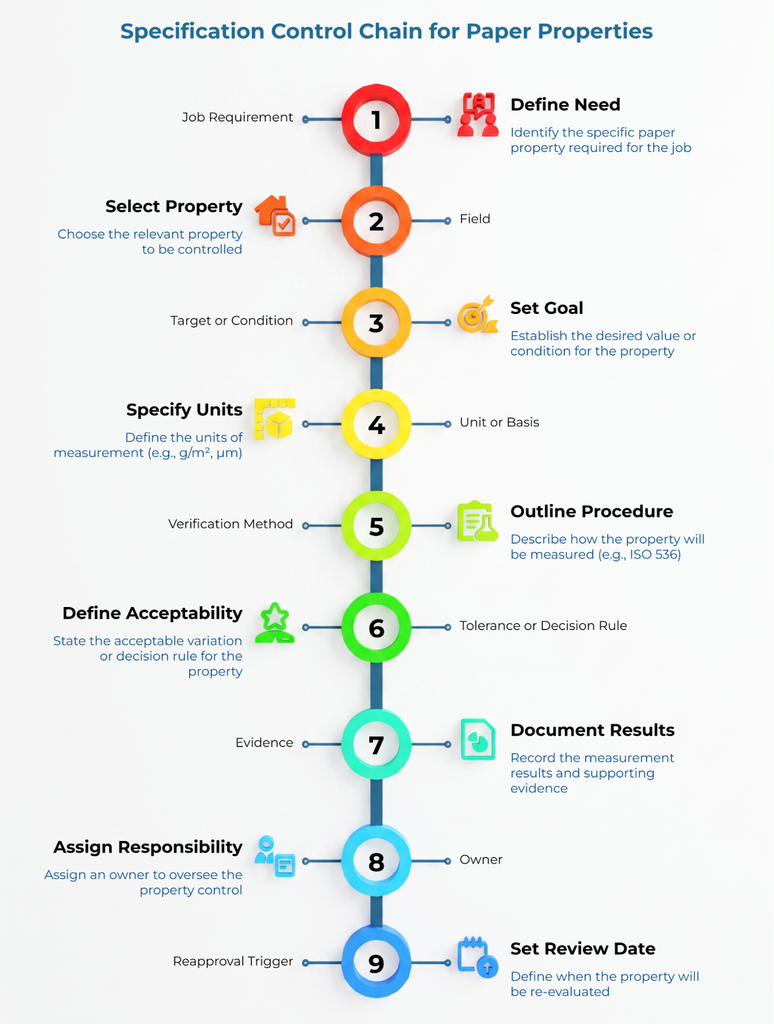
Listing “grammage” or “moisture” identifies which property matters. It does not tell anyone how the property will be measured, what value is acceptable, or who decides whether the result passes.
A few terms are worth defining before the record takes shape. Grammage is paper mass per unit area, expressed in g/m². Caliper is paper thickness, normally recorded in µm for this type of specification — and matching grammage does not establish matching thickness, because two sheets at the same mass per unit area can differ in caliper. A measurement or test method states how a result is established. A tolerance states how much variation is acceptable around a target or condition. Grain direction records the fiber orientation relative to the sheet dimensions. A conditional field is one added because the specific job makes that property relevant, not because a generic template happens to contain it.
A specification field becomes usable when it follows a complete control chain: job requirement → field → target or condition → unit or basis → verification method → tolerance or decision rule → evidence → owner → reapproval trigger.
Consider grammage. Writing “80 g/m²” is more precise than “80 gsm paper,” but the record is still incomplete if the measurement method, acceptable variation, and evidence source are undefined. ISO 536 specifies a method for determining grammage. Recording the target as 80 g/m² per a defined method, with a stated tolerance and a named evidence source, transforms the field from a label into a controlled requirement. ISO 534 covers thickness measurement separately, so a grammage match on its own does not resolve the caliper. While ISO standards are widely referenced internationally, North American printers may substitute equivalent TAPPI (Technical Association of the Pulp and Paper Industry) test methods, provided the method is documented and applied consistently.
The following matrix illustrates the structure. Not every job will use every row, but the control logic applies to any field the team considers important.
| Job Requirement | Field | Target | Unit | Method | Tolerance / Rule | Evidence | Owner | Reapproval Trigger |
| Identify the material | Grade / material ID | Approved identity | — | Documented identity | Match approved identity | Supplier document; approved record | Procurement | Changed grade or relevant source |
| Reliable feed and register | Grammage | 80 | g/m² | ISO 536 | ±X g/m² or “requires review” | Supplier report; sample | Production | Changed source, grade, or job |
| Two-sided job; show-through concern | Opacity | Value or minimum | % (paper-backing) | ISO 2471 | Minimum or “requires review” | Supplier data; sample | Production | Changed stock or coverage |
| Match previous approved run | Caliper | Value | µm | ISO 534 | ±X µm or “requires review” | Supplier report; sample | Production | Changed source or spec |
| Fine halftone; ink transfer | Surface roughness | Value or range | Method-specific (e.g., Bendtsen mL/min) | ISO 8791-2 | Range or “requires review” | Supplier data | Production | Changed grade or source |
| Dimensional stability through finishing | Moisture | Value or condition | % or conditioning basis | ISO 287 | Range or “requires review” | Supplier report; conditioning record | Production | Changed source or storage |
| Orientation affects fold/register | Grain direction | Long or short grain | Relative to sheet | Declaration or test | Must match | Supplier confirmation | Production | Changed format or finishing |
| Format fits press and finishing | Sheet dimensions | Target | mm | Measured or declared | ±X mm | Declaration | Procurement | Changed job format |
| Preserve appearance where relevant | Shade / brightness | Value or comparison basis | Defined descriptive or measurement basis | Job-defined method | Job-defined rule or “requires review” | Approved sample; supplier data | Named approver | Changed appearance or source |
| Address handling sensitivity | Curl / dimensional criterion | Defined condition | Inspection or measurement basis | Job-defined method | Approved rule or “requires review” | Inspection; trial evidence | Production | Changed job or material condition |
| Preserve approval identity | Sample / source / document ID | Documented identity | Sample ID, source, document revision | Identified evidence | Evidence must relate to material under review | Supplier document; sample record | Procurement / Production | Identity uncertainty |
| Control substitutions | Change / substitution status | Description of proposed change | — | Compare affected critical fields | Review before decision | Affected field evidence | Named approver | Any controlled field changes |
Incomplete versus usable field: “Opacity” alone is a property name. “Opacity / % paper-backing reflectance / documented method / minimum threshold or review required / supplier report / production owner” is a controlled specification field.
Separate core starting fields from conditional fields
A compact record is usually more useful than a template that treats every possible property as mandatory. The following table groups fields into four tiers rather than treating core and conditional as the only distinction.
| Field Type | Examples | When to Include |
| Core starting fields | Grade/material ID, grammage, sheet dimensions, grain direction, source/sample/document identity | Establish the baseline needed to identify the job and material |
| Core where operationally relevant | Caliper, moisture or conditioning context | Include when thickness or material condition matters to the job or evidence |
| Conditional | Opacity, surface roughness/smoothness, shade/brightness, curl or dimensional criteria | When the specific job’s quality, reproduction, handling, or approval risks require them |
| Change-control fields | Substitution status, changed source, changed method, revised evidence | When an existing approval or requirement is being reconsidered |
A hypothetical example: two candidate sheets are both listed at 80 g/m², but one offer does not clearly state the caliper or its measurement basis. Rather than assuming the sheets are equivalent, the team flags caliper as an unresolved field requiring its own target, method, and evidence before approval.
Conditional fields should follow the job’s failure or quality risks
Opacity becomes important for two-sided printing. Consider a two-sided publication job: instead of assuming grammage alone addresses show-through, the team explicitly records how opacity will be evaluated, which method applies, and what minimum is acceptable. ISO 2471 specifies a diffuse-reflectance method for determining paper opacity, but it does not establish a universal buyer target — the team still needs to define its own acceptance rule. Surface roughness or smoothness matters when fine reproduction or ink-transfer behavior is a concern, and different methods (Bendtsen, Sheffield, Parker Print-Surf, among others) produce values that are not directly comparable. ISO 8791-2 specifies the Bendtsen method, but Bendtsen is not the only valid approach. Shade or brightness becomes relevant for color-sensitive work. Dimensional stability or curl-related criteria enter the record when handling sensitivity or register precision requires them.
Add a conditional field because the job needs it, not because a template contains it. Apply the same control chain documented above.
Here is a brief, concrete scenario demonstrating a filled-out conditional field: for example, if printing a high-coverage catalog cover on 150 g/m² stock, the team might record: Target: >95%; Unit: % reflectance; Method: ISO 2471; Decision Rule: Review required if <95%; Evidence: Supplier data sheet; Owner: Press Supervisor; Reapproval Trigger: Change in paper mill source.
If The Tolerance Is Unknown, Record The Gap Instead Of Guessing
A target states the desired value. A tolerance defines acceptable variation. A decision rule explains what happens when the measured result falls outside the acceptable range.
Small teams may not always have a defensible tolerance for every field. Suppose production knows that excessive curl creates handling concerns but does not have an approved numerical limit. Rather than copying a number from an unrelated job, record the field as “tolerance requires technical review,” name the owner, and plan to resolve it through trial evidence or technical evaluation. Teams ready to develop specific limits can explore how to set offset paper tolerances before a production trial.
| Tolerance Status | Meaning | Action |
| Known target, approved tolerance | Both documented and agreed | Record and apply |
| Known target, tolerance requires review | Acceptable range not yet established | Assign owner; resolve before next approval |
| Trial-based decision pending | Will be informed by production trial | Plan trial; document conditions |
| Unresolved | Neither target nor tolerance defined | Assign owner; determine if field is needed |
This approach preserves uncertainty without turning it into an undocumented assumption. A blank tolerance field that no one questions is more dangerous than a field explicitly marked “requires review” with a named owner and resolution path. Establishing these exact numerical limits is a separate step that should be completed before initiating a production trial.
Use Supplier Data And Samples As Evidence Against The Requirement
A supplier’s technical data sheet should answer the buyer’s specification fields rather than silently define them. When the data sheet becomes the de facto specification, the team loses sight of which requirements originated from production needs and which were inherited from the offset paper supplier‘s published values.
Record the document revision, the grade and production source it covers, the test method where stated, and whether the reported values are targets, typical values, production ranges, or guaranteed tolerances. When evaluating a sample, document which grade, source, and document version it represents, and whether the supplier confirms it is representative of production-quantity material.
A team without full lab capability can still specify a property. The requirement and the evidence source are separate concerns: supplier test reports, external testing, visual inspection, or controlled production evidence may serve as verification depending on the property and the team’s situation. What matters is that the source and the conditions represented by that evidence remain visible in the record.
Five questions to ask before accepting technical evidence:
- Which exact grade and production source does this technical data apply to?
- What test or measurement method is used for each critical property?
- Does the document state a target, typical value, production range, or guaranteed tolerance?
- Is the supplied sample representative of the material that would be delivered?
- Which material, source, or specification changes would be communicated before repeat supply?
These are practical questions for the buyer’s specification process, not universal contractual requirements.
Give Every Important Field An Owner And A Handoff Path
A specification field without a named owner can remain unresolved indefinitely. In a small operation one person may fill several roles, but the record should still identify who confirms each important field and maintain the current specification in one controlled location.
Production identifies which paper characteristics affect the job and contributes run evidence. Procurement ensures the specification is complete for supplier-facing communication and that supplier evidence maps back to the buyer’s fields. Press supervision contributes observations about material behavior under actual conditions. If external finishing is involved, those requirements should feed into the specification before it is finalized.
The handoff between production and procurement is where specifications most often lose detail. Production may define a requirement in operational language that procurement translates differently, or procurement may accept a supplier’s field description without confirming it matches production’s intent. One shared record, with each field attributed to a named owner, reduces that risk. Formalizing this handover ensures both departments remain aligned on a single, authoritative document, and can explore how to align procurement and production on one paper specification.
Define What Changes Require Another Review
Not every change requires rejection or a full production trial, but certain changes should trigger a review before the team assumes the updated material still meets the specification.
Consider a supplier proposing a substitute with the same broad grade description and grammage, but from a different source. The specification tells the team which critical fields to recheck before deciding whether a document review, sample evaluation, or trial is warranted.
A simple decision flow captures the logic: What changed? → Does it affect a controlled field? → Is the existing evidence still applicable? → Does the record need updating? → Is sample evaluation or a production trial needed?
| Step | Question |
| Identify the change | Which field, source, method, or job condition changed? |
| Assess criticality | Is the changed field one the team classified as critical? |
| Check evidence | Is existing evidence still equivalent, or does the change invalidate it? |
| Determine response | Document review, sample evaluation, or production trial? |
Automatic rejection is rarely practical, and automatic acceptance is rarely safe. This documentation becomes especially valuable for maintaining consistent standards across repeat supply orders, ensuring that future incoming batches are evaluated against the exact same criteria.
Frequently Asked Questions
Is grammage enough to specify offset paper?
Grammage controls mass per unit area, but it does not address thickness, surface characteristics, opacity, grain direction, moisture-related requirements, or other fields that may be relevant to a particular job. Most sheetfed offset specifications require more than grammage alone.
Should the supplier’s technical data sheet define the specification?
The job and the buyer’s requirements should come first. Define what the job needs, then use the supplier’s technical data as evidence against those fields. When the data sheet silently becomes the specification, the team can lose track of which requirements originated from production needs and which were inherited from the supplier.
What if the correct tolerance is not known?
Mark the field as unresolved, assign an owner, and identify how it will be resolved — through technical review, trial evidence, or external evaluation. Inventing a limit merely to complete the form creates a false sense of control.
Does every sheetfed offset job need the same fields?
No. A practical core starting set establishes the baseline, and conditional fields are activated only when the job creates a reason to control them. Applying every field to every job adds administrative weight without adding value.
When should a substitute paper be reviewed again?
Review the approval whenever a material change affects a controlled field, production source, measurement basis, sample relationship, supporting evidence, or relevant job condition. The specification record itself identifies which fields are critical and therefore which changes warrant review.
What if the team does not have laboratory equipment for a specified property?
You do not need in-house laboratory capabilities to enforce a specification. As long as you explicitly document where the validation originates—whether from a mill certificate, a third-party lab, or a confirmed visual match to a reference sheet—you maintain control without falsely implying your team performed the measurement.
Build The Record Before The Next Paper Decision
An effective specification transforms isolated job requirements into a unified control chain, ensuring every critical property is assigned a measurable standard and a clear owner. When time pressure compresses a review, an explicit list of unresolved fields is safer than pretending the specification is complete. Before release, list unresolved items, assign their owners, state how they will be resolved, and explicitly decide whether each unresolved item prevents approval or requires further review.
Take one recurring sheetfed offset job and build the specification record from the job outward. Mark every missing unit, method, tolerance, evidence source, or owner as unresolved before the next paper approval.
Disclaimer:
This article is for general informational purposes only and does not constitute compliance, safety, technical, or professional advice. Requirements, risks, and best practices may vary by context, jurisdiction, system, provider, or use case. Confirm important decisions with the appropriate qualified professional, authority, or technical expert.
Our Editorial Process:
Our expert team uses AI tools to help organize and structure our initial drafts. Every piece is then extensively rewritten, fact-checked, and enriched with first-hand insights and experiences by expert humans on our Insights Team to ensure accuracy and clarity.
About the PaperIndex Insights Team:
The PaperIndex Insights Team is our dedicated engine for synthesizing complex topics into clear, helpful guides. While our content is thoroughly reviewed for clarity and accuracy, it is for informational purposes and should not replace professional advice.