

📌 Key Takeaways
When your converter depends on one or two kraft paper suppliers, every price increase feels like a threat you can’t negotiate but staged diversification over 6-12 months shifts the conversation from desperation to strategic discussion.
- Concentration Above 60% Creates Captivity: When a single supplier controls more than 60% of your kraft paper volume, you’ve lost negotiating power—above 80%, you’re essentially captive to their terms, timing, and allocation decisions.
- Trials Are Qualification, Not Shopping: Frame new supplier testing as capability validation and risk assessment, not price comparison—this positioning attracts serious suppliers and protects relationships with current partners who remain strategic to your supply base.
- Gradual Rebalancing Preserves Bridges: Moving from 90% concentration to a 60-40 split over three quarters signals risk management, not punishment—abrupt volume cuts trigger retaliation, while phased adjustments with 60-90 day notice maintain trust and supply security.
- Internal Alignment Determines Success: Owners worry about cost and relationships, operations worry about trial disruption, and both will quietly sabotage diversification they didn’t approve—secure consensus before trials begin by quantifying concentration risk with simple before-and-after charts.
- Options Enable Leverage Despite Size: Small converters can’t magically become large buyers, but having three qualified suppliers instead of one transforms price increase emails from take-it-or-leave-it ultimatums into rational negotiations about timing, phase-in, and contractual terms.
Structured diversification isn’t about switching for price—it’s about reducing dependency so negotiations become discussions instead of capitulations.
Procurement and sourcing managers at small and mid-sized packaging converters will find a practical roadmap here, preparing them for the detailed phase-by-phase implementation strategy that follows.
The email arrives on a Tuesday afternoon. Your kraft paper supplier is raising prices again—8% this time. You know your converter can’t absorb it, and passing it to customers risks losing business. But what choice do you have? They know you depend on them for 70% of your kraft supply.
This moment captures the core challenge facing procurement managers at small and mid-sized packaging converters: limited negotiating power creates dependency, and dependency creates vulnerability. When allocation gets tight or prices spike, small buyers often get the worst terms—or get cut entirely.
Diversification offers a path forward. Building supplier options won’t eliminate the structural disadvantages small converters face, but it reduces risk and creates the breathing room needed for calmer, more balanced negotiations. The key is doing it carefully, in staged steps that preserve existing relationships rather than damage them.
Why Diversification Matters When Your Leverage Is Weak
Structural disadvantages limit what small converters can achieve through negotiation alone. Volume concentration amplifies this problem. When 60-90% of your kraft paper flows through one or two suppliers, you’ve created a single point of failure.
The risks compound quickly. Supply disruptions at your primary mill leave you scrambling for spot purchases at premium prices. Allocation decisions during tight markets push small buyers to the back of the line. Price increases become take-it-or-leave-it propositions because walking away means production stops.
Major industrial research on global value chain resilience consistently identifies supplier diversification and geographic distribution as core metrics of reduced vulnerability to disruptions or bargaining pressure from any single source. In practical terms, when only one supplier can realistically serve a grade, that supplier largely sets the terms. When two or three credible options exist, even for a portion of volume, negotiations shift from pleading to structured trade-offs.
Diversification addresses these risks directly. A converter sourcing from four suppliers instead of two cuts dependency on any single relationship. If one supplier implements allocation cuts, the others can partially absorb the shortfall. While diversification cannot insulate you from global commodity price inflation, it shifts negotiations from desperate acceptance to rational benchmarking, allowing you to reject outlier increases and leverage competitive tension.
Business Impact: For owners and managing directors, supplier concentration represents business continuity risk. A single supplier issue—quality problems, capacity constraints, financial instability—can halt production and breach customer commitments. Multiple supplier relationships distribute this risk across independent sources.
The goal is not aggressive switching to chase short-term price advantages. That approach damages relationships and often backfires when you need supply security most. Instead, think of diversification as building options that make your entire supply base more stable and predictable.
Principles for Diversifying without Burning Bridges
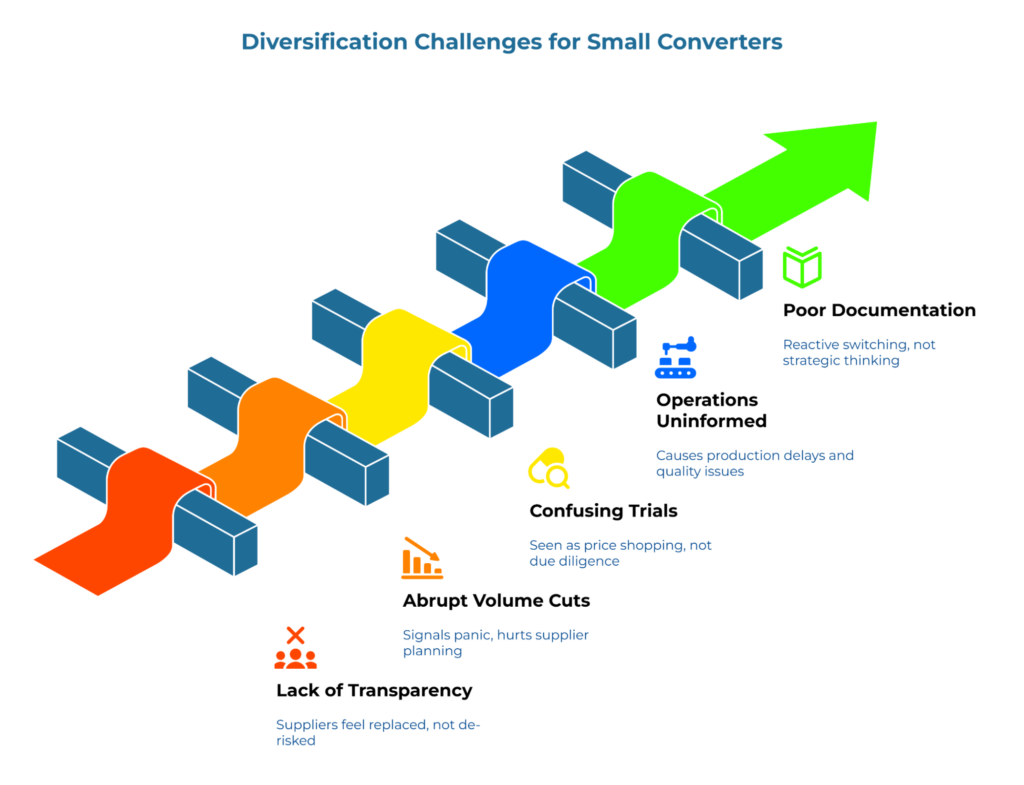
Successful diversification for small converters requires balancing two competing priorities: reducing dependency while maintaining trust with current suppliers.
Start with transparency. Your existing suppliers understand business fundamentals. Explaining that you’re de-risking your supply base by adding options—not replacing them—frames diversification as sound business practice rather than disloyalty. Most professional suppliers respect this approach when communicated clearly.
Control the pace. Abrupt volume cuts signal panic or punishment. Gradual rebalancing over 6–12 months allows current suppliers to adjust their planning and keeps your orders within agreed pricing tiers while you validate new sources. This measured approach protects both supply security and relationship quality.
Separate trials from evaluations. When testing new suppliers, frame it explicitly as due diligence on risk and capability, not shopping around for better prices. This distinction matters. Trials verify that a supplier can meet your specifications consistently. Price negotiations come later, after you’ve confirmed capability.
Keep operations informed. Plant managers bear the cost of poor trials—line adjustments, quality checks, production delays. Their early input on trial timing, volume, and specifications prevents diversification from becoming an operations headache that undermines the entire effort.
Document your decisions. When you explain supplier additions to ownership or current suppliers, having clear rationale—risk metrics, capability gaps, geographic concentration—demonstrates strategic thinking rather than reactive switching.
The 6-12 Month Diversification Roadmap (Overview)
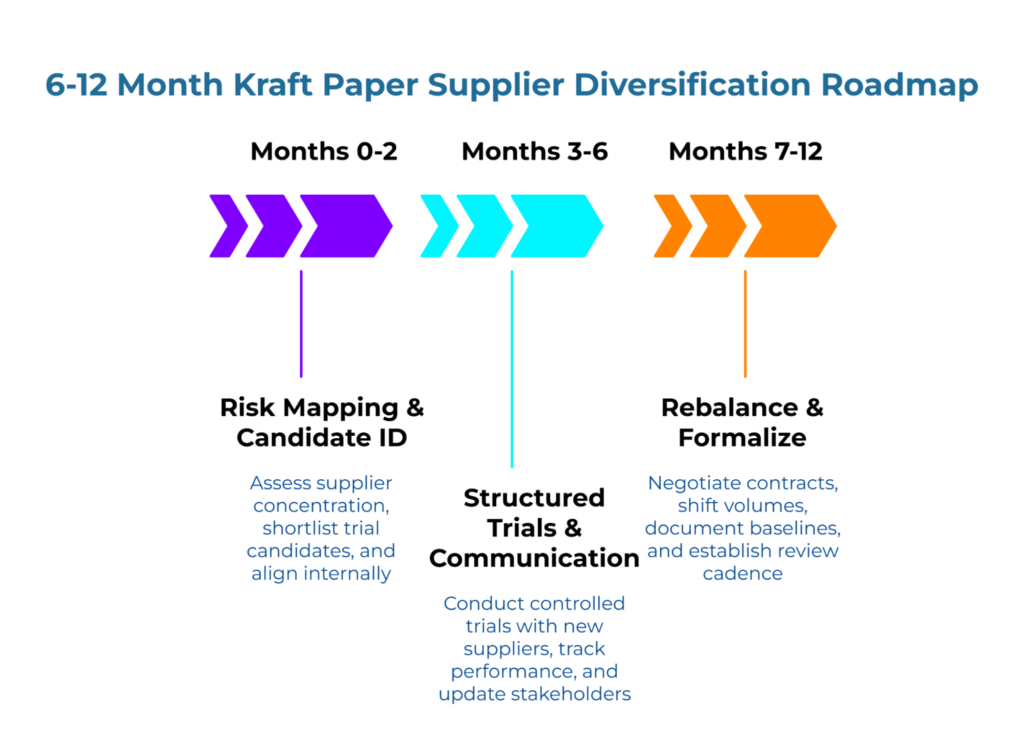
A structured timeline transforms diversification from an overwhelming project into manageable phases. The roadmap spreads risk assessment, supplier qualification, and volume rebalancing across three distinct stages, each building on the previous one.
Months 0-2 focus on mapping current risk and identifying trial candidates. You’re gathering information, not making commitments. This phase establishes baseline metrics and builds internal consensus before external changes begin.
Months 3-6 shift to structured trials and communication. You’re running controlled tests with new suppliers while signaling fair intent to current partners. This phase generates the evidence needed to justify volume adjustments.
Months 7-12 complete the transition to balanced sourcing. You’re formalizing relationships, rebalancing volumes based on trial results, and documenting new supply patterns. This phase delivers the operational reality of multiple qualified suppliers.
The complete roadmap provides a reference framework you can adapt to your specific situation:
| Phase | Objective | Key Actions | Risk Level | Internal Communication | Supplier Communication |
| Months 0-2 | Map risk, identify candidates | Calculate supplier concentration, review quality/delivery history, shortlist 2-3 trial candidates, align with operations on timing | Low | Share concentration metrics with ownership, confirm operations capacity for trials | Inform current suppliers of general de-risking initiative without specifics |
| Months 3-6 | Run trials, validate capability | Place trial orders (5-10% of monthly volume), track quality/delivery performance, gather operator feedback, begin data collection for comparisons | Medium | Weekly trial reviews with operations, monthly updates to ownership on progress | Frame trials as qualification process, maintain regular volume with incumbents |
| Months 7-12 | Rebalance, formalize options | Negotiate contracts with qualified suppliers, phase volume shifts (target: no more than 40% with single supplier), document performance baselines, establish review cadence | Medium-High | Present final supplier mix to ownership with risk reduction data | Communicate volume adjustments 60-90 days in advance, emphasize continued partnership |
This phased approach keeps changes gradual enough that operations can absorb them and current suppliers can plan around them.
Months 0-2: Mapping Risk And Finding Low-Risk Trials
The first 60 days establish the foundation for everything that follows. Start by quantifying your current supplier concentration. Calculate what percentage of kraft paper volume flows through each supplier. A simple spreadsheet showing monthly volumes by source over the past 12 months reveals patterns you might have missed.
While consolidating volume often yields ‘preferred customer’ status, concentration above 60% creates a critical single point of failure. At levels approaching 80%, the operational cost of switching becomes so high that your negotiating leverage effectively disappears.
When auditing your supply base, distinguish between two categories: grades that are sole-sourced in practice because only one supplier can realistically serve your needs, and grades that are single-sourced by choice where alternatives exist but you haven’t developed them. This distinction helps prioritize which grades offer the most practical diversification opportunities.
Regional capacity swings create supply vulnerabilities that purchasing data can quantify. Your audit makes this abstract concept concrete with your actual volume data.
Assess each existing supplier relationship honestly. Track on-time delivery rates, quality incident frequency, and responsiveness to issues. This historical performance data helps you decide which relationships to maintain at current volumes and which to reduce as you add options.
Define minimum safe options for your operation. There’s no universal correct number of suppliers—it depends on grade mix, region, freight realities, and available mills. However, a practical working principle is that critical, high-volume grades typically benefit from at least two workable sources. For highly specialized grades, you may maintain one primary supplier but ensure at least one backup has passed technical trials, even if not on regular rotation.
Set internal thresholds for each major grade: the minimum number of workable suppliers you need and the maximum share of volume you’re comfortable giving any single supplier. These targets guide your roadmap and later negotiations.
Identify trial candidates through systematic research. Finding suppliers through established B2B platforms such as PaperIndex lets you review company profiles, certifications, and product capabilities before making contact. Look for kraft paper mills or traders that serve your product specifications and have demonstrated international shipping capability if you’re sourcing cross-border.
Day-To-Day Application: For plant managers, this phase requires minimal disruption. You’re gathering data and having conversations, not changing production schedules. The main task is reviewing the trial candidate list to flag any specifications, equipment compatibility issues, or timing constraints that should influence selection.
Align with ownership during this phase. Present concentration metrics, explain risk exposure, and outline the proposed timeline. Securing buy-in now prevents resistance later when you need approval for contract terms or volume adjustments.
Contact trial candidates with clear objectives. Explain that you’re qualifying new suppliers to reduce concentration risk, not necessarily switching immediately. Request samples, technical data sheets, and preliminary pricing. Frame this as capability assessment rather than competitive bidding.
Months 3-6: Running Trials and Signalling Fair Intent
Structured trials generate the evidence needed to justify volume rebalancing. Place trial orders representing 5-10% of your monthly kraft paper volume. This size is large enough to test the supplier’s processes but small enough to contain risk if quality or delivery problems emerge.
Define clear acceptance criteria before trials begin. Specify target basis weight tolerances, moisture content ranges, burst strength minimums, and delivery timing requirements. Documenting these expectations in advance prevents subjective evaluations that undermine confidence in results.
Track trial performance rigorously. Create a simple dashboard covering quality metrics (defect rates, specification conformance), delivery performance (on-time percentage, lead time accuracy), and operational impact (line speed, waste rates, operator feedback). This data becomes your justification for volume decisions in the next phase.
Capture practical learning beyond technical specifications. How does the paper run on different machines? How responsive is the supplier to documentation requests, complaints, and minor issues? What are actual lead times compared to promises over several loads? How do they communicate when problems arise?
Research on multiple sourcing strategies notes that using more than one supplier can increase flexibility and resilience, though it also increases coordination complexity. The trial period is where you learn whether a new supplier adds genuine flexibility or simply creates unmanageable administrative burden for operations.
Maintain regular communication with current suppliers during trials. The goal is transparency without excessive detail. A simple message—”We’re qualifying additional suppliers to reduce our supply concentration risk, consistent with sound procurement practice. We value our relationship and see you as a key partner going forward”—signals fair intent without revealing competitive information.
Using price volatility data during this phase helps you time negotiations strategically. When pulp prices trend downward or freight rates soften, you have natural leverage to discuss pricing with both incumbent and trial suppliers.
Involve operations closely in trial evaluation. Schedule brief weekly reviews where plant managers can flag issues immediately. Problems caught early—incorrect reel sizes, moisture content variations, packaging damage—allow you to course-correct with trial suppliers before committing to larger volumes.
Document every trial thoroughly. Photograph packaging, retain samples, save certificates of analysis, and record operator notes. This evidence package supports your case when presenting diversification results to ownership and explaining volume changes to suppliers.
Months 7-12: Rebalancing Volumes And Formalising Options
The final phase converts trial results into operational reality. Begin by analyzing trial performance data against your documented acceptance criteria. Suppliers that met quality specifications consistently, delivered on time reliably, and received positive operator feedback qualify for volume allocation.
Negotiate formal agreements with qualified suppliers. Even if you can’t command volume commitments or pricing concessions that large buyers secure, you can establish clear terms: specifications, quality acceptance procedures, delivery timing, payment terms, and price adjustment mechanisms. Written agreements prevent future disputes.
Plan volume rebalancing carefully. A prudent target is to cap any single supplier at 40–50% of your total volume, provided this split still leaves you with sufficient purchasing weight to meet Minimum Order Quantities (MOQs) and retain relevance with each mill. For high-dependence grades, move from 90-100% with one supplier to roughly 60-70% with the incumbent and 30-40% with one or two alternates. Shift volumes gradually—10-15% movements per quarter—to allow both receiving and reducing suppliers to adjust.
Communicate volume changes 60-90 days in advance. For suppliers receiving increased volume, provide clear forecasts so they can plan capacity. For suppliers experiencing reductions, explain the diversification rationale clearly and emphasize that the relationship continues, just at adjusted volumes.
Business Impact: By month 12, you’ve transformed your supply structure. Instead of 70-80% dependence on one or two suppliers, you have three to four qualified sources, each at 25-40% of volume. Stock-out risk drops substantially. Price negotiations shift from take-it-or-leave-it to rational discussion because you have credible alternatives.
Link diversification to more structured contract terms where possible. Once your volume picture stabilizes, you can use your improved position to negotiate banded pricing for agreed volume ranges with clear triggers for review, simple volume commitments that secure capacity without overcommitting, or limited index-linking for longer-term stability on key grades.
Establish ongoing review cadence. Quarterly scorecards tracking each supplier’s quality performance, delivery reliability, and responsiveness keep relationships accountable and provide early warning of problems. This discipline prevents gradual drift back toward concentration. Supplier portfolios need periodic review; risk and performance change over time, and your diversification strategy should adapt accordingly.
Document your new supplier strategy in a simple one-page plan that shows target volume allocation, key performance metrics for each supplier, and review timing. This reference helps maintain discipline and provides continuity if procurement responsibility changes.
Getting Owners And Operations On Board With Diversification
Diversification succeeds or fails based on internal alignment. Different stakeholders care about different outcomes.
Owners and managing directors focus on business risk and financial impact. Present diversification through this lens: quantify concentration risk, estimate cost of supply disruption scenarios, and show how diversification reduces vulnerability. A simple before-and-after chart showing supplier concentration percentages makes the risk reduction visible and concrete. Frame the investment—trial costs, potential volume adjustments, administrative time—against the risk mitigation value delivered.
Aligning owner and operations priorities requires showing both the business case and the operational practicality. Use a simple checklist that connects strategic goals to daily execution.
Operations managers and plant supervisors care about production continuity and workload. Trials mean line time for testing, quality checks, and potential adjustments. Acknowledge this upfront. Schedule trials during lower-volume periods when possible. Involve operators in supplier selection to surface equipment compatibility issues early. Track and share trial results so operations see their input valued.
Finance teams want predictable costs and clear payment terms. Explain how diversification creates competitive tension that can moderate price increases over time. Show that multiple suppliers reduce exposure to any single supplier’s financial instability or capacity constraints—both of which can force premium pricing during shortages.
Schedule a joint review session midway through the roadmap—around month 6—where you present trial results to all stakeholders together. This shared visibility builds consensus and makes volume rebalancing decisions collaborative rather than imposed.
Common Pitfalls Small Converters Should Avoid
Several predictable mistakes undermine diversification efforts. Recognizing them in advance helps you navigate around them.
Switching too fast or cutting incumbents abruptly. When you reduce a current supplier’s volume by 40% in a single month, you signal that the relationship no longer matters. This burns bridges unnecessarily and can trigger retaliatory pricing or allocation cuts on remaining volume. Small converters can’t afford to make enemies of capable suppliers.
The fix: Phase volume changes gradually over two to three quarters. Communicate the shift clearly and emphasize that the supplier remains part of your long-term strategy, just at adjusted volumes that reflect broader risk management.
Ignoring operations impact. Diversification adds complexity. More suppliers mean more delivery coordination, more quality checks, more invoices to process. When procurement drives diversification without understanding operational capacity to manage it, plants push back—often by reverting to the old single-supplier pattern that felt simpler.
The fix: Limit active suppliers to three or four maximum for most small converters. More creates an administrative burden that exceeds diversification benefit. Get operations input on trial timing and volume to ensure they can support the initiative.
Treating trials as shopping around for better prices. When you request quotes from five suppliers simultaneously, run two-week trials, and then cherry-pick the lowest price, you’ve damaged trust with everyone involved. Suppliers recognize price-shopping behavior and respond by either not participating or inflating prices to cover the risk of your business not materializing.
The fix: Frame trials explicitly as qualification processes. Tell suppliers upfront that you’re validating capability to add them to your qualified source list, and that pricing discussions will follow if trials confirm specification conformance. This approach attracts serious suppliers.
Forgetting to align owners. Some procurement managers diversify quietly, hoping to present results after the fact. When owners discover volume shifts they didn’t approve—especially if trials generated quality issues or higher costs—they often reverse the entire initiative. Months of work disappear.
The fix: Build consensus before trials begin. Show ownership of the concentration risk data, explain the roadmap timeline, and get explicit approval to proceed. Update them monthly during trials so results aren’t surprises.
Over-relying on price quotes alone. The lowest-priced kraft paper looks attractive until it arrives with inconsistent moisture content that causes line jams, or until delivery delays halt production. Total cost includes quality stability, delivery reliability, and administrative ease—not just the per-ton price.
The fix: Weight trial results across multiple factors. Use a simple scorecard that balances price (40%), quality performance (30%), delivery reliability (20%), and operational fit (10%). This structured approach prevents price from dominating decisions inappropriately.
Treating diversification as a one-time project. Some converters complete a supplier expansion, then never revisit the portfolio. Markets change, supplier performance drifts, and new risks emerge. Without periodic review, diversification efforts gradually erode.
The fix: Build quarterly or semi-annual supplier reviews into your procurement calendar. Track concentration metrics, performance data, and emerging risks as ongoing management practice, not a project with an end date.
Global industrial analysis of supply chain disruptions consistently shows that concentration, lack of backup plans, and weak internal coordination are root causes of failure when shocks occur. The pitfalls above represent the small converter version of these documented failure patterns.
Turning Your Roadmap Into A Simple One-Page Plan
The roadmap framework needs customization to match your specific situation. Converting it to a working document takes about an hour.
Start with current state documentation. Fill in a simple table showing your existing supplier names, monthly volumes with each, percentage of total kraft supply, and any key concerns (delivery delays, quality issues, limited capacity). This baseline shows where you’re starting and why change matters.
Set clear targets for month 12. Define your ideal supplier mix—typically three to four qualified sources, none exceeding 40% of volume—and the risk metrics that will confirm success. Targets might include: maximum concentration below 40%, minimum of three suppliers meeting quality standards, and backup capacity equal to at least 20% of monthly usage.
Map your trial plan. List the 2-3 candidate suppliers you’ll qualify during months 3-6, the specifications they need to meet, the trial volume for each, and the timeline for testing. This section becomes your execution checklist.
Define communication touchpoints. Schedule when you’ll update ownership (monthly), when you’ll review trial results with operations (weekly during active trials), and when you’ll notify current suppliers of volume adjustments (60-90 days before changes take effect).
Create a one-page dashboard that tracks progress monthly. Simple metrics—concentration percentage by supplier, number of qualified suppliers, trial completion status, cost impact—let you monitor whether diversification is delivering the intended risk reduction.
This single-page plan serves three purposes: it keeps you accountable to the timeline, it provides a clear briefing document when personnel change, and it demonstrates structured thinking when discussing sourcing strategy with suppliers or ownership.
From Feeling Cornered to Having Options
The procurement manager who opened that price increase email on Tuesday afternoon faced a stark choice: accept the 8% hike or risk supply disruption. Limited negotiating power left no room to push back effectively.
Twelve months later, the same manager receives a similar email. But now the response differs. She has three qualified kraft paper suppliers instead of one. Trial data documents that two alternatives can meet her specifications reliably. When she calls to discuss the increase, the conversation shifts from desperate acceptance to rational negotiation about timing, phase-in, and contractual terms.
This transformation—from cornered to capable—defines successful diversification for small converters. You haven’t magically become a large kraft paper buyer with structural negotiating power. Mills and traders still prioritize their biggest customers. But you’ve reduced single-source dependency, created supply security through multiple options, and earned the respect that comes from demonstrating strategic procurement rather than reactive ordering.
Integrating diversification with other negotiation levers amplifies the benefit. When you combine supplier options with volatility-aware timing and clear specification documentation, your negotiating position improves substantially despite limited volumes.
The roadmap you’ve built provides the structure to act rather than react. Print it, share it with ownership and operations, and start mapping your current risk. In six months, you’ll have trial data. In twelve months, you’ll have options. That shift—from vulnerability to capability—changes how you show up in every supplier conversation from that point forward.
Disclaimer: This content is provided by PaperIndex for informational and educational purposes only. It does not constitute professional procurement, legal, or business advice. PaperIndex recommends consulting qualified professionals before making sourcing decisions or implementing supply chain changes. Market conditions and supplier dynamics may vary significantly from the scenarios described.
Our Editorial Process
Our expert team uses AI tools to help organize and structure our initial drafts. Every piece is then extensively rewritten, fact-checked, and enriched with first-hand insights and experiences by expert humans on our Insights Team to ensure accuracy and clarity.
About the PaperIndex Insights Team
The PaperIndex Insights Team is our dedicated engine for synthesizing complex topics into clear, helpful guides. While our content is thoroughly reviewed for clarity and accuracy, it is for informational purposes and should not replace professional advice.