

📌 Key Takeaways
Internal friction costs more than supplier leverage ever will.
- Internal Alignment Precedes External Success: Small converters lose negotiations when owner, procurement, and operations send conflicting signals to suppliers, not because suppliers are inherently unmovable.
- Three Priorities Drive Every Decision: Cost (margin protection), cash (working capital constraints), and supply security (production continuity) compete in every kraft paper negotiation, and teams must explicitly rank them before supplier conversations begin.
- Pre-Agreed Trade-Offs Eliminate Reactive Decisions: A one-page grid mapping supplier proposals to cost/cash/supply impacts transforms emotional debates into structured 15-minute pre-meeting huddles with clear response boundaries.
- Preparation Determines Outcome: Research confirms that negotiation success is largely decided during preparation, not during the conversation itself—aligned teams execute against shared logic rather than improvising under pressure.
- The Framework Adapts, Not Breaks: Mid-year resets using version control and fact-based priority reviews keep the checklist relevant when business conditions shift, preventing ad hoc decision-making during crises.
Shared decision frameworks turn supplier negotiations from internal battles into coordinated strategy.
Procurement and sourcing managers, for example, at small and mid-sized packaging converters will find a practical implementation roadmap here, preparing them for the step-by-step alignment framework that follows.
The procurement manager closes the conference room door and takes a breath. In twenty minutes, she’ll be on a call with the kraft paper supplier who just sent another price increase notice. But before that conversation happens, she needs something more difficult: getting the business owner and plant manager to agree on what they’re willing to accept.
This internal negotiation often proves harder than the external one. The owner sees only the margin squeeze. Operations worries about running out of material mid-production. And procurement sits in the middle, trying to balance both perspectives while maintaining supplier relationships. When these priorities clash in real-time during supplier discussions, the result is reactive decision-making that weakens your position further.
The challenge isn’t just limited negotiating power with paper suppliers—it’s the compounding effect when your team walks into negotiations without a shared plan. Research on cross-functional alignment shows that organizations where leadership teams agree on priorities make decisions faster, with lower friction and better overall performance. This article provides a practical framework for turning internal friction into structured alignment before you ever pick up the phone.
Why Internal Alignment Matters More Than Ever in Paper Negotiations
Small and mid-sized packaging converters face a structural reality: suppliers prioritize larger kraft paper buyers who place consistent, high-volume orders. This power imbalance becomes more pronounced when your internal team sends mixed signals during negotiations.
Consider what happens when priorities aren’t aligned in advance. The supplier proposes a 7% increase with a six-month commitment. Operations immediately accept because steady supply matters most to them. The owner interrupts, pushing back on both the price and the cash exposure of a long commitment. Procurement is left managing contradictory instructions while the supplier observes the internal discord.
This dynamic has three predictable consequences. First, suppliers recognize the lack of coordination and adjust their approach accordingly—often holding firm on terms they might have negotiated with a unified counterpart. Second, the procurement function loses credibility with both internal stakeholders and external partners. Third, decisions get made reactively under time pressure rather than following a deliberate strategy.
The solution isn’t to eliminate competing priorities—cost, cash flow, and supply security will always create tension. Instead, the goal is to surface those trade-offs explicitly and agree on boundary conditions before negotiations begin. For business owners, this means margin and cash are protected through conscious trade-offs rather than reactive concessions. For operations, supply security gets written into the decision framework rather than becoming an afterthought when aggressive pricing deals create production problems.
The Three Competing Priorities: Cost, Cash, and Supply Security
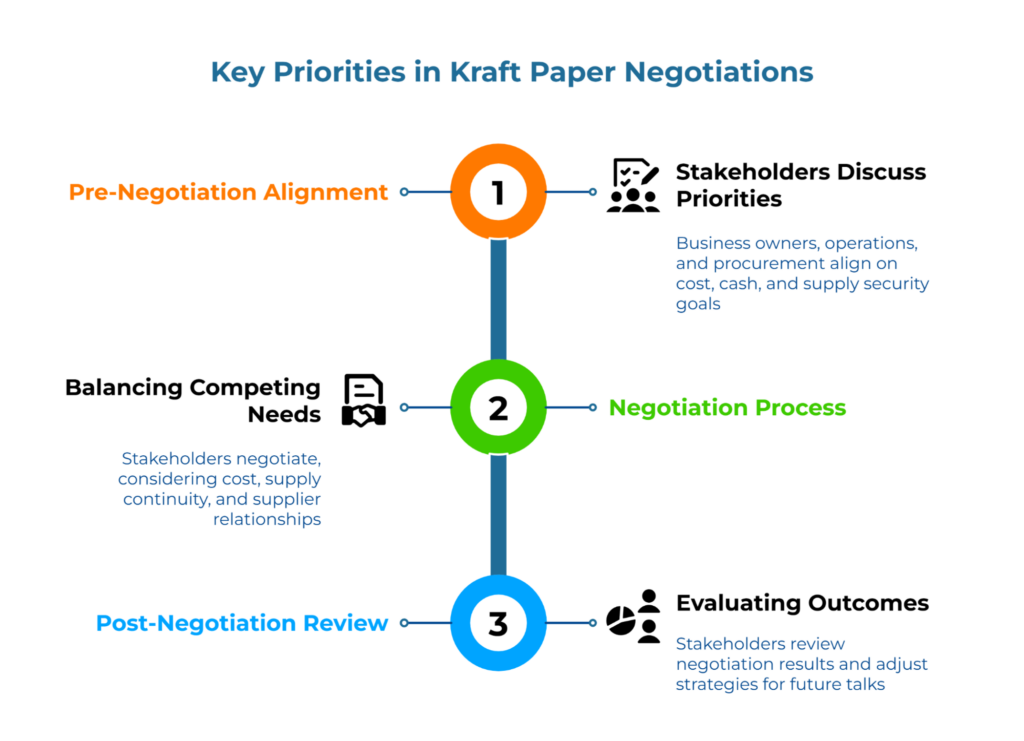
Every kraft paper negotiation involves balancing three fundamental concerns, and each stakeholder typically champions one.
Business owners focus on cost and margin protection. A 5% kraft paper price increase might erase 40-50% of net margin for a small converter operating on thin margins. Owners need to understand how price movements translate directly to profitability and whether the business can sustain the impact or must pass costs through to customers.
Operations managers prioritize supply continuity and production stability. Running out of kraft paper mid-production isn’t just inconvenient—it means idle equipment, missed customer deadlines, and potential long-term relationship damage. Operations will often accept higher prices or longer commitments if it guarantees material availability and consistent quality.
Procurement balances both perspectives while managing supplier relationships. The procurement function must maintain working relationships with suppliers for the long term, even when pushing back on prices. They understand that burning bridges today limits options tomorrow, particularly given the limited supplier alternatives available to smaller converters.
The framework presented here doesn’t eliminate these tensions. Rather, it converts them from unstated assumptions into explicit choices that all stakeholders make together before entering negotiations. This alignment directly supports the broader frameworks covered in kraft paper price volatility and budget management and the leverage-building approaches detailed in limited paper negotiating power: 5 simple levers beyond just asking for a lower price.
Step 1: Agree the Shared Goal for the Next 12 Months
Start by defining what success looks like over the coming year. This isn’t about wishful thinking—it’s about establishing a realistic primary objective that guides all subsequent trade-off decisions.
Gather your owner, procurement lead, and operations manager for a focused 30-minute conversation. Ask one question: “If we could guarantee only one of these three outcomes for the next twelve months, which matters most right now?”
The three options are: holding kraft paper costs within a defined band, minimizing cash exposure and payment term risk, or ensuring uninterrupted supply even if it costs more.
This isn’t a theoretical exercise. A converter facing declining customer volumes might prioritize cash preservation, accepting some supply risk to avoid tying up working capital. A converter with strong sales growth and tight customer commitments might choose supply security as the non-negotiable, accepting higher costs to prevent production disruptions.
Document this primary goal clearly. Use straightforward language: “Our primary goal for kraft paper sourcing through Q4 2025 is maintaining supply continuity to support our 25% year-over-year volume growth, even if it means accepting price increases within our defined tolerance band.”
Add one or two secondary goals that provide additional guidance without diluting the primary focus. Examples might include avoiding large one-off price shocks by using budget bands and scenarios, or limiting working capital tied up in kraft inventory to an agreed range.
This shared goal becomes your North Star. When you’re mid-negotiation and the supplier offers a trade-off—say, better pricing but longer lead times—you have a pre-agreed framework for evaluating the offer. The goal statement also links directly to the low/base/high budget bands framework detailed in kraft paper budget management in excel, determining how aggressively you’ll act within those bands.
Step 2: Map Each Stakeholder’s Non-Negotiables and Flex Points
With the primary goal established, identify what each stakeholder absolutely cannot accept and where they have flexibility. This mapping must happen before supplier conversations, not during them.
Create a simple three-column table. List the business owner, procurement, and operations down the left side. Add two columns: “Cannot Accept” and “Can Be Flexible.”
Owner’s typical constraints: Cannot accept losses on customer contracts already priced. Cannot commit cash beyond current credit facility limits. Can be flexible on timing of price increases if customers can be notified in advance.
Procurement’s typical constraints: Cannot damage relationships with current qualified suppliers without alternatives ready. Cannot commit to terms that won’t be honored by finance or operations. Can be flexible on communication approach and negotiation timeline.
Operations’ typical constraints: Cannot risk stockouts during peak production periods. Cannot accept material that requires line modifications or extensive trials. Can be flexible on order frequency and lot sizes if total volume is maintained.
Populate this table honestly during your alignment meeting. The goal is transparency, not positioning. When the plant manager says “I cannot risk running out during our Q3 peak season,” that’s not negotiating leverage—it’s essential information that shapes your supplier strategy.
This exercise reveals where your team actually has flexibility. You might discover that operations can tolerate a two-week buffer period before a new price takes effect, giving procurement time to negotiate. Or the owner might accept a slightly higher price if payment terms extend from 30 to 45 days, easing cash flow pressure. For procurement presenting this framework to stakeholders, emphasize how clearly defined flex points provide room to negotiate without calling a meeting for every supplier counterproposal, while non-negotiables protect the business from surprise margin collapse or production shutdowns.
Step 3: Build the Internal Trade-Off Grid (The Heart of the Checklist)
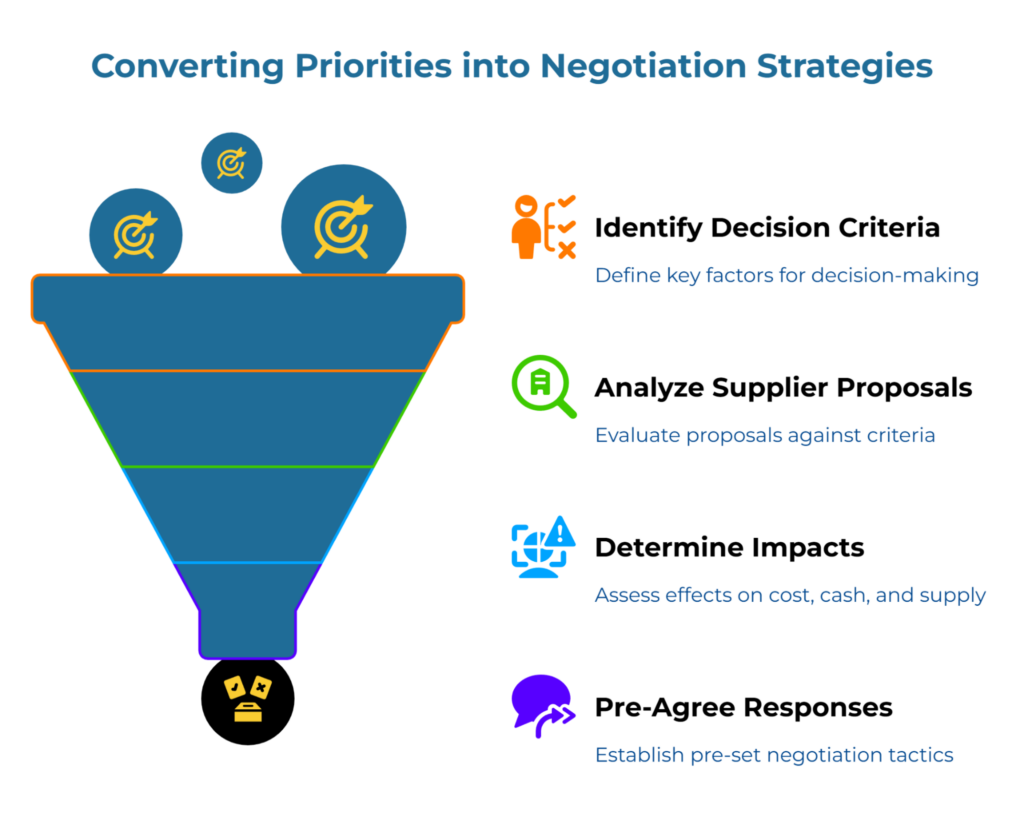
The trade-off grid converts your abstract priorities into concrete decision rules. This tool anticipates the most common supplier proposals and pre-determines your response based on your aligned priorities.
Create a grid with supplier proposal types down the left and your decision criteria across the top. The criteria should directly reflect your primary goal and the non-negotiables you identified. For each negotiation lever, note how it affects cost, cash, and supply security, plus its current status for the next twelve months.
For a converter prioritizing supply security, the grid might look like this:
Supplier Proposal: Price increase ≤5% with 12-month commitment
- Impact on Cost: Acceptable (within volatility budget band)
- Impact on Cash: Review payment terms to stay within credit limits
- Impact on Supply: Strong positive (secures volume for peak season)
- Pre-Agreed Response: Approve if payment terms work, counter with 9-month term
Supplier Proposal: Price increase 6-8% with spot purchasing flexibility
- Impact on Cost: Marginal (above preferred band but preserves flexibility)
- Impact on Cash: Neutral
- Impact on Supply: Negative (no volume guarantee during peak)
- Pre-Agreed Response: Decline unless supplemented with minimum volume guarantee
Supplier Proposal: Hold current price but extend lead times from 3 to 5 weeks
- Impact on Cost: Positive
- Impact on Cash: Neutral
- Impact on Supply: Negative (conflicts with just-in-time operations)
- Pre-Agreed Response: Decline, or accept only for non-critical grades
The power of this grid is that it forces you to think through combinations before you’re in the heat of negotiation. Build it collaboratively with all three stakeholders present so everyone understands the logic behind each response. This grid draws directly on the levers introduced in the 5 Simple Levers framework and the structural constraints explained in 5 Structural Reasons Small Converters Feel Cornered.
Include rows for the six most common supplier proposals: straight price increases, price increases with volume commitments, price holds with lead time extensions, payment term changes, MOQ increases, and grade consolidation requests.
Step 4: Turn the Grid into a One-Page Pre-Meeting Checklist
Distill your trade-off grid into a single-page checklist that can be reviewed in fifteen minutes before any supplier negotiation call or meeting. Evidence from aviation and healthcare shows that checklists significantly reduce errors and improve reliability in high-stakes environments. The goal here is similar: reduce avoidable negotiation mistakes and inconsistent decisions through structured preparation.
The checklist should contain five elements:
Current context (3 bullets). What’s changed since your last negotiation? Has customer demand shifted? Have you qualified new suppliers? Has your cash position improved or tightened? This grounds everyone in the current situation.
Primary objective reminder (1 sentence). Restate your twelve-month goal so it’s top of mind during the discussion.
Non-negotiables for this specific negotiation (3-5 items). Pull these from your stakeholder mapping but customize them for the specific supplier and timing. If you’re negotiating in June for Q4 delivery, supply security might move up the priority list compared to a negotiation in February.
Pre-approved responses to likely proposals (4-6 scenarios). Simplify your trade-off grid into decision rules written as “If supplier proposes X, we respond with Y because Z.” For example: “If the supplier proposes >6% increase, we request phase-in over two quarters because customer contracts renew in Q3.”
Escalation trigger (1 clear rule). Define what situations require pausing the negotiation to regroup. For instance: “If the supplier cannot guarantee supply during Sept-Nov peak season, end the call and escalate to the owner before proceeding.”
Format this checklist for easy scanning. Use bold headers, keep sentences short, and leave white space. The test is whether someone could read it in a waiting room two minutes before the call and feel prepared.
This checklist becomes your team’s shared language. When the supplier makes an unexpected offer during the call, procurement can reference the pre-agreed response framework rather than inventing a position on the spot. If the situation falls outside your anticipated scenarios, the escalation rule gives clear permission to pause and regroup rather than committing under pressure.
How to Run a 15-Minute Alignment Huddle Before Each Supplier Negotiation
The checklist only works if you actually use it. Institute a standing practice: a brief huddle before every substantive supplier negotiation. For an in-depth guide on the critical steps to cover, review this supplier negotiation checklist to see how much of the outcome is decided before people enter the room, in the preparation phase.
Schedule fifteen minutes with your owner and operations manager before the supplier calls. Break it down into specific time blocks to maintain discipline:
Five minutes: Reset context. Confirm the current budget band and scenario from your volatility framework. Walk through what’s changed since you last met—customer order confirmations, cash position updates, or supplier signals about capacity constraints. Re-read the shared goal statement aloud to ensure everyone starts from the same foundation.
Five minutes: Confirm trade-offs. Walk through the selected levers on your trade-off grid. Verify which are Preferred, Acceptable, or Last Resort for this specific negotiation. A major customer might have just confirmed a large order, changing your volume needs and shifting certain levers from Acceptable to Preferred. Check that non-negotiables remain valid or update them if circumstances genuinely shifted.
Three minutes: Assign roles and escalation. Confirm who leads the call and who will speak if the supplier pushes on a sensitive lever. Be explicit about what requires a pause or follow-up rather than an on-the-spot decision. This prevents the mixed-signal problem where multiple stakeholders respond to the same supplier question with different answers.
Two minutes: Capture updates. Note any changes to statuses or red lines directly on the checklist for future negotiations. This version history approach demonstrates that changes are recognized and managed, not ignored.
For procurement managers presenting this structured approach to skeptical owners or operations managers, the contrast is stark: unstructured pre-meeting discussions often run 45 minutes, involve repeated arguments, produce no clear decision, and result in mixed signals to suppliers. The structured 15-minute huddle uses one page, establishes clear priorities, and ensures procurement knows exactly where there’s room to move and where there isn’t.
Integrating the Checklist with Other Frameworks in the Paper Sourcing Playbook
This internal alignment checklist doesn’t exist in isolation. It connects to other frameworks you might be using to manage kraft paper sourcing challenges.
If you’ve implemented budget bands for kraft paper price volatility, your trade-off grid should reference those bands directly. When evaluating a supplier’s price proposal, you can quickly determine whether it falls within your low/base/high scenarios and respond accordingly. The alignment checklist ensures everyone interprets those bands the same way.
If you’re working on building additional supplier options to improve your leverage position, the checklist helps you evaluate new suppliers consistently. Does a new supplier’s pricing offset the risk of qualifying unproven material? Your pre-agreed trade-off grid provides the answer based on your current priorities. This connects directly to the diversification roadmap detailed in building supplier options when your paper negotiating power is limited.
If you’ve developed scenario planning for different market conditions, the alignment checklist becomes your tactical execution tool. The scenarios tell you what might happen; the checklist tells you how to respond when it does. Once your internal plan is stable, frameworks like using paper price volatility data to strengthen your limited negotiating power can layer in market intelligence to support your pre-agreed positions.
The key is treating these frameworks as complementary layers. Strategic planning happens at the scenario and budget band level. Tactical execution happens at the negotiation level using your alignment checklist. Both are necessary, and they reinforce each other.
Common Pitfalls and How to Reset When Priorities Change Mid-Year
Even with strong initial alignment, three common pitfalls can undermine your framework.
The first pitfall is letting the checklist become stale. Business conditions change, but teams often forget to update their decision framework. If customer demand drops significantly or a major quality issue emerges with your current supplier, your original trade-off grid may no longer apply. Address this by scheduling a mid-year checklist review, not just before individual negotiations. Use this review to revisit the shared goal statement, update non-negotiables, and adjust lever statuses based on what actually happened in the first half of the year.
The second pitfall is reverting to ad hoc decision-making during crises. When your supplier suddenly announces allocation of supply due to kraft paper mills maintenance, the instinct is to panic and abandon your framework. Resist this. Your pre-agreed escalation rules exist precisely for these situations. Use them to quickly regroup and decide whether the crisis requires a temporary priority shift or whether your original framework still applies.
The third pitfall is allowing one stakeholder to dominate after initial alignment. The owner might start overruling pre-agreed responses if market conditions tighten, or operations might push for commitments beyond what was agreed. When this happens, call an explicit reset meeting. Acknowledge that conditions have changed and that you need to revisit priorities formally rather than letting the framework erode through individual decisions.
To reset mid-year effectively, follow a compressed version of your original alignment process. Confirm whether the primary objective still holds. If not, what’s changed and why? Update the non-negotiables and flex points based on current reality. Revise the trade-off grid for the most likely scenarios you’ll face in the remaining months. Issue an updated checklist and communicate clearly that this supersedes the previous version.
Keep discussions fact-based when revising the checklist. Link proposed changes to actual events: confirmed customer losses, documented stock-outs, or verified supplier capacity constraints, rather than isolated anecdotes. Studies consistently link clear strategic alignment to better operational and financial performance, which can reassure owners that investing time in alignment drives measurable stability, not just process for its own sake.
The framework is a tool, not a constraint. If your business situation genuinely shifts, adapt the framework deliberately rather than abandoning it quietly. Log every major change as a controlled version history so the checklist remains a living document that reflects current priorities.
A Simple Alignment Habit That Upgrades Every Negotiation
The internal friction that weakens small converters in kraft paper negotiations isn’t inevitable. It stems from stakeholders working from different unstated assumptions about what matters most and what’s acceptable.
This alignment framework—from the initial priority-setting conversation through the trade-off grid to the pre-meeting checklist—converts those unstated assumptions into shared decisions. The supplier still has structural advantages in the negotiation. You can’t eliminate that power imbalance by hope or force of will.
What you can do is ensure that your side speaks with one voice and makes decisions based on pre-agreed logic rather than real-time emotion. When the supplier proposes a trade-off, you’re not scrambling to build internal consensus on the spot. You’re executing against a plan everyone already understands.
The fifteen-minute huddle before supplier calls becomes a habit that compounds over time. Each negotiation becomes slightly more professional, slightly more strategic, and slightly less stressful. Your procurement function gains credibility with both internal stakeholders and external suppliers. Decisions happen faster because the decision framework already exists. Owners see margin, cash, and risk handled explicitly. Operations sees supply security and practicality built into every decision. Procurement stops fighting on two fronts.
Start with your next negotiation. Gather your owner and operations manager for thirty minutes. Build the first version of your alignment checklist. Use it once and refine it based on what you learn. This isn’t sophisticated strategy consulting—it’s a simple, shared discipline that small converters can implement immediately. Over time, this alignment habit becomes part of your sourcing culture, supporting more advanced moves like scenario planning, data-driven leverage, and supplier diversification.
The negotiating power imbalance won’t disappear, but you’ll stop fighting two battles at once. And that changes everything about how kraft paper negotiations feel and how they end.
Ready to implement this framework? Share this checklist structure with your owner and plant manager, and schedule a 30-minute session to build your first trade-off grid before your next supplier conversation. For additional kraft paper sourcing frameworks, explore the complete playbook at PaperIndex Academy. Once your internal plan is clear, use PaperIndex to identify additional kraft paper suppliers that fit your agreed strategy.
Disclaimer: This article is provided for educational purposes only. The frameworks and strategies discussed in this article represent general educational guidance. Business decisions should be made based on your specific circumstances, and you should consult with qualified financial, legal, or business advisors as appropriate for your situation.
Our Editorial Process
Our expert team uses AI tools to help organize and structure our initial drafts. Every piece is then extensively rewritten, fact-checked, and enriched with first-hand insights and experiences by expert humans on our Insights Team to ensure accuracy and clarity.
About the PaperIndex Insights Team
The PaperIndex Insights Team is our dedicated engine for synthesizing complex topics into clear, helpful guides. While our content is thoroughly reviewed for clarity and accuracy, it is for informational purposes and should not replace professional advice.