
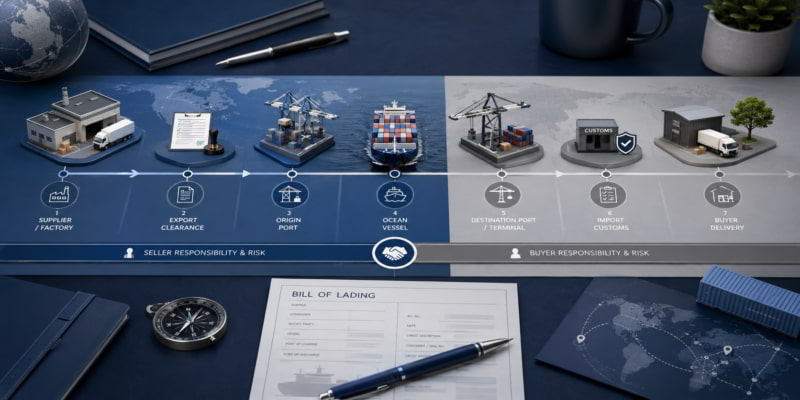
Incoterms® are globally recognized trade rules that define the responsibilities of sellers and buyers in contracts for the sale of goods. They explain who arranges and pays for transportation, who handles export and import clearance, who is responsible for insurance, where delivery occurs, and at what point the risk of loss or damage passes from seller to buyer.
The International Chamber of Commerce (ICC) first created the international commercial terms (Incoterms®) in 1936 to facilitate and promote international trade and commerce. Since then, the ICC has updated these terms periodically to reflect changes in shipping practices, documentation, insurance, customs procedures, and logistics. The rules spell out who pays the costs of freighting and insuring the goods, where and when the goods are delivered, what the payment is for the goods, and who assumes the risk of loss or damage once delivery has taken place.
The purpose of the Incoterms® is to leave no room for trade misunderstandings, but the terms are not, in themselves, binding contracts. Standard industry practice involves executing proper legal contracts alongside the chosen Incoterm, and trading parties typically operate within the governing laws of the countries in which or through which they are trading. The parties can stipulate in their trade contracts any changes they want to make to the Incoterms®.
Incoterms® 2020
Incoterms® 2020 is the ninth edition of the rules and came into force on January 1, 2020, replacing Incoterms® 2010. Like the 2010 edition, the 2020 edition defines 11 rules. The number of rules has stayed the same, but several important refinements were introduced.
Rules at a Glance
The 11 rules fall into two groups based on the modes of transport for which they are intended.
Rules for any mode or modes of transport (road, rail, air, sea, inland waterway, or multimodal):
- EXW – Ex Works
- FCA – Free Carrier
- CPT – Carriage Paid To
- CIP – Carriage and Insurance Paid To
- DAP – Delivered at Place
- DPU – Delivered at Place Unloaded
- DDP – Delivered Duty Paid
Rules intended only for sea and inland waterway transport:
- FAS – Free Alongside Ship
- FOB – Free On Board
- CFR – Cost and Freight
- CIF – Cost, Insurance and Freight
A Quick Glossary of Logistics Terms
Several terms recur throughout this guide. Knowing them up front makes the rules easier to follow.
- Bill of lading: A document issued by a carrier acknowledging that goods have been received for shipment. An on-board bill of lading confirms that the goods have actually been loaded onto the vessel, which banks often require before releasing payment.
- Letter of credit: A bank’s guarantee that the seller will be paid once specific documents — frequently an on-board bill of lading — are presented. It lets a buyer and seller who don’t know each other trade with confidence.
- Demurrage: Charges that accrue when goods or containers sit at a port or terminal longer than the allowed free time, often because of customs delays.
- Importer of record: The party legally responsible for ensuring imported goods comply with destination-country law, and for paying the associated duties and taxes. Some countries require this party to be locally registered.
Key Changes in Incoterms® 2020
The most visible change is that the rule DAT (Delivered at Terminal) has been renamed DPU (Delivered at Place Unloaded). The ICC made this change to remove the confusion caused by the word “terminal,” because delivery can take place at any location, not just a terminal. DPU is also the only Incoterm that requires the seller to unload the goods at the named place of destination.
The other substantive changes introduced in Incoterms® 2020 are:
- Different insurance levels for CIF and CIP. Under Incoterms® 2010, both CIF and CIP required only minimum insurance cover under Institute Cargo Clause C. Under Incoterms® 2020, CIF continues to require the lower Clause C coverage (it is most often used for bulk commodity trades), but CIP now requires the more comprehensive Institute Cargo Clause A (“all risks”) coverage, as it is more often used for manufactured goods. In both cases, the buyer and seller remain free to agree on a different level of cover.
- Allowance for transport using one’s own vehicles. For the first time, the rules recognize that the buyer or seller may carry the goods using their own means of transport rather than engaging a third-party carrier. This applies to FCA, DAP, DPU, and DDP.
- On-board bill of lading under FCA. Where goods are sold FCA for carriage by sea, the parties (or their banks) often require a bill of lading with an on-board notation. Because delivery under FCA is completed before the goods are loaded onto the vessel, the seller may not always be able to obtain such a document. The 2020 rules now allow the parties to agree that the buyer will instruct its carrier to issue an on-board bill of lading to the seller, which the seller then tenders to the buyer (often through the banks). This helps FCA work smoothly with letter-of-credit transactions.
- Consolidated list of costs. All costs associated with each rule are now listed together in article A9/B9 of that rule, so users can see at a glance the full list of expected costs allocated between seller and buyer.
- Enhanced security obligations. Security-related requirements for the carriage of goods are now set out more clearly in articles A4 (carriage) and A7 (export/import clearance) of each rule, with the associated costs reflected in the consolidated costs article.
- Explanatory Notes for Users. The “Guidance Notes” of the 2010 edition have been expanded into more detailed “Explanatory Notes for Users” at the start of each rule, to help users select the appropriate rule for their transaction.
Incoterms® 2020 also retains the formal definition of delivery that was introduced in 2010, defining it as the point in the transaction where “the risk of loss or damage [to the goods] passes from the seller to the buyer.”
Here are some quick definitions of the important terms used in Incoterms® 2020:
Delivery: The point in a transaction where the risk of loss or damage to the goods is transferred from the seller to the buyer.
Arrival: The point named in the Incoterm to which carriage has been paid.
Free: Seller has an obligation to deliver the goods to a named place for transfer to a carrier.
Carrier: Any person who, in a contract of carriage, undertakes to perform or to procure the performance of transport by rail, road, air, sea, inland waterway, or by a combination of such modes.
Freight Forwarder: A firm that makes or assists in the making of shipping arrangements.
Place / Terminal: Any place, whether covered or not, such as a quay, warehouse, container yard, or road, rail, or air cargo terminal.
To Clear For Export: To file the shipper’s export declaration and obtain an export permit.
Important Notes
- Incoterms® are not legally binding in themselves, although they may be used to help settle disputes.
- Incoterms® do not define title transfer or ownership of goods. This is defined in the sales contract between the buyer and seller.
- Incoterms® do not determine the method or timing of payment.
- Incoterms® do not replace or constitute a sales contract. Sales contracts are defined separately.
- Incoterms® do not automatically decide dispute resolution, jurisdiction, or governing law.
- Incoterms® do not supersede government laws, customs rules, or sanctions regulations.
To avoid ambiguity, it is customary to state the selected rule, the named place or port, and the version clearly in the contract — for example, “FCA Mumbai, India, Incoterms® 2020.”
Comparison of Incoterms®
The table below shows whether the Buyer or the Seller is responsible for each stage of the shipment under each rule.
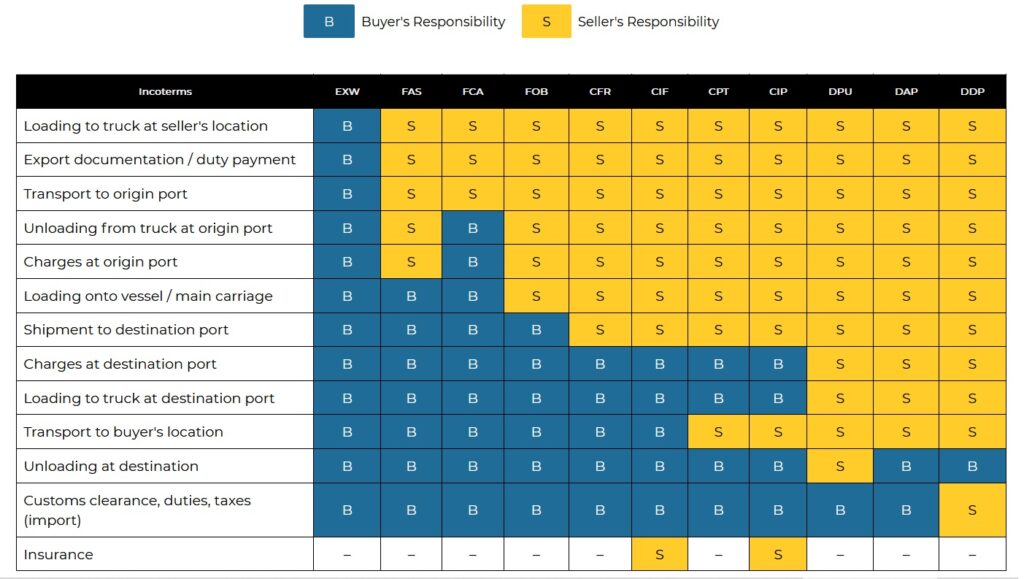
Note: For CIF and CIP the seller is obligated to purchase insurance on the buyer’s behalf, but for CIP that cover must meet the higher Institute Cargo Clause A standard. The point at which risk transfers from seller to buyer differs from the point at which the seller pays the cost of carriage, so the parties benefit from reading the rule in full.
Incoterms® Acronyms
- EXW = Ex Works
- FAS = Free Alongside Ship
- FCA = Free Carrier
- FOB = Free On Board
- CFR = Cost and Freight
- CIF = Cost, Insurance, and Freight
- CPT = Carriage Paid To
- CIP = Carriage and Insurance Paid To
- DPU = Delivered at Place Unloaded
- DAP = Delivered at Place
- DDP = Delivered Duty Paid
Incoterms® in Detail
Let us look at the Incoterms® used for the transportation of goods. We have categorized them based on the mode of transport.
A. Incoterms® for Sea and Inland Waterway Transport
1. FAS (Free Alongside Ship) (named port of shipment)
The international commerce term Free Alongside Ship (FAS) indicates that the seller must take on the responsibility of clearing goods for export at customs and delivering them to an agreed-upon sea or inland port alongside the ship that the buyer has designated. When using the FAS rule, the sales contract must separately outline the payment amount and the payment mode. The chosen Incoterm dictates the permitted mode of transportation, the mechanics of delivery, the exact point of risk transfer, and the allocation of freight and insurance costs.
It is the seller’s responsibility to clear the goods with customs for export. The buyer assumes the cost of loading, sea transportation, and insurance. FAS facilitates the shipping of a variety of items that are not transported in containers; items that are transported in containers are generally delivered to a container yard or terminal, and the buyer must then collect them from there. Because FAS is exclusively designed for sea and inland waterway transport, the goods must be delivered alongside the nominated vessel at the designated port of shipment, rather than an inland destination.
2. FOB (Free On Board) (named port of shipment)
The Incoterm FOB (Free On Board) applies to goods transported by ships and boats through seas, rivers, and canals. The seller is responsible for transporting the goods to the departure port and pays for all associated costs and risks up to that point. The seller acquires the necessary export permits and other documentation. The seller’s responsibility ends once the goods have been loaded on board the vessel at the named port of shipment.
The buyer then assumes all liabilities for the goods, including freight and insurance costs. The buyer takes delivery of the goods at the named port of shipment once they are on board, and all responsibilities associated with the goods transfer from the seller to the buyer. Note that the ICC recommends FCA rather than FOB for containerized goods, because the seller usually hands such goods over before they are loaded on board.
3. CFR (Cost and Freight) (named port of destination)
Under the CFR (Cost and Freight) rule, it is the seller’s responsibility to arrange and pay for transporting the goods by waterway — sea, river, or canal — to a destination port specified by the buyer. This contract is suited to transporting goods in bulk that cannot be packed inside a container. In addition to paying for the transport of the goods, the seller pays for delivering the goods to the agreed-upon departure port. The seller must also pay for acquiring export licenses and for loading the goods onto the transport vessel. The seller’s risk of loss or damage ends once the goods are loaded on board the vessel. Unlike CIF, the CFR contract does not require the seller to insure the goods during the main carriage, so the buyer arranges insurance if they deem it necessary.
Once the goods are loaded onto the transport vessel, the buyer becomes responsible for any loss or damage to the goods. The seller must provide the buyer with all essential documents such as invoices, proof of delivery, and any other documents the buyer needs to accept delivery of the goods at the destination port. The buyer is responsible for acquiring any import licenses or other permits and paying any customs duties and taxes levied by the destination country.
4. CIF (Cost, Insurance, and Freight) (named port of destination)
Cost, Insurance, and Freight is an Incoterm in which the seller is responsible for transporting the goods by sea or inland waterway to a destination port specified by the buyer. The seller pays all the transportation costs from the seller’s premises to the departure port and then from the departure port to the destination port. The seller is responsible for procuring export licenses and other documentation and loading the goods onto the transport vessel.
Although the seller’s risk of loss or damage ends entirely once the goods are on board, the seller must still procure insurance to cover the buyer’s risk during transit. Under Incoterms® 2020, the minimum insurance the seller must provide for CIF remains at the lower Institute Cargo Clause C level, reflecting its common use in bulk commodity trades. The buyer and seller may agree on a higher level of cover. The ICC advises against using the CIF rule for goods transported in containers, recommending CIP instead.
Along with paying the contract sale price, the buyer must acquire import licenses and any official authorizations and complete all necessary customs formalities for importing the goods. Where the goods pass through several countries on the way to the final destination, the buyer handles transit formalities. The buyer bears the risk of loss or damage to the goods once they are on the ship and receives the goods when they are delivered at the destination port. The buyer pays for unloading the goods at the final destination.
B. Incoterms® for Any Mode of Transport
1. EXW (Ex Works) (named place of delivery)
In the Ex Works contract, the buyer transports the goods from the seller’s premises to the buyer’s destination. The transport mode may be whatever is convenient for both parties — road, rail, air, sea, or waterway. The buyer is responsible for loading the goods for transportation, acquiring export and import licenses, getting security clearances, paying taxes and customs duties, unloading the goods at the destination, storing the goods at a warehouse at the destination, and all other costs and liabilities. Because the buyer bears the risk of loss or damage during transit, they typically arrange for their own insurance; however, the EXW rule imposes no legal obligation on either party to insure the goods. The primary responsibility the seller has is to make sure that the goods are properly packaged and made available at the agreed location, while providing the commercial invoice. The buyer is entirely responsible for arranging shipping and completing all customs documentation.
The buyer may request the seller to load the goods at the buyer’s risk. If the buyer does not have the capability to complete the necessary export procedures, or if the country does not allow foreign entities to do so, the buyer may request the seller to assist in obtaining export licenses and other documentation at the buyer’s expense. EXW represents the minimum obligation for the seller.
2. FCA (Free Carrier) (named place of delivery)
The Incoterm FCA is suitable for any transport mode — rail, sea, road, and air — and for more than one transport mode. Under FCA, the seller arranges for packaging the goods and delivering them, cleared for export, to the carrier or another party nominated by the buyer at the agreed-upon place of delivery.
The seller must assume the responsibility of getting the goods cleared for export through customs. Where the named place is the seller’s premises, the seller loads the goods onto the buyer’s collecting vehicle. Where the named place is another location, such as a terminal or a freight forwarder’s warehouse, the seller delivers the goods there but is usually not responsible for unloading them. Once the goods are delivered to the carrier at the named place, they become the buyer’s responsibility. The buyer must arrange and pay for the main carriage, unload the goods at the port of the buyer’s choice, and transport the goods to the final destination.
A notable revision in Incoterms® 2020 addresses containerized sea shipments. Although the ICC recommends FCA for containers, many exporters historically used FOB because banks issuing letters of credit required an on-board bill of lading. Under the 2020 rule, the parties may agree that the buyer will instruct its carrier to issue an on-board bill of lading to the seller once the goods have been loaded. The seller then tenders that document to the buyer. This allows FCA to work smoothly with letter-of-credit requirements. The 2020 edition also recognizes that the buyer or seller may use their own means of transport under FCA rather than engaging a third-party carrier.
3. CPT (Carriage Paid To) (named place of destination)
The Incoterm CPT is used for any transport mode such as air, rail, road, sea, and inland waterway, and also for a combination of these transport modes. In this type of sales contract, the seller assumes the responsibility for packaging the goods and arranging and paying for their transport to the agreed-upon location, as well as paying any required export fees and taxes in the country of origin.
The seller, however, does not undertake the responsibility for insuring the goods during transit. Once the goods have been delivered to the first carrier, the seller is no longer responsible for the goods, and the entire risk of loss or damage transfers to the buyer.
This holds true the moment the goods are handed to the first carrier. Even if subsequent carriers still have to move the goods toward the buyer’s destination, the responsibility for any loss or damage lies wholly with the buyer. So if one of the still-to-arrive trucks gets into an accident en route and the goods are damaged, the buyer bears the loss.
To avoid such a situation, the buyer may prefer to insure the goods beforehand. In addition to insuring the goods, the buyer must also pay for their unloading at the destination, unless otherwise agreed, and for transporting them from there to a warehouse or any other destination of the buyer’s choice.
4. CIP (Carriage and Insurance Paid To) (named place of destination)
The CIP Incoterm is used for any rail, ship, air, inland waterway, and road transport mode, and even for multiple forms of transportation. In the CIP sales contract, the seller assumes responsibility for packaging the goods and for insuring them. Under Incoterms® 2020, the seller must obtain a higher level of insurance cover for CIP. That cover must comply with Institute Cargo Clause A (“all risks”) for at least 110 percent of the contract value. This reflects the rule’s common use for manufactured goods, and it is a key change from Incoterms® 2010, under which only the minimum Clause C cover was required. If the buyer wants additional insurance coverage for the goods during transit, they arrange it at their own expense.
The seller is also responsible for clearing the goods for export from the country of origin and for arranging the transportation of the goods from the seller’s premises to the location previously agreed upon with the buyer.
Once the goods have been delivered to the first carrier, the seller is no longer responsible for them. The buyer assumes the risk of loss or damage, even though the seller continues to pay for carriage and insurance up to the named destination. The buyer is responsible for obtaining the import permit, completing import formalities, and unloading the goods unless otherwise agreed. The named place indicates the destination to which carriage and insurance are paid. So if the contract says CIP San Francisco, the seller must pay for the freight and insurance of the goods all the way to San Francisco.
5. DPU (Delivered at Place Unloaded) (named place of destination)
DPU replaced DAT (Delivered at Terminal) in Incoterms® 2020. The name was changed because the place of destination can be any location — a warehouse, container yard, transport hub, quay, construction site, logistics centre, or any other point — and not just a terminal. DPU is the only Incoterm rule that requires the seller to unload the goods at the named place of destination.
In the DPU contract, the seller is responsible for packaging and transporting the goods to the designated place by whatever transport mode is convenient and for unloading them there. The seller bears all risks involved in bringing the goods to, and unloading them at, the named place. Neither the seller nor the buyer is obligated to insure the goods, though either may choose to. The seller must obtain export licenses and provide invoices, proof of delivery, and any other necessary documentation to the buyer. Once the seller has unloaded the goods at the named place, the risk of loss or damage transfers to the buyer. The buyer is responsible for obtaining import licenses and paying taxes and customs duties for importing the goods.
One practical caution: if the goods must be cleared through customs before they can reach the named place, customs delays can trigger demurrage — the charges that build up when goods sit at a port longer than the allotted free time. For this reason, the parties benefit from choosing a destination where unloading can reliably take place.
6. DAP (Delivered at Place) (named place of destination)
Under DAP, the seller is responsible for packaging and transporting the goods to the agreed-upon destination, ready for unloading. The seller can use any mode of transport and bears all the associated risks up to the delivery point. Unlike DPU, the seller is not responsible for unloading the goods — they are delivered ready for the buyer to unload. The seller is required to obtain export licenses and prepare documents such as the invoice, proof of delivery, and any other required documentation. When the goods reach the named place of destination, the risks associated with the goods transfer to the buyer. The buyer is responsible for unloading the goods, obtaining import licenses, paying taxes and customs duties, and arranging for any further transportation. Incoterms® 2020 also recognizes that the seller may use its own means of transport under DAP.
7. DDP (Delivered Duty Paid) (named place of destination)
Under the Incoterm Delivered Duty Paid (DDP), the maximum responsibility for delivering the goods lies with the seller. The seller must deliver the goods to the agreed-upon destination at the agreed-upon date and time. The seller also pays all the costs associated with the delivery, including import duties and taxes. The buyer should note that the price of the goods reflects all the charges incurred by the seller.
The seller may transport the goods by road, railway, airway, or waterway and is liable for any loss or damage until they are delivered. The seller must obtain all necessary export and import clearances and pay any taxes and customs duties imposed on the goods. The rule itself does not require insurance, but the seller bears the risk during transit and may choose to insure the goods.
Two issues deserve attention. First, in some countries only locally registered entities can act as the importer of record or recover certain taxes — meaning a foreign seller may not legally be able to take on the import role. Second, in some countries the import laws are complex enough that the buyer is more likely to have the expert knowledge needed to obtain clearances, often at lower cost. If the parties agree that the buyer is to bear the cost of VAT or other import taxes, this is typically made clear in the contract (for example, “DDP, VAT unpaid”).
The seller must prepare all necessary trade documentation, such as the commercial invoice, packaging and transport contracts, proof of delivery, and any required export and import clearance documents. Once the goods are delivered to the named place, the buyer is responsible for unloading the goods and for all costs and risks thereafter. Incoterms® 2020 also recognizes that the seller may use its own means of transport under DDP.
Choosing the Right Incoterm
The right Incoterm depends on the type of goods, the mode of transport, the bargaining position of the parties, customs capabilities, insurance needs, and the level of control each party wants over logistics. A rule that suits a bulk-commodity shipment between experienced commodity traders may be entirely wrong for a containerized shipment of finished goods sold on a letter of credit.
For containerized shipments, FCA, CPT, or CIP are usually more appropriate than FOB, CFR, or CIF, because the seller typically hands containers over to the carrier before they are loaded on board the vessel. For sea bulk cargo and traditional commodity trades, FAS, FOB, CFR, and CIF remain commonly used and well understood by the market.
For buyers who want maximum control over freight and main carriage, FCA is often the most practical choice. For sellers willing to arrange carriage but unwilling to take on import clearance in the destination country, CPT, CIP, DAP, or DPU usually fit the transaction better. For buyers who want the seller to handle nearly everything, DDP can be attractive, but the seller must be both legally able and operationally prepared to manage import obligations in the destination country before agreeing to it.
Common Real-World Pitfalls
Even experienced traders trip over a handful of recurring mistakes. Most stem from choosing a rule out of habit rather than matching it to the actual shipment.
Using sea-only rules for air or container freight. FOB, CFR, CIF, and FAS were built around goods loaded over a ship’s side at a named port. They are frequently — and incorrectly — applied to air shipments and to containerized cargo handed over at a terminal. For containers, the seller usually relinquishes the goods before they are loaded on board, so risk and responsibility don’t line up with where the rule says they transfer. FCA, CPT, and CIP are designed for these situations and avoid the mismatch.
Confusing who pays with who bears the risk. Under CFR, CIF, CPT, and CIP, the seller pays for carriage all the way to the destination, but the risk transfers to the buyer much earlier — at loading or at the first carrier. A buyer who assumes “the seller is paying for shipping, so the seller carries the risk” may discover too late that a loss in transit is theirs to absorb. Reading the rule’s risk-transfer point, not just its cost allocation, prevents this.
Underestimating destination customs under DDP. DDP looks attractive to buyers because the seller handles everything, including import duties and taxes. But a foreign seller may not be allowed to act as the importer of record, may struggle to recover local VAT, and may face import procedures it doesn’t understand. The result can be stalled shipments and unexpected costs. DDP works best when the seller has a genuine, established presence in the destination country.
Forgetting the on-board bill of lading problem under FCA. When a sale is financed by a letter of credit, the bank typically wants an on-board bill of lading before releasing payment. Under FCA, delivery happens before the goods are loaded, so the seller can’t automatically produce that document. The Incoterms® 2020 fix — arranging for the carrier to issue an on-board bill to the seller — only works if the parties agree to it in advance.
Examples in Paper Trade
The following scenarios apply the rules above to a paper-trade setting. They are illustrative; the actual obligations come from whichever rule and named place the parties select.
A US kraft paper mill shipping rolls to a converter in India. If the mill sells CIF Nhava Sheva, it arranges and pays for ocean freight to that port and buys Institute Cargo Clause C insurance for the buyer’s benefit. Risk passes to the Indian converter the moment the rolls are loaded on board at the US port — so a storm-damaged cargo mid-voyage is the buyer’s loss to claim, even though the mill paid the freight and the basic insurance. The converter handles Indian import clearance, duties, and unloading at the destination. Because kraft rolls here are break-bulk rather than containerized, CIF is a defensible fit.
The same mill ships cut-size copy paper in containers, financed by a letter of credit. Containerized cartons handed over at a US terminal point toward FCA rather than FOB. The mill clears the goods for export and delivers them to the carrier; risk passes there. Because the buyer’s bank needs an on-board bill of lading to release payment, the parties agree in advance that the buyer will instruct the carrier to issue that document to the mill, which then presents it through the banks. This keeps the letter-of-credit transaction moving without forcing the mill into a sea-only rule that doesn’t match how containers actually move.
Obsolete Incoterms®
The terms below are no longer part of the current Incoterms® rules but are included here for historical reference, as older contracts may still refer to them.
Removed or renamed in Incoterms® 2020
DAT (Delivered at Terminal) was renamed DPU (Delivered at Place Unloaded) in 2020. The substance of the rule is essentially the same — the seller delivers and unloads the goods at the named place and bears all risk until unloading is complete — but the name was changed to clarify that delivery can occur at any place, not only a “terminal.” See the DPU section above.
Removed in Incoterms® 2010
The following Incoterms® from the year 2000 were removed by the ICC when it published the 2010 rules. They are no longer recognized but are sometimes still seen in older contracts.
1. DAF (Delivered At Frontier)
The shipping term Delivered At Frontier (DAF) was replaced by Delivered at Terminal and Delivered at Place in 2010. When this term was in use, its precise meaning differed in various countries, but it usually referred to goods being transported by road or railway across international borders.
Under this contract, the seller was responsible for transporting the goods to an agreed point at the frontier. The seller paid all the costs and risks associated with delivering the goods to the frontier, procured export licenses, and paid export customs duties and taxes. The seller had to provide the buyer with all the necessary documentation.
The seller was under no obligation to insure the goods while they were in transit. However, if the buyer asked for assistance in obtaining insurance, the seller had to provide all the relevant information for this purpose. Once delivery was taken at the frontier, the costs and risks became the buyer’s responsibility, including onward transport, import licenses, and import customs duties and taxes.
2. DES (Delivered Ex Ship)
The Incoterm Delivered Ex Ship was made obsolete in 2010, and the terms Delivered at Terminal or Delivered at Place were used in its place. In this contract, the seller was responsible for transporting the goods by sea or inland waterway to the specified destination port. The seller paid for transporting the goods to the departure port, loading the goods onto the vessel, procuring export licenses, and any other costs, and bore the risk of loss or damage until the destination port was reached.
The seller was not obliged to provide insurance for the goods in transit but was expected to give the buyer all the necessary information and assistance to obtain insurance if requested. At the destination port, once the goods were made available on board, responsibility transferred to the buyer, who became responsible for unloading the goods, acquiring import permits, and paying customs duties and taxes.
3. DEQ (Delivered Ex Quay)
Delivered Ex Quay (DEQ) was a standard contract term defined by the ICC. It was made obsolete in 2010 and replaced by Delivered At Terminal (DAT).
The DEQ contract was used only when goods were delivered by ship to a quay located in a harbor or on the bank of a river or canal. The seller was responsible for delivering the goods to the destination quay and paying for the packaging and transportation costs and was liable for any loss or damage to the goods, as well as any other necessary costs. The seller was usually also responsible for paying any taxes and customs duties associated with the goods, in which case the contract was denoted as duty paid; if the buyer agreed to pay the taxes and duties, it was denoted as duty unpaid.
The seller was responsible for preparing all documentation necessary to deliver the goods to the buyer, which could be in electronic form. The seller had to hold any export and import licenses or legal permits required. Insurance in transit was not the seller’s responsibility; if the buyer wished to insure the goods, they did so at their own expense, with the seller expected to assist with the necessary information and documentation.
4. DDU (Delivered Duty Unpaid)
The contract term Delivered Duty Unpaid was replaced by Delivered at Place (DAP) in 2010, but the term is still sometimes used in international trade. In this contract, the seller was responsible for delivering the goods to the specified destination, bearing all the risks and costs of transporting the goods. The seller was not obligated to insure the goods in transit but was held liable for loss, damage, or theft. The seller had to obtain export licenses and any other permits and prepare documentation such as invoices.
The buyer was responsible for acquiring import licenses and paying taxes and customs duties to take delivery of the goods at the destination. Thereafter, all the risks and costs associated with the goods, such as unloading and further transportation, were the buyer’s responsibility. Both the seller and buyer often preferred this contract, as each was responsible for the export and import formalities in their own country.
Conclusion
Incoterms® 2020 gives sellers and buyers a clearer and more modern framework for allocating costs, risks, and responsibilities in international trade. The rules establish who arranges carriage, who clears the goods for export and import, who pays for insurance, where delivery occurs, and when risk transfers from one party to the other. Used well, they remove a major source of friction from cross-border transactions. Used carelessly, they can create costly misunderstandings — which is why traders commonly identify the chosen rule, the named place or port, and the version (such as “Incoterms® 2020”) in the contract, and address title transfer, payment terms, governing law, dispute resolution, product specifications, and any special logistics or insurance arrangements separately.
Disclaimer:
This Incoterms® 2020 guide is for general informational purposes only and does not constitute legal, customs, shipping, insurance, or commercial advice. Parties should review the official ICC rules and consult qualified legal, trade, or logistics professionals before applying any Incoterm to a contract.