

📌 Key Takeaways
Route cupstock specification questions to the right internal reviewer — procurement, QA, production, or compliance — before comparing suppliers on price.
- Sort Questions by Owner First: Coating, food-contact, and runnability questions each need a different specialist, so assign review owners before supplier comparison starts.
- “Food Grade” Is a Starting Point: That label alone does not confirm which foods, temperatures, or markets the documentation actually covers — compliance teams should verify.
- Samples Do Not Prove Line Performance: A cupstock sheet that looks good by hand may fail at real machine speeds, so production teams need forming trials before approval.
- Sustainability Claims Need Scope Checks: A “recyclable” label on the base paper may not apply to the coated cup — route claim evidence to compliance or legal before using it.
- Fill Documentation Gaps Before Pricing: Once a supplier wins on price, unresolved technical or compliance gaps become much harder to challenge objectively.
Assign review owners early so procurement, QA, production, and compliance approve the same specification — not different versions of it.
Cupstock procurement teams and paper cup manufacturers evaluating new suppliers will gain a clear escalation framework here, guiding them into the specification-by-specification review details that follow.
~ ~ ~ ~ ~ ~ ~ ~ ~ ~ ~ ~ ~ ~ ~ ~ ~ ~
Cupstock selection touches more than price and lead time. A coating decision can determine whether cups seal reliably on a forming line. Documentation gaps can surface weeks later as food-contact disputes in a destination market the buyer never verified. And tolerance ambiguity on base paper properties — stiffness, caliper, moisture — can turn a promising supplier trial into a production stoppage.
Most procurement teams already know what to ask. The harder question is which answers they can evaluate themselves and which need input from QA, production engineering, or compliance before a supplier moves forward. When that boundary remains unclear, specification questions get treated as buying questions. Cupstock supplier claims get repeated without document review. Quotes get compared against requirements that different internal teams understand differently.
This article provides an escalation map: what stays in procurement, what routes to technical review, what needs compliance input, and when to pause supplier comparison until internal reviewers agree.
Start by Separating Buying Questions from Review Questions
Procurement handles commercial questions every day — MOQ, lead time, quote validity, payment terms, packing, delivery. These have straightforward answers that do not depend on technical judgment or regulatory context.
Other cupstock questions sit in different territory. Technical questions — GSM, caliper, stiffness, coating side, sealing behavior, curl, moisture, runnability — require input from packaging technologists or production engineers. QA questions around tolerances, acceptance criteria, sampling plans, batch consistency, and test methods need quality team involvement. Compliance questions about food-contact declarations, migration testing, destination-market documentation, and sustainability claim evidence require regulatory or legal review.
Supplier data sheets arrive in inconsistent formats, making structured comparison difficult without preliminary field alignment. Procurement can collect documentation, but should not independently validate technical claims or compliance-sensitive statements.
The routing matrix below maps common cupstock specification areas to review owners. Assign these before comparing suppliers — not after a dispute.
Cupstock Specification Review Routing Matrix
| Specification Question Area | Why It Matters | Primary Review Owner | Evidence to Request | Escalation Trigger |
| Base paper properties | Affects forming, stiffness, conversion fit | Packaging technologist / QA | TDS, test methods, tolerances | Missing tolerance bands or unnamed test methods |
| Coating type and side | Affects sealing, barrier, cup use | Technical / production | Coating description, side, weight, intended use | Supplier uses vague terms like “food grade” only |
| Food-contact suitability | Affects legal and customer acceptance | Compliance / regulatory | Declaration, test reports, intended-use statement | New destination market or food-contact claim |
| Heat and beverage conditions | Affects use-case fit | QA / technical / compliance | Temperature and contact assumptions | Hot-fill, hot beverage, acidic or fatty use |
| Runnability and cup forming | Affects production continuity | Production / converting team | Production-equivalent samples, trial records | New supplier, new coating, new GSM range |
| Sustainability claims | Affects packaging claims and market access | Compliance / sustainability | Claim-specific evidence | Recyclable, compostable, PFAS-free, or plastic-free wording |
This matrix is a workflow tool, not a compliance instrument. Specific test names, regulatory requirements, and document sufficiency decisions require verification by qualified reviewers.
Coating Questions That May Need Technical Review
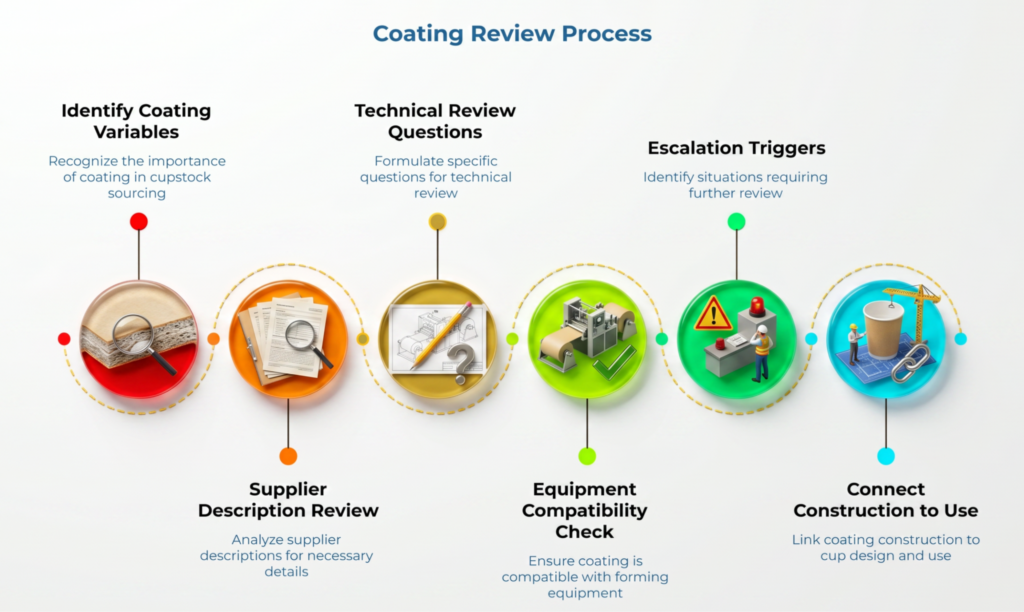
Coating is among the most consequential variables in cupstock sourcing. It affects heat sealing, barrier performance, cup-forming behavior, and converting-line runnability. Beyond those primary concerns, coating details can also influence leakage risk, cracking, stacking, and production consistency. Yet supplier descriptions often stay broad — “PE-coated” or “food-grade coated” — without the detail that technical teams need.
Technical and production reviews must explicitly answer: What coating type is applied, and on which side? Is the material single-side or double-side coated? What coating weight or range is specified? What sealing method and forming conditions has the supplier tested? Are the samples production-equivalent, or lab and hand samples only?
For example, a supplier quoting ‘PE-coated cupstock’ without specifying layer breakdown or tested sealing windows requires immediate technical routing to determine equipment compatibility. Procurement can request clarification, but evaluating whether that coating suits a specific forming line and cup design is a judgment for packaging technology or production engineering.
Escalation triggers include: the supplier cannot confirm coating weight ranges, sealing behavior has not been tested under the buyer’s forming conditions, or a non-PE barrier coating alternative is offered without comparable performance documentation.
No coating category should be treated as universally suitable by name alone. Review should connect the actual construction to the cup design, sealing process, filling conditions, storage conditions, and intended food-contact use.
Food-Contact and Documentation Questions That May Need Compliance Review
Statements like “food grade,” “safe for beverages,” or “compliant” are starting points, not conclusions. Each carries assumptions about food types, temperatures, contact durations, material layers, and jurisdictions that the documentation may or may not cover.
Questions that typically need compliance or QA input:
- What intended food-contact use does the documentation cover — hot beverages, cold beverages, fatty foods, acidic contents, or general contact only?
- Which material layers are addressed — base board, coating, ink, adhesive, additives, or finished cup construction?
- Does the declaration or test report name the specific product, grade, batch, or supplier entity?
- Which jurisdiction or customer standard does the claim reference?
A common friction point: a supplier describes a grade as “food grade” but provides only a generic certificate that does not name the product, the intended conditions of use, or the regulatory framework. Procurement can request product-specific documentation. Deciding whether that documentation is sufficient for the buyer’s intended use and destination market is a compliance judgment.
Where regulatory context matters, official sources should be consulted directly. In the United States, the FDA provides guidance related to food-contact substances and maintains an inventory of authorized food contact notifications. In the European Union, Regulation (EC) No 1935/2004 establishes the framework for food-contact materials. Requirements vary by jurisdiction, and the references above are illustrative examples — not universal rules. These references should not be used as a shortcut to make legal conclusions inside procurement. They are high-authority starting points for qualified review.
Production-Fit Questions That May Need Line or Converting Input
A cupstock sample can look acceptable in hand evaluation yet fail under actual machine speed, forming pressure, humidity, or heat-sealing temperature. Production teams are the ones who can evaluate whether a grade will run reliably — and too often, they get involved only after procurement has already shortlisted suppliers.
Questions that typically need production or converting input include:
- Has this grade run on similar cup-forming equipment?
- What GSM, caliper, stiffness, moisture, and curl tolerances are stated — and are the test methods named?
- What sample quantity supports a meaningful forming trial?
- What defect criteria should trigger a hold, retest, or supplier escalation?
A sample alone does not prove production consistency. Approval may require production-equivalent trials at representative machine speeds, batch-level documentation, and agreed acceptance criteria.
GSM matters, but it is not a complete performance definition. When suppliers reference specific test methods, technical teams should verify those against recognized standards bodies. ISO publishes standards relevant to paper and board properties — for example, ISO 536 specifies a method for determining grammage. TAPPI publishes test methods, specifications, guidelines, and glossaries for the pulp and paper industry. Confirming alignment between supplier-stated methods and recognized standards reduces ambiguity in acceptance criteria.
The practical point is simple: If a specification names a test value, the buyer should know the test method, tolerance, sampling basis, and acceptance rule. Otherwise, two suppliers may appear comparable while quoting against different assumptions.
Sustainability and Claim Questions That Need Careful Review
Claims such as recyclable, compostable, plastic-free, PFAS-free, responsibly sourced, or recycled content appear frequently in cupstock marketing. They influence buyer decisions, end-customer expectations, and regulatory exposure — but the evidence behind them can vary by product construction, scope, and market.
Questions that typically need compliance, sustainability, or legal review:
- Which exact claim is being made, and does it apply to the base paper, the coating, the finished cup, or the full packaging system?
- Is the claim valid in the destination market?
- What evidence supports it — a certification, a test report, a self-declaration, or a marketing statement?
- Who internally is authorized to approve the use of this claim in buyer-facing materials?
Supplier claims can be broad. A “recyclable” label might apply to the base paper but not to the coated cup. A supplier may describe a material as recyclable, but that may not answer whether the finished coated cup can be described that way in a specific market or customer program. Similarly, a claim tied only to base paper may not support a claim about the full finished cup. Procurement can collect documentation, but deciding whether the evidence supports the claim for the buyer’s specific product, market, and labeling context should be routed to compliance, sustainability, or legal reviewers.
How to Build an Escalation Workflow Before Supplier Comparison
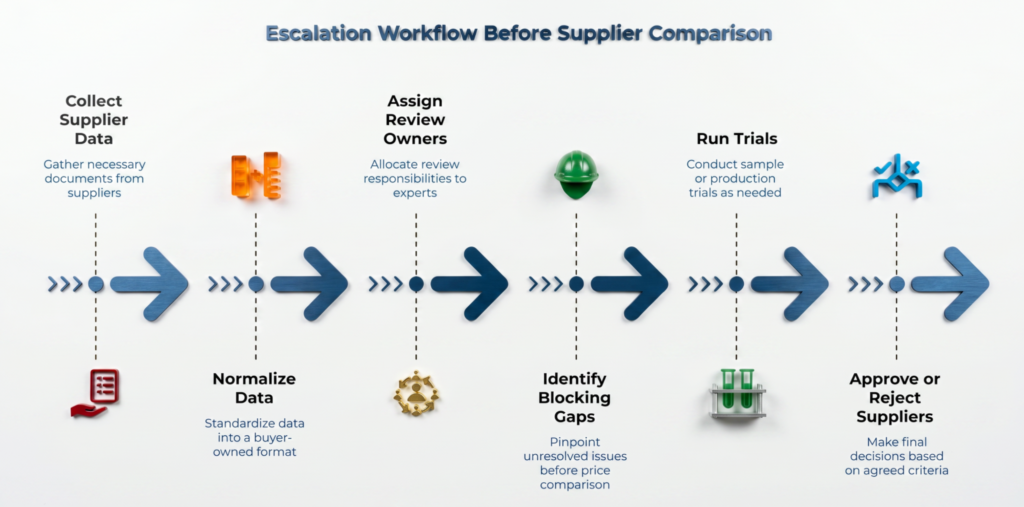
Routing questions to reviewers works best when it follows a structured sequence rather than ad hoc escalation. The escalation workflow should begin before price comparison. Once a preferred supplier has been selected based on price, unresolved technical and documentation gaps become harder to address objectively.
A practical workflow follows six steps.
First, collect supplier data sheets, declarations, test reports, and claim documentation.
Second, normalize collected fields into a buyer-owned specification sheet so suppliers are compared against the same requirements — not against each other’s formats.
Third, assign review owners by question area: procurement for commercial terms, QA for tolerances and acceptance criteria, production for runnability and forming trials, compliance for food-contact documentation and claim evidence.
Fourth, identify blocking gaps — questions where the supplier’s answer is missing, vague, or untested — before moving to price comparison.
Fifth, run sample or production trials where review owners determine they are needed.
Sixth, approve, hold, or reject each supplier based on documented criteria that review owners have agreed on.
Not every document needs to arrive at the screening stage. Light evidence works for initial qualification; deeper proof comes before final approval. Procurement can coordinate the process, but should not be the sole reviewer for technical or compliance-sensitive decisions. This process can make sourcing faster, not slower — it separates normal buying work from technical and compliance-sensitive decisions before the comparison becomes distorted by price.
What to Do When Supplier Answers Are Incomplete
Vague supplier answers are common — especially around coating details, food-contact documentation scope, and sustainability claims. When a response does not clearly answer the question, procurement should not fill the gap with assumptions.
Request product-specific documents rather than generic brochures. Ask for named test methods rather than unspecified claims of conformity. Ask what the supplier’s claim does and does not cover — for instance, whether a food-contact declaration applies to all intended food types and temperatures, or only a subset. Route uncertain answers to the internal specialist responsible for that question area.
If a supplier cannot provide the requested documentation after a reasonable follow-up period, that gap itself is useful information for the review team. A generic certificate, on its own, may not answer a product-specific question.
The important discipline is to avoid converting uncertainty into approval language. Procurement can write, “This answer needs QA review,” or “This claim needs compliance review,” without deciding the technical or regulatory issue alone.
Frequently Asked Questions
Is “food grade” enough to approve cupstock?
Not on its own. “Food grade” is a starting claim that may not specify which food types, temperatures, or jurisdictions the documentation covers. Treat it as a prompt for further review against the buyer’s intended use and destination market.
Should procurement ask for migration test reports?
Procurement can request them, but compliance or QA should determine whether the reports are relevant and sufficient. Migration testing requirements can vary by jurisdiction and food-contact conditions.
Can a cupstock sample prove supplier approval?
A sample supports evaluation, but approval typically requires production-equivalent trials at representative machine conditions, batch-level documentation, and agreed acceptance criteria — not a favorable hand-sheet assessment alone.
Who should approve sustainability claims for cupstock?
That depends on the internal process, but sustainability claims typically need review by compliance, sustainability, legal, or brand and claims teams. Procurement can gather the evidence; the decision to use a claim in buyer-facing materials should not rest with procurement alone.
Build Supplier Approval Around Review Ownership
Strong cupstock procurement depends on routing the right questions to the right reviewers early — before supplier comparison, not after a dispute or a failed trial. The goal is not for procurement to become a compliance expert or a packaging technologist. The goal is to recognize when a specification question needs specialist review, so procurement, QA, production, and compliance approve the same requirement set.
Use the routing matrix above to assign review owners before comparing suppliers. Turn these questions into a review-owner checklist so each team confirms its requirements before the specification is finalized.
Once technical and compliance review questions are clear, explore cupstock suppliers, review cupstock board mills, or submit an RFQ with aligned specifications.
Disclaimer:
This article is for general informational purposes only and does not constitute compliance, safety, technical, or professional advice. Requirements, risks, and best practices may vary by context, jurisdiction, system, provider, or use case. Confirm important decisions with the appropriate qualified professional, authority, or technical expert.
Our Editorial Process:
Our expert team uses AI tools to help organize and structure our initial drafts. Every piece is then extensively rewritten, fact-checked, and enriched with first-hand insights and experiences by expert humans on our Insights Team to ensure accuracy and clarity.
About the PaperIndex Insights Team:
The PaperIndex Insights Team is our dedicated engine for synthesizing complex topics into clear, helpful guides. While our content is thoroughly reviewed for clarity and accuracy, it is for informational purposes and should not replace professional advice.