
📌 Key Takeaways
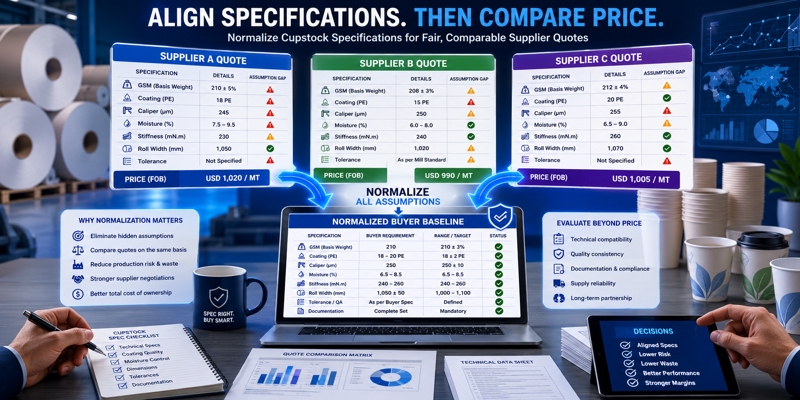
A cheaper cupstock quote can cost more in production if the specs behind each price are not the same.
- Align Specs Before Comparing Price: Two quotes built on different thickness, coating, or moisture assumptions describe different materials, not different prices.
- Tighten Only What Matters: Specs tighter than your machines actually need can shrink your supplier pool and raise costs without improving results.
- Vague RFQs Invite Disputes: Phrases like “food-safe” or “equivalent grade” without defined test methods give suppliers room to deliver material that surprises production.
- Normalize Quotes With a Shared Baseline: A one-page spec template sent to every supplier makes gaps and mismatches visible before price enters the conversation.
- Ask Suppliers the Hard Questions Early: Questions about forming behavior, tolerance limits, and coating documentation surface hidden risks before a production trial does.
Specification clarity is the negotiation leverage most buyers skip.
Procurement and quality teams at growth-stage paper cup manufacturers will gain a practical framework for turning spec trade-offs into stronger supplier conversations, preparing them for the detailed overview that follows.
~ ~ ~ ~ ~ ~ ~ ~ ~ ~ ~ ~ ~ ~ ~ ~ ~ ~
When a paper cup business runs a handful of SKUs from one or two familiar suppliers, cupstock buying stays manageable. Procurement knows the material. Production knows the machine settings. Quotes arrive in a format everyone recognizes.
That simplicity breaks down as the business grows. More cup sizes, more suppliers, more coating needs, and more production variables enter the process — and suddenly two quotes that look comparable on price reflect very different assumptions about GSM (grams per square meter, a measure of basis weight), coating structure, caliper (board thickness), tolerances, and roll dimensions. For growth-stage paper cup manufacturers adding SKUs and supplier relationships in parallel, the lower number may not be the better deal.
Unit price only means something when the specifications behind each quote are aligned. A quote built on different caliper assumptions, wider moisture tolerances, or a different coating weight can shift production outcomes enough to offset any per-ton savings. The practical challenge is identifying which specification trade-offs matter before negotiation starts — not after a production trial reveals unexpected waste or runnability problems (the material’s ability to feed, form, and seal consistently on a converting line).
Why Specifications Turn Price Into a Comparable — or Misleading — Number
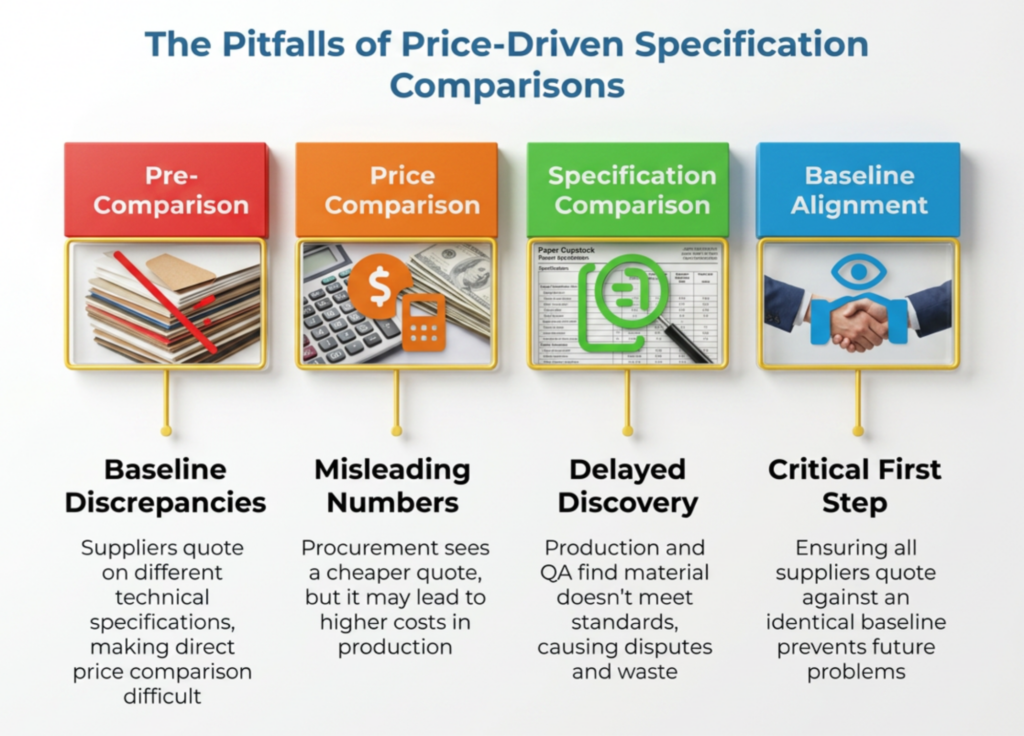
Two cupstock quotes rarely reflect the same technical baseline. One supplier may quote a lighter GSM with a heavier coating. Another may offer tighter caliper tolerances but wider moisture limits. A third may price aggressively on a roll width that does not align with the buyer’s converting layout.
These differences are not always visible in a price-per-ton comparison. A quote that appears cheaper can become more expensive in practice if it creates additional trim waste (material lost during blanking and cutting), slower line speeds, higher reject rates, or longer changeover times.
The deeper risk is sequencing: price comparison happens before specification comparison. When that occurs, procurement sees a favorable number, production sees a material they have not tested, and QA sees a data sheet that does not match the acceptance criteria (the documented standards that define whether incoming material is fit for production). That misalignment is where avoidable disputes and waste tend to originate.
The critical first step is ensuring all suppliers quote against an identical technical and commercial baseline. If the baseline is vague, procurement may see a lower unit price while production later encounters more adjustment work, feeding issues, rejects, or unclear supplier accountability.
Specification Trade-Offs That Can Affect Yield and Waste
Not every specification field carries the same weight in every operation. The trade-offs below highlight how buyer choices impact production fit, waste, and supplier negotiations. Exact outcomes depend on the cup design, machine setup, coating system, end-use requirements, and supplier capability. This matrix is qualitative — a buyer-owned review tool, not a set of prescribed values. It helps procurement, QA, and production discuss which fields should be mandatory, which can stay flexible, and what evidence suppliers should provide.
| Specification Area | Optimization Goal | Trade-Off | Production Implications | Negotiation Question | Evidence Required |
| GSM | Lower material cost | Reduced barrier performance | Forming/rim curl issues | “How does lower GSM affect forming?” | TDS & sample feedback |
| Caliper/Stiffness | Consistent feeding | Higher cost/stiffness mismatch | Sealing/feeding rejects | “What stiffness range is guaranteed?” | Test basis & TDS |
| Coating | Barrier performance | Sealing window variance | Leaking/compliance gaps | “Documentation for barrier claims?” | Compliance reports |
| Moisture/Curl | Dimensional stability | Supplier limitations | Jams/misregistration | “How is curl managed?” | Lot documentation |
| Roll Width | Minimize trim waste | Reduced supplier pool | Avoidable trim waste | “Can you match our layout?” | Roll specs & packaging |
| Tolerances | Consistent production | Higher cost/low flexibility | Batch-to-batch variation | “Which tolerances are critical?” | Acceptance criteria |
Where specific test methods matter, buyers can refer to ISO’s standards for ISO 536 for grammage, ISO 534 for thickness and density, and ISO 287 for moisture content, as well as the TAPPI Standards, Methods, and TIPs portal. The relevant method should be selected by qualified technical or quality personnel for the actual material, market, and application.
Coating trade-offs deserve particular attention. Changing from one PE coating structure to another — or moving toward aqueous or bio-based barriers — can affect sealing windows, converting behavior, and the documentation needed for food-contact claims. Food-contact, recyclability, compostability, and coating-compliance statements should not be treated as generic claims. These must be verified against current, specific jurisdictional regulations (such as US FDA 21 CFR, EU Framework Regulation EC 1935/2004, or relevant national standards for your specific target market, such as UK Food Contact Material regulations or China’s GB standards), and the target market’s legislative framework, and the exact product construction. Compliance documentation must be validated by internal legal or food-safety teams to confirm it meets the requirements of the product’s destination market.
How Tighter Specifications Can Help — or Hurt — Supplier Negotiation
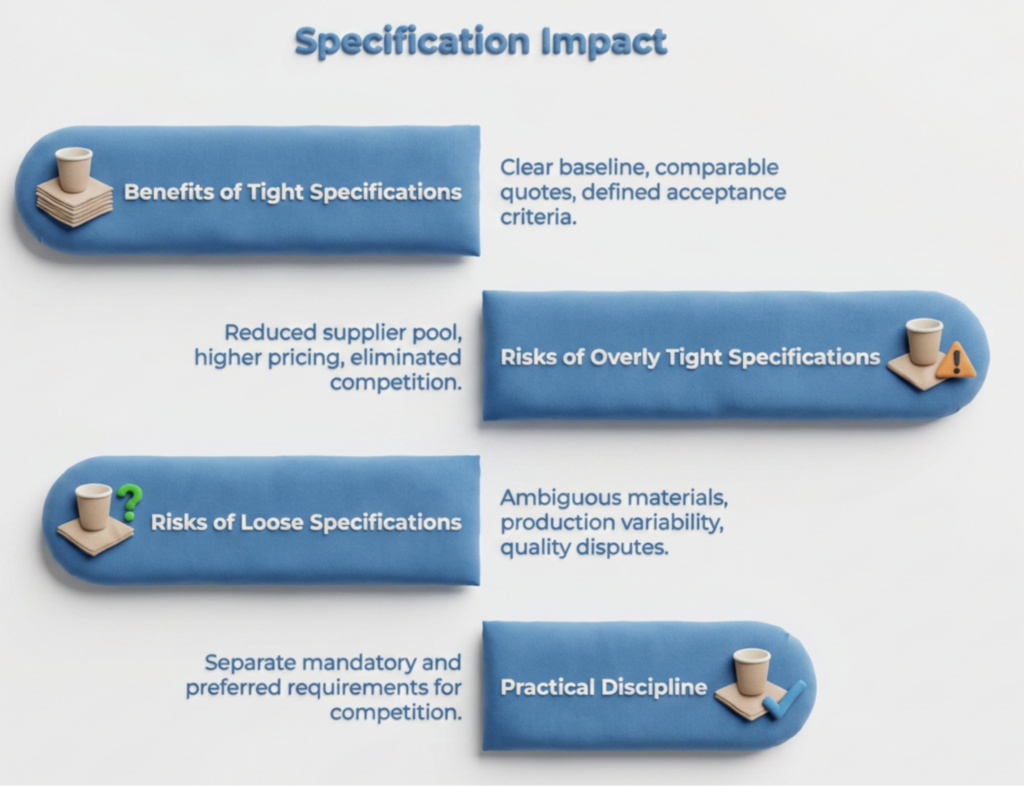
Tightening a cupstock specification is not automatically better. The goal is precision that matches real production needs, not maximum tightness for its own sake.
When specifications reflect verified production requirements, they improve negotiation in several ways. Suppliers can quote against a clear baseline. Quotes become more comparable because every supplier responds to the same technical ask. Acceptance criteria are defined before delivery, not debated after it.
The trade-off appears when specifications become narrower than the operation requires. Overly tight GSM tolerances, for example, can reduce the number of suppliers willing to quote — or push pricing higher without a proportional improvement in production outcomes. Specifying a coating structure that only one supplier offers may solve a technical problem but eliminate competitive tension entirely. A legacy requirement copied from an older grade may no longer be essential, and in that case, the buyer may be limiting competition without improving production confidence.
Loose specifications create a different kind of risk. When a buyer asks for “cupstock, PE coated, 200–250 GSM” without defining caliper, stiffness, moisture, curl limits, or tolerance bands (the acceptable range of variation for a given property), suppliers have wide latitude in what they offer. The resulting quotes may look competitive on paper, but they may describe fundamentally different materials. That ambiguity can surface later as production variability, quality disputes, or unclear accountability.
The practical discipline is separating mandatory requirements — the fields that must be met for the cup to perform — from preferred ranges where some flexibility is acceptable. That separation gives suppliers room to compete on what matters while keeping non-negotiable requirements visible.
Normalize Cupstock Quotes Before Negotiating Price
Price comparison is only useful after technical and commercial assumptions are aligned. A practical normalization sequence helps buyers avoid comparing quotes that reflect different materials, tolerances, or delivery conditions.
Define the buyer-owned baseline specification. Before requesting quotes, document the fields that matter: GSM, caliper, stiffness, coating type and weight, moisture range, curl limits, roll or sheet dimensions, tolerance bands, test methods, and packaging requirements. This baseline becomes the common reference for every supplier conversation.
Ask every supplier to quote against the same fields. When suppliers receive the same specification template, their responses become structurally comparable. Gaps — fields left blank or answered vaguely — become visible before price enters the discussion. If a supplier proposes an alternative grade, keep it separate from the baseline offer so the difference stays visible.
Separate mandatory requirements from preferred ranges. Marking which requirements are non-negotiable and which allow flexibility gives suppliers clarity on where they can compete and where they cannot.
Request test methods and tolerance assumptions. A quoted GSM means different things when suppliers test to different standards. Aligning on test methods before comparing numbers prevents false precision.
Compare price only after assumptions are aligned. Once specifications, test methods, delivery format, and documentation requirements are consistent across quotes, price comparison reflects actual cost rather than an artifact of mismatched assumptions.
Record unresolved assumptions before entering negotiation. If any field remains unclear or unmatched, document it. Unresolved assumptions that enter a negotiation tend to become disputes after delivery.
One area that deserves close attention during this process is vague phrasing in RFQs and internal approvals. Describing material as “same as sample” without defining what the sample proves does not create a comparable specification. Neither does “best price” without aligned specifications, “food-safe” without market-specific documentation and qualified review, “equivalent grade” without explaining which fields must be equivalent, or “approved” without stating acceptance criteria and trial basis. These phrases feel precise but carry no measurable commitment. Buyers strengthen their position by replacing vague language with defined fields tied to specific test methods and acceptance criteria.
What to Verify Before Supplier Approval or Specification Change
Before approving a new cupstock supplier or changing a specification, a short verification pass can reduce problems that only surface after production begins. This is a starting point — procurement, QA, and production teams should adapt it to their approval workflows.
Check whether the supplier has provided:
- Technical data sheet tied to the quoted grade. Confirm that the TDS matches the specific grade being quoted, not a generic product family sheet.
- Coating and food-contact documentation where relevant. If the cup application involves food or beverage contact, request documentation that supports the coating’s suitability for the intended use case. Supplier marketing language is not a substitute for technical declarations or test reports. Food-contact requirements vary by market, product, and regulatory framework — verify rather than assume.
- Test methods and tolerance basis. Confirm which standards the supplier uses for GSM, caliper, stiffness, moisture content (the amount of water present in the board, which affects dimensional stability), and other quoted properties. Mismatched test methods can make two identical-sounding specifications produce different measured results.
- Production-equivalent samples or trial rolls where feasible. Desk samples confirm visual and tactile properties but may not predict runnability. Where possible, request material produced under conditions representative of a full production run.
- Roll dimensions, packaging, labeling, and batch traceability. Confirm that delivered roll widths, diameters, core sizes, wrapping, and labeling match receiving and converting requirements.
- Supplier explanation of acceptable variation. Ask what variation is normal for the quoted grade. This sets expectations and reduces disputes over borderline deliveries.
- Internal QA and production signoff criteria. Before the first delivery, align procurement, QA, and production on what “acceptable” means for the incoming material. A shared acceptance standard prevents the situation where procurement approves a supplier that production later rejects.
Similar verification principles apply across all packaging categories when structuring supplier questions for material consistency.
Converting Trade-Off Awareness Into Supplier Questions
The specification trade-offs covered above become most useful when buyers convert them into direct questions during supplier discussions. The goal is not to interrogate suppliers but to surface assumptions that might otherwise stay hidden until production.
Practical questions to bring to the negotiation:
- “What changes in cup performance or forming behavior if this GSM is adjusted by five to ten points?”
- “Which tolerance is the tightest to hold consistently, and which has more natural variation?”
- “What documentation supports the coating claim for our intended cup application?”
- “What production issues have other converters reported with this grade, and how were they resolved?”
- “Can you quote an alternative grade against the same performance requirement so we can compare options?”
- “If we loosen this tolerance, how does that affect pricing and lead time?”
- “Which roll dimensions, packaging details, or labels should be fixed before order release?”
These questions protect proprietary supplier data while forcing clarity on grade specifications, evidence, and production assumptions. The goal is to shift negotiations from unit-price comparisons toward holistic accountability.
Frequently Asked Questions
Is higher GSM always better for cupstock?
Not necessarily. Higher GSM can improve stiffness and barrier performance for some cup designs, but it also increases material cost and can affect forming behavior on equipment calibrated for lighter board. The right GSM depends on the cup size, wall structure, lid fit, coating system, and end-use performance requirements. Choosing GSM based on a general assumption rather than verified production needs can lead to over-specification — paying more without a proportional benefit.
Can tighter specifications reduce waste?
Tighter specifications can support better incoming material control, which may contribute to more consistent production outcomes. Waste reduction is not guaranteed by tighter specs alone, though. It depends on whether the limits reflect actual production needs, whether suppliers can consistently meet them, and whether QA and production processes are equipped to use the tighter control effectively. Waste outcomes should be verified through production data or controlled trials, not assumed from the specification document.
Should buyers negotiate cupstock price before or after sample review?
Price discussions can happen at any stage, but final comparison is most useful after specifications are aligned, samples have been evaluated, and — where feasible — trial material has been run on the production line. A price agreed before specification alignment may need revisiting if the material does not perform as expected. Treating price as the last variable to finalize gives procurement a stronger position and reduces the risk of approving a quote that creates downstream costs.
Preparing for a Stronger Negotiation
Better cupstock negotiation does not start with asking for a lower price. It starts with knowing which specification fields matter, where the trade-offs sit, and what documentation supports each supplier’s claims.
When procurement, QA, and production align on a shared specification baseline before quotes are treated as comparable, the conversation shifts from price pressure to informed evaluation. A practical first step is building a one-page internal cupstock trade-off matrix — adapted from the framework above — that reflects the operation’s actual cup designs, machine capabilities, and quality requirements. That document becomes the foundation for every supplier conversation that follows.
After defining your cupstock specification fields, compare cupstock suppliers and exporters, review cupstock manufacturers, or use your clarified requirements to submit a cupstock RFQ built on the specification clarity this review supports.
Disclaimer:
This article is for general informational purposes only and does not constitute technical, compliance, safety, legal, or professional advice. Cupstock requirements, production outcomes, supplier capabilities, and food-contact or coating documentation needs may vary by product design, equipment, market, and use case. Confirm important decisions with qualified technical, quality, compliance, or supplier representatives before approving specifications or purchase orders.
Our Editorial Process:
Our expert team uses AI tools to help organize and structure our initial drafts. Every piece is then extensively rewritten, fact-checked, and enriched with first-hand insights and experiences by expert humans on our Insights Team to ensure accuracy and clarity.
About the PaperIndex Insights Team:
The PaperIndex Insights Team is our dedicated engine for synthesizing complex topics into clear, helpful guides. While our content is thoroughly reviewed for clarity and accuracy, it is for informational purposes and should not replace professional advice.