

📌 Key Takeaways
Most toilet tissue stockouts happen because products sit in the wrong place, not because the building ran out.
- Rank Your Restrooms by Risk: High-traffic, public-facing restrooms need more frequent checks than low-use staff restrooms do.
- Stock Supplies Near the Restroom: Backup rolls stored in a distant central room won’t help when a lobby dispenser runs empty during a rush.
- Set Clear Refill Triggers: Tell staff exactly when to restock — like when a twin-roll dispenser’s backup roll becomes the active roll — instead of leaving it to guesswork.
- Plan Separately for Events: Conferences, holidays, and visitor surges need their own restocking routines because normal schedules can’t handle abnormal traffic.
- Track Every Stockout: Logging where, when, and why dispensers go empty turns repeat problems into fixable patterns.
A stocked restroom signals competence — an empty dispenser signals neglect.
Facility managers, custodial supervisors, and commercial procurement leads will gain a ready-to-use prevention framework here, preparing them for the detailed operational guide that follows.
~ ~ ~ ~ ~ ~ ~ ~ ~ ~ ~ ~ ~ ~ ~ ~ ~ ~
Empty dispensers get noticed fast.
A guest complaint lands on the front desk about a bare restroom during a conference break. Two floors down, the supply closet has cases — but the custodian covering the lobby has moved on to the next wing. The operations manager opens a spreadsheet showing the same three restrooms flagged for outages every week. Purchasing ordered the product. The stock sits somewhere in the building. And yet dispensers keep running dry.
In high-traffic commercial environments, empty dispensers signal systematic service failure. In many cases, the problem is not that the facility failed to buy enough products. The issue is that inventory, replenishment timing, backup stock placement, and custodial workflows were not planned around actual restroom demand.
A toilet tissue stockout prevention plan helps Away-From-Home (AFH) operators keep dispensers filled, reduce emergency restocking, and maintain restroom service continuity. Most supply failures trace back to systemic process failures rather than erratic consumption patterns. A structured plan targets these specific mechanical and logistical vulnerabilities. The plan should account for stockout risk factors, high-use restroom locations, peak occupancy periods, backup stock access, and clear service-level expectations for janitorial teams.
For workplace facilities, local rules vary by country and jurisdiction, but the broader expectation is consistent: restrooms and sanitation supplies are basic facility provisions, not optional extras. OSHA mandates that workplace restrooms be kept in a sanitary condition and that employers provide prompt access to these facilities, while the UK HSE Approved Code of Practice for workplace welfare explicitly requires a supply of toilet paper among suitable toilet and washing facilities.
Why Toilet Tissue Stockouts Happen in Commercial Facilities
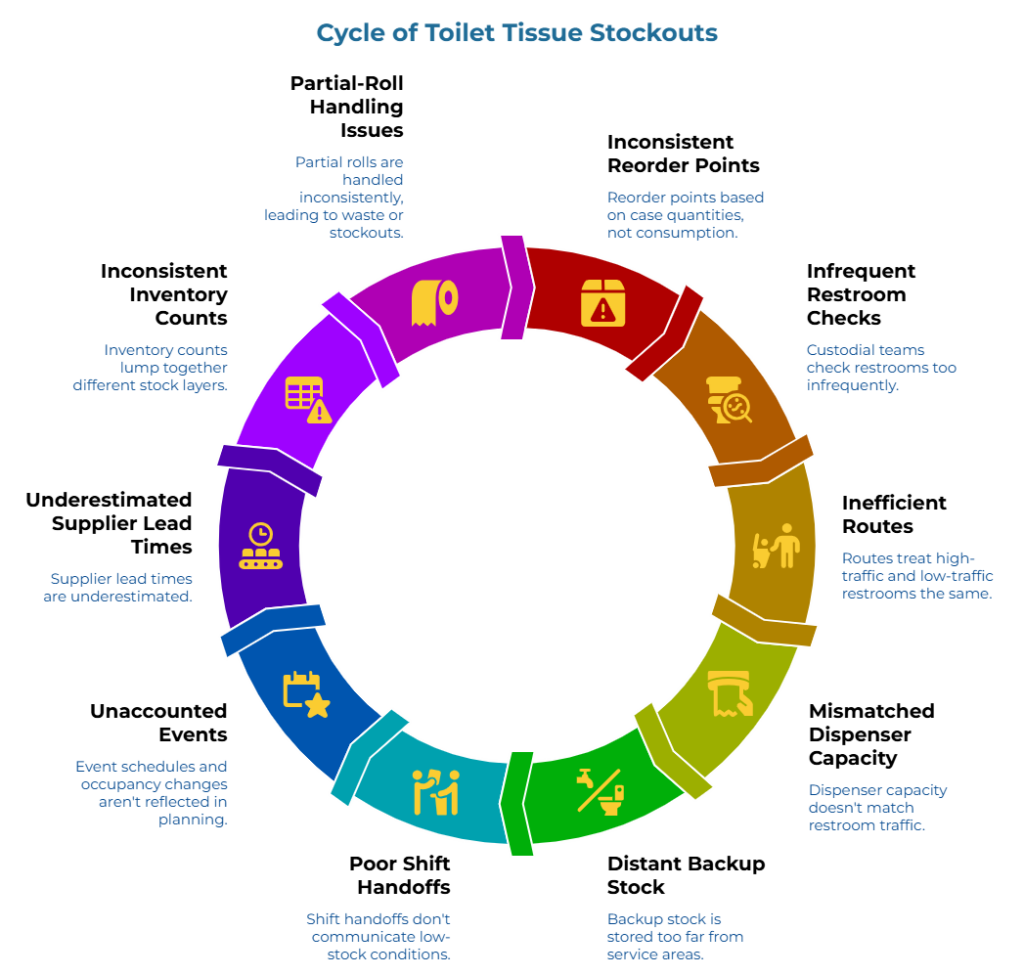
Stockouts are typically caused by multiple small planning failures, not a single procurement shortfall.
A facility may have enough total inventory in the building and still have an empty dispenser in a public restroom. That happens when the central stockroom, janitorial closet, custodial cart, and in-dispenser supply are not tracked as separate inventory layers. Product exists, but it is not available at the point of use.
The most common causes include reorder points based on case quantities instead of actual restroom-level consumption, custodial teams checking restrooms too infrequently, routes that treat a high-traffic lobby the same as a remote staff restroom, dispenser capacity that does not match the traffic a restroom handles, backup stock stored too far from service areas, shift handoffs that do not communicate low-stock conditions, event schedules and occupancy changes not reflected in supply planning, supplier lead times that are underestimated, and inventory counts that lump together central stock, closet stock, and in-dispenser supply.
Partial-roll handling is another practical issue. Removing partial rolls too early creates waste. Leaving partial rolls too long can allow a dispenser to run empty before the next scheduled check. The right answer depends on dispenser type, traffic level, and whether the facility has a documented reuse or consolidation practice. Without a standard trigger, staff make inconsistent decisions that compound stockout risk.
Preventing stockouts requires visibility across consumption, storage, staff workflow, and replenishment timing — not simply a bigger purchase order.
Identify the Restrooms Most at Risk of Stockouts
Not every restroom requires the same replenishment frequency. Facilities should identify “critical restrooms” where a stockout would have the highest impact — and separate them from routine locations that can tolerate a less intensive schedule.
A stockout in a remote staff restroom is inconvenient. A stockout in a hotel lobby restroom, hospital waiting-area restroom, school cafeteria restroom, or venue restroom during intermission is more visible and more disruptive. These are complaint-sensitive locations. They may not always be the largest restrooms, but they carry higher service risk.
| Priority Level | Restroom Type | Replenishment Approach |
| Critical | High-traffic, public-facing, complaint-sensitive restrooms | Check multiple times per shift |
| Standard | Moderate-traffic restrooms used during routine operations | Check during normal cleaning rounds |
| Low-use | Staff-only or remote restrooms | Check on a fixed schedule |
| Event-sensitive | Restrooms affected by meetings, visitor surges, occupancy spikes, or scheduled events | Check before, during, and after peak periods |
Critical restrooms often include lobby restrooms, guest-facing hotel restrooms, patient and visitor restrooms in healthcare, student restrooms near cafeterias and gyms, office restrooms on high-occupancy floors, retail restrooms near entrances, event venue restrooms near main traffic routes, and restrooms serving conference rooms or public waiting areas.
This ranking prevents your custodial team from spending equal effort on unequal-risk areas. The highest-risk restrooms should receive earlier checks, more backup stock, and tighter refill triggers.
Map Stockout Risk Factors by Facility Type
Facility type changes the stockout pattern. Risk varies by building layout, traffic, staff coverage, and operating hours, but several patterns are widely recognized in facility operations.
| Facility Type | Typical Stockout Risk | Planning Response |
| Hotels | Occupancy swings, group bookings, lobby traffic, banquets, and housekeeping shift timing | Tighten checks around lobbies, meeting rooms, restaurants, and ballrooms |
| Healthcare facilities | Waiting rooms, visitor restrooms, emergency departments, and outpatient clinics may have unpredictable demand | Treat service continuity as part of hygiene perception and patient-family experience |
| Schools and universities | Demand spikes before classes, during lunch, after assemblies, near gyms, and during athletic events | Increase checks around cafeteria corridors, auditoriums, gyms, and event zones |
| Commercial offices | Usage varies by floor population, tenant mix, hybrid schedules, and conference-room activity | Set service levels by floor occupancy and meeting density |
| Retail sites and public venues | Weekends, promotions, holidays, festivals, tournaments, and visitor surges can overwhelm normal assumptions | Build event-based restroom demand planning into the schedule |
| Small commercial facilities | Minimal staffing and multitasking | Designate one ‘Primary Stock Lead’ per shift to ensure accountability. |
| Institutional buildings | Large floor plans and dispersed service zones can slow replenishment | Use zone-level backup stock and clear route responsibilities |
In healthcare environments, restroom supply continuity also sits inside a broader hygiene context. The CDC’s Water, Sanitation, and Hygiene (WASH) guidelines note that a lack of clean water, adequate toilets, and handwashing facilities in healthcare settings can significantly increase the spread of healthcare-associated infections (HAIs) among patients, staff, and communities.
Document stockout risk by restroom zone, not just by building. A single office tower, school, hotel, or hospital can contain several different stockout-risk profiles.
Set Restroom Supply Service Levels
A restroom supply service level is the minimum acceptable standard for toilet tissue availability. It turns “keep restrooms stocked” into a measurable commitment that staff can follow and supervisors can review.
| Service Standard | Why It Matters |
| No public-facing dispenser should be empty during open hours | Protects the user experience and reduces complaints |
| Critical restrooms should have nearby backup stock | Speeds replenishment when traffic is high |
| High-use restrooms checked at defined intervals during peak periods | Prevents long gaps between inspections |
| Custodial staff refill before a defined low-roll threshold | Reduces reliance on individual judgment |
| Emergency stock accessible to authorized staff during all operating hours | Prevents night, weekend, or shift-gap failures |
| Stockout incidents logged and reviewed | Turns repeated failures into fixable patterns |
The exact threshold will vary by dispenser type. Standard rolls, jumbo rolls, coreless systems, twin-roll dispensers, and controlled-use dispensers do not need identical refill triggers. The standard should answer one question clearly: the specific inventory threshold that mandates immediate intervention to prevent a service gap.
Standards make replenishment more consistent and auditable.
Place Backup Toilet Tissue Where Staff Can Use It Quickly
Backup stock placement determines replenishment speed more than total inventory volume. A facility may have plenty of products in central storage, but if that room is far from the restroom, locked, or unavailable during certain shifts, it will not prevent service failures.
| Backup Stock Location | Best Use | Watchouts |
| Central storage | Bulk inventory, receiving, case control, and longer-term stock | Too far away for fast response during busy periods |
| Janitorial closets | Shift-level working stock near service routes | Must be organized by product type, dispenser compatibility, and zone |
| Zone-level storage | Large buildings, schools, hospitals, hotels, and venues with multiple wings or floors | Needs access control to prevent clutter, shrinkage, or misuse |
| Custodial carts | Route-based replenishment across several restrooms | Must be restocked at the start or end of each shift |
Match backup rolls to the dispenser type in each zone. Label storage areas by zone or product type. Keep emergency stock accessible during all operating hours. Refill local backup from central inventory on a routine schedule.
Backup stock should be convenient but controlled — poor placement can create shrinkage, clutter, or product damage from improper storage conditions. For storage controls that protect roll condition and accessibility, see PaperIndex’s guide to bathroom tissue roll storage requirements for commercial janitorial programs.
Build Refill Triggers Into Custodial Routines
Standardized refill triggers reduce both stockouts and waste compared to individual staff judgment.
Useful refill triggers include:
- Refill twin-roll dispensers when the reserve roll becomes the active roll.
- Replace or stage backup when a standard roll reaches the defined low-roll level.
- Check jumbo roll dispensers before peak periods — a jumbo roll may appear adequate at 8:00 AM and vanish by noon.
- Coreless systems and controlled-use dispensers may require specific instructions based on dispenser format and roll type.
- Do not remove usable partial rolls without a documented reuse practice.
- Record repeated low-stock findings — recurring patterns signal a need to adjust check frequency or reassess the restocking approach.
The refill trigger serves different roles depending on who uses it. For building service contractors, it should be written into the site routine. For facility supervisors, it should be visible during inspections. For procurement leads, the trigger must align with product type and dispenser capacity. For distributor buyers, repeated low-stock findings can point to usage changes, pack-size issues, or account-level replenishment risk. That is where a refill trigger becomes more than a cleaning instruction — it becomes a stockout-control point.
Plan for Events, Peak Occupancy, and Visitor Surges
Event-based demand spikes are predictable and should have separate replenishment routines. Normal restroom checks are designed for normal traffic. Events, occupancy spikes, and visitor surges are not normal traffic.
Common scenarios include hotel conferences, weddings, banquets, and group bookings; school assemblies, sports events, exams, parent nights, and graduations; office town halls, training sessions, and tenant events; retail holiday traffic; healthcare clinic days, visiting hours, and emergency department surges; and public venue events, festivals, tournaments, and community gatherings.
| Timing | Action |
| Before the peak period | Confirm expected attendance, identify event-adjacent restrooms, check dispensers before doors open, increase backup stock in nearby closets or carts, assign staff check times, and confirm who responds if a restroom runs low |
| During the peak period | Check critical restrooms at shorter intervals, restock before intermissions and breaks, and track low-stock areas |
| After the peak period | Replenish depleted backup stock, record usage patterns, and adjust future event estimates |
The after-event step is easy to skip. It should not be skipped. That is where the facility learns whether the next banquet, exam day, tenant meeting, or holiday weekend needs more stock, more checks, or better cart staging.
Create a Stockout Response Procedure
A prevention plan still needs a response procedure. Deliveries can be delayed. A shift handoff can miss a low-stock note. A restroom can receive unexpected traffic. A dispenser can jam. The response procedure should be simple enough for staff to follow while the facility is open.
| Question | Required Answer |
| Who reports a low or empty dispenser? | Custodial staff, front desk, facility staff, tenant contact, or supervisor |
| Who restocks immediately? | Assigned custodial role or shift lead |
| Where is emergency stock stored? | Named closet, cart, central store, or zone cabinet |
| Who has access during all operating hours? | Authorized staff list or key/access protocol |
| What temporary substitute is approved? | Only products compatible with the dispenser or approved manual-use backup |
| How is the incident logged? | Restroom, time, condition, response time, and likely cause |
| Who escalates central-stock shortages? | Procurement lead, distributor buyer, or facility supervisor |
| How are critical restroom failures reported? | Supervisor notification path and management threshold |
Keep the procedure short. During a shift gap or a busy event, staff need clarity, not a policy manual.
Track Stockout Incidents and Usage Patterns
Simple incident tracking reveals recurring patterns invisible in monthly purchasing data. Monthly case usage may show total consumption. It will not show that one restroom runs low before lunch every Tuesday, that evening staff cannot access the right closet, or that backup rolls are missing from carts after events.
| Data Point | Why It Helps |
| Restroom location or zone | Identifies recurring problem areas |
| Date and time | Shows shift, lunch, evening, weekend, or event patterns |
| Empty vs. low dispenser | Separates service failure from early warning |
| Backup stock availability | Tests whether local storage is working |
| Response time | Shows whether staff can replenish quickly |
| Product or dispenser type | Highlights compatibility or capacity issues |
| Event or occupancy condition | Connects stockouts to demand spikes |
| Likely cause | Guides the correction |
Typically, over a tracked period of several weeks, clear usage patterns emerge that can inform a more structured approach to forecasting commercial toilet tissue usage. If one restroom repeatedly runs low before lunch, increase morning checks. If stockouts cluster during evening shifts, improve shift handoff or local backup. If a restroom with standard rolls runs out often, consider higher-capacity dispensers. If outages happen only during events, build a separate protocol. If backup stock is frequently unavailable, improve closet replenishment schedules or access control.
A simple spreadsheet or custodial checklist is sufficient for many facilities.
Align Purchasing Quantities With Service Continuity
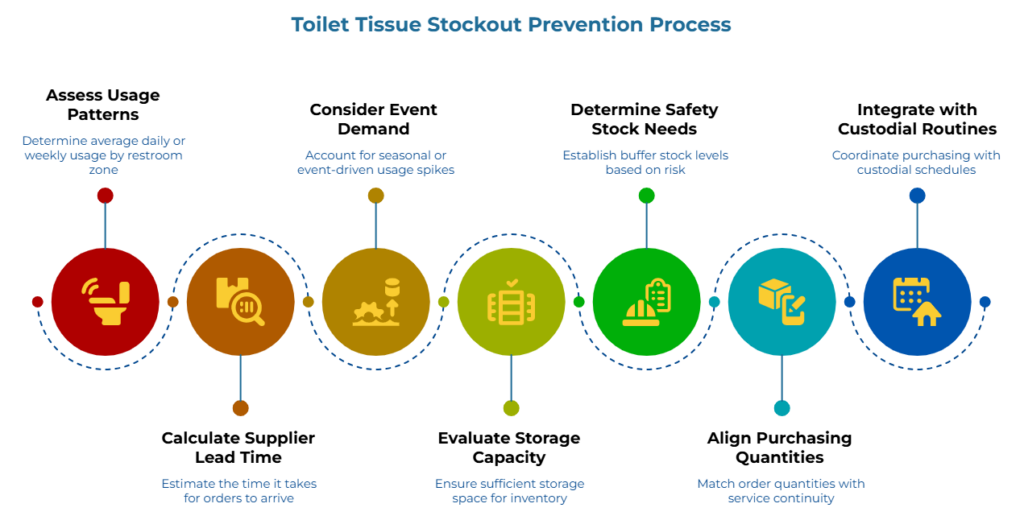
Procurement should protect restroom readiness, not only stockroom inventory. A facility can have toilet tissue on order and still experience a service failure if the order arrives after local stock is depleted. That is why reorder points and safety stock should account for restroom usage, supplier lead time, event demand, dispenser compatibility, and storage capacity.
Important purchasing inputs include average daily or weekly usage, usage variation by restroom zone, supplier lead time, minimum order quantities, case pack sizes, available storage capacity, safety stock needs, seasonal or event demand, dispenser format compatibility, and emergency reorder costs.
The exact safety stock level will vary by facility. A hospital with unpredictable visitor flow, a hotel with banquet traffic, and a small office with stable occupancy should not use the same buffer logic. Higher-risk restrooms and longer supplier lead times require stronger backup coverage.
Treating purchasing as the final link in the prevention chain — aligned with storage, custodial routines, and service standards — changes how reorder points get set.
Stockout Prevention Plan Template
Use this template to turn the plan into an operating document. A one-page version covering these fields, posted in the custodial office and reviewed monthly, provides more structure than most AFH toilet tissue programs have in place today.
| Field | What to Record |
| Restroom zone | Building, floor, wing, department, or public area |
| Restroom priority | Critical, standard, low-use, or event-sensitive |
| User group | Guests, patients, students, tenants, employees, public visitors |
| Dispenser type | Standard roll, jumbo roll, twin-roll, coreless, or controlled-use |
| Normal check frequency | Routine daily or shift-level inspection interval |
| Peak-period check frequency | Event, lunch, occupancy surge, weekend, or holiday interval |
| Low-roll trigger | Specific point when staff must act |
| Backup stock location | Central storage, closet, cart, or zone cabinet |
| Backup stock minimum | Minimum local rolls or cases required |
| Responsible role | Custodial staff, shift lead, supervisor, procurement, or contractor |
| Escalation path | Who is notified when stock is low or unavailable |
| Incident log method | Spreadsheet, checklist, CMMS, or facilities system |
| Review cadence | Weekly, monthly, or after major events |
This is the most important part of the plan. It turns a general intention into assigned work.
For additional perspective on why fixed, linear restocking schedules can fail when demand spikes, see PaperIndex’s article on why linear AFH toilet tissue restocking leads to washroom outages.
Common Mistakes to Avoid
The same mistakes appear across many AFH toilet tissue programs.
| Mistake | Better Control |
| Treating all restrooms as equal-risk locations | Rank restrooms by traffic, visibility, and complaint sensitivity |
| Keeping all backup stock in one distant room | Stage working stock near high-use zones |
| Setting reorder points without supplier lead time | Build lead time into safety stock |
| Ignoring events and occupancy changes | Use a separate peak-period replenishment routine |
| Letting staff use inconsistent refill judgment | Define low-roll triggers by dispenser type |
| Failing to document incidents | Track location, time, cause, and response |
| Buying incompatible products | Match rolls to installed dispensers before ordering |
| Underestimating evening, weekend, or holiday usage | Review stockout logs by shift and day type |
| Relying on emergency orders | Use emergency orders as a fallback, not a plan |
| Measuring only cases on hand | Track central stock, local backup stock, and in-dispenser supply |
The strongest prevention plans are usually not the most complicated ones. They are the ones staff can follow under pressure.
Keep the Restroom Ready, Not Just the Storeroom
Toilet tissue stockouts are preventable when facilities treat restroom supply as a service-continuity requirement. The most effective programs identify high-risk restrooms, place backup stock where staff can access it quickly, define refill triggers, plan for demand spikes, and track recurring incidents.
A good plan tells staff which restrooms matter most. It places backup stock where it can be used quickly. It defines refill triggers before judgment varies by person. It prepares for events, occupancy spikes, supplier delays, and shift gaps. It tracks failures so the same restroom does not keep creating the same emergency.
A stocked restroom signals facility competence. An empty dispenser signals neglect. The difference is a documented plan — and the discipline to follow it.
Review your current dispenser capacity, storage locations, and replenishment schedule to identify where stockout risk is highest. Browse toilet tissue rolls by, or contact commercial toilet tissue suppliers.
Frequently Asked Questions
How can commercial facilities prevent toilet tissue stockouts?
Commercial facilities can prevent toilet tissue stockouts by ranking restroom risk, setting restroom supply service levels, checking high-use restrooms more frequently, placing backup stock near service areas, documenting refill triggers, and tracking stockout incidents. Event demand, occupancy spikes, and supplier lead times should be planned separately from normal usage.
What causes toilet tissue stockouts in AFH restrooms?
Common causes include inaccurate usage estimates, infrequent checks, poor backup stock placement, supplier delays, high-traffic restrooms treated the same as low-use areas, event-related demand spikes, incompatible dispenser products, unclear refill triggers, and inventory counts that do not separate central stock, closet stock, and in-dispenser supply.
Where should backup toilet tissue be stored?
Backup toilet tissue should be stored in a combination of central storage areas, janitorial closets, custodial carts, and zone-level storage near high-use restrooms. Bulk stock should remain controlled, while working stock should be close enough for fast replenishment.
Which restrooms should be prioritized for replenishment?
Facilities should prioritize high-use, public-facing, event-sensitive, and complaint-sensitive restrooms. Examples include lobby restrooms, patient visitor restrooms, student restrooms near cafeterias or gyms, office restrooms on high-occupancy floors, and restrooms near meeting rooms or event spaces.
How often should commercial restrooms be checked for toilet tissue?
Check frequency depends on restroom traffic, dispenser capacity, facility type, operating hours, and service-level expectations. Critical restrooms may need multiple checks per shift, while low-use restrooms may fit into scheduled cleaning rounds.
How should facilities plan toilet tissue supply for events?
Facilities should identify event-adjacent restrooms, check dispensers before the event, increase backup stock nearby, assign staff check times during the event, and review usage afterward. This helps future event estimates become more accurate.
What is a restroom supply service level?
A restroom supply service level is a defined standard for supply availability. A facility may set a standard that no public restroom dispenser should be empty during operating hours, or that high-use restrooms must be checked at defined intervals during peak periods.
How much safety stock should a facility keep?
Safety stock should be based on average usage, supplier lead time, usage variability, storage capacity, and the facility’s tolerance for stockout risk. High-traffic facilities, critical restrooms, and long supplier lead times usually require stronger backup coverage.
What should be included in a toilet tissue stockout prevention plan?
A stockout prevention plan should include restroom priority levels, dispenser types, check frequencies, refill triggers, backup stock locations, event replenishment procedures, emergency response steps, purchasing reorder points, and a method for tracking stockout incidents.
Is buying more toilet tissue the best way to prevent stockouts?
Not necessarily. Procurement volume is secondary to ‘point-of-use’ availability. Stockouts often occur in buildings with full storerooms but inefficient ‘last-mile’ distribution to the dispensers. A stronger approach aligns purchasing, storage, replenishment workflows, and response procedures so the right product reaches the right restroom at the right time.
Disclaimer:
This article is provided for educational and informational purposes only. Facility operations, regulatory requirements, and supply chain conditions vary by location, facility type, and organizational context. Readers should evaluate this guidance against their own operational needs and consult with qualified professionals where appropriate.
Our Editorial Process:
Our expert team uses AI tools to help organize and structure our initial drafts. Every piece is then extensively rewritten, fact-checked, and enriched with first-hand insights and experiences by expert humans on our Insights Team to ensure accuracy and clarity.
About the PaperIndex Insights Team:
The PaperIndex Insights Team is our dedicated engine for synthesizing complex topics into clear, helpful guides. While our content is thoroughly reviewed for clarity and accuracy, it is for informational purposes and should not replace professional advice.