
📌 Key Takeaways
Restroom supply failures start with broken inventory systems, not bad purchasing contracts — and fixing them means treating toilet tissue like a tracked, managed product flow.
- Visibility Beats Volume: A building can be overstocked and still run out if nobody knows where usable inventory actually sits across carts, closets, and stockrooms.
- FIFO Stops Hidden Waste: Using older stock before newer deliveries prevents crushed cases, forgotten closet inventory, and packaging damage from long storage.
- Calculate Backup, Don’t Guess: Multiply daily usage by real supplier lead time, then add a safety buffer — comfort stockpiling ties up space without reducing runout risk.
- Forecast by Traffic, Not by Floor: A visitor-facing lobby restroom can burn through four times more tissue than an employee-only restroom on the same building plan.
- Route-Based Restocking Creates Data: When teams follow set routes, log usage by zone, and replenish carts from central stock, every shift generates numbers that improve the next forecast.
Managed flow beats managed pile — track it, route it, measure it.
Janitorial supervisors and facility managers overseeing multi-restroom operations will gain a ready-to-use inventory framework here, guiding them into the detailed workflows and KPI benchmarks that follow.
~ ~ ~ ~ ~ ~ ~ ~ ~ ~ ~ ~ ~ ~ ~ ~ ~ ~
The dispenser is empty. A supply cart rattles past the restroom door, but the spare case is two corridors away in a locked closet. The complaint is already on its way.
That is the problem with weak toilet tissue inventory control. The failure looks small from a purchasing desk, but it feels immediate on the restroom floor. One missing roll can trigger an emergency refill trip, interrupt a cleaning route, expose a blind spot in satellite storage, and leave occupants wondering why a basic service failed.
Commercial janitorial teams do not need bigger stockpiles. They need a visible, repeatable system for moving toilet tissue through the building — knowing what is in central storage, what is on each route cart, what is sitting in satellite closets, and what must be reordered before service quality slips.
Leading restroom programs treat toilet tissue as a critical operational SKU, transitioning from passive storage to active inventory management. They use FIFO rotation, calculated backup stock, traffic-based forecasting, protected storage, route-based replenishment, and simple KPIs. Facility-operations guidance supports the same direction: centralized inventory lists, min/max stock levels, high-usage SKU tracking, routine evaluation of historical usage (typically spanning 6 to 12 months), periodic forecast updates, standardization, and staff training all help move teams away from guesswork.
This guide breaks down how commercial janitorial programs can manage toilet tissue inventory more efficiently, reduce waste and shrinkage, and keep high-traffic restrooms stocked without tying up unnecessary space or labor.
Why Toilet Tissue Inventory Is an Operations Issue, Not Just a Purchasing Issue
Missing tissue is a front-line service failure. An empty dispenser is noticed immediately by every occupant — the complaint is instant, visible, and personal.
Procurement sees cases, SKUs, unit prices, vendor lead times, and reorder quantities. Janitorial operations sees the rest: which restroom bank runs out before lunch, which closet has stranded inventory, which cart runs short mid-route, and which partially opened cases never make it into the official count. In a lobby restroom, clinic washroom, school corridor, hotel public area, or distribution center break room, that empty dispenser becomes a direct signal that basic service control has slipped.
Stockouts are only the most obvious symptom. Overstock is costly too — but far less visible. Nobody files a complaint about cases sitting in a closet. That asymmetry allows poor inventory control to persist. Emergency runs to a central stockroom pull custodial staff off their routes. Duplicate closet checks — where technicians walk the same storage areas multiple times because they cannot trust the count — waste even more time. Excess stock carries its own burden: clutter, carrying cost, blind spots where cases get forgotten, and more opportunity for shrinkage.
The best commercial restroom programs do not win by stockpiling paper. They win by knowing what they have, where it sits, how fast it moves, and when it truly needs to be replenished.
That reframe — from “how much to buy” to “how to store, move, count, and replenish” — is where inventory discipline lives. Getting it right improves labor efficiency, reduces complaints, and builds janitorial consistency across multiple restrooms.
Build Visibility Before Changing Order Quantities
A building can be overstocked and still run out.
That happens when total inventory is visible, but usable inventory is not. Five cases in a basement stockroom do not help a high-traffic restroom on level three if the route cart is empty and the satellite closet has not been checked in 11 days.
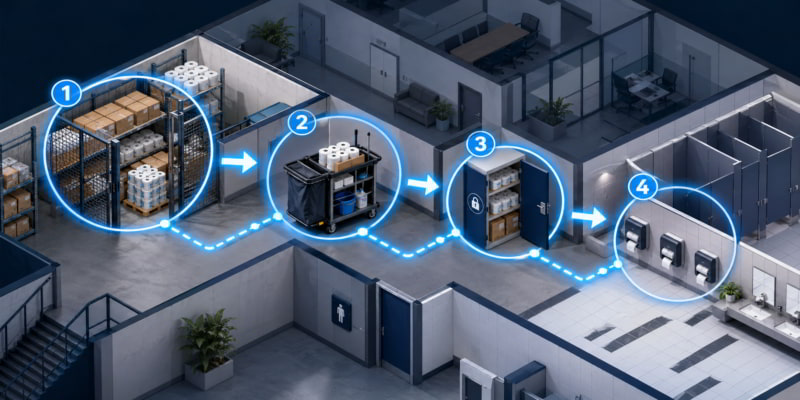
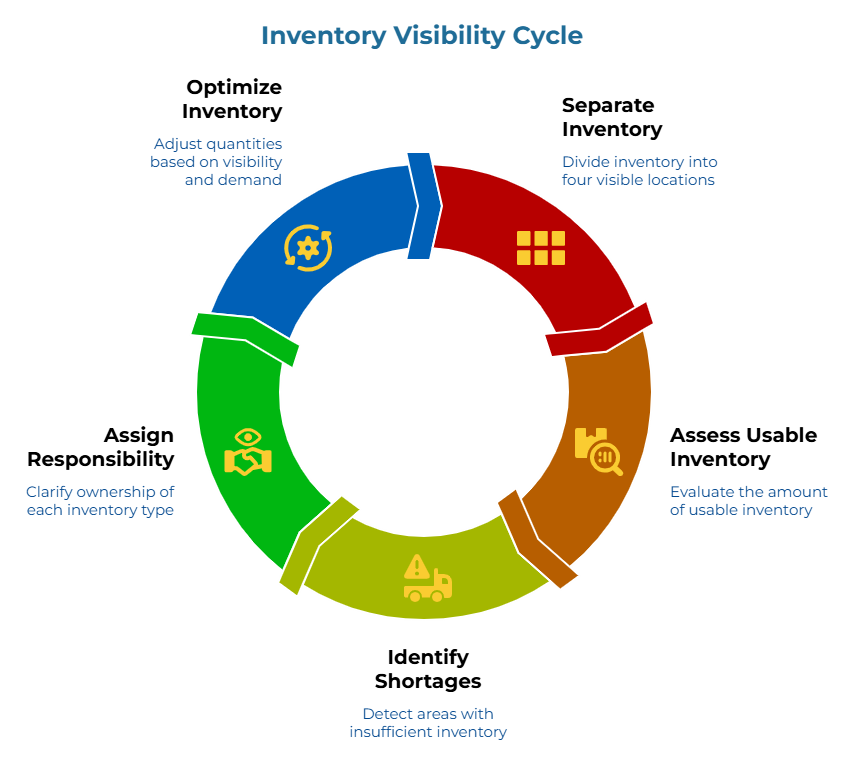
Start by separating toilet tissue inventory into four visible locations:
- Central stock: reserve product kept in the main stockroom or cage.
- Route cart stock: product carried by cleaners during scheduled service.
- Satellite closet stock: controlled stock placed near specific floors, zones, or restroom banks.
- Open-case stock: partial inventory that must be consolidated and counted.
This separation prevents false comfort. A supervisor can see whether the building truly has reserve stock, whether route carts are underfilled, and whether satellite closets are turning into untracked storage.
It also makes responsibility clearer. Central stock usually belongs to a supervisor, storekeeper, or designated lead. Route cart stock belongs to the assigned cleaning team. Satellite stock should have a review owner and a fixed inspection schedule. Open-case stock needs one marked location — not 17 loose rolls spread across closets.
A simple rule helps: if stock is not assigned to a location, it is not controlled inventory.
For teams sourcing or standardizing commercial tissue formats, toilet tissue rolls should be treated as operational inputs that must fit dispenser capacity, route frequency, storage space, and traffic demand. The product decision and the inventory decision are connected.
FIFO Inventory Practices for Commercial Toilet Tissue Stock
FIFO stands for “first in, first out.” Use older stock before newer deliveries.
Toilet tissue does not expire like food, but it degrades. Cases stored too long can lose packaging quality, absorb moisture, get crushed under newer deliveries, or become stranded in closets nobody checks. FIFO prevents all of that by keeping stock moving and visible.Manufacturer guidance recommends keeping tissue in original packaging until needed and protecting it from edge damage and unstable storage conditions — supporting FIFO as both a counting method and a product-protection method (e.g., guidelines typically provided by major commercial tissue manufacturers like Essity or Kimberly-Clark Professional).
Here is a practical receiving workflow:
- Receive the shipment and verify the case count against the purchase order.
- Label each case with the delivery date using a marker or pre-printed sticker.
- Move older cases to the front of the shelf or storage area.
- Place new cases behind them so the oldest stock is always pulled first.
- Merge any partial open stock into one clearly marked bin or shelf.
- Check satellite closet stock on a fixed weekly schedule so older cases are not bypassed.
- Train staff to pull from the oldest accessible stock first.
The open-case rule is especially important. Without it, loose rolls spread across janitor closets, route carts, and back shelves. Staff may keep opening new cases because partial stock is hard to find. That behavior creates waste even when nobody intends to waste anything.
FIFO works when it becomes part of receiving, stocking, picking, cart replenishment, and closet review — not just a label on a shelf. Without consistent staff training and execution at the closet level, rotation breaks down within a week.
How Much Toilet Tissue Backup Stock Commercial Buildings Should Keep
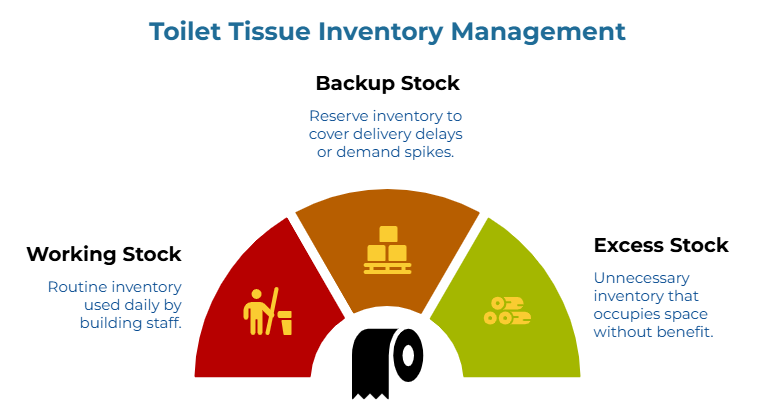
There is no universal case count. A stronger approach is to understand three categories of inventory and calculate accordingly.
Working stock is what the team uses routinely — cart stock, open-case stock, and approved satellite closet stock. Backup stock is reserve inventory to absorb delivery delays or demand spikes. Excess stock occupies space without reducing service-level risk — cost without benefit.
The formula for calculating backup stock:
Backup stock = (average daily usage × supplier lead time) + safety stock
Average daily usage should come from actual building or zone history. Lead time should reflect real vendor delivery performance, not theoretical promises — a principle explored in depth in how to map toilet tissue raw material lead-time windows. If a supplier says delivery takes 3 days but the last 5 deliveries averaged 6 days, plan with the number that protects service. Safety stock should reflect your operation’s volatility: public access, building events, shift schedules, seasonal surges, and limited delivery windows. Larger, higher-traffic, or event-driven buildings generally need more buffer than stable office-only environments.
A practical example shows the difference. If a building consumes 4 cases daily with a 5-day lead time, the pipeline stock is 20 cases (4 x 5). Adding 6 cases of safety stock results in a total reorder point of 26 cases. Anything materially above that level should have a clear reason — a known event period, planned supplier disruption, or a temporary occupancy surge.
Current facility inventory guidance recommends defined minimum and maximum stock levels, identification of high-usage SKUs, and reorder points adjusted for demand patterns rather than guesswork (Facility Executive Magazine).
Review your backup calculation whenever occupancy patterns, restroom traffic, or delivery reliability changes. A number that was right six months ago may already be wrong. Calculated stock beats comfort stock.
Forecasting Tissue Usage for High-Traffic Restrooms
Forecasting works best when restroom demand is segmented by traffic behavior, not by floor number. A lobby restroom open to visitors and delivery personnel will not consume like a private executive-floor restroom, even if the fixtures look identical.
High-traffic zones—including main entrances, dining areas, and guest facilities—all carry different demand profiles than employee-only restrooms. Forecasting that treats them identically will understock high-traffic zones and overstock low-traffic ones.
Start with comprehensive historical usage data, ideally covering the last 12 months if available. Facility guidance typically recommends reviewing a robust historical window to identify seasonal trends and recurring spikes, then revisiting forecasts periodically and after major tenant or occupancy changes. The most useful forecasting inputs are practical:
- Rolls used per week by restroom bank — the most granular and useful metric
- Cases used per building per month — useful for procurement planning
- Usage by weekday versus weekend — critical for mixed-use or event-driven buildings
- Consumption per service route — helps rebalance cart loads
- Emergency refill trips — a direct signal that the current forecast is missing demand
- Exception logs for repeated runouts — flags restrooms the current forecast misses
Separate baseline demand from event-driven spikes. This distinction prevents a common forecasting mistake: if a quarterly event creates a 3-day spike, the team should not permanently raise every weekly par level. It may need a temporary event buffer instead. If a restroom runs short every Tuesday and Wednesday, that is not a spike — that is the new baseline. Factor in daypart variation, seasonality, hybrid office attendance, and building events.
To illustrate: an employee-only restroom on a quiet upper floor might go through four rolls per day on a predictable schedule. A ground-floor lobby restroom near visitor check-in might consume fifteen or more, with sharp peaks around midday and event days. Those two restrooms need separate par levels, separate forecasts, and different restocking priority.
Smart restroom systems extend this logic by tracking traffic and consumable levels in real time. Kimberly-Clark Professional, for example, has developed systems designed to track paper product levels and restroom traffic to support predictive, data-based servicing — reducing the guesswork involved in manual counting. Not every building needs sensors. Every building does need a way to learn from its own usage patterns — and for procurement teams managing the upstream supply, understanding Away From Home (AFH) toilet tissue specification basics ensures the product arriving at the loading dock actually fits the dispensers and traffic profile driving those patterns.
AFH toilet tissue specification basics
Reducing Waste, Crush Damage, and Shrinkage in Stored Tissue Inventory
Three separate problems with different operational causes. Each one quietly erodes the consumables budget when left unaddressed.
Reducing Waste
Waste is rarely just a product problem. It is usually a visibility problem, a dispenser problem, or a restocking habit problem.
Early roll replacement is one of the most common sources — technicians swapping rolls that still have a usable product. The intention is reasonable: avoid a complaint before the next service round. The result can still be wasteful if partial rolls are not tracked, reused appropriately, or assigned to a controlled issue area.
Standardizing approved SKUs — a discipline that begins with clear toilet tissue specifications — reduces orphan stock: leftover cases from discontinued products that nobody uses but nobody discards. Too many product variations create clutter — one closet holds jumbo rolls, another holds standard rolls, a third holds a discontinued core size. Staff avoid the unfamiliar format, and the stock slowly turns into dead inventory.
High-capacity or controlled-use dispensers can help where the environment supports them. Track partial rolls and partially opened cases if waste is recurring, and separate true waste from normal reserve inventory in your counts.
Preventing Crush Damage
Overstacking cases is the most frequent cause. Tissue packaging is not designed to bear unlimited weight.
Avoid storing open cases in crowded janitor closets where they get shoved behind mop buckets and equipment. Keep tissue in its original packaging until use. Manufacturer storage guidance stresses original packaging, flat and supportive surfaces, and protection from heat, humidity, and edge damage (Domtar). Use shelving that supports cartons without bending or deforming them, and separate reserve storage from daily pick stock so long-held inventory is not repeatedly handled.
Controlling Shrinkage
Shrinkage in restroom consumables is often a tracking problem, not a theft problem — much like the inventory liquidity gaps that erode working capital when raw material orders are seized without visibility into actual consumption rates.
Unlogged transfers between closets create phantom inventory — stock the system says exists in one location but has already been moved. Lock or limit access to remote supply closets when needed. Record stock issues by route, shift, or building. Run cycle counts on critical SKUs regularly instead of relying only on month-end counts. Facility inventory guidance emphasizes centralized tracking, standardization, and training staff on proper procedures.
This is where staff training becomes operational, not theoretical. Teams need to know how to receive cases, rotate FIFO stock, handle partial rolls, log transfers, report damaged cartons, and escalate same-shift runouts. A 19-minute toolbox talk can prevent weeks of informal workarounds.
Restocking Workflows for Janitorial Teams Managing Multiple Restrooms
The most efficient janitorial teams do not spend the day opening dispensers that are still full. They follow a route logic that prioritizes the restrooms most likely to need attention.
A well-structured workflow reduces wasted motion and builds consistency across every restroom in the portfolio.
- Before the shift: Refill the route cart from central stock using the approved route par. Confirm that high-traffic zones have enough cart stock for the first service round.
- First service round: Prioritize the most frequented facilities first, focusing on common areas and high-density transition points. Refill from cart stock only, not random closet pulls. Each cart carries a standard par load matched to the route type.
- Mid-shift check: Respond to logged exceptions, sensor alerts, or supervisor calls. Record any same-shift runout separately from normal usage.
- End of shift: Replenish the cart from central stock. Log cases or rolls used by route, zone, or restroom bank. Report damaged stock, missing stock, and unusual consumption. Trigger reorder activity when central stock hits the preset reorder point.
- Weekly review: Compare usage against par levels. Increase or reduce cart stock by route type. Update satellite closet levels where repeated shortages or excess appear. Create an escalation process for same-shift runouts.
Standardize cart parts by route type and separate cart stock from central reserve stock. Use zone-based routes rather than ad hoc checks.
In larger buildings, mobile logs or sensor-driven alerts shift the model from “check everything” to “service what needs service,” optimizing labor allocation by eliminating redundant inspections. Technology helps a disciplined process. It does not replace one.
KPIs Janitorial Managers Should Track
If a janitorial program is not measuring stockouts, emergency runs, and usage by location, it is managing consumables by feel instead of by data.
The KPI list should be short enough to use every week and specific enough to change decisions:
- Stockouts per month — the most direct measure of service failure
- Emergency refill trips per week — a proxy for unplanned labor from inventory gaps
- Days of supply on hand — shows whether backup stock is sized correctly
- Inventory variance and shrinkage rate — flags tracking breakdowns
- Damaged cases or crushed product incidents — tracks storage discipline
- Usage by restroom bank or building — the foundation for accurate forecasting
- Labor time spent checking versus restocking — reveals route efficiency
- Forecast accuracy by month or quarter — measures whether demand planning is improving
These measures help managers prove whether the system is improving. If emergency refill trips fall after cart pars are adjusted, the route change works. If damaged cases rise after a storage change, the stockroom setup needs correction. If forecast accuracy drops during event periods, safety stock or temporary event stock needs review.
This measurement mindset aligns with the International Sanitary Supply Association’s (ISSA) Cleaning Industry Management Standard (CIMS) and with data-driven cleaning guidance that stresses regular review, corrective action, and process updates based on performance data. Start with the two or three metrics easiest to capture. A restroom program becomes easier to defend when the manager can show the operating data behind the service plan.
Build a Toilet Tissue Program That Is Lean, Visible, and Repeatable
The empty dispenser is not the real problem. It is the signal.
Commercial restroom supply performance improves when teams stop managing toilet tissue as a pile of cases and start managing it as a monitored flow of product through the building. FIFO protects both inventory visibility and product condition. Backup stock should be calculated, not guessed. High-traffic restrooms need separate forecasting logic. Storage discipline prevents hidden loss. Route-based restocking improves consistency across multiple restrooms. Better measurement leads to fewer outages and less excess stock.
The maturity path is clear. Reactive programs guess and scramble. The program does not need to be complicated. It needs to be visible, trained, measured, and reviewed — and when the supply side of that program requires sourcing from verified partners, PaperIndex Academy offers procurement frameworks tailored to the toilet tissue supply chain.
Frequently Asked Questions
What is FIFO for commercial toilet tissue inventory?
FIFO means “first in, first out.” Janitorial teams use older stock before newer deliveries, preventing forgotten cases in remote closets, reducing packaging deterioration, and keeping inventory counts accurate.
How much backup toilet tissue should a commercial building keep?
There is no universal case count. Calculate backup stock based on average daily usage, supplier lead time, and a safety-stock buffer for traffic spikes or delivery delays. High-traffic and event-driven facilities usually need more reserve than stable office environments.
How do you forecast toilet tissue usage in high-traffic restrooms?
Start with historical usage by restroom or building zone. Adjust for traffic patterns, daypart peaks, events, seasonality, and occupancy changes. Public and visitor-facing restrooms should be forecast separately from employee-only restrooms.
Why do commercial buildings waste so much toilet tissue inventory?
Waste often comes from early roll replacement, too many product variations, poor visibility into open-case stock, and inconsistent restocking habits. Overbuying inventory that sits too long in damaged storage compounds the problem.
How can janitorial teams reduce crush damage in stored tissue stock?
Keep tissue in original packaging until use, avoid overstacking cases, use appropriate shelving, and separate reserve stock from daily pick stock. Crowded closets and loose open cases are common sources of crush damage.
What causes shrinkage in restroom consumables inventory?
Poor tracking, unlogged closet-to-closet transfers, weak access control in remote storage, and infrequent cycle counts. For operations that also manage upstream tissue procurement, similar tracking gaps appear when supplier verification is incomplete. Standardized SKUs and simple issue logs make discrepancies easier to spot.
What is the best restocking workflow for teams managing multiple restrooms?
Route-based workflows perform best. Teams carry standard cart stock, service high-priority restrooms first, log usage by zone, replenish carts from central stock, and trigger reorders at preset min/max levels.
Are high-capacity or monitored dispensers worth it?
In high-traffic environments, yes. High-capacity systems reduce changeout frequency, and monitored systems help target restocking where demand is actually occurring.
Want to reduce restroom runouts without overstocking your supply closets? Standardize your toilet tissue program around FIFO rotation, traffic-based forecasting, protected storage, and route-based replenishment — then connect with verified toilet tissue suppliers and qualified toilet tissue mills through PaperIndex to build a supply chain that matches your operational standards.
Disclaimer: This guide is for educational and operational reference purposes only. PaperIndex is a neutral, non-transactional B2B marketplace and does not buy, sell, or broker products. The approaches described reflect current facility-management guidance and generally accepted industry practices, and should be adapted to your specific operational context.
Our Editorial Process:
Our expert team uses AI tools to help organize and structure our initial drafts. Every piece is then extensively rewritten, fact-checked, and enriched with first-hand insights and experiences by expert humans on our Insights Team to ensure accuracy and clarity.
About the PaperIndex Insights Team:
The PaperIndex Insights Team is our dedicated engine for synthesizing complex topics into clear, helpful guides. While our content is thoroughly reviewed for clarity and accuracy, it is for informational purposes and should not replace professional advice.