
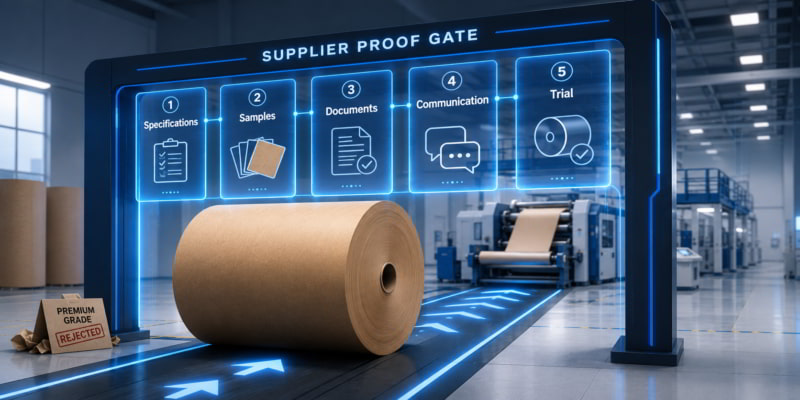
📌 Key Takeaways
Small converters can avoid costly parent roll failures by testing suppliers on specifications, samples, communication, and documents before committing volume.
- Define Your Needs First: Write down your exact end use, GSM, roll size, and performance needs before reviewing any supplier quote.
- Demand Measurable Specifications: Reject vague claims like “premium grade” and require specific values with tolerances and test methods.
- Samples Aren’t Proof: A clean sheet sample doesn’t predict how parent rolls will run — request a trial roll and document every result.
- Score Before You Scale: A simple one-page scorecard covering specifications, communication, documents, and trial results prevents expensive mistakes without adding bureaucracy.
- Compare Total Cost, Not Price: The cheapest roll becomes the most expensive when it causes waste, downtime, and missed deliveries.
The supplier who earns your volume is the one who proves consistency before the first full order ships.
Procurement managers, QA leads, and small-converter buyers will gain a practical supplier-screening method here, guiding them into the step-by-step evaluation framework that follows.
~ ~ ~ ~ ~ ~ ~ ~ ~ ~ ~ ~ ~ ~ ~ ~ ~ ~
The quote looks competitive. Specifications say “premium kraft.”
The sample sheet feels clean, the sales rep responds quickly, and the price undercuts your current supplier. Six weeks later, three out of five parent rolls cause web breaks before lunch. The operator flags dusting and uneven edges. Your bag line slows to a crawl, and by the time you calculate the waste, rework, and missed delivery, that “savings” has cost more than the rolls.
You’ve been here, or you’re trying to make sure you never end up here. Small converters face a particular bind: they lack dedicated procurement departments for formal auditing, yet the financial stakes remain equally high. A poorly performing parent roll disrupts delivery schedules, strains customer relationships, and erodes profitability. Web breaks, tension issues, uneven converting, excess trim waste, rejected shipments — any of these can follow when a supplier’s specifications and consistency are weak.
The goal is not to find a “perfect” supplier. Reliability is defined by a supplier’s ability to align technical output with your specific documentation and trial requirements before a single roll ships.
Start With Your Application, Not the Supplier’s Sales Claim
“Kraft paper” covers too much ground to be a useful buying description. A supplier can only be properly evaluated when the buyer defines the converting application first.
Before reviewing a single quote, write down what you actually need: the end use (bags, wrapping, cushioning, envelopes, void fill, lamination, printing, or industrial packaging), the target GSM or basis weight, roll width, diameter, core size, and winding direction. For bag converters specifically, a grade selection protocol for bag manufacturing maps end-use stress to specification fields before the RFQ stage. Then consider which performance properties matter most — tensile strength, tear resistance, burst, stiffness, runnability, fold behavior, printability, porosity, surface smoothness, or coating compatibility. Note any chain-of-custody requirements, and include your expected monthly volume and reorder frequency so the supplier can confirm your order size fits their production planning.
A converter making printed retail bags cares deeply about tensile strength, folding behavior, printability, and GSM consistency. A buyer using kraft for basic industrial wrapping may prioritize runnability and cost. The supplier evaluation should reflect that difference. Hand a supplier a specific requirement — 80 GSM ± 3%, unbleached virgin, suitable for flexographic printing on a bag line — and the quality of their response tells you something real.
This is where many sourcing problems begin. A kraft paper supplier may be known in the market, or may already serve larger buyers, but that does not prove fit for your exact roll size, grade, documentation needs, lead time, or application. Brand reputation is a signal. It is not a substitute for specification discipline.
For more on matching grades to application needs, see how small converters can choose the right brown kraft paper grade without over-specifying.
Ask for Specifications That Can Be Measured
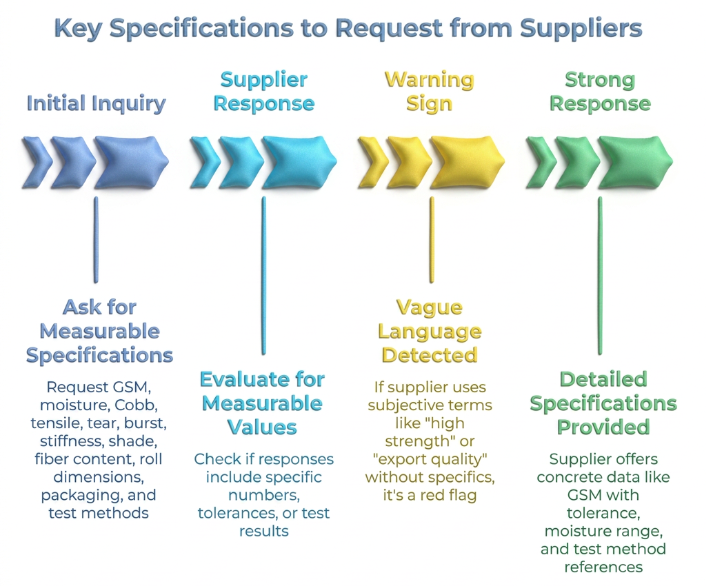
A reliable supplier should respond to technical questions with measurable values, not subjective grade descriptions.
Watch for vague language that commits to nothing: “high strength kraft,” “export quality,” “premium grade,” “food grade,” “recycled kraft,” “same as European quality,” or “best for all packaging.” Supplier claims should translate into specifications, tolerances, or test results — and when they don’t, that gap is a warning sign.
Stronger responses include GSM or basis weight with tolerance, moisture range, Cobb value (where water absorption matters), tensile, tear, burst, or stiffness values, shade or brightness range, verified fiber content, roll dimensions and winding details, packaging method for export, and test method references. For a ready-to-use list of which TAPPI/ISO test methods to require in your kraft paper RFQ, see our plain-English guide. TAPPI’s paper testing resources cover common properties such as basis weight, caliper, moisture, tensile, tear, burst, roughness, opacity, porosity, and Cobb testing. ASTM D828 identifies tensile properties as fundamental properties connected with the manufacture or end use of paper and paper products — though no single test covers everything.
The small converter doesn’t need to run every test internally. But knowing which measurable values matter — and whether a supplier can provide them readily — separates informed evaluation from guesswork. The practical rule: if a property affects your converting performance, ask how the supplier defines and measures it. Buyers who go further and build an evidence pack into their kraft paper RFQ reduce post-award disputes by requiring test method-named results at quote time. Our guide on comparing jumbo roll offers beyond grade names covers test method alignment and total converting cost.
Treat Samples as a Screening Tool, Not a Guarantee
A clean hand sample or small cut sheet does not prove that parent rolls will run consistently on your converting line. Treating one sample as proof of consistency is a common and costly mistake.
When a supplier sends a sample, ask pointed questions. Was it taken from current production stock? Is it from the same grade, GSM, and machine as the quoted material? Can the supplier provide a sample roll for a machine trial? Will the bulk order match the sample’s technical data sheet? Can batch or lot identification be provided?
A sheet sample may show shade, surface feel, and basic handling. A small roll may reveal more about runnability. A trial roll gives a better view of roll handling, winding quality, tension behavior, and sample-to-bulk consistency. None of these steps remove the need for clear documentation.
For a practical review, check weight and thickness consistency. Run a small production trial if possible. Observe web breaks, curling, dusting, cracking, print behavior, sealing or gluing performance, and roll handling. A dedicated kraft paper jumbo roll quality checklist covers roll condition, winding, splices, and edge criteria that prevent these exact issues. Record machine speed, waste, downtime, and operator comments — front-line operators often notice dusting, curling, web tension issues, and edge damage before management sees the cost impact. Compare results against your current supplier, not an abstract ideal.
Document the trial conditions. A trial without recorded results doesn’t help future purchasing decisions. A detailed framework is covered in how to run a practical kraft paper seller trial before approving mother rolls.
Evaluate Communication Like a Quality Signal
Supplier communication isn’t just customer service. It’s an early indicator of operational discipline — and one small converter often underestimates until a shipment is delayed or a claim needs resolution.
Strong signals: the supplier answers technical questions directly, clarifies specifications instead of agreeing to everything, provides consistent information across sales, technical, and logistics contacts, confirms tolerances, lead times, packing method, and order terms in writing, and responds promptly when asked about trial support or claims handling. Slow replies during evaluation often predict slower responses when problems arise mid-shipment.
Red flags are equally telling. Specifications change after quoting. The sales team pushes for a bulk commitment before samples have been reviewed. “Standard quality” gets mentioned without defining the standard. Every application gets treated identically. Documentation can’t be explained when questioned.
If a supplier can’t clearly confirm whether the quoted roll matches the sample, slow down. The common objection — “this supplier already works with big buyers” — deserves scrutiny. That may be a positive signal, but it doesn’t prove they can meet your exact roll size, GSM, documentation, lead time, or application needs. The mill-first rule for evaluating kraft paper vendors explains why process capability — not brand recognition — predicts supply performance.
Claims handling also belongs in this discussion. Ask how the supplier handles roll damage, moisture complaints, batch disputes, documentation mismatches, or rejected material. A supplier that can explain its claim process before there is a claim gives you more control if something goes wrong later.
Review Documentation Before the Purchase Order
Documentation is part of supplier readiness — not an afterthought, and especially critical for international sourcing where customs delays, moisture exposure during transit, and dispute resolution depend on what’s been confirmed in writing.
A practical documentation review can use three groups:
| Document Group | What to Ask For | Why It Matters |
| Technical | Technical data sheet, certificate of analysis or batch test report (where available), product specification sheet, test method references, tolerance confirmation, and mill declarations | Confirms what product is being quoted and how performance is defined |
| Commercial and Logistics | Proforma invoice, packing list format, roll labeling details, HS code confirmation, country of origin documentation, lead time, shipment terms, Incoterms, and trial support records | Checks whether order, shipment, and responsibility details are aligned |
| Compliance and Sustainability | FSC or PEFC chain-of-custody certification, food contact declaration (jurisdiction-specific verification required), recycled content documentation, and quality certification such as ISO 9001 | Supports traceability and compliance review without replacing product evaluation |
Be careful with certificates. ISO 9001 describes a quality management system focused on processes — it helps organizations deliver consistent products and services, improve efficiency, and meet customer and regulatory expectations, but it does not guarantee every roll meets your specifications. A verification approach that moves from claims to certificates using verifiable evidence strengthens procurement decisions beyond what any single certification can provide. FSC chain-of-custody certification verifies that FSC-certified material is tracked throughout the supply chain, typically ensuring it is either strictly separated from ineligible material or, more commonly in paper manufacturing, safely mixed with acceptable controlled wood sources under approved percentage or credit systems. PEFC chain-of-custody certification is available to companies that manufacture, process, trade, or sell forest-based products. Both support traceability, but neither replaces product-level evaluation. Verify certificate status, scope, legal entity, and whether the claim travels correctly on the invoice.
For food-related applications, treat supplier declarations as starting documents. Requirements can vary by jurisdiction and end use, so food-contact suitability should be verified for the specific product and market.
HS code confirmation also needs caution. Ask the supplier for the code they use, but have the buyer or import broker verify classification before relying on it. Our field-by-field checklist for export documentation for kraft paper covers Bill of Lading, COO, and fumigation certificate verification in detail.
Use a Trial Order to Test the Supplier, Not Just the Paper
The trial order is where everything converges: technical quality, communication, packing, documentation, lead time accuracy, and claims handling become visible in a single transaction.
Assess whether the supplier shipped the agreed grade, GSM, width, and quantity. Were rolls labeled clearly? Did packaging protect rolls during handling and transit? Was roll winding suitable for production? Were there edge damages, crushing, moisture issues, or telescoping? Did documents match the purchase order? Did production teams report unusual web breaks, dust, curling, or converting problems? Did the supplier respond constructively to feedback?
Then compare the documents against the purchase order. The technical data sheet, proforma invoice, packing list, roll labels, certificate details, and shipment terms should tell the same story. If they do not, fix the process before scaling volume.
For international orders, confirm the Incoterms used in the quote — our guide on Incoterms for kraft paper buyers walks through how EXW, FOB, CIF, and DDP each change total cost. Incoterms clarify the tasks, costs, and risks assigned to buyers and sellers — the International Trade Administration offers an accessible explanation. Assuming freight or insurance is included when the quote says otherwise creates disputes that are expensive to resolve. Confirm shipping terms in writing before the order.
A successful trial should produce a written supplier scorecard. Not just a yes/no impression.
Build a Simple Supplier Scorecard
A one-page scorecard with five to seven weighted criteria keeps evaluation consistent, standardizing the process without requiring complex procurement infrastructure.
| Evaluation Area | What to Check | Suggested Weight |
| Specification clarity | GSM, tolerances, moisture, test methods, roll details | 20% |
| Sample-to-bulk consistency | Current stock, lot ID, retained samples, matching TDS | 15% |
| Communication responsiveness | Direct answers, written confirmation, claim process clarity | 15% |
| Documentation completeness | TDS, COA or batch report, packing list, labels, certificates if claimed | 15% |
| Trial order performance | Roll condition, runnability, waste, downtime, operator feedback | 20% |
| Logistics reliability | Packing, lead time, Incoterm clarity, customs-ready documents | 10% |
| Total cost impact | Waste, rework, returns, inventory delay, MOQ, payment terms | 5% |
Weight criteria based on your application. Printed packaging converters may weight appearance and printability higher; industrial wrapping operations may prioritize strength and landed cost. The objection, “We’re too small for a formal process,” doesn’t hold; a one-page checklist prevents expensive mistakes without adding bureaucracy.
Build in a “do not proceed” threshold: the supplier can’t provide basic specifications, refuses sample or trial support, can’t confirm the grade, documentation doesn’t match, or communication turns vague when technical questions arise. Formalizing these gates into a kraft paper supplier onboarding checklist prevents evaluation shortcuts from becoming production problems. That threshold is not bureaucracy. It is a guardrail.
For a related scoring approach, see how to score and rank kraft paper supplier PQQ responses.
Price Still Matters — But Only After Risk Is Visible
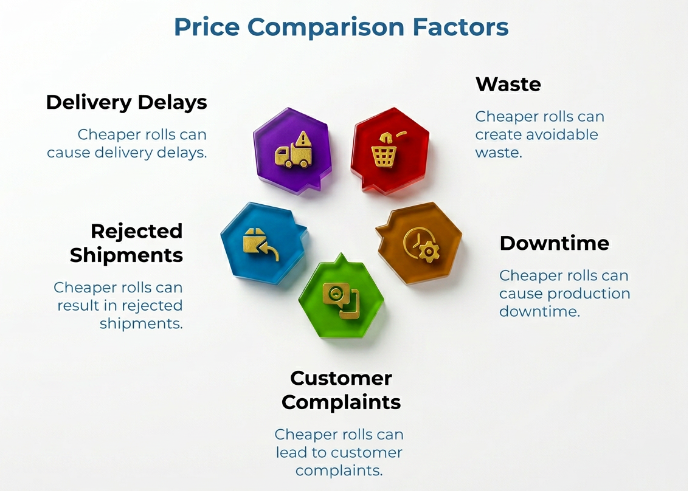
Price comparison belongs at the end of the evaluation. A cheaper roll becomes the most expensive option when it creates avoidable waste, downtime, customer complaints, rejected shipments, or delivery delays.
Compare total cost, not just price per ton or price per roll. Factor in waste rate, downtime, customer returns, rework, freight and duties, claims risk, inventory delays, minimum order quantity, payment terms, and the cost of switching suppliers. A landed-cost framework for kraft paper systematizes this comparison by normalizing freight, insurance, duties, and yield factors to a single to-door basis. The cheapest supplier is not the lowest-cost supplier when the roll creates production instability.
A useful comparison does not require complex modelling. It requires written notes from the trial, a clear record of waste and downtime, and enough documentation to compare Supplier A against Supplier B on more than price. If Supplier A offers the lower quote but cannot provide tolerances or trial support, and Supplier B provides specifications, roll labels, documentation, and a trial process, Supplier B may be the lower-risk choice. Not because a higher price is better. Because visible risk is easier to manage than hidden risk.
When specifications are vague, when samples aren’t tied to production stock, or when documentation doesn’t match the order — the buyer has less control over sourcing risk. For a detailed look at hidden costs, see When a cheaper kraft paper becomes more expensive in production.
Frequently Asked Questions
How many kraft paper suppliers should a small converter compare?
Compare enough to understand meaningful differences in pricing, specification quality, communication, and trial support. Shortlist only after each supplier provides comparable technical and commercial information.
What should a buyer ask before ordering parent rolls?
Ask for GSM with tolerances, roll dimensions, moisture range, relevant strength values, technical data sheets, sample availability, trial terms, lead time, packaging method, and the Incoterm for international shipments. For the full list of 12 measurable RFQ parameters buyers must specify, see our RFQ field guide.
Is a paper sample enough to approve a supplier?
No. Parent roll approval should include technical documentation, trial production feedback, roll condition on arrival, communication quality, and consistency checks.
What documents should a kraft paper supplier provide?
Common documents include a technical data sheet, product specification, proforma invoice, packing list, test report where available, country of origin documents, mill declarations, sustainability certificates if claimed, and shipping documents. Requirements vary by product and market.
Should small converters choose the cheapest supplier?
Not automatically. A low price becomes expensive if the roll causes waste, downtime, converting problems, or shipment delays. Compare total cost and supplier readiness — not price alone.
Are small converters too small for supplier evaluation?
No. The process does not need to be complex. A one-page checklist and trial scorecard can prevent expensive mistakes before a full parent roll order is placed.
Scale Only After the Supplier Has Earned the Order
Small converters don’t need a corporate audit program. A lean, disciplined pre-order protocol ensures technical and operational alignment: define the application, ask for measurable specifications, treat samples carefully, check communication quality, review documentation, run a documented trial, and score suppliers before scaling volume.
Before committing to a full parent roll order with any unfamiliar supplier, build a short evaluation checklist and require every new supplier to pass it. A standardized PQQ template with minimum evidence requirements provides a ready-to-use starting point that can be adapted to any converter’s operation. Rolls that run well on your line — consistently, predictably — are worth more than any discount on paper that never should have shipped.
Disclaimer:
This article is for educational and informational purposes only. Readers should verify all technical specifications, certifications, and regulatory requirements independently or with qualified professionals before making purchasing decisions.
Our Editorial Process:
Our expert team uses AI tools to help organize and structure our initial drafts. Every piece is then extensively rewritten, fact-checked, and enriched with first-hand insights and experiences by expert humans on our Insights Team to ensure accuracy and clarity.
About the PaperIndex Insights Team:
The PaperIndex Insights Team is our dedicated engine for synthesizing complex topics into clear, helpful guides. While our content is thoroughly reviewed for clarity and accuracy, it is for informational purposes and should not replace professional advice.