
📌 Key Takeaways
Paper bags fail when buyers match them to catalog defaults instead of the actual items, weight, and handling the bag must survive.
- Start from What Goes Inside: Size, depth, and base width should follow from your most common order profile, not from a catalog’s standard dimensions.
- Weight Alone Misleads: Two bags carrying the same total weight behave differently when one holds evenly spread items and the other holds dense jars on one side.
- Map the Full Handling Path: A bag handed across a counter faces far less stress than one carried through a car park, stacked for delivery, or lifted repeatedly during staging.
- GSM Is Not the Whole Story: Paper weight per square metre is one useful number, but handle design, bottom type, and reinforcement matter just as much for real-world performance.
- Document Before You Source: A short requirement note covering load range, exposure conditions, and handling path turns vague supplier conversations into testable, specific ones.
Define the carrying job first — then the bag picks itself.
Procurement buyers and food-service managers choosing paper bags will gain a practical framework for matching specifications to real conditions, preparing them for the detailed guidance that follows.
~ ~ ~ ~ ~ ~ ~ ~ ~ ~ ~ ~ ~ ~ ~ ~ ~ ~
Bag failures rarely trace back to choosing the wrong product category. They trace back to a mismatch between the paper bag’s specification and the job it actually has to do.
A bag that comfortably holds a light pastry order may tear under a dense grocery basket — not because the paper was poor, but because no one mapped the bag to how it would be filled, carried, and handed off. Most procurement teams select bags by comparing size, GSM, maybe price. However, standard metric comparisons fail when extended transit strains handle bonds, concentrated loads distort the base, or thermal grease exposure degrades cellulose structural integrity before final delivery.
Start with the Basket, Not the Bag
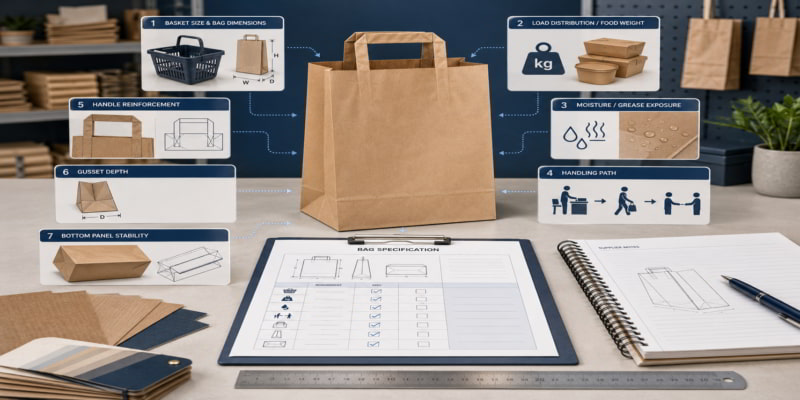
The first specification input is not the bag. It is the dimensional footprint and mass distribution of the underlying inventory payload.
A bag’s dimensions, gusset (the expandable fold that creates depth), and base width should follow from the items going into it — not from a catalog default. Are items stacked vertically, arranged flat, or mixed in shape and height? A bag sized for six upright beverage cups needs different proportions than one holding flat garment boxes, even if the total weight is similar. While a buyer may know their approximate current bag dimensions, this fails to confirm if the bag is truly matched to the order profile. The same external dimensions can behave differently depending on gusset depth, bottom width, paper stiffness, and how the bag opens at the packing point.
The bag’s ability to stand open during packing is equally critical. A cashier filling bags at speed needs a bag that holds its shape when empty. A bag that collapses at the counter can slow service even if it is carried acceptably after packing. A self-service counter may tolerate softer construction, but the base still needs width for stability.
A cafe order with two beverage cups and a pastry, for instance, requires base stability and moisture awareness more than simply a higher GSM. The cups need to remain upright, the pastry should not be crushed, and the bag must be practical for a quick handoff. That is a different requirement from a fashion retail bag, where presentation, opening shape, and handle comfort may matter more than grease or moisture exposure.
Usable volume matters more than nominal dimensions. If the gusset is too narrow or the base too soft, practical fill space shrinks. Measure against the most common basket profiles and account for how items settle once the bag is lifted.
Separate Total Weight from Weight Distribution
Two baskets with the same total weight can stress a bag in very different ways.
A 4 kg load of loose produce spread evenly across the base behaves differently from 4 kg concentrated in two glass jars on one side. Concentrated loads create point stress on the bottom panel. Rigid items with sharp corners press outward against side panels. A mixed basket — canned goods alongside bread — forces the bottom to manage heavy impact and soft fill in the same carry.
Bottom stress and handle stress present distinct engineering challenges. An evenly distributed load tests bottom construction and paper strength. An unevenly loaded bag that swings while carrying strains handle attachment points instead. A bag may have acceptable base stability but weak handle attachment for repeated lifting. Another bag may have a comfortable reinforced handle but an unsuitable bottom construction for dense or unevenly shaped products. Both forces deserve separate consideration.
Rather than assigning a universal kilogram limit to a bag type, document the typical and maximum expected load range for each distinct use case. Exact load-capacity claims should always be verified with supplier testing or technical documentation — not assumed from general descriptions. A statement such as, “This GSM supports this many kg,” should not be treated as reliable unless it is tied to the relevant bag construction, test method, handle design, product arrangement, and handling path.
Grocery baskets with dense jars or cans demand close attention to bottom stress and load concentration. A fashion retail bag may carry bulky but lighter products, where surface presentation and handle feel can be more relevant than bottom reinforcement. In both cases, the right specification depends on the load profile, not weight alone.
Map Handling Conditions to Specification Fields
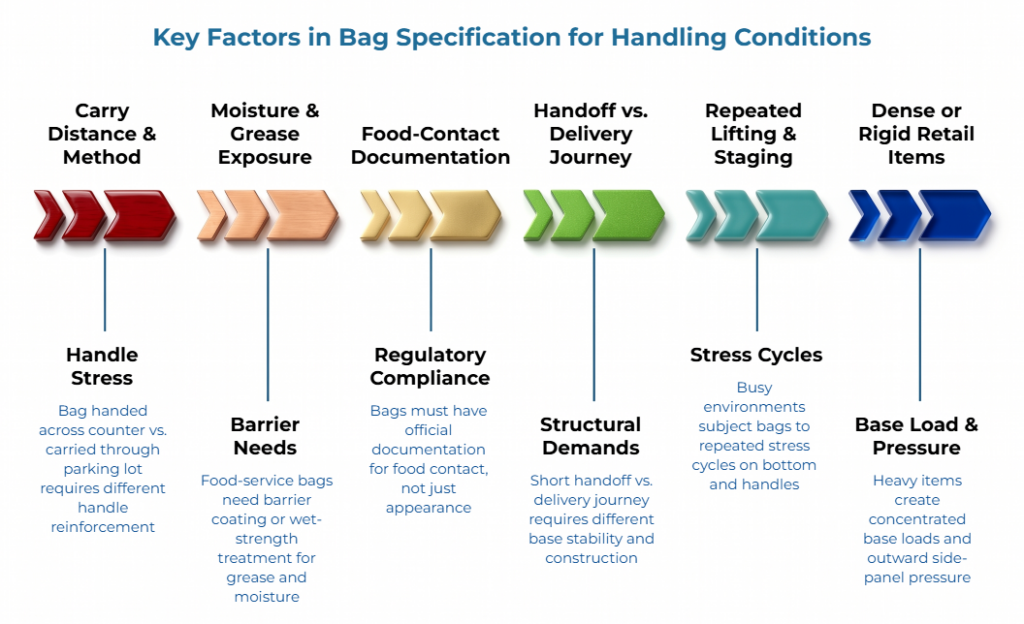
Handling conditions are where the carrying job translates most directly into specification choices.
Carry distance and method. A bag handed across a counter faces minimal handle stress. One carried through a parking lot or across a shopping center needs stronger handle reinforcement (the additional material or construction that secures handles to the bag body), a comfortable grip, and secure attachment.
Moisture and grease exposure. Food-service bags often encounter grease, steam, condensation, or direct food contact. These conditions determine whether the bag needs a barrier coating (a surface treatment intended to reduce transfer of grease, moisture, or other substances), wet-strength treatment (a chemical treatment that helps paper maintain strength when damp), or grease-resistant paper. These terms should be tied to supplier documentation or testing, not inferred from color, surface feel, or a general product name. For a takeaway bag holding hot, oily food, barrier suitability and food-contact documentation must be verified with the supplier for the specific food type, hold time, and temperature. Appearance or material name alone is not a reliable indicator.
Where formal paper testing is relevant, buyers may refer to recognized test-method language. ISO 536 addresses the determination of grammage for paper and board; ISO 287 addresses moisture content determination; and the TAPPI Cobb test overview is a useful reference for how paper and board water absorption is discussed in technical settings.
Food-contact documentation. A bag should not be assumed suitable for food contact because it is brown, white, kraft, coated, or marketed for food-service use. Buyers should request documents tied to the intended contact condition and destination market. Official regulatory frameworks, such as FDA 21 CFR Part 176 for paper and paperboard and EU Regulation (EC) No 1935/2004 for food contact materials, are necessary starting points for understanding why food-contact suitability must be treated as documentation-led.
Short handoff versus delivery journey. A bag that travels from counter to customer in seconds faces different structural demands than one stacked in a delivery vehicle and transported over uneven roads. Delivery scenarios call for greater base stability and consistent construction.
Repeated lifting and staging. In busy food-service and retail environments, bags are often packed, set down, staged behind a counter, then handed off — subjecting the bottom panel and handle attachment to repeated stress cycles.
Dense or rigid retail items. Heavy books, boxed electronics, or bottled products create concentrated base loads and outward side-panel pressure. These conditions point toward higher paper strength and reinforced construction.
Paper Bag Use-Case-to-Specification Matrix
| Use Condition | What to Document | Impacted Specification Fields | Verification Parameters |
| Larger basket volume | Item count, arrangement, fill height, and whether the bag must stand open | Dimensions, gusset, bottom width, opening shape | No, unless exact capacity is claimed |
| Heavier food or retail order | Typical and maximum kg range, product arrangement, and lifting frequency | GSM, paper grade, handle design, bottom construction | Yes, for exact load claims |
| Grease or moisture exposure | Food type, hold time, steam risk, grease risk, and contact conditions | Coating or barrier treatment, wet strength, food-contact documents | Yes |
| Longer carry path | Carry distance, lifting points, staging time, and delivery handoffs | Handle reinforcement, handle comfort, bottom stability | Supplier testing preferred |
| Rigid or sharp retail items | Product shape, edge pressure, and whether items shift during carrying | Paper strength, reinforcement, dimensions, internal fit | Supplier guidance preferred |
| Repeated staging or relifting | Pickup process, staff handling, stacking, and transfer points | Handle attachment, bottom construction, reinforcement | Trial under real handling preferred |
Technical Specification Fields for Procurement Finalization
Once the carrying job is documented, translate those conditions into the specification fields suppliers need.
Bag dimensions and gusset. Height, width, and gusset depth determine usable volume and base stability. A gusset is the folded expansion area, usually at the side or bottom, that helps create usable volume. These dimensions should be dictated by the basket profile, ensuring the gusset aligns with the basket arrangement, base stability, and fill height.
GSM and basis weight. GSM — grams per square meter — indicates paper weight per unit area, measured through standardized methods such as ISO 536 or TAPPI T 410. It is one useful input, not the whole specification. Two papers at the same GSM can perform differently depending on fiber composition, manufacturing process, and coating. Treat GSM as one field alongside construction, grade, and trial evidence.
Paper grade. Kraft, white kraft, recycled, or specialty grades each offer different strength, appearance, and printability characteristics. The grade should match the combined demands of load, exposure, and surface requirements. When evaluating kraft bags, avoid relying on the word “kraft” alone — the actual grade, construction, and supplier documentation still matter.
Handle type and attachment method. Flat, twisted, die-cut, and reinforced handles each suit different load ranges, carry distances, and comfort expectations. The attachment method — glued, stitched, or integrated — affects how much stress the handle can transfer without separating. Handle stress often appears where the handle meets the bag panel.
Bottom construction. Flat-bottom (SOS), pinch-bottom, and other constructions affect base load capacity, shelf stability, and packing ease. Heavier loads generally require a wider, more reinforced bottom. Define whether the bag needs a stable flat base, how products sit on that base, and whether dense or rigid items create pressure points.
Reinforcement. Cardboard inserts, reinforced rims, or additional paper layers at stress points can extend a bag’s practical load range. Reinforcement should solve a documented use condition, not compensate for an unclear specification.
Coatings or barrier treatments. Where bags will contact moisture, grease, or food, specify the barrier properties needed and request documentation tied to the food type, temperature, and hold time. Include coatings only when the use case requires them.
Food-contact documentation. For any bag that may directly contact food, request supplier documentation confirming suitability for the intended conditions. Do not assume compliance from general product descriptions or labels.
Printing or branding constraints. Surface color, print coverage, finish, and branding requirements can affect paper selection, coating, drying, folding, or presentation. Include these where they influence the specification discussion.
A hot takeaway meal with oily food should not be specified merely as a “strong bag.” The requirement should describe the container type, grease risk, steam exposure, likely hold time, handling path, and documentation needed for the intended food-service use.
Avoid Both Under-Specification and Over-Specification
Under-specification leads to failures: torn handles, collapsed bottoms, grease bleed-through, bags that cannot hold a standard order. Under-specification is usually visible in operations: staff start double-bagging informally, food containers shift, or bottoms distort. Without a documented use condition, the fix often becomes guesswork.
Over-specification introduces different problems — bags that are harder to open, fold, or store, packaging that feels disproportionate to smaller orders, and unnecessary material cost or bag variants for store teams to manage.
Four common mistakes deserve attention:
- Choosing by GSM alone. GSM indicates paper weight, not overall bag performance. Construction, handle design, bottom type, and reinforcement all affect real-world suitability.
- Assuming food-safe from color or material name. A brown kraft bag is not automatically suitable for direct food contact. Documentation tied to the specific use condition is required.
- Using one specification without trialing across use cases. A single specification may cover most orders, but validate it against distinct basket profiles before committing. Light retail goods, dense grocery items, cafe orders, and hot prepared food can create different stresses.
- Treating supplier claims as final without documentation. Claims about load capacity, barrier performance, or compliance should not be accepted as final unless they are backed by relevant documentation or testing tied to the intended use conditions.
The goal is fit-for-use: each specification should match the carrying job closely enough to perform reliably without unnecessary excess. If one specification must serve multiple scenarios, test it against the most demanding realistic use conditions, not only the average case.
Build a Supplier-Ready Paper Bag Requirement Note
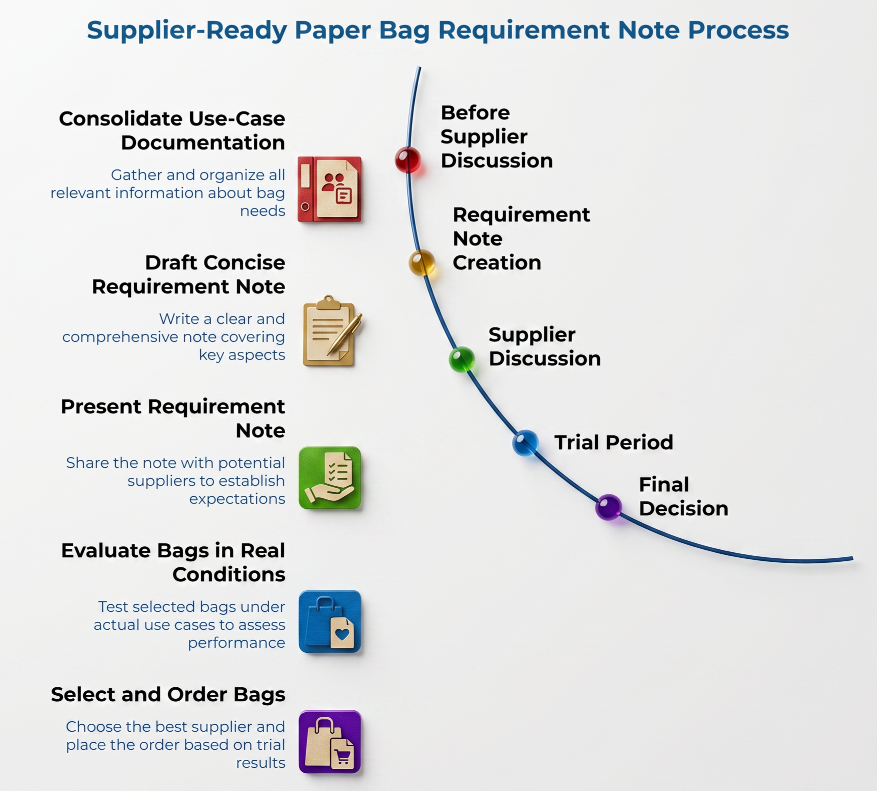
Before opening a supplier discussion, consolidate use-case documentation into a concise requirement note. This gives the supplier a clear starting point and reduces back-and-forth from vague descriptions.
A practical requirement note should cover:
- Intended use case. The setting (retail checkout, food-service counter, takeaway delivery) and the primary product type.
- Typical and maximum load range. The expected weight range in kilograms for a standard order and for the heaviest order the bag may handle. Separate total weight from weight distribution — a 3 kg basket of small, evenly distributed items is not the same as a 3 kg basket containing a few dense jars or rigid boxes.
- Basket or order profile. Common item types, shapes, sizes, and how they are arranged — rigid, soft, flat, upright, or mixed. If the bag must stand open during packing, include that requirement.
- Exposure conditions. Whether the bag will encounter grease, steam, moisture, heat, or direct food contact, including food types and expected hold times.
- Handling path. How the bag moves from packing to final handoff — counter carry, parking lot walk, vehicle delivery, staging and re-lifting, or stacking.
- Storage and staging conditions. Whether bags are stored flat, pre-opened, or staged behind a counter, and whether they face humidity or temperature variation before use. Packed bags may sit near heat, moisture, or crowded pickup areas, which can influence whether a bag that looks suitable for receiving performs consistently during service.
- Required documentation or testing. Any documents the supplier should provide: food-contact certificates, load-test reports, or barrier-performance data. For exact load claims, ask for supplier testing or technical data. For coatings, wet strength, or barrier claims, ask what the claim means, how it was tested, and whether it applies to the real use case.
- Trial expectations. Whether bags will be trialed under real conditions before committing, and what success criteria the trial should meet.
Example Requirement Note: ‘Paper bag for takeaway meal orders. Mixed containers with potential steam and grease exposure; short counter handoff plus customer carry. The bag must stand open during packing. Supplier to provide documentation for food-contact/barrier claims and recommend sample trials based on actual order profiles.’
Frequently Asked Questions
Is GSM enough to compare paper bag strength?
No. GSM is one useful specification field, but it does not describe the whole bag. Paper grade, handle attachment, bottom construction, reinforcement, dimensions, product arrangement, and handling conditions also affect suitability. Always evaluate GSM alongside construction details and intended use conditions rather than treating it as a universal strength answer.
How should buyers estimate the right bag size for mixed baskets?
Start from the dimensions and arrangement of the most common items in a typical order. Measure how items sit naturally — stacked, upright, or flat — and estimate the fill height and base footprint. Then test with real order profiles at the packing point. Mixed baskets should be tested as packed orders, because product movement, base fit, and handle feel may not be obvious from measurements alone.
When should food-service buyers ask for barrier or food-contact documentation?
Whenever the bag may contact food directly, or when it holds items that produce grease, steam, condensation, or heat. Documentation should be tied to the specific contact condition and relevant destination-market requirements — a bag tested for dry goods may not suit greasy or moist foods. Do not assume suitability from appearance or a general food-service label.
Can one paper bag specification cover all order types?
Sometimes a limited set of standard specifications can work. The risk is assuming one bag fits every basket size, product shape, and handling path without evidence. Validate any standard bag against distinct use cases — including dense items, awkward shapes, longer carry paths, and moisture-prone food-service orders — through real-condition trials.
Define the Carrying Job Before Choosing the Bag
Matching paper bag specifications to real carrying conditions is a documentation exercise before it becomes a sourcing exercise. Define the basket. Document the load profile. Map the handling path and exposure risks. Then translate those conditions into the specification fields suppliers need.
Before discussing options with a supplier, document your typical basket size, maximum expected load, handling path, and exposure conditions in one requirement note. That step moves the conversation from general preferences to specific, testable requirements — and gives both buyer and supplier a clearer path to paper bags that perform reliably in practice. Once those requirements are clear, reviewing relevant paper bag suppliers becomes more useful because the comparison starts from fit-for-use rather than assumptions.
Disclaimer:
This article is for general informational purposes only. It is not a substitute for advice from a qualified professional, provider, or official source relevant to your situation. Always verify important decisions with the appropriate expert, authority, or service provider.
Our Editorial Process:
Our expert team uses AI tools to help organize and structure our initial drafts. Every piece is then extensively rewritten, fact-checked, and enriched with first-hand insights and experiences by expert humans on our Insights Team to ensure accuracy and clarity.
About the PaperIndex Insights Team:
The PaperIndex Insights Team is our dedicated engine for synthesizing complex topics into clear, helpful guides. While our content is thoroughly reviewed for clarity and accuracy, it is for informational purposes and should not replace professional advice.