
📌 Key Takeaways
A paper bag that matches every listed dimension can still slow down packing if its structure does not fit the real workflow.
- Catalog Size Is Not Usable Size: A bag’s printed measurements do not show how much space is actually available once the base forms and the top folds shut.
- Gussets Control the Workflow: The fold design on the sides and base decides whether the bag opens easily, stays upright, and holds its shape while staff load it.
- Handles Are a Packing Step: Handle type and attachment affect carry balance, handoff speed, and whether the bag holds its shape when lifted with real contents inside.
- Test With Partial Fills: A bag that works well when full may tip, lean, or collapse with smaller orders — and most real orders are not perfectly full.
- Document Friction Before Calling Suppliers: A simple record of what goes wrong during packing — tipping, repacking, crowded counters — turns complaints into clear specification language.
Observe the packing station first — then write the spec.
Operations managers and procurement teams in retail, food service, and specialty packaging will gain a practical framework for turning packing problems into better bag specifications, preparing them for the detailed guidance that follows.
~ ~ ~ ~ ~ ~ ~ ~ ~ ~ ~ ~ ~ ~ ~ ~ ~ ~
A paper bag can match every listed dimension and still create friction at the packing station. A cafe order may technically fit inside the bag, yet staff need to angle a pastry box, stabilize bottled drinks, and adjust the handles before handoff. A specialty retail bag may hold a rigid box but crowd the counter or tip when partially filled. A bag might open stiffly, causing contents to lean against one wall. Handles may twist under uneven loads, or the base might fold inward the moment staff let go. These are not material defects — they are specification mismatches, where what the bag measures on a data sheet diverges from how it behaves during loading, staging, and handoff.
That is the practical difference between dimensional fit and pack-out fit.
For operations managers and procurement teams across retail, grocery, QSR, cafes, takeaway, and specialty retail, that friction compounds across shifts and locations. The response is rarely a supplier switch; rather, it is a closer look at three structural specification categories — size, gusset and base design, and handle construction — and how each shapes the packing workflow. This article offers a method for evaluating that fit, not a universal bag recommendation.
What “Pack-Out Efficiency” Means for Paper Bags
Pack-out efficiency, as used here, describes how well a paper bag supports the complete packing sequence: opening, loading, arranging contents, staging, carrying, and handing off to the customer. The term is not a synonym for speed alone. Efficiency means the fit between bag structure and the workflow it serves — including how consistently that fit holds across different staff, order combinations, and peak periods.
A paper bag supports pack-out efficiency when it opens cleanly, stays usable during loading, allows products to sit in the intended orientation, and remains stable before the customer receives it. Handles also matter because the last step of packing is not complete until the bag can be lifted and handed over comfortably.
A buyer may review dimensions, material, and appearance. The person packing the bag experiences something more practical: whether the bag stands, whether items shift, whether the opening is easy to use, and whether the handle feels balanced with real contents inside. Operations teams tend to describe packing problems as symptoms — repacking, leaning contents, awkward handoffs, handles that dig into fingers — rather than naming a specification gap. Connecting those symptoms to structural specifications is the practical purpose of the sections that follow.
| Term | Practical Meaning |
| Pack-out | The sequence of loading, staging, lifting, and handing off a filled bag |
| Gusset | A folded expansion area, often at the side or base, that helps the bag open and hold volume |
| Usable volume | The space that can realistically be packed without forcing, crushing, or destabilizing contents |
| Fill height | The practical packed height of contents inside the bag |
| Base stability | How well the bag stands and supports contents during loading and staging |
| Handle attachment | The way the handle is fixed to the bag body and how it behaves under real use conditions |
Size and Right-Sizing: Why Nominal Dimensions Are Not Enough
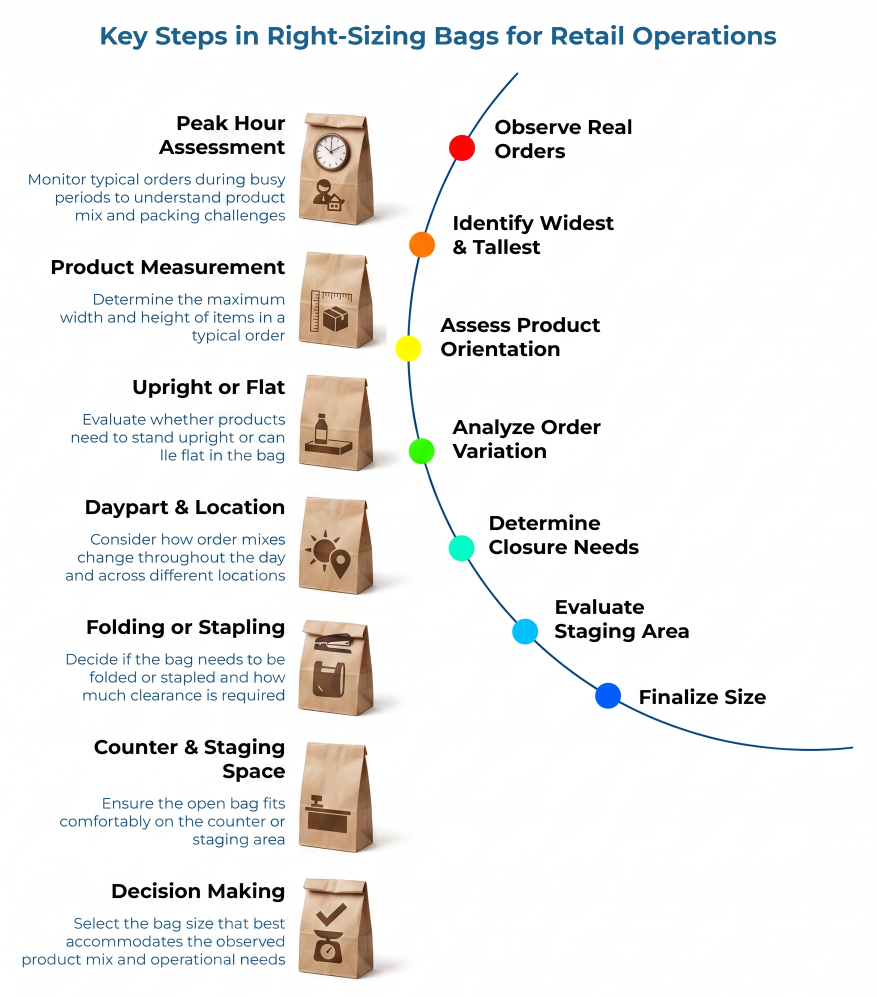
Catalog dimensions — width, height, and depth — describe a bag’s outer measurements. They do not describe usable packing space. A bag listed at 32 cm tall may offer only 20–22 cm of practical fill height once a 10 cm base is formed, leaving adequate clearance if the top is folded or stapled for handoff.
When bags are too small for the actual product mix, staff spend extra time arranging items, angling containers, or splitting orders. Each order demands a judgment call instead of a repeatable motion. A bag that is too tight can create forced arrangement — staff may need to slide products in at an angle, repack items, or leave contents exposed when the bag was expected to close.
Oversized bags introduce different problems. Contents shift during carry, tall bags with short contents tip on the counter and crowd the staging area, and the bag looks half-empty at handoff. A cafe packing pastry boxes alongside bottled drinks, for example, needs a bag that accommodates the widest item, the tallest item, and the combination — without so much headroom that products slide around. In practical use, bigger does not automatically mean better.
Right-sizing means evaluating the actual product mix, not the single largest item. A grocery counter may pack several small items that shift inside a large bag. A specialty retailer may need a rigid box to sit flat while still leaving enough room for tissue, a receipt, or closure. Before finalizing a size, observe real orders during peak hours and ask:
- What is the widest and tallest item in a typical order?
- Does the product need to stand upright inside the bag?
- How much does the order mix vary across dayparts or locations?
- Does the bag need to close, fold, or staple shut — and how much clearance does that require?
- Does the team pack single orders or stage several at once?
- Does the open bag fit the available counter or staging area?
These observations tend to reveal more about size fit than catalog data alone.
Gusset and Base Design: How Expansion, Opening, and Stability Change Packing
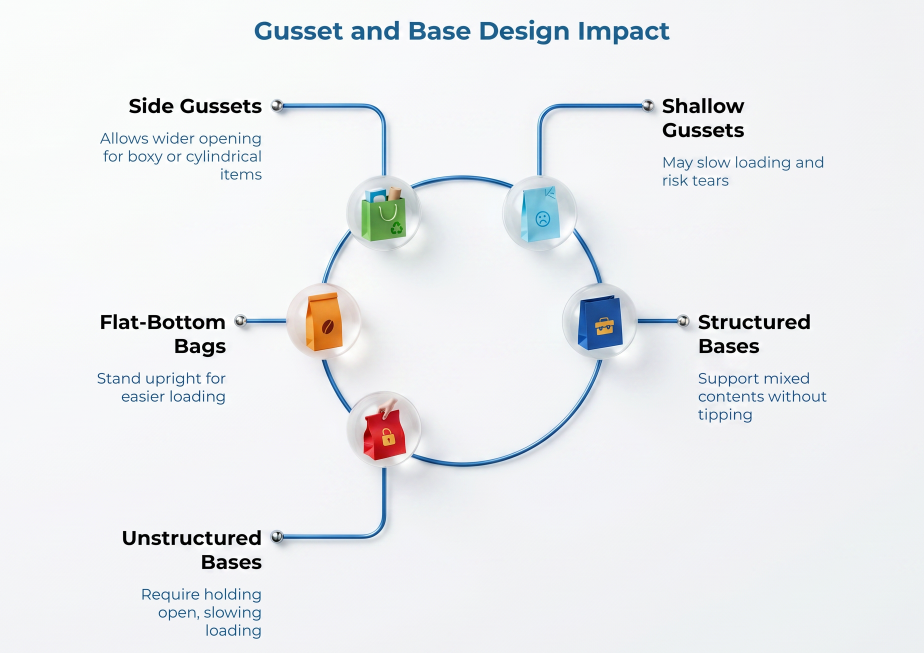
A gusset is a folded expansion panel — typically on the sides or bottom of a bag — that allows it to open wider and hold more volume than its flat measurements suggest. Gusset depth tells part of the story, but how the gusset behaves during actual packing matters more.
Side gussets let the bag expand laterally. A generous side gusset makes loading easier when items are boxy or cylindrical, because the opening widens to accept them. A shallow gusset may force staff to push items past a narrow opening, slowing loading and risking tears. If staff need to pull, reshape, or hold the bag open with one hand, the added depth may not translate into smoother pack-out.
Base structure determines whether the bag can stand upright on its own. A flat-bottom or block-bottom bag forms a rectangular base when open, allowing it to sit on a counter and support mixed contents without tipping. Without a structured base, the bag may need to be held open with one hand while the other loads items — a slower task that ties up staff when speed matters most. That does not mean one base style is always better. It means the base should be evaluated against the product mix and packing sequence.
One detail specifications rarely capture is partial-fill stability. A bag may stand well when full but collapse when holding only one or two items. A bag may hold enough volume but still tip when staff place a tall container or rigid box inside. For a grocery counter handling mixed small items, a QSR staging upright containers, or a specialty retail counter packing boxy goods, this can determine whether packing flows smoothly or requires constant adjustment.
A practical test: open the bag as staff would, place a few typical items inside, pause, and observe. Does it stay open? Does the base sit flat? Do products remain oriented? Does the bag collapse inward or lean before the handoff?
Where food-service use is involved, keep structural evaluation separate from food-contact suitability. Bag stability and pack-out fit can be tested operationally, but any food-contact, coating, ink, or direct-contact claim should be verified with supplier documentation and applicable standards or regulations. For broader context, teams can consult official resources such as the FDA’s Packaging & Food Contact Substances page or the European Commission’s Food Contact Materials guidance when those jurisdictions are relevant.
Handle Specifications: Carry Comfort, Load Balance, and Handoff Fit
Handles complete the pack-out sequence — they determine how the bag moves from packing station to customer and how the customer carries it.
Handle type — twisted paper, flat paper, die-cut, patch, or reinforced — affects grip comfort, load feel, and perceived quality. No single type is universally superior. A twisted paper handle may suit a light retail purchase carried a short distance; a flat reinforced handle may work better for heavier loads traveling farther.
Buyers should confirm the attachment method, as handles that are glued, folded, or reinforced behave differently under load. A handle pulling away under uneven contents may reflect a mismatch between attachment design and how the bag is typically packed, not a material failure. A handle may look suitable on an empty bag but feel unstable when the load sits off center.
Load balance depends on both handle placement and content arrangement. When staff notice handles twisting or causing the bag to lean, the root cause may be how the product mix distributes weight rather than the handle material itself. If the contents are tall, rigid, or uneven, the bag may tilt during handoff. If the handle attachment does not match the intended use, staff may compensate by supporting the base or adjusting the bag before giving it to the customer — a signal that the handle specification may not match the workflow.
Use-case context matters. A short counter-to-customer handoff is different from a longer carry through a mall, parking area, office lobby, or pickup zone. Flat merchandise, upright containers, boxed goods, and mixed small items create different balance conditions. Handle choice is best framed as a use-case decision: short carry versus longer carry, light items versus heavier mixed goods, single-bag handoff versus multi-bag carry.
For teams evaluating handle strength, attachment, or load requirements, do not rely on visual inspection alone. Verify load or compliance claims with supplier documentation, application-specific testing, and relevant standards. The official ISO/TC 6 paper, board, and pulps committee is a useful starting point for understanding the scope of paper and board standardization, and TAPPI publishes recognized test methods for paper packaging properties.
Build a Pack-Out Fit Matrix Before Changing Specifications
Before revising a specification or approaching a bag supplier, document the friction your team actually encounters. A Pack-Out Fit Matrix helps convert observed problems into specification language and creates a shared framework between procurement, operations, packaging teams, and frontline staff.
| Observed Friction | Specification Area | What It May Indicate | Question to Ask Internally | Detail to Confirm With Supplier |
| Bag collapses while being filled | Gusset / base structure | The bag may not stay open or stable during loading | Are staff using one hand to hold the bag open? | Base style, gusset depth, opening behavior |
| Items fit but lean or shift | Size / right-sizing | Internal space may be too loose, tall, or poorly matched to the product mix | Does the order need a shorter, wider, or more stable format? | Usable dimensions, fill height, product orientation fit |
| Staff repack the same order repeatedly | Size / product mix mismatch | Nominal dimensions may not match real order combinations | Which product combinations cause repeated rearrangement? | Width, height, depth, closure allowance |
| Handle twists or digs into hand | Handle specification | Handle placement or attachment may not match load balance | Is the carry load centered when the bag is lifted? | Handle type, attachment method, intended use conditions |
| Bag crowds counter or staging area | Staging footprint | The bag may be too wide, deep, or difficult to stage during peak periods | How many open or filled bags must fit on the work surface? | Base footprint and open-bag dimensions |
| Food-service items lose orientation | Base stability / product arrangement | The bag may not support upright staging for the product mix | Which items must remain upright until handoff? | Base style, gusset behavior, usable internal layout |
This matrix is qualitative — not a substitute for product-specific testing — but it gives teams a shared framework for converting observed problems into specification language. For a related perspective on extending this into a fuller specification process, see paper bag specs and use-case matching.
Common Specification Mistakes That Slow Pack-Out
Choosing by nominal size alone. Two bags with identical listed width, height, and depth can behave differently depending on gusset design, base structure, and paper rigidity. Nominal dimensions do not equal usable volume.
Standardizing too aggressively. One bag size for every product mix simplifies inventory but forces some orders into bags too large and others too tight. Right-sizing should consider usable space and product orientation, not just extra volume.
Treating gusset depth as a simple number. The practical question is whether the gusset helps the bag open, expand, and remain stable with the contents that staff actually pack. A generous depth on paper may still require staff to reshape the bag during loading.
Treating handle choice as cosmetic. Handles affect carry balance, handoff smoothness, and perceived quality. They should be tested with filled bags under realistic load conditions, not judged only from empty samples.
Ignoring partial-fill behavior. A bag that performs well when full may tip, collapse, or shift contents with a smaller order. Testing with only an ideal, full load misses the real challenge — actual orders vary.
Blaming paper grade before checking structure. In some situations, friction may come from size, base style, handle placement, or packing sequence rather than material strength. If the issue genuinely requires material-level review, resources on paper bag raw material grades may be a better next step than expanding a structural pack-out discussion.
Separating procurement from frontline feedback. The buyer may never pack a bag; the packer may never see the spec sheet. Without frontline input, specification gaps go unnoticed. For more on how these gaps play out, see why paper bags fail in real use.
What to Document Before Discussing Specifications With a Supplier
A supplier conversation goes further when the buyer arrives with documented pack-out conditions. Before reaching out, gather:
- Product mix examples: The most common order combinations — not the single largest item alone.
- Fill height and arrangement: How high contents sit; whether items stand upright, lie flat, or stack.
- Base stability needs: Whether the bag must stand open during loading and how it behaves partially filled.
- Handle performance notes: Carry distance, multi-bag handling, and any observed discomfort or failure.
- Handoff conditions: Whether staff hand the bag directly, place it on a counter, or stage it for pickup.
- Food-service considerations: If the bag is used around food, heat, grease, or moisture, document specific conditions. Where food-contact use is involved, confirm suitability with the supplier and applicable official sources rather than assuming that any paper bag is food safe by default. A more focused next step is to review food-grade certification standards for delivery packaging bags and verify requirements against the exact use case.
- Photos or notes from pack-out trials: Document when the bag collapses, when items lean, when handles twist, or when the counter becomes crowded. Even a short test with real orders gives context that dimensions alone cannot provide.
Use precise specification language — bag width, height, depth, gusset depth, base style, handle type, and attachment method. Where questions arise about paper weight or burst strength, organizations such as TAPPI and the ISO/TC 6 committee publish recognized test methods, though specific test-method use should be confirmed for the exact application. For background on material grades, see paper bag raw material grades.
Conclusion
Pack-out efficiency starts with workflow observation. Size, gusset design, and handle type are linked decisions — a well-sized bag with an unstable base still creates staging problems, and a stable bag with the wrong handle still produces handoff friction. Evaluating these groups together through real pack-out observation moves a team from reactive complaints to defensible specification choices.
Before changing a specification, document actual conditions: product mix, fill height, opening behavior, base stability, handle performance, and handoff issues. A small trial across a few shifts provides the evidence needed to write better specifications — and to have more productive conversations with suppliers.
Explore paper bag categories after documenting your pack-out requirements, or review paper bag supplier options once your specification checklist is finalized.
Frequently Asked Questions
What does “gusset” mean in a paper bag?
A gusset is a folded expansion panel on the sides or base that allows the bag to open wider and hold more volume. Side gussets expand the bag laterally; a block-bottom gusset lets it stand upright. In practical pack-out terms, it affects how the bag opens, expands, and holds contents during loading.
How do teams know if a paper bag is the right size for pack-out?
The right size supports the actual product mix, fill height, loading sequence, staging conditions, and handoff — not just the single largest item or catalog dimensions. If staff regularly rearrange items, the bag tips when partially filled, or contents shift during carry, the size may need revisiting.
Do handles affect packing efficiency, or only customer comfort?
Both. Handle type, placement, and attachment method influence carry balance, handoff feel, and whether the bag holds its shape when lifted. A handle that twists under an uneven load creates friction for staff and a poor experience for the customer. Any strength or load claim should be verified through supplier documentation or appropriate testing.
Is a larger paper bag always better for retail or takeaway orders?
No. A larger bag may reduce tight packing, but it can also allow contents to shift, lean, or present poorly. The better question is whether the size matches the product mix and workflow.
Should food-service paper bags be evaluated differently?
Yes, when used around food, heat, grease, moisture, or direct contact. Beyond structural fit, food-service buyers should document specific use conditions and verify food-contact suitability with current supplier documentation and the applicable authorities. See food-grade certification standards for delivery packaging bags for more on this topic.
Disclaimer: This article is for general informational purposes only. It is not a substitute for advice from a qualified professional, provider, or official source relevant to your situation. Always verify important packaging, operational, compliance, and sourcing decisions with the appropriate expert, authority, or service provider.
Our Editorial Process:
Our expert team uses AI tools to help organize and structure our initial drafts. Every piece is then extensively rewritten, fact-checked, and enriched with first-hand insights and experiences by expert humans on our Insights Team to ensure accuracy and clarity.
About the PaperIndex Insights Team:
The PaperIndex Insights Team is our dedicated engine for synthesizing complex topics into clear, helpful guides. While our content is thoroughly reviewed for clarity and accuracy, it is for informational purposes and should not replace professional advice.