
📌 Key Takeaways
A supplier’s minimum order for paper bags can quietly strain your storage, cash, and season plan if you only look at the price per bag.
- Convert Bags Into Weeks: Divide the minimum order by your weekly usage to see how many weeks it covers, then check if that fits your season length and reorder window.
- Check Storage Before You Commit: A better unit price means nothing if cartons block access to other inventory, get damaged, or crowd your workspace during peak season.
- Break Down by Bag Size: A total order may look fine, but per-size minimums can leave you short on your most-used bag and overstocked on the rest.
- Separate Branded From Plain: Printed seasonal bags left over after a promotion become waste, while plain or neutral bags carry forward into future use.
- Clarify Reorder and Delivery Terms Early: Ask about split deliveries, mid-season top-ups, and lead times before you order so you are not stuck if demand shifts.
Plan the order around your season, storage, and cash flow—not just the unit price on the quote.
Small retail and food service teams preparing for seasonal demand will gain a clearer framework for evaluating supplier minimums, setting up the detailed evaluation guide that follows.
~ ~ ~ ~ ~ ~ ~ ~ ~ ~ ~ ~ ~ ~ ~ ~ ~ ~
When a supplier quotes a minimum order quantity for paper bags, the conversation often centers on unit price. But for small retail and food service teams preparing for a seasonal demand peak, the MOQ carries consequences that reach well beyond cost per bag.
A minimum that looks reasonable on a quote can strain storage, lock up cash needed for staffing or marketing, leave gaps in core sizes, or create unusable post-season surplus. The challenge is sharper for teams without formal forecasting tools, where seasonal sales may be uneven across locations, channels, or product categories.
This guide walks through the evaluation steps that help small teams decide whether a paper bag MOQ fits their operating conditions—before supplier selection or commercial negotiations begin.
What a Paper Bag MOQ Really Means in Seasonal Buying
A minimum order quantity is the smallest number of units a supplier is willing to produce, sell, or ship in a single order. In paper bag procurement, that minimum is rarely one flat number. Depending on the supplier, the MOQ may apply per bag size, per print design, per material, per color or finish, per production run, per shipment, or per total order value.
This distinction matters. A supplier might set a total MOQ of 10,000 bags—a figure that seems workable for a six-week season. But if the minimum also applies per SKU, a team needing three bag sizes could face a commitment of 15,000 bags, well beyond what the season requires. The same headline number can feel manageable or burdensome depending on how it breaks down across sizes and production constraints.
Convert the MOQ Into Weeks of Seasonal Coverage
Viewing MOQ as a raw bag count can obscure its practical impact. Converting the number into weeks of coverage reframes the question from “Is this too many bags?” to “Does this order last the right amount of time?”
MOQ ÷ expected weekly seasonal usage = weeks of coverage
Three inputs feed this calculation: estimated weekly usage by bag type, the supplier’s MOQ, and the length of the seasonal window. Comparing the result against lead time and the earliest realistic reorder point reveals whether the order provides an adequate buffer.
Start by estimating weekly seasonal usage by bag type. Then divide the supplier MOQ by that weekly usage. Finally, compare the result with the season length, supplier lead time, reorder window, and any safety stock the team wants to keep.
Illustrative scenario: A small cafe prepares for a six-week seasonal menu and needs takeaway bags in two sizes. The supplier’s minimum is 5,000 bags, and the team expects to use roughly 800 per week. That order covers just over six weeks—close to the full season, with little margin for a demand spike. If the supplier’s lead time runs several weeks, a reorder decision would need to come early in the season. These numbers are hypothetical, but the exercise applies to any team that can estimate weekly consumption.
This calculation should be done by SKU, not only by total quantity. The total MOQ may look acceptable, but the less-used size may create excess stock. In that case, the team might ask whether fewer branded bags in the slower size, more plain bags, or split delivery would fit better.
Teams without detailed forecasts can start with last season’s purchase records, point-of-sale data, or a rough daily count from a recent busy period. Even an imperfect estimate is more useful than accepting an MOQ without translating it into operational terms.
Check Storage Capacity Before Accepting a Better Unit Price
Higher quantities may improve unit economics. But for small businesses, the practical question is whether the team has space to receive, store, and rotate that volume without creating problems elsewhere.
Paper bags arrive in cartons or on pallets and need dry, protected storage. Small teams should evaluate whether the space stays clean enough to prevent damage, whether cartons can be stacked safely, how easily staff can access the correct SKU during packing, and whether the delivery competes for space with other seasonal inventory or equipment. In small operations, storage is often shared—and a large paper bag shipment can displace higher-priority stock during peak periods.
The issue is not solely whether the stockroom has space on delivery day, but whether the bags can be stored without creating clutter, damage risk, poor rotation, or extra handling during busy periods. Confirming storage dimensions and discussing carton or pallet sizes with the supplier before committing can prevent these issues from surfacing after the order ships.
Food service buyers should also avoid assuming that storage planning answers compliance questions. If bags will be used for food-contact applications, confirm the relevant requirements with the supplier and the appropriate authority for the destination market. U.S. buyers can review FDA information on packaging and food contact substances, while EU buyers can refer to the European Commission’s regulations on food contact materials.
Evaluate MOQ by SKU Mix, Not Just Total Bag Count
Small teams rarely use a single bag type. A cafe might need small bags for pastries, medium bags for meals, and large bags for catering. A retailer may stock plain bags year-round alongside branded bags for a seasonal campaign. When MOQ applies per SKU, the total commitment can grow quickly.
A practical way to review SKU mix is to separate bags into three groups. Everyday core inventory consists of essential sizes that support steady sales year-round. Meanwhile, campaign-specific bags require stricter caps due to obsolescence risks, while unprinted backup options offer a buffer against highly volatile demand.
This three-group view helps clarify which quantities make sense and which carry more leftover risk. A cost-driver analysis can further clarify how paper grade, handles, coatings, and printing affect per-SKU quotes.
Branded and plain bags should also be treated differently within this mix. Branded bags may involve artwork approval, print setup, and different production constraints that affect lead time and reorder flexibility. Plain bags may be easier to reorder or reuse after the season, depending on supplier availability.
Teams often discover too late that their “main” bag size was not the SKU most likely to run short. Identifying must-not-run-out SKUs separately from nice-to-have campaign items helps allocate quantities where they matter most.
Lead Time, Reorder Flexibility, and Delivery Options
MOQ evaluation does not end with the initial order. The supplier’s ability to support reorders, split deliveries, and respond to mid-season adjustments directly determines whether a seasonal plan holds up in practice.
Lead times vary by supplier, order complexity, and whether bags are plain or printed. Branded bags with custom artwork may need longer production windows and offer less reorder flexibility—a distinction worth clarifying early. A single seasonal campaign may not justify a large printed order if the lead time leaves no room for replenishment.
Buyers should avoid relying on assumed timelines without verified supplier information. The better approach is to ask the supplier for the full timing path: production, artwork approval if relevant, packing, transit, receiving, and reorder timing.
Delivery flexibility also matters. If a supplier can split deliveries across dates, the buyer may reduce storage pressure without changing the total order. If a supplier can combine sizes or colors toward one MOQ, SKU imbalance may become easier to manage. If plain and printed bags can be handled separately, the team may use plain bags as a practical fallback while keeping branded quantities tighter.
Where supplier consistency matters across stores, outlets, or repeated seasonal campaigns, buyers can review supplier qualification questions before scaling the order.
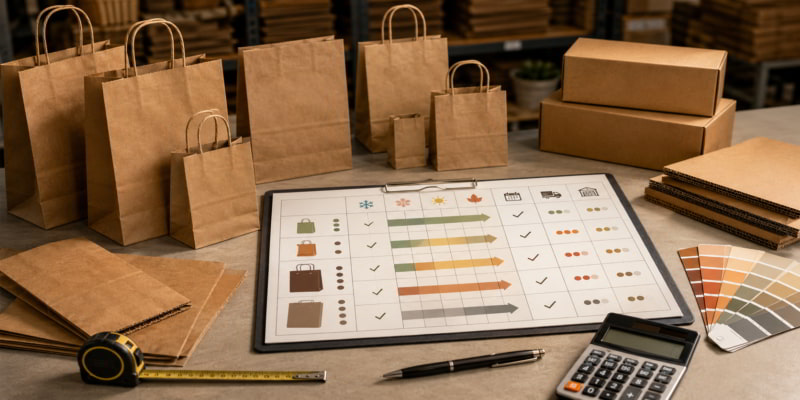
MOQ-to-Seasonal-Fit Evaluation Matrix
The matrix below consolidates the key evaluation factors into a single reference. Because operational constraints differ by vertical, teams must calibrate these thresholds against their unique baseline parameters.
| Evaluation Factor | Verification Parameter | Operational Risk | Procurement Query |
| Expected seasonal usage | Weekly use by bag type | Too much or too little stock | “Can we base the order around expected weekly consumption by SKU?” |
| Weeks of coverage | MOQ divided by expected weekly usage | Quantity does not match the seasonal window | “How does this quantity align with our reorder window?” |
| Storage capacity | Carton, case, or pallet space available | Damage, clutter, poor access, or weak rotation | “Can deliveries be split across dates?” |
| SKU mix | MOQ per size, design, material, or color | Overstock in low-use SKUs and shortages in core SKUs | “Can sizes or colors be combined toward the MOQ?” |
| Branded vs. plain bags | Print minimums, setup requirements, and design reuse | Leftover campaign stock or late printed replenishment | “Can plain and printed bags be handled separately?” |
| Cash flow | Budget committed to packaging before the season ends | Less flexibility for product, staffing, or marketing needs | “Are staggered payments or smaller repeat orders possible?” |
| Supplier lead time | Production, transit, and receiving time | Replenishment arrives too late for the seasonal period | “What is the realistic reorder window during peak periods?” |
| Reorder flexibility | Top-up order terms and repeat-order availability | Emergency buying or unsuitable substitutes | “What is the minimum for a top-up order?” |
| Delivery split options | Whether stock can arrive in phases | Storage overload at the start of the season | “Can part of the order be delivered later?” |
| Post-season usability | Whether remaining bags can still be used | Dead stock or unnecessary waste | “Can designs be kept season-neutral?” |
This matrix does not replace supplier-specific confirmation. It helps convert a vague purchasing constraint into an operational decision.
Common MOQ Mistakes Small Teams Should Avoid
Accepting an MOQ based only on unit price. Higher quantities may change unit pricing, but the operational tradeoffs—storage strain, cash pressure, surplus risk—can outweigh the per-unit saving.
Forecasting total bag count without a per-SKU breakdown. Aggregate planning misses imbalances. Seasonal demand may shift toward a particular size, channel, or product category. The bag size that runs out first is often the one with the thinnest margin between its MOQ and real demand.
Overlooking storage conditions. Paper bags stored in damp, cramped, or high-traffic areas can reach the packing station damaged or unusable. If cartons are difficult to access, moved repeatedly, or stored in a space that does not suit the packaging, the MOQ can create operational friction even when the quote looks workable.
Treating branded seasonal bags like everyday stock. Campaign-specific designs have a shorter useful life. Overordering printed bags for a limited promotion increases waste that plain bags would not create.
Waiting until the season starts to discuss lead times. Suppliers may have longer queues during peak periods. Confirming lead times early—and documenting the supplier’s MOQ assumptions in the quote or purchase order—reduces the chance of misalignment once production begins. If the minimum applies per SKU, per design, or per shipment, that detail should be clear before the order is approved.
Supplier Questions to Ask Before a Seasonal Paper Bag Order
Before committing to a seasonal order, small teams should clarify these points with their supplier. Recording the answers alongside an internal specification sheet keeps quotes comparable and expectations aligned.
- Is the MOQ per SKU, per print design, per material, or for the total order?
- Can plain and printed bags be handled as separate line items with different minimums?
- Can delivery be split across two or more dates?
- What is the production and shipping lead time for an initial order and for a reorder during peak periods?
- Can multiple bag sizes be combined within one production run toward a single MOQ?
- What is the minimum quantity for a mid-season top-up order?
- How long can the quoted price and production slot be held?
- What carton, case, or pallet dimensions should the team plan storage around?
For general supply chain terminology referenced during these conversations, buyers can consult the ASCM Supply Chain Dictionary as an external professional reference.
Frequently Asked Questions
Is a lower paper bag MOQ always better for a small business?
Not necessarily. A lower MOQ reduces inventory exposure, but it can also mean higher unit pricing, fewer customization options, or more frequent ordering. The better question is whether the MOQ fits seasonal usage, storage, cash flow, and reorder timing.
Should seasonal buyers choose branded or plain paper bags?
That depends on whether the design stays useful after the season. Plain or season-neutral bags carry forward without waste. Branded bags may need tighter quantity planning because leftover stock has limited reuse value.
What should small teams calculate before accepting an MOQ?
Expected weekly usage by bag type, weeks of coverage the MOQ provides, available storage space, per-SKU breakdown, supplier lead time for initial and repeat orders, the reorder window relative to season length, and post-season usability of leftover bags.
Can buyers negotiate paper bag MOQs?
In some cases, yes; however, negotiation should not be assumed. Rather than requesting a blanket reduction, buyers may find it more productive to ask about combining SKUs toward one MOQ, splitting delivery, using plain bags for part of the order, or securing a confirmed reorder option at a smaller quantity.
Conclusion
A supplier’s minimum order quantity is not just a rule to accept or push back on—it is a planning input. Evaluating MOQ against seasonal usage, storage capacity, cash flow, SKU mix, lead time, and reorder flexibility before requesting quotes helps small teams ask better questions and receive order structures that fit their operating reality.
Before reaching out to suppliers, document expected seasonal usage, must-have bag sizes, and the reorder window. Once those details are ready, supplier discovery listings or a free RFQ submission can help connect with paper bag suppliers equipped to respond to specific MOQ and delivery requirements.
Disclaimer:
This article is for general informational purposes only. It is not a substitute for advice from a qualified professional, provider, or official source relevant to your situation. Always verify important decisions with the appropriate expert, authority, or service provider.
Our Editorial Process:
Our expert team uses AI tools to help organize and structure our initial drafts. Every piece is then extensively rewritten, fact-checked, and enriched with first-hand insights and experiences by expert humans on our Insights Team to ensure accuracy and clarity.
About the PaperIndex Insights Team:
The PaperIndex Insights Team is our dedicated engine for synthesizing complex topics into clear, helpful guides. While our content is thoroughly reviewed for clarity and accuracy, it is for informational purposes and should not replace professional advice.