

📌 Key Takeaways
Asking suppliers the right questions before shortlisting turns vague “food grade” claims into documents your review team can actually use.
- Define the Real Use First: Start with your actual beverage types, serving temperatures, and hold times — not the coating name on a data sheet.
- Match Documents to Products: Every food-contact declaration should name the exact cupstock grade, coating, cup format, and intended use conditions being quoted.
- Separate Three Claim Types: Food-contact suitability, barrier performance, and sustainability claims answer different questions and need different evidence.
- Confirm Market-by-Market Scope: One supplier document rarely covers every country — check whether the declaration names each target market’s rules.
- Assign Clear Review Roles: Procurement collects and organises supplier answers, QA checks material fit, and compliance reviews food-contact scope.
Structured questions turn supplier conversations into reviewable packages — not just received files.
Foodservice procurement teams and packaging buyers sourcing paper cups across multiple markets will gain a ready-to-use question framework here, preparing them for the detailed supplier evaluation guide that follows.
~ ~ ~ ~ ~ ~ ~ ~ ~ ~ ~ ~ ~ ~ ~ ~ ~ ~
Paper cups used for hot drinks cannot be evaluated by appearance, cup size, or a supplier’s product label alone. A sample cup may look right, but without documentation tying the material, lining, and coating to actual beverage and service conditions, procurement teams have little to hand off to QA or compliance for review.
The problem is common: suppliers describe products as “food grade,” “hot cup suitable,” or simply “compliant” — broad terms that rarely specify which material grade, coating type, beverage exposure, temperature range, or regulatory framework the claim covers. Buyers sourcing cups for coffee, tea, cocoa, dairy-based drinks, or sweetened hot beverages across multiple markets need sharper questions.
This article outlines a structured set of supplier questions for foodservice buyers and procurement teams to use before shortlisting food-contact paper cup materials. The aim is practical: organize questions so the answers produce documentation that internal reviewers can work with. These questions do not replace professional compliance or regulatory review; they prepare the groundwork for it.
Start with the Actual Beverage and Service Conditions
Supplier questions should begin with how the cup will actually be used — not with the coating name on a data sheet.
Different beverages create different material exposure profiles. Black coffee, milky tea, hot cocoa with sugar, and acidic fruit-infused drinks each present distinct combinations of temperature, fat content, acidity, and sweetness. A paper cup performing well with plain hot water may respond differently when filled with a dairy latte held for 20 minutes during delivery. Before requesting documentation, define the service scenario the supplier’s material needs to support:
- What beverage types will the cup hold — coffee, tea, cocoa, dairy-based, sweetened, or a mixed menu?
- What serving temperature range is expected at fill and at the point of consumption?
- How long might the beverage remain in the cup — dine-in, takeaway, delivery, vending, or catering?
- Will lids, sleeves, double-wall construction, or insulated carriers affect heat retention and exposure duration?
- Is the cup intended for a single service format or multiple formats?
A supplier who understands the actual beverage and service conditions can provide more targeted documentation than one responding to a generic “hot cup” inquiry. This step also prevents procurement teams from comparing suppliers on price before confirming suitability.
A stronger way to frame the request is to give the supplier a specific scope to respond to: “Please confirm whether the quoted cupstock grade, cup format, and lining or coating have documentation for our intended hot beverage use, including beverage type, temperature range, contact time, and target market.” That phrasing also helps internal reviewers avoid a common handoff problem — procurement has a document, but QA cannot tell whether it applies to the product being considered.
For official background on food-contact materials, buyers can consult sources such as the U.S. FDA’s food-contact packaging resources and the European Commission’s Food Contact Materials overview. These references are useful context, but they do not replace product-specific supplier documentation or qualified review.
Ask What Lining or Coating Is Being Supplied — and What It Is Meant to Do
The lining or coating on a paper cup serves multiple roles: liquid holdout, heat-exposure tolerance, sealing behavior during cup forming, and resistance to taste or odor transfer. Some coatings carry end-of-life claims such as compostability or recyclability, but those address disposal pathways — not barrier performance or food-contact suitability.
Ask the supplier to clarify:
- What lining or coating type is applied to the quoted cup or cupstock?
- Is the coating applied to one side, both sides, or selectively on specific contact surfaces?
- Is the same coating used across the cup wall, base, rim, and seam areas?
- Does the documentation cover only the cupstock, or also the finished cup and other contact components?
- What barrier and performance claims does the supplier support with data — liquid holdout, heat resistance, seal strength, or odor/taste neutrality?
- Are end-of-life claims documented separately from barrier and food-contact claims?
Coating names such as PE, PLA, aqueous, or water-based describe broad categories, each with variations in formulation, application weight, and performance under specific conditions. While no coating type should be treated as universally better, safer, recyclable, or compostable without product-specific evidence, procurement must also verify if specific materials—such as PFAS or certain single-use plastics—are strictly restricted or banned in the target jurisdiction, regardless of supplier documentation. Treat these terms as starting points for deeper questions — the practical question is always narrower: What is being supplied, what is it intended to do, and what documentation supports that intended use?
Ask for Food-Contact Documents That Match the Exact Product
This is where many supplier conversations lose precision. A food-contact declaration may arrive promptly, but if it does not clearly identify the specific material, coating, product format, and intended use conditions, reviewers cannot confirm whether it applies to the cup being quoted.
Ask the supplier to confirm:
- Which exact cupstock grade, cup SKU, coating type, and supplier entity does the document cover?
- Does the document address the finished cup, the cupstock only, the coating only, an adhesive, an ink, or a single component?
- Does it identify intended food or beverage contact conditions, including temperature range, contact duration, and beverage type?
- Does it state any use limitations?
- Which target market or regulatory framework does the document reference?
- Who issued the document — the mill, converter, coating supplier, testing laboratory, or distributor?
- Is the document current, signed, dated, and version-controlled?
- What changes would require new or updated documentation?
Procurement teams — especially smaller ones without a dedicated compliance specialist — should not treat “document received” as “document reviewed.” Route supplier documents to QA or compliance with a note explaining the intended beverage use and target market. Clarifying terminology early reduces review cycles; review compliance documentation terms procurement that teams should clarify prior to review. A cupstock food-contact documentation intake form can also help standardize collection protocols across departments.
Supplier Question Matrix for Food-Contact Paper Cup Materials
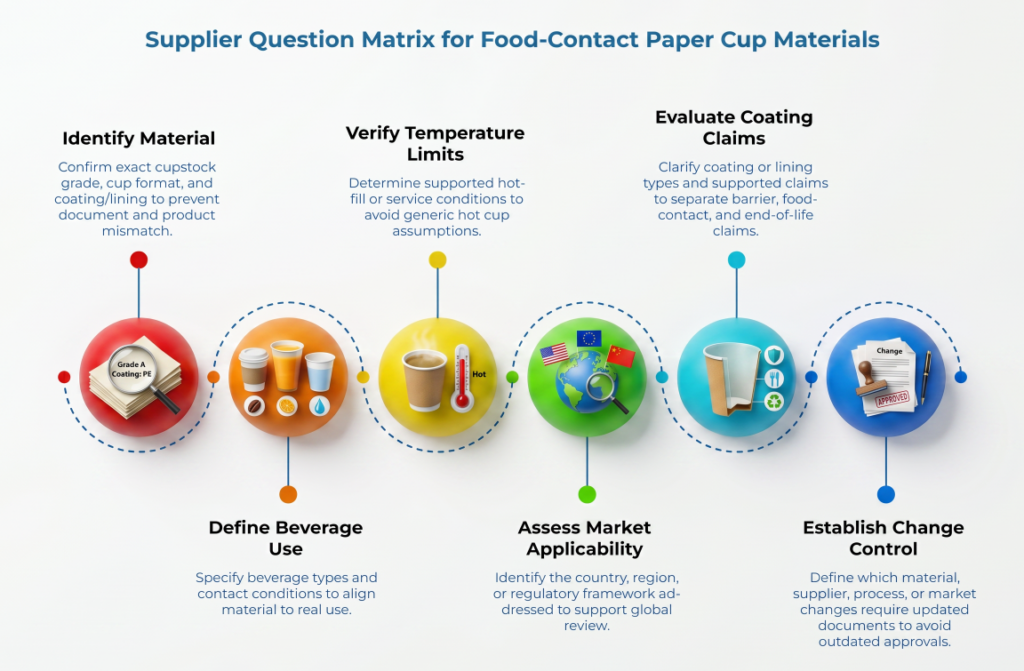
Before comparing suppliers or routing materials for review, organize key question areas into a consistent format. The matrix below provides a starting framework for structuring supplier conversations and tracking what has been received.
| Question Area | What to Ask the Supplier | Why It Matters | Who Should Review |
| Material identity | Which exact cupstock grade, cup format, and coating/lining does this document cover? | Prevents document/product mismatch | Procurement + QA |
| Beverage use | What beverage types and contact conditions were considered? | Aligns material to real use | QA / Packaging |
| Temperature and hold time | What hot-fill or service conditions does the material support? | Avoids generic “hot cup” assumptions | QA / Operations |
| Market applicability | Which country, region, or regulatory framework does the documentation address? | Supports global review | Compliance |
| Coating claims | What coating or lining is used, and what claims are supported? | Separates barrier, food-contact, and end-of-life claims | QA / Compliance |
| Change control | What material, supplier, process, or market changes require updated documents? | Avoids relying on outdated approvals | Procurement + QA |
The matrix is a screening tool, not an approval decision. Its value is in making supplier responses more comparable and reviewable across candidates. Adapt it to match specific beverage menus, operating markets, and internal review workflows.
Ask How the Material Was Evaluated for Hot Beverage Compatibility
Food-contact documentation and hot beverage performance are related but distinct. A material may carry a food-contact declaration and still underperform under specific conditions — sustained high temperature, dairy fat exposure, extended hold times, or aggressive sealing during conversion.
Ask the supplier:
- What hot-fill or hot-service temperature conditions were considered during material evaluation?
- Was the material tested with water only, or with representative beverages such as coffee, tea with milk, sweetened cocoa, or acidic drinks?
- Are there known limitations involving dairy, sugar, cocoa butter, acidity, oils, or flavored syrups?
- What leakage, wicking, seal integrity, rim curl, or base deformation checks were performed?
- Could storage, humidity, converting conditions, nesting, lid fit, or transport affect in-service performance?
- Are trial results available for the same cupstock grade and coating being quoted?
- Are there conditions where the supplier recommends additional testing before approval?
These questions do not assume a particular ingredient automatically causes failure. They help buyers determine whether the supplier has evaluated the material against the actual beverage environment or only a narrow baseline. For further depth on hot beverage cupstock coating questions before approving a new barrier board, detailed technical protocols can clarify specific barrier properties.
Ask Whether the Documentation Fits Each Target Market
A single supplier document stating broad food-contact suitability may not address the regulatory frameworks or market-entry requirements for every country where the buyer operates. Food-contact requirements vary by jurisdiction — frameworks from the U.S. FDA and the European Commission illustrate how oversight differs across major markets.
Ask the supplier:
- Which countries, regions, or regulatory frameworks does the food-contact documentation explicitly address?
- Does the document apply to all intended sales or service markets, or only to the country of manufacture?
- Are there market-specific limitations, additional declarations, or required testing?
- If the buyer operates in multiple countries, what additional documents or market-specific evidence may be needed?
- Can the same document be reused if the supplier, coating, cup format, or target market changes?
For global operations, confirm market applicability in cupstock compliance documents rather than assuming one declaration covers every jurisdiction. Different regulatory bodies mandate fundamentally distinct chemical testing methodologies—such as the EU’s specific migration limits versus the U.S. FDA’s extraction protocols—meaning underlying laboratory data frequently cannot be cross-applied between regions. This is where procurement and compliance roles should stay distinct. Procurement collects the supplier package and confirms product linkage. QA or packaging reviews technical fit. Compliance or qualified external reviewers assess market applicability. Verifying market-specific scope typically falls on the buyer’s compliance or regulatory team.
Separate Food-Contact, Performance, and Sustainability Claims

Supplier documentation sometimes bundles food-contact suitability, barrier performance, and end-of-life claims into a single narrative. These three categories answer different questions and should be evaluated independently.
| Claim Type | Buyer’s Core Question | Review Focus |
| Food-contact suitability | Is the material documented for the intended contact conditions? | Product, component, use condition, and market scope |
| Barrier and performance fit | Does the cup hold the beverage under real service conditions? | Heat exposure, hold time, sealing, leakage, wicking, and trials |
| Sustainability and end-of-life claims | Is the claim substantiated for the target market and disposal route? | Claim wording, certification scope, local system fit, and evidence |
A compostable certification does not automatically confirm whether a cup seals properly, resists a dairy latte at serving temperature, or meets food-contact requirements in the buyer’s market. Environmental marketing claims generally require clear substantiation and careful qualification; the FTC’s Green Guides are one high-authority reference for environmental claim principles in the US.
When a supplier presents compostability or recyclability language, ask what exact claim is being made, which product or component it covers, which market it applies to, and what evidence supports it. Understanding why compostable claims do not answer the full barrier selection question prevents procurement teams from conflating compliance with functional performance. Ask suppliers to identify which claims are supported by which documents, and confirm that each category has its own evidence trail.
Common Mistakes That Slow Down Supplier Approval
Approval delays often start with weak intake, not with final review. The most common problem is a mismatch between what procurement requested and what QA or compliance needs to evaluate.
- Accepting “food grade” without confirming the specific material, coating, contact conditions, and market the claim covers.
- Comparing suppliers on price before normalizing material specifications and documentation scope across candidates.
- Treating coating claims, food-contact declarations, and end-of-life certifications as interchangeable evidence.
- Reusing older documents after a change in supplier, coating formulation, cup format, or target market.
- Forwarding documents to QA without noting the intended beverage type, service format, or operating market.
- Approving materials based solely on physical samples or product photos without supporting documentation.
- Letting sustainability claims distract from food-contact and barrier questions that address different risks.
Small teams without dedicated compliance staff can still improve the process by assigning clear review ownership. Procurement gathers and organizes supplier answers. QA or packaging checks material and performance fit. Compliance or qualified external reviewers evaluate food-contact scope for the target market.
Better Supplier Questions Create Better Review Handoffs
Buyers do not need to become material scientists or regulatory specialists. What they need is a structured set of questions that turns a supplier conversation into a reviewable package — material specs, coating details, food-contact declarations, beverage compatibility data, and market-specific scope that procurement, QA, and compliance can independently evaluate.
Before shortlisting paper cup or cupstock suppliers, use this question framework to organize the material, coating, beverage-use, and documentation details your review team will need. When ready to identify potential suppliers, buyers can explore paper cups for hot beverages, cupstock suppliers and exporters. Supplier documentation and suitability should still be reviewed directly by the buyer’s qualified internal or external reviewers.
Frequently Asked Questions
Is a “food grade” claim enough for paper cup approval?
Not on its own. “Food grade” may be a starting claim, but buyers should ask what exact material, coating, contact condition, and target market it covers. Without product-specific scope, the term does not give reviewers enough to work with.
Should buyers ask different questions for coffee, tea, cocoa, and dairy-based drinks?
Yes. Different beverage compositions create different exposure profiles — temperature, fat content, acidity, sugar concentration, and hold time all vary. A cup evaluated with plain hot water may not reflect performance with a sweetened dairy drink. Tailor supplier questions to the actual beverage menu.
Can one supplier document cover all countries?
Only if its scope explicitly addresses the target markets and intended use conditions. Global buyers should confirm market applicability with qualified regulatory or compliance reviewers rather than assuming broad coverage from a single declaration.
Do compostable or recyclable claims prove food-contact suitability?
No. Compliance and functional safety require specific food-contact documentation; circularity markers only validate end-of-life pathways, not barrier survival under heat and fat exposure.
Disclaimer:
This article is for general informational purposes only and does not constitute compliance, safety, technical, or professional advice. Requirements, risks, and best practices may vary by context, jurisdiction, system, supplier, product, or use case. Confirm important decisions with the appropriate qualified professional, authority, or technical expert.
Our Editorial Process:
Our expert team uses AI tools to help organize and structure our initial drafts. Every piece is then extensively rewritten, fact-checked, and enriched with first-hand insights and experiences by expert humans on our Insights Team to ensure accuracy and clarity.
About the PaperIndex Insights Team:
The PaperIndex Insights Team is our dedicated engine for synthesizing complex topics into clear, helpful guides. While our content is thoroughly reviewed for clarity and accuracy, it is for informational purposes and should not replace professional advice.