
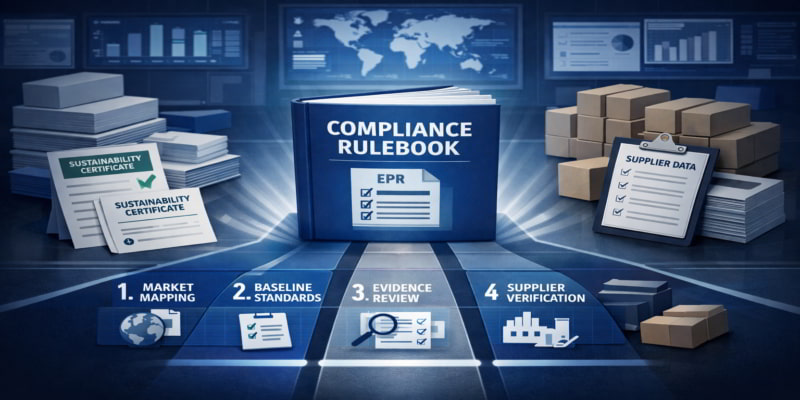
📌 Key Takeaways
Sustainable packaging compliance starts with knowing what the law requires—not with what suppliers claim to offer.
- Rules First, Suppliers Second: Map each market’s legal requirements before talking to any supplier, so you control the criteria instead of reacting to sales pitches.
- Generic Labels Hide Gaps: “Eco-friendly” and “recyclable” claims answer marketing questions, not the legal questions regulators actually ask during audits.
- Certificates Need Fresh Checks: A valid certificate from three years ago may not cover today’s materials if suppliers quietly changed factories, ingredients, or processes.
- Build Your Own Evidence Standard: Decide what proof you’ll accept before suppliers send documents, so you’re not adjusting your rules to match whatever they provide.
- Separate Review from Negotiation: Check supplier evidence against your standards before price talks begin—deal pressure can cloud judgment on weak documentation.
Method beats marketing when compliance is on the line.
Packaging buyers and sustainability managers navigating global EPR requirements will gain a clear verification framework here, preparing them for the detailed four-phase model that follows.
~ ~ ~ ~ ~ ~ ~ ~ ~ ~ ~ ~ ~ ~ ~ ~ ~ ~
The transition from voluntary sustainability goals to mandatory Extended Producer Responsibility (EPR) is creating a documentation crisis. Procurement teams often find that existing eco-labels and supplier ‘green commitments’ fail to provide the granular evidence required by emerging global regulations.
Global supply chains now span dozens of jurisdictions, each enforcing its own interpretation of what “sustainable” means under law. Suppliers offer certificates and claims. Regulators demand proof. The gap between the two is where compliance failures live—and where careers can quietly derail.
This article offers a different starting point. Rather than asking which supplier offers the most impressive green credentials, it asks a harder question first: What does the destination market’s law actually require, and how do you verify compliance without depending on the supplier’s word alone?
By the end, you will understand why generic sustainability claims collapse under regulatory scrutiny. You will see how Extended Producer Responsibility frameworks function as the governing rulebook for packaging decisions. And you will have a four-phase verification blueprint that positions your sourcing methodology—not supplier marketing—as the foundation for defensible decisions.
The Industry Shift: Why Sustainable Folding Cartons Are Now a Compliance Problem, Not Just a Packaging Choice
Sustainable folding cartons have crossed a threshold. They are no longer a procurement preference or a brand-messaging opportunity. They are a regulated category with enforceable obligations and real penalties for non-compliance.
For years, the packaging conversation centered on functional specifications—caliper, print fidelity, crush resistance during transit. Sustainability entered as an overlay: a way to communicate environmental values to consumers and differentiate on shelf. An FSC logo here, a “recyclable” claim there. Internal stakeholders nodded. Marketing had their talking points. The system worked well enough.
That system is now breaking down. Extended Producer Responsibility frameworks are transforming packaging from a materials decision into a regulatory obligation. Under EPR, brands placing packaging on a market become legally accountable for that packaging’s end-of-life management. This accountability does not stop at intention or aspiration. It demands documented evidence that packaging meets specific recyclability thresholds, material composition requirements, and reporting standards—jurisdiction by jurisdiction.
The European Union’s Packaging and Packaging Waste Regulation exemplifies this shift. It establishes binding recyclability criteria, mandates for recycled content, and design-for-recycling standards that the European Commission describes as “more harmonized and more demanding packaging rules.” Following its formal adoption in November 2024, the PPWR mandates a transition period concluding in May 2026. The compliance clock is not approaching—it is already running.
The implication for buyers is direct. A folding carton that satisfied your sustainability checklist last quarter may fail to satisfy a regulator’s checklist next year. And in enforcement scenarios, the regulator’s checklist is the only one that determines whether shipments clear, fines accumulate, or market access narrows.
For a sustainability director, the issue now sits inside a larger lifecycle ecosystem that includes carbon footprint reduction, sustainable sourcing requirements, and EPR compliance. For a procurement manager, it reshapes sourcing criteria, supplier discovery, and the way documentation is evaluated before supplier approval. The folding carton is still physical. The exposure is no longer just physical.
Why the Old Model Is Broken: The Hidden Failure of Generic Eco-Claims in Global Sourcing
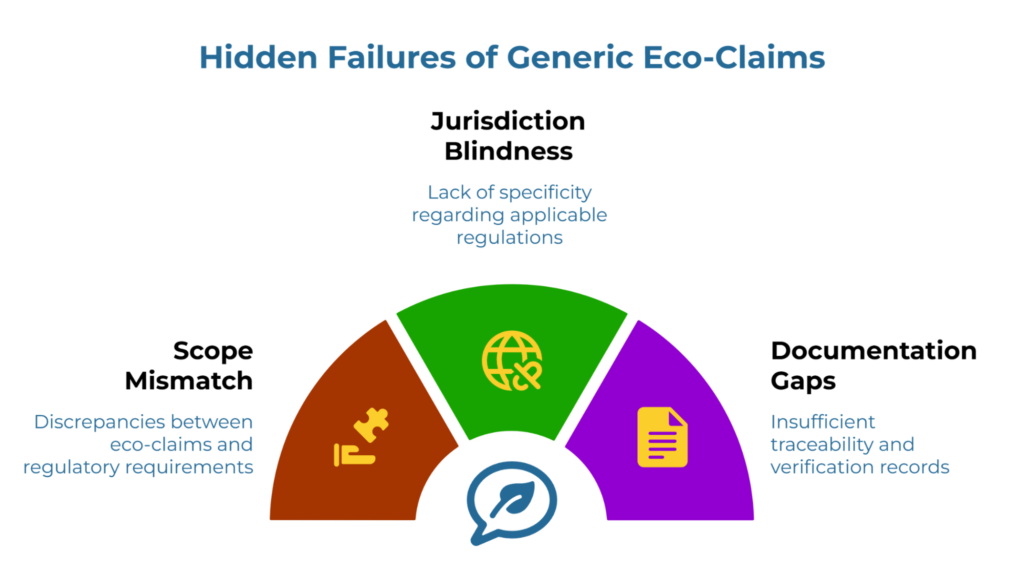
Generic eco-claims fail because they answer a marketing question rather than a legal one.
When a supplier describes their folding cartons as “eco-friendly,” “sustainable,” or “made from recycled content,” they are using language designed for commercial persuasion. These terms carry no standardized legal definition. They do not specify which jurisdiction’s requirements have been satisfied, under which testing protocols, or for which end-of-life scenarios.
This ambiguity generates three failure patterns that surface during compliance verification:
Scope mismatch. A certificate proving responsible forestry (such as FSC chain-of-custody) does not prove recyclability under a particular EPR scheme. A claim about recycled content does not establish whether that content meets the minimum percentage threshold a specific market mandates. Buyers frequently discover that the documentation in hand answers a different compliance question than the one regulators are asking.
Jurisdiction blindness. EPR requirements differ across markets. Recycled content minimums vary between the EU, US states with active EPR legislation, and emerging frameworks across Asia-Pacific. A supplier’s generic claim may hold validity for one geography and prove inadequate for another—yet the claim itself rarely specifies where it applies.
Documentation gaps. Regulatory compliance requires traceable, auditable records connecting specific shipments to specific proof points. A PDF certificate downloaded from a supplier website rarely provides the lot-level traceability, independent testing reports, or chain-of-custody documentation that a compliance audit demands.
The underlying problem is a mismatch of purpose. Suppliers craft claims to win business. Regulators require evidence to verify legal compliance. Treating one as a substitute for the other is how compliance surprises happen—a dynamic explored in depth in The danger of vendor-led data sheets: establishing rigid folding carton specification requirements.
The New Strategic Imperative: A Methodology-First Approach for Sustainable Folding Cartons
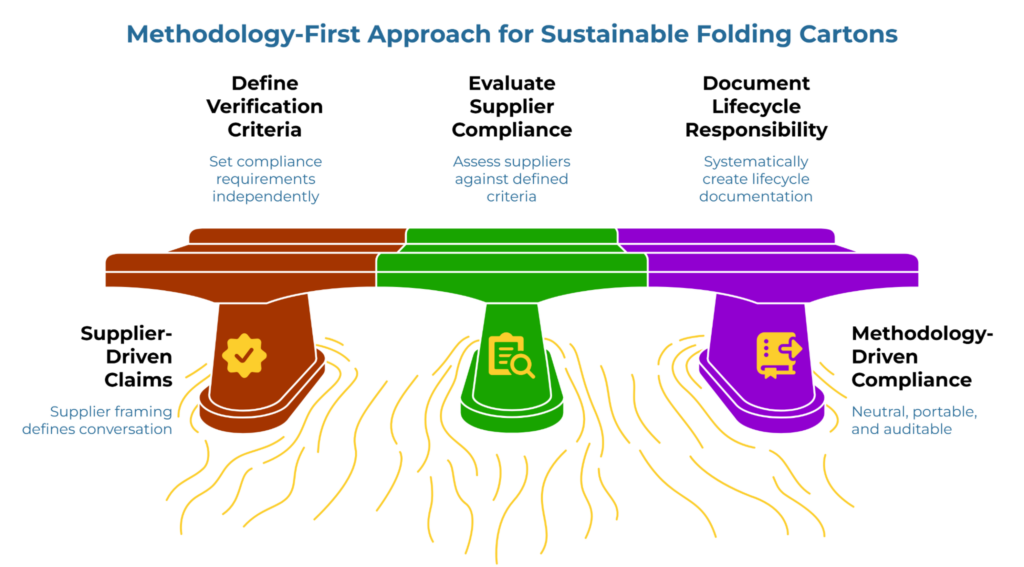
The safer model starts with method, not with supplier persuasion.
A methodology-first approach means defining your verification criteria before engaging suppliers—not deriving your criteria from whatever suppliers happen to offer. This reordering represents the core shift. Under the old model, buyers collected supplier claims, compared credibility signals, and selected the option that sounded most robust. The supplier’s framing defined the conversation. Under a methodology-first model, buyers define compliance requirements independently, then evaluate whether suppliers can meet them with documented evidence.
Sustainable folding carton solutions, understood correctly, are not products to be purchased. They are frameworks—systematic approaches to procuring environmentally compliant folding carton packaging within global supply chains. The methodology becomes the deliverable. While the physical folding carton remains the tangible goal, the underlying verification framework serves as the primary asset protecting the supply chain.
The OECD’s work on Extended Producer Responsibility frames EPR as extending lifecycle responsibility to the post-consumer stage. For packaging buyers, this means lifecycle responsibility now requires lifecycle documentation. A methodology-first approach creates that documentation systematically rather than hoping suppliers provide it voluntarily.
This framing delivers three strategic advantages:
- Neutrality. When criteria exist before supplier engagement, evaluation becomes insulated from sales pressure. The question shifts from “Which supplier seems most sustainable?” to “Which suppliers can document compliance with requirements I have already defined?”
- Portability. A methodology travels across suppliers and across time. Switching suppliers does not mean rebuilding your compliance framework. Regulatory tightening means updating your framework rather than starting from scratch with each new mandate.
- Auditability. Methodology creates a paper trail. When a compliance auditor asks why you selected a particular supplier, you can point to documented processes rather than subjective assessment.
EPR Frameworks as the Rulebook: Why Legal Context Must Come Before Supplier Conversations
EPR frameworks function as the legal rulebook defining what “compliant” means in each market you serve. They are not optional guidelines or best-practice suggestions.
Before evaluating any folding carton supplier’s sustainability claims, you must first understand what your destination markets legally require. This sequence is non-negotiable. Suppliers cannot tell you what the law demands—they can only describe what they offer. Whether what they offer satisfies legal requirements is a determination only you can make, grounded in your own analysis of the regulatory landscape.
EPR frameworks typically govern four compliance dimensions for packaging:
Material composition requirements. Many EPR schemes mandate minimum recycled content percentages, restrict certain materials or coatings, and require disclosure of material composition for recyclability assessment.
Design-for-recycling standards. The EU PPWR, for instance, requires packaging to meet specific recyclability criteria. For folding cartons, this can affect adhesive choices, coating types, ink formulations, and multi-material constructions that complicate recycling streams.
Reporting and registration obligations. Brands placing packaging on the market typically must register with national EPR schemes, report packaging volumes by material type, and pay fees funding collection and recycling infrastructure.
Labeling and consumer communication. Requirements for on-pack recycling instructions, material identification symbols, and claims substantiation vary by jurisdiction and continue evolving.
Each dimension generates specific documentation requirements. A supplier who cannot provide the evidence your target markets demand—regardless of how polished their sustainability narrative appears—creates compliance risk rather than reducing it.
The practical step is mapping your market footprint against active and upcoming EPR obligations before drafting your next RFQ. That regulatory map becomes the foundation against which every sourcing criterion is built.
The Neutral Verification Blueprint: A Four-Phase Model for Global Folding Carton Sourcing
Neutral verification separates what suppliers claim from what regulations require, using a structured process that does not depend on any single party’s commercial interest.
First, map target-market obligations. Begin by documenting specific EPR requirements for every market where your packaged products will be sold. This includes regulations currently in force, regulations adopted but not yet applicable (such as EU PPWR provisions taking effect in 2026), and credible legislative proposals likely to become law within your planning horizon. For each market, identify the relevant compliance dimensions: recycled content thresholds, recyclability criteria, reporting deadlines, and labeling requirements. This map becomes your master reference—the legal reality against which all supplier claims will be tested.
Second, baseline internal packaging requirements. Translate your regulatory map into operational specifications. What does your organization need from a folding carton to satisfy compliance across all target markets? This phase produces a specification document addressing minimum recycled content percentages by material layer, permitted and prohibited coatings or treatments, acceptable adhesive types for recyclability, required certifications and the scope those certifications must cover, and documentation deliverables including testing reports, chain-of-custody records, and batch traceability. For guidance on structuring these requirements systematically, see the baseline packaging parameter checklist: structuring your folding carton specification requirements. Where feasible, aim for market-neutral specifications—a highest-common-denominator approach that satisfies all markets rather than fragmenting into jurisdiction-specific requirements that complicate procurement. This principle extends to portfolio management, as explored in cross-SKU material standardization: preventing folding carton collapse during product expansion.
Third, define evidence standards. Before contacting suppliers, establish what evidence you will accept as proof of compliance. This prevents the common trap of adapting evidence requirements to match what suppliers happen to provide. Evidence standards should specify which certifications you recognize and what scope those certifications must cover, what testing protocols you accept (referencing specific standards such as ISO or TAPPI test methods), what documentation format and recency you require, and how you will verify that certificates remain current and apply to the specific products you are purchasing.
Fourth, separate claim review. Evaluate supplier evidence against your predefined standards before entering commercial negotiations. This separation matters. When evidence review happens during negotiation, pressure to finalize a deal can bias interpretation of ambiguous documentation. Create a documented evaluation record for each supplier showing which requirements they satisfy with adequate evidence, which requirements they satisfy with partial or unclear evidence, and which requirements they cannot currently meet. This record serves as both an audit trail and a foundation for structured conversations about closing compliance gaps.
This model does not eliminate judgment. It improves judgment by creating a structure in which buyers can compare suppliers against the same standard instead of allowing each supplier to define the standard in its own language.
What Buyers Must Baseline Internally Before Comparing Any Folding Carton Supplier
Internal alignment must precede external evaluation. Before procurement contacts suppliers, several questions require clear organizational answers.
Which markets are in scope? Compliance requirements follow your product’s destination, not your supplier’s location. A folding carton manufactured in Southeast Asia for sale in Germany must satisfy German requirements. Define geographic scope explicitly.
What is your compliance risk tolerance? Some organizations pursue minimum viable compliance—meeting legal requirements as they take effect. Others maintain compliance headroom—exceeding current mandates to buffer against regulatory tightening. Risk tolerance shapes specification development.
Who owns compliance verification internally? EPR compliance intersects procurement, sustainability, legal, and regulatory affairs. Unclear ownership creates gaps. Designate a compliance owner with authority to approve or reject supplier documentation.
What are your substitution boundaries? Define whether mills, grades, coatings, or converting inputs can change without reopening the compliance file. A supplier substitution that looks commercially neutral may invalidate previously verified documentation—an issue examined in board grade tolerances explained: securing folding carton specifications across suppliers.
What is your documentation retention policy? Compliance audits may examine decisions made years earlier. Verification records, supplier evidence, and evaluation rationale must be archived in retrievable form.
How will you handle non-compliant suppliers? Define escalation processes before they become urgent. If a current supplier cannot satisfy new requirements, what transition timeline is acceptable? What interim measures apply?
These internal baselines convert compliance from reactive scrambling into a managed process. They also surface a common organizational tension: procurement teams think about continuity, lead time, and cost optimization while sustainability teams think about lifecycle risk, carbon footprint reduction, and EPR compliance. Both perspectives are valid. Neither can drive the decision alone. Getting alignment before supplier engagement prevents these functions from speaking past each other during evaluation.
How to Separate Useful Supplier Evidence from Broker Bias and Certification Theater
Not all sustainability documentation delivers equal compliance value. Distinguishing between evidence that satisfies regulators and evidence that merely satisfies marketing objectives is a core buyer competency.
Useful evidence connects directly to a specific compliance requirement, originates from an identifiable and verifiable source, applies to the specific products and production runs being purchased, and can be traced through the supply chain with documented chain-of-custody.
Certification theater consists of impressive-looking documents that fail one or more of these tests. Common patterns include certificates with expired validity dates, certificates scoped to a different product line or facility than the one supplying your order, generic sustainability reports describing company-wide initiatives without product-specific documentation, and claims referencing testing protocols without providing underlying test reports.
The distinction is not necessarily about supplier intent. Many suppliers genuinely believe their documentation suffices. The gap exists because suppliers optimize for winning business while compliance requires optimization for regulatory defensibility. These objectives overlap imperfectly.
Public verification tools help move from passive trust to active verification. FSC’s certificate search database provides up-to-date certification and licensing information, advanced search criteria, and time-stamped downloadable records that enable buyers to confirm certificate validity independently. For a deeper methodology on running these checks, see how to run a quick registry check for FSC/PEFC certificates.
PEFC’s Find Certified directory serves a similar function for verifying PEFC-certified suppliers and supporting responsible supply-chain checks. For clarity on what each scheme actually certifies, see FSC vs PEFC claims in plain english: what the labels do (and don’t) prove. These tools add independence to your evaluation, though they do not replace legal interpretation or buyer-side judgment. A logo can signal credibility. It cannot carry the whole compliance case on its own.
A practical verification habit: for every certificate or claim a supplier provides, ask three questions. For visual guidance on distinguishing authentic documentation from fraudulent submissions, consult fake FSC, PEFC, ISO certificates vs. real ones: a visual spotter’s guide. What specific compliance requirement does this address? Is the certificate current, and does its scope cover this specific order? Can the certificate’s validity be confirmed through an independent source?
If any answer remains unclear, the documentation creates risk rather than reducing it. Requesting clarification before purchase is far less costly than discovering gaps during audit.
The Methodology Blueprint: What a Defensible Sustainable Folding Carton Program Actually Looks Like
A defensible program is built as a repeatable operating model, not as a series of one-off supplier conversations.
In mature form, the methodology looks like this: rule interpretation first, internal baselining second, evidence design third, neutral claim review fourth, supplier comparison fifth, and documentation retention throughout. The sequence matters more than any individual step. The buyer does not begin with a preferred converter and work backward. The buyer begins with the compliance frame and works forward.
Ongoing regulatory monitoring. EPR frameworks evolve. New markets adopt requirements. Existing requirements tighten. Methodology must include mechanisms for tracking regulatory changes and updating specifications accordingly. This is how compliance headroom is maintained as the landscape shifts.
Supplier qualification cycles. Initial qualification establishes that a supplier can meet requirements. Requalification confirms continued compliance over time. Build periodic documentation review into supplier management processes.
Lot-level traceability. Compliance often requires demonstrating that specific shipments meet specific standards. Documentation systems should link purchase orders to supplier evidence to finished goods, creating an auditable trail connecting regulatory requirements to individual product batches. This principle mirrors the chain-of-custody verification framework that ensures certified claims survive from quote to invoice.
Exception management. Not every compliance gap disqualifies a supplier. Some gaps close with corrective action. Some require interim risk acceptance with defined timelines. Methodology should include decision criteria for evaluating, approving, and monitoring exceptions.
Continuous improvement. Treat compliance findings—whether from internal audits, supplier reviews, or regulatory interactions—as inputs to methodology refinement. Defensible programs strengthen over time rather than remaining static.
This approach also explains why the distinction between connectors and intermediaries matters in sourcing. PaperIndex operates as a connector, not an intermediary—it facilitates discovery and education without brokering deals, handling payments, or taking commissions. That neutrality matters because a methodology-first sourcing decision is strongest when the educational layer is not tangled with a transaction layer. Buyers who want to understand that positioning in more detail can read why PaperIndex Is the Switzerland of the paper trade.
The PaperIndex Academy provides educational resources across these operational dimensions, offering frameworks that complement internal compliance processes.
Neutrality Is Not Optional When Compliance Risk Is Global
Return to that conference room. The pressure for regulatory defensibility is permanent. As global EPR frameworks tighten, the ability to produce verifiable, audit-ready data becomes the primary differentiator in global sourcing. Regulatory complexity is increasing. EPR frameworks are expanding to new markets and tightening in established ones.
The organizations navigating this landscape successfully build verification methodology into their sourcing DNA. They do not treat supplier assurances as substitutes for independent validation. They do not accept certifications as compliance proof without confirming scope and currency. They do not conflate marketing claims with regulatory evidence.
Sustainable folding carton solutions, properly understood, begin with methodology—a structured, neutral, repeatable process for translating regulatory requirements into sourcing decisions.
The difference between the buyer who can answer the sustainability director’s question and the buyer who cannot is rarely expertise about paperboard or coating chemistry. It is whether they built their sourcing process on supplier promises or on a verification framework they control.
Rulebook first. Verification second. Supplier decision last. That is how sustainable sourcing becomes defensible.
To deepen understanding of sustainable sourcing methodology, explore the PaperIndex Academy for educational resources on international trading, verification frameworks, and compliance documentation. Review the folding cartons category to understand the commercial landscape. When ready to apply methodology to supplier discovery, the folding carton suppliers directory provides a starting point for identifying potential partners to evaluate against the verification framework you have built.
Disclaimer: This article is for educational purposes only and does not constitute legal advice.
Our Editorial Process:
Our expert team uses AI tools to help organize and structure our initial drafts. Every piece is then extensively rewritten, fact-checked, and enriched with first-hand insights and experiences by expert humans on our Insights Team to ensure accuracy and clarity.
About the PaperIndex Insights Team:
The PaperIndex Insights Team is our dedicated engine for synthesizing complex topics into clear, helpful guides. While our content is thoroughly reviewed for clarity and accuracy, it is for informational purposes and should not replace professional advice.