
📌 Key Takeaways
Greasy, leaking food bags fail because paper thickness (GSM) doesn’t block oil—only a chemical grease barrier (Kit Level) matched to your menu’s fat content and hold time will stop the leak.
• Kit Level Beats GSM: Heavier paper still soaks through without a chemical barrier; grease resistance comes from Kit ratings, not weight.
• Match Barrier to Menu: Use Kit 1–4 for pastries, Kit 5–7 for burgers, and Kit 8–12 for fried chicken or delivery orders with longer hold times.
• Double-Bagging Hides the Problem: Using two bags doubles cost without fixing the spec gap—the inner bag still saturates.
• Test Before You Trust: A simple oil-drop screen and real-world hold test reveal whether current packaging matches your actual menu conditions.
• Ask for Named Specs: Require suppliers to cite Kit Level per TAPPI T 559 and provide a Letter of Guarantee—vague claims like “greaseproof” are marketing, not specifications (specs).
Spec the barrier, not the weight—that’s how packaging protects margins and brand reputation.
Food service operators and procurement managers sourcing takeout packaging will find actionable audit steps and supplier questions here, preparing them for the detailed specification guidance that follows.
~ ~ ~ ~ ~ ~ ~ ~ ~ ~ ~ ~ ~ ~ ~ ~ ~ ~
12:15 PM. The lunch rush peaks. A customer slides a takeout bag back across the counter—the bottom is translucent with grease, leaving a dark stain across the pickup surface.
You grab a second bag, double-wrap the order, and send it out—a workaround that signals your current paper bag specification may need review. That’s the third time today. Each rework adds seconds to service time, creates workflow bottlenecks during peak hours, and quietly drains your margins. Somewhere in the back of your mind, you wonder what happens when that greasy bag shows up in a customer’s social media post.
There is a fix. And it does not involve burning through twice the packaging.
The Soggy Bag Audit: What the Leak Is Actually Telling You
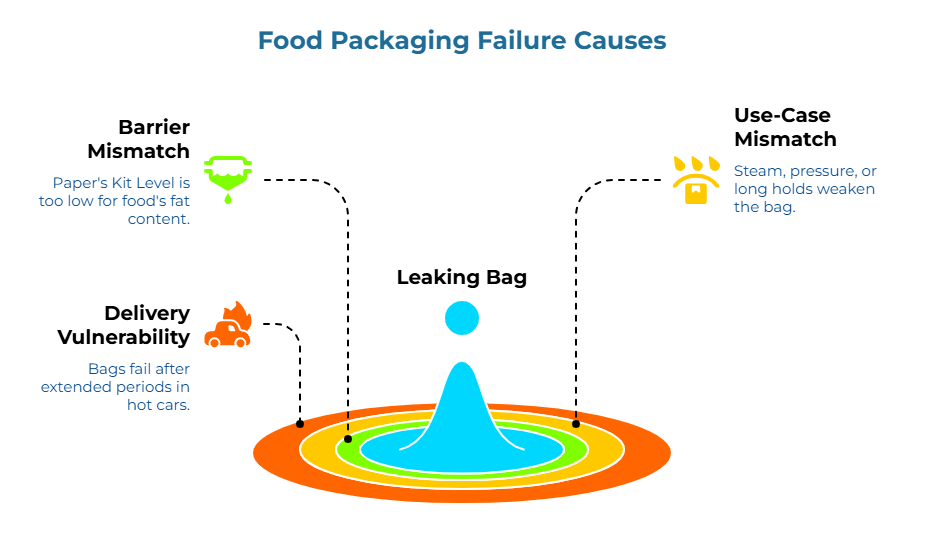
A leaking bag is not random bad luck. It is a diagnostic signal—one that points to a spec mismatch between your food packaging paper and your menu.
Most failures trace to one of two causes. The first is a barrier mismatch: the paper’s Kit Level is too low for the fat content and hold time of your food, so oil wicks through the fibers. The second is a use-case mismatch: steam, stacking pressure, or longer-than-expected holds weaken the bag even when the barrier would otherwise suffice. Delivery operations are especially vulnerable to this second mode—bags that perform fine at the counter can soften and fail after 25 minutes in a hot car.
Grease Resistance Ratings (Kit Levels) define the standardized “Kit Test” (Levels 1–12) measuring a paper’s ability to repel oil and grease for a specific duration. Standardized ratings function as a performance barrier; a Kit 9 rating provides the necessary defense for high-temperature fryer oils. Practically, this means matching the Kit Level to the menu item: Kit 3 for pastries, Kit 9 for fried chicken.
Think of your packaging as a shield. It protects customer experience at the point of handoff and reduces operational risk downstream. Failure results in immediate margin erosion through rework and long-term brand erosion via social media exposure.
Why Are My Bags Leaking Grease?
The root cause is almost always a low Kit Level—the paper’s chemical barrier rating—rather than paper thickness. A Kit 3 wrapper handles croissants, but it fails within minutes around fried chicken. Grease wicks through untreated fibers via capillary action; heat accelerates the process. Increasing paper weight (GSM) in the absence of a chemical barrier merely provides a larger substrate for saturation.
Two common misconceptions make this problem worse. First, many operators assume thicker paper (higher GSM) means better grease resistance. It does not. GSM measures weight and stiffness, not barrier performance. Second, there is a widespread belief that all brown kraft paper is inherently food safe. It is not — kraft paper bags require verified food-contact certification and the appropriate Kit Test rating per TAPPI T 559.
Why “Thicker Paper” (GSM) Often Fails Anyway
The instinct is logical: if the bag leaks, get heavier paper. A 60 GSM greaseproof paper with Kit 9 treatment will outperform an 80 GSM paper with no barrier every time.
Untreated paper—regardless of weight—contains tiny channels between fibers. Grease moves through these channels over time, especially when heat is involved. A sturdy kraft bag might feel robust in your hand, but give it 18 minutes holding a hot, greasy order and it will saturate just like the lighter paper did.
Double-bagging is the most common workaround, and it is a costly band-aid. You double your packaging expense on every order without addressing the chemical issue. The inner bag still saturates; you have simply added a second layer to catch overflow. That approach does not improve quote comparability with suppliers, does nothing to prevent silent substitutions shipment-to-shipment, and inflates your total cost of ownership without solving the underlying spec problem.
For procurement teams, the lesson is clear: named specs plus quick validation tests lead to fewer disputes, more stable pricing, and fewer customer complaints. Chasing “thicker paper” after complaints spike is a symptom of paper distrust, not a solution.
For a deeper understanding of how paper weight interacts with barrier performance, the GSM explained guide breaks down what the numbers actually mean for your menu.
FAQ: GSM and Grease Resistance
Does a higher GSM bag always stop grease leaks?
Not always. GSM contributes to structure and tear resistance, but seep-through is primarily controlled by barrier performance. A lightweight paper with a high Kit Level will outperform a heavy paper with no barrier.
If a bag passes in-store, why does it fail in delivery?
Delivery adds time and pressure. Longer holds, stacking weight, and trapped steam accelerate wicking and soften fibers. A bag rated for 10-minute counter pickup may not survive 30 minutes in a delivery vehicle.
The Real Fix: Match Kit Level to Menu Fat and Hold Time
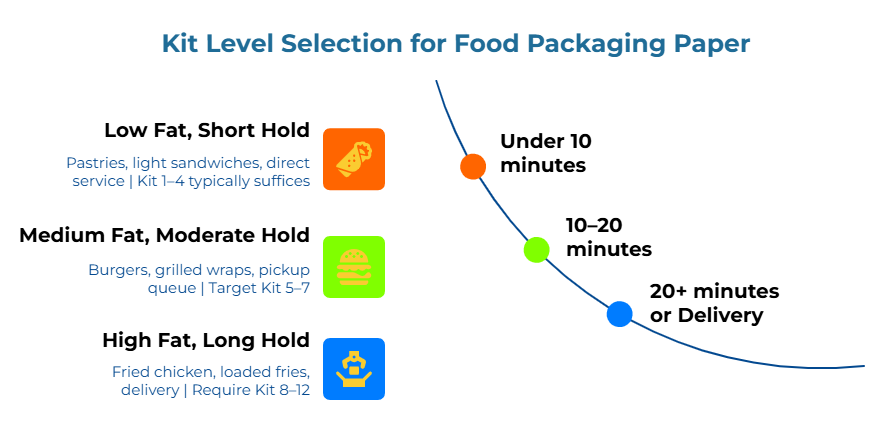
Kit Levels work like sunscreen SPF ratings. Low-fat, short-hold items—often served in wrapping paper — need minimal protection. High-fat, long-hold items—especially for delivery—need serious barrier strength.
Low fat, short hold (under 10 minutes): Pastries, light sandwiches, items handed directly to customers. Kit 1–4 typically suffices.
Medium fat, moderate hold (10–20 minutes): Burgers, grilled wraps, items that sit in a pickup queue. Target Kit 5–7.
High fat, long hold (20+ minutes or delivery): Fried chicken, loaded fries, anything with rendered grease pooling at the bottom. Require Kit 8–12.
These ranges are illustrative, not universal—results can vary by temperature, venting, and the presence of secondary liners (e.g., polyethylene or plant-based coatings). Still, writing the requirement down supports price stability by reducing silent substitutions and strengthens supplier qualification conversations.
When hold times are unpredictable—common in delivery-heavy operations—step up one Kit Level as a buffer, switch formats (from flat wrap to lined bag), or add a grease-resistant liner inside a standard bag. The decision depends on your unit economics, but the framework stays constant: match the barrier to the stress.
Generic wraps often fail under these conditions. The wax paper trap explains why coatings that work at room temperature break down when heat enters the equation.
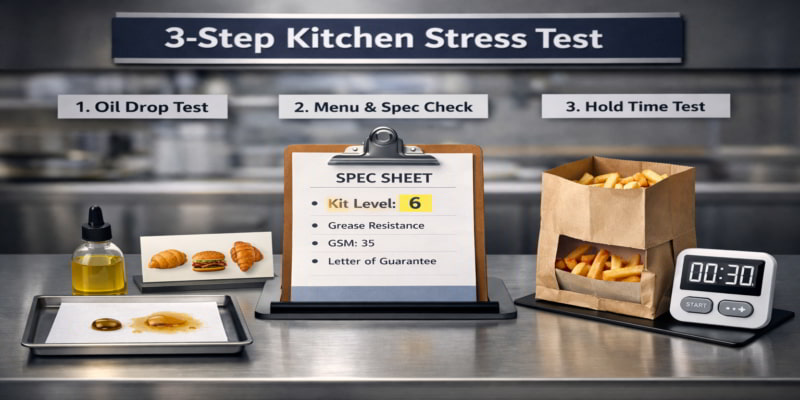
A 3-Step Kitchen Stress Test for Today’s Inventory
You can audit current packaging during prep, before service starts. No lab equipment required.
Step 1: The Water-Drop Screen (30 seconds) Place a single drop of room-temperature cooking oil on the inside surface of your bag or wrapper. If the drop holds its shape without immediately soaking through, some oleophobic (grease-resistant) barrier treatment likely exists. If it absorbs immediately and darkens the paper, there is no meaningful grease barrier. Note: this is a rapid screening tool only. Because room-temperature oil behaves differently than hot, rendered animal fats, this screen must be validated by the Step 3 hold test.
Step 2: The Menu Match (2 minutes) Pull your three greasiest menu items. Check whether your current packaging shows a Kit Level on the spec sheet or supplier documentation. No Kit rating listed? Assume the paper is untreated or minimally treated. Compare any available rating against the fat-load guidance above.
Step 3: The Real-World Hold Test (during service) Wrap one high-fat item in your standard packaging using the normal wrap or liner and folding method. Replicate staging conditions, including stacking pressure. Set a timer matching your average delivery or pickup wait—use the longest typical hold, not the average. Inspect the exterior when the timer ends. Visible grease staining or paper softening means the spec is not holding.
Interpreting results:
Pass all three steps: Current packaging matches your menu. Document the spec as a line item for future supplier qualification.
Fail the water-drop test: No barrier exists. Replace the paper or add a liner for any greasy item.
Fail the hold test: Barrier exists but is insufficient. Step up the Kit Level or reduce hold time where possible.
A related 5-minute grease spot test provides additional receiving-dock protocols if you want to screen incoming shipments before they reach your kitchen.
What to Ask Your Supplier So the Next Shipment Does Not Fail
9:00 AM on inspection day. The health inspector asks for food-contact documentation. The manager searches for a Letter of Guarantee that does not exist—because no one requested it when the packaging was ordered.
That scenario is avoidable. Think of food-contact certification as a passport for your packaging: without it, the product cannot legally travel to your customer’s plate. Regulatory frameworks like 21 CFR 176.170 in the US and Regulation (EC) No 1935/2004 in the EU establish what “food contact safe” actually requires—but the burden of traceability falls on you.
Three questions separate credible food packaging paper suppliers from those who just move paper:
“What is the Kit Level of this paper, and what test method was used?” A credible answer cites a number and standard (e.g., “Kit 7 per TAPPI T 559”). Vague claims like “greaseproof” or “food grade” are marketing language, not specifications. A stamp on the box is a claim, not proof.
“What application and hold time is this paper designed for?” The supplier should reference specific food categories and durations. If they cannot answer, they are selling commodity paper without performance verification.
“Can you provide a sample roll for a kitchen trial and a Letter of Guarantee for food contact compliance?” Any supplier confident in their specs will agree. Where applicable—particularly for EU markets—ask whether ISEGA-related documentation is available. Run your own hold test before committing to volume, and file the compliance documentation for audit readiness.
The food packaging paper trail guide details the three documents you need to pass a health inspection without last-minute scrambling.
Concerns about fraudulent or unverified suppliers are valid. Price stability matters, but so does knowing that your packaging will perform consistently shipment after shipment. Named specs, verified documentation, and a willingness to provide samples are the trust factors that separate reliable sources from risky ones. For suppliers seeking to connect with buyers who understand these standards, the platform’s active food packaging paper buyers represent a qualified audience.
From Firefighting to Confidence: Make Packaging a Spec Decision
The soggy bag is not a mystery. It is a message: your packaging spec does not match your menu’s demands.
The fix is not thicker paper. It is not double-bagging. It is diagnosing the right variable (Kit Level), running a simple stress test on current inventory, and holding suppliers accountable for named specs and verification evidence.
Picture the shift: instead of grabbing a second bag mid-rush and hoping it holds, you hand over an order knowing the packaging was spec’d for exactly this fat load and hold time. No rework slowing your line speed. No stained counters. No anxious glances at the delivery queue wondering which bag will fail next.
That is what audit-ready, complaint-resistant operations look like. That is brand equity protected at the point of handoff. The PaperIndex Academy offers additional resources for building this operational foundation.
Immediate Action: Implement the 3-Step Kitchen Stress Test to baseline current inventory performance before your next procurement cycle. Then, when you are ready to source packaging that actually performs, find suppliers who can meet your verified specifications,read the complete Kit Levels (1–12) guide to match grease resistance ratings to your menu, explore GSM basics to stop over-specifying paper weight as a grease fix, or browse greaseproof paper suppliers to begin comparing options.
Disclaimer:
This content is provided for educational and informational purposes only. Always verify packaging specifications and compliance documentation directly with your supplier and through your own application testing.
Our Editorial Process:
Our expert team uses AI tools to help organize and structure our initial drafts. Every piece is then extensively rewritten, fact-checked, and enriched with first-hand insights and experiences by expert humans on our Insights Team to ensure accuracy and clarity.
About the PaperIndex Insights Team:
The PaperIndex Insights Team is our dedicated engine for synthesizing complex topics into clear, helpful guides. While our content is thoroughly reviewed for clarity and accuracy, it is for informational purposes and should not replace professional advice.