
📌 Key Takeaways
Date-based rotation fails for food-grade paper because moisture exposure—not age—is what actually ruins barrier performance.
- Exposure Beats Age: A pallet near steam for two days can fail before one stored dry for six weeks, regardless of delivery dates.
- Build a “Safe Pool” First: Zone your storage into protected and exposed areas, then rotate by date only within the protected zone.
- Watch for Warning Signs: Edge curl, dampness, softness, strange smells, or torn wrapping all mean a pallet should skip rotation and go to quarantine.
- One Log Field Fixes It: Adding “zone + condition check” to receiving records turns basic inventory tracking into audit-ready documentation.
- Quarantine Isn’t Waste: Flagged pallets get inspected and tested—some can still be used for non-critical tasks instead of being thrown away.
The safest pallet isn’t the oldest one—it’s the one that stayed protected.
Warehouse managers and food-service operators handling paper packaging will gain a practical rotation system here, preparing them for cleaner audits and fewer wrapper failures in daily operations.
~ ~ ~ ~ ~ ~ ~ ~ ~ ~ ~ ~ ~ ~ ~ ~ ~ ~
FIFO works—until it doesn’t.
You pull the oldest pallet from the rack, exactly as training taught you. The receiving date checks out. But as you strip the shrink wrap, something’s wrong: faint dampness at the edges, a subtle curl to the top sheets. You press a thumb against the surface and feel softness where there should be resistance.
That pallet sat in your dry-goods area for three weeks. The one behind it arrived last Tuesday. So why is the “older” stock failing while the newer delivery still feels crisp?
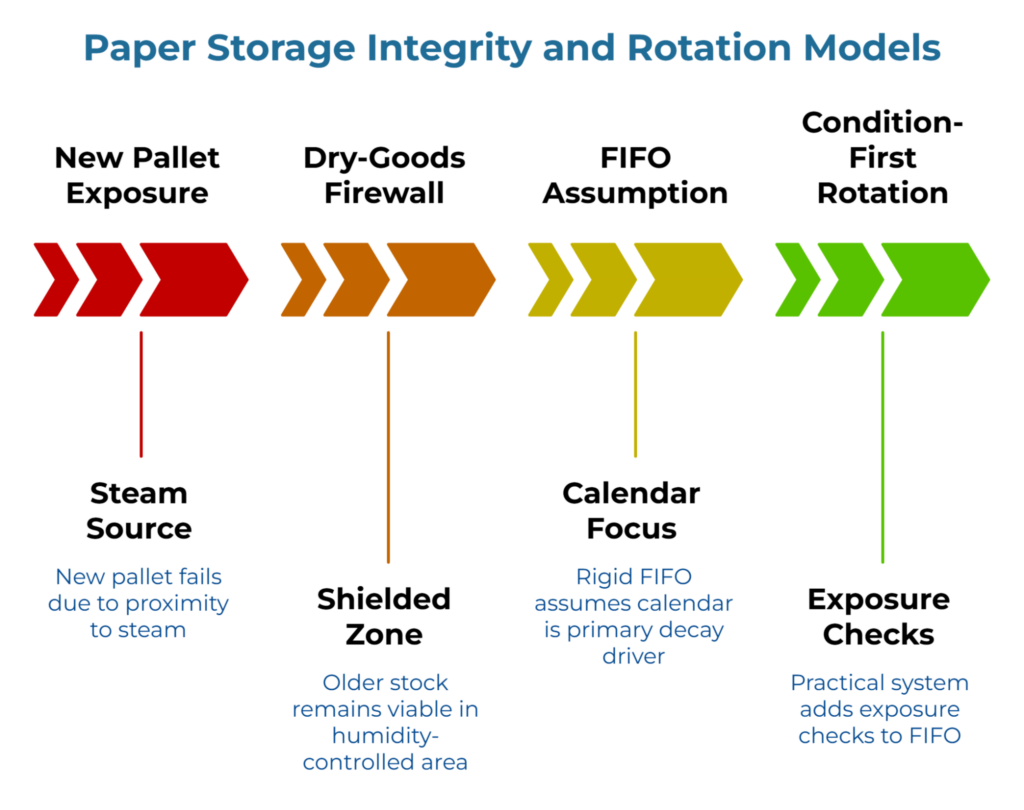
Paper storage integrity is exposure control, not just date control. Paper is hygroscopic—it absorbs moisture from the air continuously—and in kitchens or commissaries where steam, humidity, and temperature swings are constant, environmental exposure can degrade barrier performance faster than the calendar ever could. The newest pallet can fail first if staged near a steam source, while older stock remains viable within a ‘dry-goods firewall’—a designated zone shielded from humidity and airborne contaminants.
A rigid reliance on FIFO assumes the calendar is the primary driver of decay; however, a Condition-First Rotation Model provides a practical system that keeps FIFO where it belongs (inside a verified safe pool) while adding the exposure checks that prevent wrapper failures and audit surprises.
The FIFO Myth: Why “Oldest First” Feels Safe (and When It Actually Works)
FIFO is a sound principle for most inventory. Canned goods, cleaning supplies, shelf-stable commodities—these items degrade primarily over time. Rotate by date, and you’re protected.
Food-grade paper seems to fit the same logic. It arrives dry, sits on a pallet, and doesn’t spoil the way produce does. Facilities apply the same rotation rule: oldest stock moves first.
The hidden assumption is that time is the dominant decay variable.
For inert dry goods, that assumption holds. For food packaging paper engineered with grease barriers, moisture barriers, or specialized coatings, it does not.
The Reality: Food-Grade Paper Degrades by Exposure, Not Just by Age
Paper fiber is hygroscopic. The substrate is ambient-reactive, continuously exchanging moisture with its environment. In a climate-controlled warehouse held at around 50% relative humidity, this exchange stays balanced and the paper remains stable. Testing standards like ISO 187 define these controlled conditions precisely because paper performance depends on them.
In a central kitchen or commissary—where dish stations generate steam, walk-in coolers cycle humidity, and loading docks open to weather—that balance breaks. Moisture uptake begins within hours of exposure. Over days, fiber swells and barrier coatings can begin to delaminate.
This is the mechanism of failure: standard fiber storage fails because the paper begins hygroscopic moisture intake, which compromises the surface tension and lipid-resistance of specialized barrier coatings.
In high-steam environments, environmental saturation accelerates barrier failure faster than chronological age. A pallet staged for an estimated 48 hours near a dish pit can typically absorb more damaging humidity than a pallet stored for six weeks in a protected dry zone. Broader material science research, such as peer-reviewed studies in journals like Cellulose (Springer), consistently confirms that elevated relative humidity rapidly degrades the mechanical and barrier properties of paper materials—a principle any warehouse manager can observe firsthand when pulling compromised stock.
A Simple Condition-First Rotation Model (the “Safe Pool” Approach)
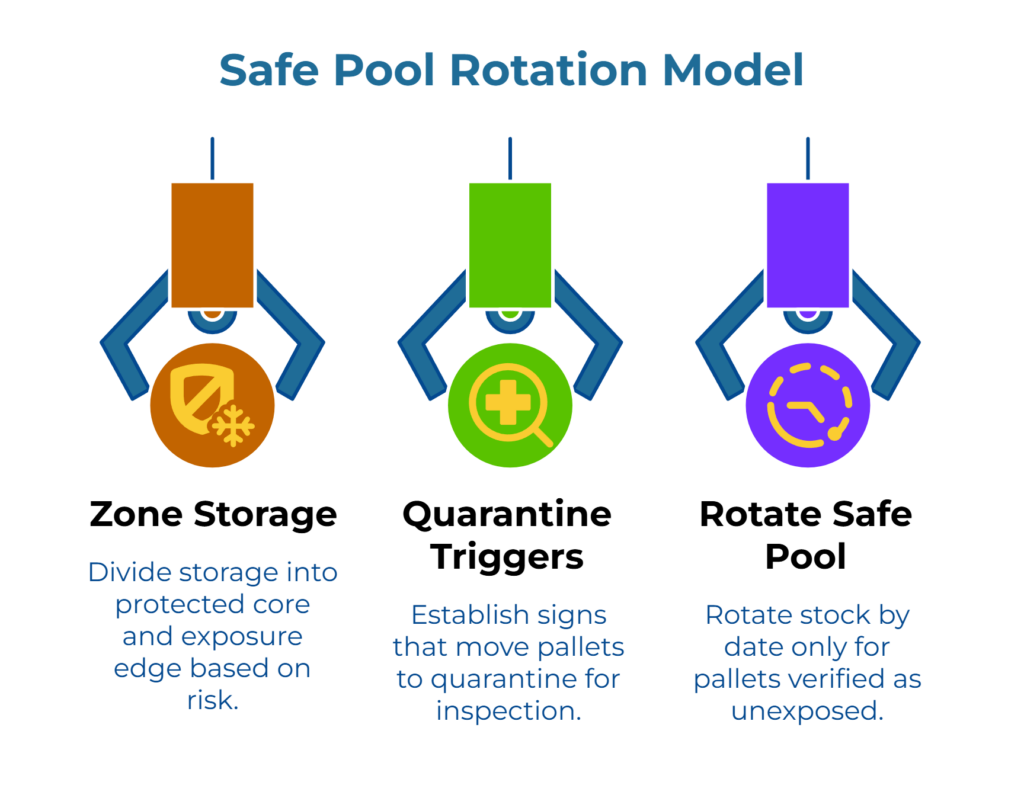
The fix isn’t to abandon FIFO. It’s to nest FIFO inside a condition-first system. A Specification-First approach rotates stock based on environmental exposure risk, not just delivery date.
Think of it as building a dry-goods firewall around your usable inventory.
Step 1: Zone your storage by exposure risk.
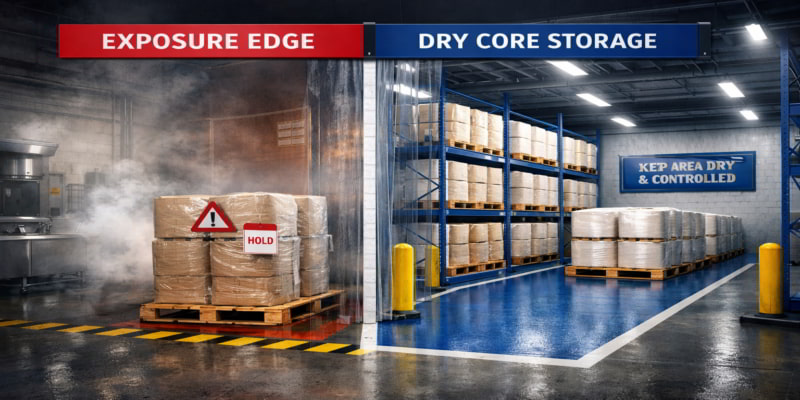
Divide your storage area into two categories. The “protected core” is space that stays dry, away from steam sources, temperature swings, and chemical storage—a zone that keeps humidity, splash, grease aerosols, and handling damage away from food-contact paper. The “exposure edge” includes areas near dish stations, loading docks, HVAC vents, or anywhere humidity fluctuates—the parts of the room where those risks drift inward. Paper stored in the protected core enters your safe pool. Paper that touches the exposure edge gets flagged for inspection before use.
Step 2: Establish quarantine triggers.
Any pallet showing these signs moves to quarantine, not rotation:
- Torn or opened outer wrap
- Dampness, softening, curl, or visible staining
- Unusual odour (musty, chemical, or foreign)
- Stock staged in a known exposure zone without approved recheck
Quarantined stock doesn’t automatically become waste. It gets inspected, tested if necessary, and either cleared for non-critical use or disposed of with documentation.
Step 3: Rotate by date within the safe pool only.
Once your storage is zoned and compromised stock is quarantined, FIFO resumes—but only for pallets verified as unexposed. This preserves the simplicity of date-based rotation while adding the exposure filter that prevents failures.
Add one line to your receiving and rotation log: Zone + Condition Check. Example: “Pallet #2247 | Received 03/01 | Zone: Core | Condition: Pass.” That single field transforms your documentation from date-only to exposure-aware, which is exactly what auditors increasingly expect under frameworks like 21 CFR 117.80 which mandates that food-contact materials, including packaging, be stored under conditions that protect against allergen cross-contact and contamination [21 CFR 117.80(a)(1)].
FIFO vs. Condition-Based Rotation
| Decision Metric | What FIFO Does | Why It Fails for Food-Grade Paper | Condition-First Rule | How to Document It |
| Rotation priority | Oldest receiving date moves first | Ignores exposure; older stock in a dry zone may be safer than newer stock near steam | Rotate from safe pool by date; quarantine exposed stock regardless of age | Log zone assignment + condition check at receiving |
| Storage location | Any available rack space | Uncontrolled placement exposes paper to humidity, chemicals, or temperature swings | Assign protected core vs. exposure edge; only core stock enters safe pool | Label zones; record zone on pallet tag |
| Inspection trigger | Receiving inspection only | Misses damage that occurs after receiving (condensation, contamination, wrapper breach) | Inspect at receiving, at rotation, and after any exposure event | Add rotation-date + condition field to log |
| Quarantine criteria | Visible damage (tears, crushing) | Misses moisture uptake, odour transfer, and coating degradation | Quarantine for dampness, curl, softness, odour, or breached containment | Quarantine log with reason code |
| Audit readiness | Date stamps on pallets | Auditors increasingly expect environmental controls for food-contact materials | Zone map + condition logs demonstrate HACCP-aligned storage discipline | Maintain zone diagram and weekly condition audit trail |
This matrix serves as a technical reference for updating Standard Operating Procedures (SOPs).
Common Failure Scenarios During Rotation
Scenario 1: Staged near steam.
A delivery arrives and sits on the dock while the crew finishes lunch. The pallet ends up staged near the dish return for two hours. Humidity uptake begins immediately. By the time it reaches the rack, barrier performance has already started to degrade—even though the receiving date is “fresh.” Prevention: designate a staging area away from steam sources and move paper to protected storage within 30 minutes of arrival.
Scenario 2: Secondary containment breached during partial picks.
A picker pulls half the cases from a pallet and leaves the rest unwrapped overnight. Exposed sheets absorb ambient humidity. The next day, the remaining stock enters rotation as if it were still sealed. Prevention: re-wrap partial pallets immediately and treat breached containment as a quarantine trigger.
Scenario 3: Stored near chemicals or grease aerosols.
Paper absorbs more than moisture. Pallets stored near cleaning chemicals, fryer exhaust, or aerosol lubricants can pick up odours or surface contamination that transfer to food. Prevention: store food-grade paper away from all non-food materials. If your facility has limited space, prioritize separation over date order. Understanding the difference between steam barriers and grease barriers helps clarify why chemical exposure matters as much as humidity.
Quick-Start Checklist: Implement in One Shift
- Walk your storage area and identify the protected core vs. exposure edge
- Label zones with simple signage (“Dry Core” / “Exposure Edge”)
- Brief staff on the four quarantine triggers: dampness, curl, softness/odour, breached wrap
- Add “Zone + Condition Check” fields to your receiving log
- Designate a quarantine area for flagged pallets
- Re-wrap any partial pallets currently in storage
- Remove pallets stored in splash or steam paths
- Move any pallets near chemicals or temperature swings to the core or quarantine
- Separate “safe pool” stock from “hold for review” stock with visible labels
- Schedule a weekly 10-minute condition audit for stored paper
- Update your rotation SOP to specify “safe pool first, then FIFO within safe pool”
- Rebrief kitchen and warehouse teams on who can release quarantined material
- Post the comparison table in your receiving area for quick reference
Frequently Asked Questions
Should FIFO be abandoned entirely?
No. FIFO remains valid for rotation within your safe pool. The change is adding an exposure filter before stock enters that pool. Condition-first and FIFO work together, not as replacements for each other.
What’s the fastest sign of exposure damage?
Edge curl or waviness. Paper that has absorbed moisture loses dimensional stability at the edges first. If sheets don’t lie flat, inspect further before use.
How do we quarantine without wasting everything?
Quarantine isn’t automatic disposal. Flagged stock gets inspected. Minor exposure may allow use for non-critical applications such as outer wrapping or box liners. Severe exposure gets documented and disposed. The goal is informed decisions, not blanket rejection.
What do auditors look for in packaging storage?
Auditors reviewing food-contact materials increasingly expect environmental controls—not just date labels. Zone maps, condition logs, and documented quarantine procedures demonstrate that your facility treats packaging as a critical ingredient, not just a supply item. The FDA Food Code and regulations like 21 CFR 117.80 address the processes and storage controls for food-packaging materials, and audit expectations continue to tighten.
How do we verify our paper still meets spec after storage?
For operations with the capacity, a simple 15-minute kitchen trial can validate barrier performance before committing questionable stock to service. For grease resistance specifically, understanding Kit level thresholds (TAPPI T 559) helps you know what to test for.
Next Steps
A calmer wrapper program starts with two basics: know what the paper is supposed to do, and stop treating time as the only storage signal. The safest pallet is not always the oldest one—it’s the one that stayed protected.
Start with the two foundations: understand what food packaging paper specifications actually mean..
When you’re ready to compare options, browse phone-verified food packaging paper suppliers or submit your buying requirements to receive quotes directly.
For more foundational guides on food-contact compliance and specification management, explore the PaperIndex Academy.
Disclaimer:
This article is educational and does not replace facility-specific food-safety, regulatory, or legal advice. Implement storage SOPs in line with local regulations and internal QA requirements.
Our Editorial Process:
Our expert team uses AI tools to help organize and structure our initial drafts. Every piece is then extensively rewritten, fact-checked, and enriched with first-hand insights and experiences by expert humans on our Insights Team to ensure accuracy and clarity.
About the PaperIndex Insights Team:
The PaperIndex Insights Team is our dedicated engine for synthesizing complex topics into clear, helpful guides. While our content is thoroughly reviewed for clarity and accuracy, it is for informational purposes and should not replace professional advice.